Beth Kanter shares her presentation on Mapping metrics to strategy (with slide show) focused on non-profits using social media:
The session will share an overview of why the sequence listen, learn, and adapt is critical to implementing a successful social media strategy. We’ll take a look at how to use both qualitative and hard data points to refine and adapt your strategy as well as the role of continuous listening and learning through implementation of pilots. We’ll examine what can and can’t be quantified as well as various metrics and analytics tools.
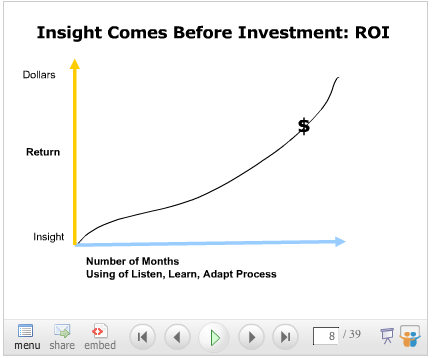
The main lessons in this presentation are that you have to know what you are measuring (and it isn’t always the same thing) and that you have to jump in and try things out and even make mistakes in order to learn (e.g. perpetual Beta). Slide 28 of Beth’s presentation gives a good snapshot of the lessons learned from two social media campaigns.
Using social media to connect to networks and engage communities requires improvisation. What I’ve learned about improv is the importance of listening, understanding others and leaving an opening to continue the conversation. Fixing a social media framework in stone doesn’t leave room for the community to change it to their needs. Flickr is an example of a social media platform that evolved to meet the needs of its users, as it wasn’t originally intended to be a photo-sharing platform.
Whether you’re developing a non-profit campaign or a business network, it’s important to develop a social architecture, not just a technical one:
Social architecture is the conscious design of an environment that encourages certain social behavior leading towards some goal or set of goals.
Referred to in Beth’s presentation are hard metrics via The Social Organization, such as – contributors, visitors, referrals, word count, etc. Dave Duarte provides 20 additional subjective ways to measure the social interactions in a network, including – recommendations to peers, and acknowledges the contributions of others. Measurement in social networking is not a single lens but a series of perspectives that evolve through time. It’s essential to have ongoing conversations about measurement as the network, community or campaign grows. Effective measurement becomes a critical feedback loop to check that you have the right social architecture.


Thanks for this – but I want o be sure to credit the original inspiration – Listen, Learn, and Adapt is David Armano’s idea – he wrote a brilliant BusinessWeek article on the topic – applying the concept to corporate social media – I remixed for nonprofits. Go read his original paper and article
Linked off of this
http://beth.typepad.com/beths_blog/2009/02/riffing-on-listen-learn-and-adapt-need-your-organizations-adaption-stories.html
Thanks, Beth; it’s definitely worth a read.
This is really good advice, though I think it’ll seem counterintuitive to the hyperactive. There’s a good portion of “take your time / don’t sweat it” here, or perhaps a digital version of the Quaker maxim, “Proceed as the way opens.”