Pasteur said that discovery favoured the prepared mind. A diagnosis, also a discovery, must favour the prepared mind. Yet medical schools have been inattentive to preparing the mind to meet the patient, inattentive to errors, inattentive to attention, inattentive to inattention, and inattentive to the study of the self which is to be inattentive to the minefield within. —JMM
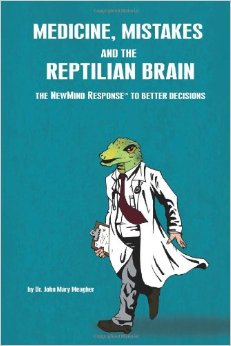 Dr. John Mary Meagher has over 40 years experience as an emergency physician. In Medicine, Mistakes and the Reptilian Brain, he combines lessons from health care, aviation, and some of the greatest thinkers in history to examine why mistakes are made and how to develop methods to overcome the reptile within all of us. While focused on physicians, there are many lessons that anyone can take from this book.
Dr. Meagher identifies three core tendencies that increase errors in medical practice:
- Apathy
- Haste
- Egoism
He then outlines many practical ways to overcome the reptile brain and use a “NewMind Response ™”. The three basic skills are self-monitoring (especially to what irritates us), developing responses to our basic instincts, and staying focused on the task at hand. Dr. Meagher also discusses the importance of fostering an attitude of doubt.
Callisthenics to initiate doubt:
Regularly challenge ourselves.
- What else could this be?
- What else could have caused this?
- What else could complicate this?

I had the pleasure of meeting Dr. Meagher last week, in one of those serendipitous encounters at our local coffee shop. He described an upcoming training session he is giving to physicians next month and how he plans to structure it. His focus on calisthenics, or daily practice, makes a lot of sense, and is what I try to develop in my personal knowledge mastery workshops. New behaviours take time to practice before they become habits.
But it is only through practice that we will change our behaviours. Here are some of the 12 ways to change our focus for an entire day:
- Monitor what irritates us.
- Monitor how well we listen.
- Note how we label people.
- Go without a timepiece.
- Observe how attached we are to our self-image
For more information, visit FewerErrors.com [dead link]
I will give this book to my son, who intends on going into medicine.


Harold,
Thanks for taking the time to read and write a review of Medicine Mistakes and the Reptilian Brain.
Our CME “Staying Tuned” was presented to Physicians last Saturday May 3, and was appreciated by participants. Aristotle observed “We are what we repeat. Excellence, then is not an act, but a habit.” You emphasize this and we do in our course as well.
Yours gratefully,
and striving for aequanimitas,
John Mary Meagher