Working Together

Tom Haskins has presented an excellent series of posts on complexity, work and collaboration, comparing aspects of the Cynefin and TIMN frameworks. As I thought about what Tom has written I saw one more column that could be added to his comparison, provided by Shawn at Anecdote, and that is how we can best work together at different levels of complexity.

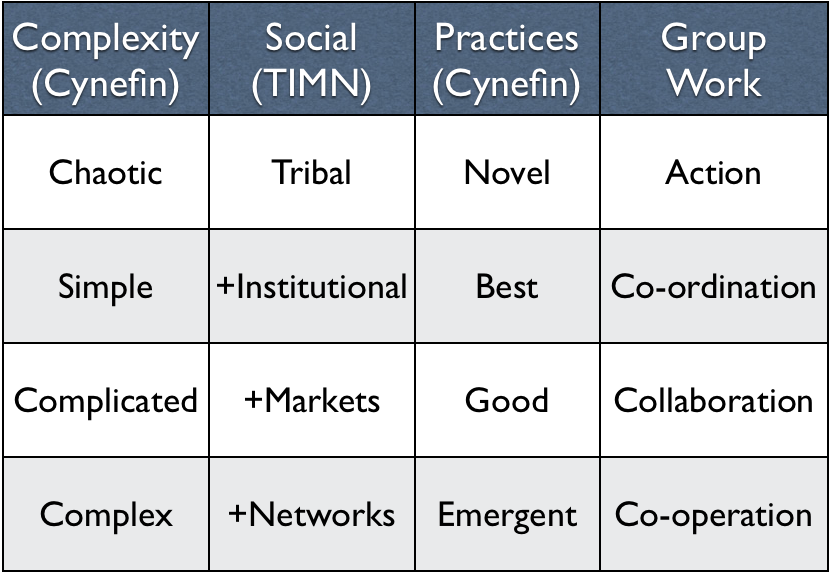
Even though all levels of complexity exist in our world, more of our work (especially knowledge-intensive work) deals with complex problems, whether they be social, environmental or technological. As can be seen in the table below, complex environments & problems are best addressed when we organize as networks; our work evolves around developing emergent practices; and we collaborate to achieve our goals. As Shawn’s post shows, coordination, cooperation and collaboration are not the same thing.

Working Together
Complexity (Cynefin) Social (TIMN) Practices Group Work
Chaotic Tribal Novel Action
Simple Tribal + Institutional Best Coordination
Complicated Tribal + Institutional + Markets Good Collaboration
Complex Tribal + Institutional + Markets + Networks Emergent Cooperation

I’m putting this table up because it provides a quick view of why we have to change how we teach, train and work. Ask any organization how many of their problems are complex and how important it is to address these. Then find out how social networking is supported and encouraged. Ask how emergent practices are developed and whether anyone actually monitors the process or captures learning that enables emergence. Finally look at whether groups merely co-ordinate activities or perhaps co-operate and if there is real collaboration. As Shawn writes:

Collaboration works well for complex situations because the style of working collaboratively matches the nature of the issues that complex situations pose. Complexity is unpredictable, and collaborating is adaptable; complexity is messy – it’s difficult to work out the question, let alone the answer – and collaborating involves bringing together a diversity of people and talents to improvise and test possible approaches, all learning as you go. Complexity offers unique and novel conundrums, and collaboration draws on a deep foundation of trust to that fosters creativity and delivers innovations.

This is one more reason to consider a wirearchical management framework built on mutual trust.

ATMC – Providing Excellent Training in a Tough Economy

The Automotive Training Managers Council (ATMC) annual conference is online and open to members and guests this year. ATMC is focused on the “exchange of training ideas and strategies helpful to both technical and sales/marketing training professionals”. The theme for the conference, to be held on Thursday, 28 May 2009, is Providing Excellent Training in a Tough Economy.

Here’s the schedule (Eastern Time Zone GMT -4):

12:30 PM: Welcome and Brief ATMC Update
12:45 PM: “Training and the Networked Workplace” by Harold Jarche – Workplace Learning Strategist, jarche.com
1:45 PM: “Service Training at Daimler Trucks North America” by Brian Stowe – Manager, Training Development, Daimler Trucks North America
2:45 PM: A topic related to delivering video on the Web by Paul Louwers – President & CEO, AVI (Automotive Video, Inc.).
3:15 PM: A topic related to finding grant funding for training by Jeff Miller – Partner, Incentis Group
3:45 PM: Rapid Networking.

Free conference registration is now available.

Friday’s Finds #1

In an attempt to make my finds on Twitter more explicit, this may be the start of regular posts on some of the things I learned this past week (weekly seems better than monthly).

Numbers & Measurement

From Charles Green at The Trusted Advisor:

If you can measure it, you can manage it; if you can’t measure it, you can’t manage it; if you can’t manage it, it’s because you can’t measure it; and if you managed it, it’s because you measured it.

Every one of those statements is wrong. But business eats it up. And it’s easy to see why.

The ubiquity of measurement inexorably leads people to mistake the measures themselves for the things they were intended to measure.

More on meaningless numbers used to measure things, from Dave Snowden.

We face the challenge of meeting increasing legitimate demands for social services with decreasing real time resources. That brings with it questions of rationing, control and measurement which, however well intentioned, conspire to make the problem worse rather than better. For me this all comes back to one fundamental error, namely we are treating all the processes of government as if they were tasks for engineers rather than a complex problem of co-evolution at multiple levels (individuals, the community, the environment etc.).

Open Source

David Eaves discusses how being open, like embracing open source software, is becoming important for economic development:

Vancouver is not broken – but it could always be improved, and  twitter confirms a suspicion I have: that programmers and creative workers in all industries are attracted to places that are open because it allows them to participate in improving where they live. Having a city that is attractive to great software programmers is a strategic imperative for Vancouver. Where there are great software programmers there will be big software companies and start ups.

Via @SoulSoup is the story of DimDim (free, open source, web conferencing platform) [dead link] making CNET’s Webware Top 100 for 2009 [dead link]. Open source is moving up the software stack, first with operating systems, then general applications and now richer applications. Software vendors have to be continuously moving into higher value applications to remain relevant. This is a natural industry evolution that few purchasers, especially in government, understand.

Learning & Working

Rob Paterson:

In 1996, aged 45, I was on a train with Fraser Mustard. We were returning from a trip to Queens University in Kingston,  where he had been giving a master class to  a group of senior people in the Canadian Government service. I had been working for him as an adviser for about a year. Working with him was the most exciting thing that had ever happened to me. I asked him if he would consider taking me on full time.

“You are an adult now Rob. Time to go out on your own.” He paused and then added. “I am tired. You cannot rely on me for your life.”

The greatest advice I have ever had given by the greatest man I have ever encountered.

Via @changedotorg –  “In fact, if you look at what’s really happening right now in the nonprofit sector, you’ll find several reasons NOT to go back to school and focus on what organizations are really looking for in potential candidates.” When a Degree isn’t enough [dead link]

Charles Jennings:

There’s enough evidence now to show that Instructor-Led Training is not effective as an approach for the majority of employee development. ILT may be helpful for some change management and big-picture ‘concept’ development, but it is demonstrably the least effective and certainly the least efficient approach for most learning that’s required.
On curriculum

I noticed today something that reinfornced my opinion of education curriculum. As you can see from my last post, there’s a production of My Fair Lady at the high school for the next three nights, plus an in-school presentation this morning. Our son came home from the session today and after an extended long weekend of practices he’s exhausted, but happy. He took a nap and is now preparing for this evening’s performance. He has a lot of lines plus many songs, dances and stage movements to memorize and perform.

There is an English assignment due for tomorrow that requires a re-write of an ending to a book. This is similar to the re-writes of several plays he has done and is something he can do and do well. However, he has almost no time to get it done. He will get something completed, but I’m sure it won’t be his best work or a great learning experience. Of course, he is presented with no options other than doing the prescribed task. There is no flexibility in the system for anything like prior learning assessment or objective based learning where achievement lets you move on to other things. This is the bully of curriculum.

As I was thinking about this in relation to my work I thought of the best way that I could describe curriculum to someone who had never heard of the term:

Curriculum: an outdated broadcast model for knowledge-sharing, based on the presumption of a shortage of information, limited social connections and finite knowledge boundaries.

My Fair Lady in Sackville

The production will feature student actors ranging from Grades 9 to 12, lavish costumes and a spectacular set. This year’s production is being directed by a student sister duo, Charlotte and Marilla Steuter-Martin. The performance will occur on May 21, 22 and 23 at the TRHS Auditorium in Sackville, N.B. Doors will open at 6:30 p.m. with the show starting at 7:00 p.m. Tickets are $6 for students and $10 for adults. Currently, they can be reserved online by emailing trhsmyfairladytickets@hotmail.com.

Tickets will be available for purchase starting tomorrow at Tidewater Books and starting Monday, May 4th at the Tantramar Regional High School office! Pick up yours today to assure your seat at what will be a great show!

My Fair Lady

TRHS Drama Website

This post strays a bit from my usual fare, but that’s Nicholas Jarche in the lead role :-)

Managing emergent practice

What would happen if you called for closing your training department in favor of a new function?  Imagine telling senior management that you were shuttering the classrooms in favor of peer-to-peer learning. You’re redeploying training staff as mentors, coaches, and facilitators who work on improving core business processes, strengthening relationships with customers, and cutting costs. You’re going to shift the focus to creativity, innovation, and helping people perform better, faster, cheaper. You might want to give it a try.  Perhaps the time has come.

This is how Jay Cross and I finished our article on The Future of the Training Department. We showed that in complex environments, which more of us face each day, only emergent practices are effective, as backward-looking “good practices” are inadequate. Training is a method based on good practices and best practices. We establish our performance objectives based on an understanding of what we want to achieve, usually engaging subject matter experts to help us. But what if nobody knows how to do or even describe our future roles and tasks? That is the challenge for training managers in preparing workers to face complex problems.

According to Dave Snowden’s Cynefin framework, sense can be made in complex environments by 1) first probing through some action and then 2) sensing to understand what is happening and 3) finally responding based on what you have learned. Think of it as launching a new Web service. First it goes up as a Beta site and people join and use the services. Through their actions they give feedback; implicit and explicit. An effective strategy is to tap the feedback and actions of users and revise the service. Sometimes it is a radical change that is needed, such as when Flickr (now owned by Yahoo!) changed its early business focus from online gaming to photo sharing. In other cases it is a minor change, like accepting the use of the “@” symbol as a way of sending replies in Twitter. On the Web, and in complexity, it’s – Ready, Fire, Aim, Re-aim. I call it Life in Perpetual Beta.

A key understanding about complex environments is that they cannot be planned for. Certain skills can be developed in preparation for dealing with complexity but it is just as important to have systems in place that support workers in dealing with complexity. Shifting the main effort of the training department from content delivery to connecting and communicating is needed. That means pushing learning development tools to all workers. Everyone is now a subject matter expert at some point in time. Workers need to develop practices so that they can easily capture, find and share emerging practices. Web tools like social bookmarks, feed readers, blogs, and wikis can help (See Jane Hart’s 25 Tools for Learning Professionals).

The training department not only needs to teach how to use these tools but has to mine current practices as they evolve. Sense-making and pattern recognition become core skills for training specialists as they continuously develop new tools and processes based on emerging practices. Working in complex environments requires constant recalibration of methods and practices. There is no status quo.

In complex work environments we may need more coaches and facilitators but they will have to be as close to the work as possible. Standing back with a non-practitioner’s perspective will not help those doing the work. New roles such as ‘coach-as-co-worker’ or ‘facilitator-peer’ may emerge in this environment. As has already happened in this late industrial age, mid-level managers will become more redundant unless they can can do more than just manage. Who wants to hire a knowledge worker, as more of us are becoming, who still needs to be managed?

A landscape of influences

More exciting pattern and sense-making from Ross Dawson, this time with the Influence Landscape Framework Beta v. 1:

This adds to other conceptual frameworks to inform us on how we can look at learning, work and especially communication in this era. The comment on influence networks echos of connectivism (just replace influence with learning):

Influence flows through networks – it cannot be understood as a linear mechanism focused on individual influencers. There are a number of key aspects of influence networks that need to be addressed to tap the power of influence.

I view the influence mechanisms as sources that one can tap when creating a personal knowledge management system. The landscape graphic also enhances the framework of wirearchy, showing that influence is dynamic and non-linear, as our working relationships must become in a networked environment.

If we put ourselves at the centre of the landscape then how we structure our lenses on the world has a significant impact on what we see. If our organisation only lets us view mass media information or from limited networks then we are closed to a wealth of other sources. If our influencers are only celebrities and famous people we are missing out on a rich source of human experience. If we don’t realize the driving forces changing the landscape then we may be blind-sided by events.

As a node in an open network we have a better chance of influencing our landscape, whether it be for learning, working or communicating. This model gives one more reason to open organisational walls to the outside – so influence can travel both ways.

The Learning Age

This isn’t the Information Age, it’s the Learning Age; and the quicker people get their heads around that, the better – Prof Stephen Heppell

This is a quote from a short video on the future of learning which asks the key question, What do we want to do? (with all of this networked information technology).

There is little doubt that we need systemic change to prepare for the Learning Age, the signals are everywhere and the conversations are getting louder. Here’s an example: I recently met with some people in a large organization who are working on some new learning network initiatives. I mentioned that I was connected on Twitter to a person working on similar things and that I could connect them. On checking the name, we discovered that all of these people worked in the same organization but didn’t know what the others were doing. One limiting factor was the iron fist of the IT department, which doesn’t allow access to a wide variety of web sites and platforms. People cannot easily connect and therefore they cannot learn from each other. The silence between the silos is deafening.

Starting in the early years, schools need to shift to individualized learning. With 2GB of information being added every second, no one can “master content” any more. Jobs and roles are fragmenting so quickly (what’s a social media expert?) that a single, 12-year curriculum is laughable.

Business models and work practices are becoming networked and global, speeding the rate of time to implementation. The lines between work and leisure are blurring, as with work and learning. Today, about 16% of us can be described as hyperconnected but that is expected to grow to 40%, and I would say those people will be the main drivers of our economies and societies.

Every person in an organization can, and should, begin a journey to be active in the Learning Age:

Accept life in Beta and give up some control by trusting people to do their work.

Help people by enabling connections (outsourcing the IT department would be a good start) and assisting with methods like PKM.

Examine better ways to organize and structure but start the change at the individual and personal level.

Work at becoming better teachers, because when we teach, we learn best.

Adding value to information

Once again, I have to thank Dave Pollard for an insightful post and another model I can use for online community development. Dave looks at the processes that could enable mainstream media to remain relevant in the Internet age.

Adding value to information is an important aspect of online communities, especially business and learning-related ones. The community manager can ensure 1) that environmental scans are done; 2) canvassing of members happens; 3) analysis & questionning is ongoing; 4) suggestions are made and 5) information tools (e.g. checklists) are developed. The community manager also organises the peer-to-peer events that are important to maintain the community.

You could use this chart of Dave’s as part of the job description of anyone starting a community of practice.

Mapping metrics

Beth Kanter shares her presentation on Mapping metrics to strategy (with slide show) focused on non-profits using social media:

The session will share an overview of why the sequence listen, learn, and adapt is critical to implementing a successful social media strategy. We’ll take a look at how to use both qualitative and hard data points to refine and adapt your strategy as well as the role of continuous listening and learning through implementation of pilots. We’ll examine what can and can’t be quantified as well as various metrics and analytics tools.

The main lessons in this presentation are that you have to know what you are measuring (and it isn’t always the same thing) and that you have to jump in and try things out and even make mistakes in order to learn (e.g. perpetual Beta). Slide 28 of Beth’s presentation gives a good snapshot of the lessons learned from two social media campaigns.

Using social media to connect to networks and engage communities requires improvisation. What I’ve learned about improv is the importance of listening, understanding others and leaving an opening to continue the conversation. Fixing a social media framework in stone doesn’t leave room for the community to change it to their needs. Flickr is an example of a social media platform that evolved to meet the needs of its users, as it wasn’t originally intended to be a photo-sharing platform.

Whether you’re developing a non-profit campaign or a business network, it’s important to develop a social architecture, not just a technical one:

Social architecture is the conscious design of an environment that encourages certain social behavior leading towards some goal or set of goals.

Referred to in Beth’s presentation are hard metrics via The Social Organization, such as – contributors, visitors, referrals, word count, etc.  Dave Duarte provides 20 additional subjective ways to measure the social interactions in a network, including – recommendations to peers, and acknowledges the contributions of others. Measurement in social networking is not a single lens but a series of perspectives that evolve through time. It’s essential to have ongoing conversations about measurement as the network, community or campaign grows. Effective measurement becomes a critical feedback loop to check that you have the right social architecture.