Blogs: Social Media’s Home Base

I’ve called my blog my persistent presence on the Web. It’s the one place that hasn’t changed over the years — it’s just a bit bigger. As more social media applications come and go and we see value in some of them and maybe even use them more than our blogs, it becomes even more important to have a spot that doesn’t change too much. Here at jarche.com is where you will always be able to find me. The look has changed over the years, as has the underlying system (from Drupal to WordPress).

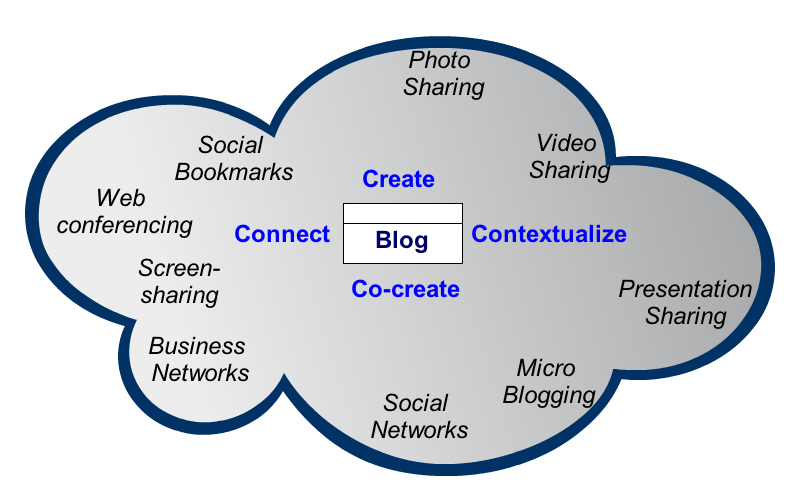
I noted that it’s important to know where’s your data but you also need some control over all the social media you’re using. The problem is that you’re on somebody else’s platform. A blog can be used as the more stable node in your social media ecosystem. For example here are several social media applications I’ve used but have pretty much discarded for one reason or another — Furl, Magnolia, Spoke, Xing, Blogflux, Eduspaces (insert your own list). However, my blog hasn’t changed — it’s my social media home base. In addition, blogging also helps to develop meta-cognitive processes and as Tom Peters says in this interviewno single thing in the past 15 years has been more important to my professional life than has blogging”.
blog-homebase
My four C’s of social media can be addressed through many social media applications but these processes do not need to be owned by any single application. I would say that it would be a mistake to use a single SaaS (software as a service) platform as your only way to engage in these processes. You can create, contextualize, connect and co-create in many ways; most of which can, and perhaps should, be linked back to your blog. Having watched MySpace get marginalized while Facebook dominates for now, it’s only a matter of time before more new platforms that we don’t own come along and lure the next bunch of digital sharecroppers. To see where blogging may be headed (Blogs 2.0?) check out Om Malik’s The Evolution of Blogging.

Sackville Local Food Day

We’re having our first Sackville Local Food Day on Saturday August 15th from 9:00 am to 1.30 pm at the Farmers Market on Bridge Street.

  • taste the produce of our local region
  • meet some local farmers
  • buy from local artisans
  • listen to local music
  • win great door prizes

If you’re a new vendor or want to come out for Local Food Day only contact Cathy at the Bridge Street Café; tel 506-536-4428

Natures Route Farm

Creating your PKM processes

In Sense-making with PKM I described some personal knowledge management processes using various web tools. The overall process consists of four internal actions (Sort, Categorize, Retrieve, Make Explicit) and three externally focused ones (Connect, Contribute, Exchange). Personal knowledge management is one way of addressing the issue of TMI (too  much information).

pkm-flow

A sense-making routine can be regularly reading certain blogs and news feeds, capturing important ideas with social bookmarks and then putting ideas out in the open on a blog. The power of this process is realized after many iterations when you have created a personally contextualized knowledge base. PKM takes the notion of a personal journal and extends it significantly.

In Web Tools for Critical Thinking I expanded on Dave Pollard’s critical thinking process, showing how web tools can be used to develop critical thinking skills. Critical thinking is an important aspect of PKM but I had not put the two together explicitly. I created the following table to integrate my PKM process with Dave’s critical thinking process. You may have noticed that I’ve changed the order of  Retrieve & Make Explicit, but this is an iterative and non-linear process, so it doesn’t really matter.

My own PKM process has changed lately with my increasing use of Twitter and this is noted in the tools and strategies column.

PKM Critical Thinking Process Web Tools & Strategies
1 Sort Observe & Study Use an aggregator (feed reader) to keep track of online conversations

Follow interesting people on Twitter

2 Categorize Synthesize & Qualify
Use Social Bookmarks

Find a Twitter App to suit your needs

3 Retrieve Draw Inferences Now that information is in a DB, use Search, instead of file folders.

Create online (reusable) mind maps,  graphics and text files of your thoughts

4 Make Explicit Form Tentative Opinions Tweet

Write a Blog post

A Connect Identify Missing Information (and people) Connect via Twitter, follow blogs or join Social Networks
B Contribute Develop Supporting Arguments Join in Tweet Chats

Write Blog Comments

C Exchange Analyze & Challenge Arguments Continue and extend conversations from news sources, other tweets or blog posts

Community Supported Agriculture

Dave Cormier is getting started on connecting people with local farmers, using the Web, on Prince Edward Island. This is Dave’s initial plan:

it’s normal, it’s easy and it’s good to buy local

I want a list of people who are interested in finding out where the good local food is WHEN it is ready. Once the system is ready you’ll be able to either get ALL messages of ‘food is ready to come be picked up, bought or picked’ or be able to subscribe to certain kinds of food or certain producers.

I also want to get a group of people together to prove to the local farmers that we are here. So far, the people I’ve talked to think this is a really exciting idea. I’d like to get those people together so that when i meet with farmers i can say “look, these people want your product, and they want to buy locally”.

Since PEI is not far from here, we share many things, such as climate, our rural environment and distance from major markets. I shared with Dave some of what we have learned in the past three years with the Sackville Community Supported Agriculture initiative. For me, it’s about local control and having a more resilient local agriculture infrastructure that can weather the storms of peak oil, climate change and pandemic. As with nature, in diversity is resilience.

Carrots_of_many_colors

Here are some further readings related to CSA’s.

Friday’s Finds #7

From the Twitter files this past week:

via @c4lpt10 Strategies for Integrating Learning and Work (part 3)

via @1ernesto1Cheater or Collaborator?

via @johnsgunnCanadians have no legitimate expectation of privacy when they use the Internet

via @kdwashburn –  Florida school boosts achievement by jettisoning textbooks

ROI:

Productivity in a Networked Era: Not Your Fathers ROI  CLO article

Flexibility has it’s own Return on Investment

Connecting ideas with communities

I use the chasm model to explain my professional work of 1) seeing what is ready to cross the chasm by 2) staying connected to the innovators & being an early adopter so that 3) I can help mainstream organizations. It’s a good graphic summary of my consulting practice.

Five years ago I looked at a couple of models (Rogers & Gladwell) in the Dummies Guide to Change and came up with a model on how you might be able to effect a change in a population. It wasn’t tested, it was just an idea. One of the core ideas was the law of the few, or the notion that a few key types of people help to speed social communication. As Charlene Croft puts it [looking at how Twitter is used]:

Connectors are individuals who know lots of people and who use those connections to their advantage.  Connectors are people who have invested in social, cultural and identity capital and who can convert those intangible resources into pretty much whatever they decide to.

Mavens are the senders and receivers of information.  They are the people who always have the pulse on the good deals and breaking stories of the day.  Mavens are the trendsetters and the people who you turn to to find out about this thing or that.  Citizen Journalists are types of Mavens, often scooping the mainstream media in reporting “from the ground”

Salesmen are the persuaders of society.  They are the people who dedicate a great deal of their lives to selling people on their ideas.

I figured that if you want to foster large-scale change in an organization or even a network, then you would:

  1. connect the right Mavens with the potential Innovators,
  2. target the Early Adopters via the Connectors and then
  3. find the Salespeople who will influence the Early Majority

I also figured that the Late Majority and the Laggards were not worth the effort, time and resources.

I’ve noticed that this is what has happened with some of the ideas that I’ve worked with in those five ideas. For example, informal learning in the organization was an idea five years ago. Jay Cross (maven) published one of the first business books on the subject in 2006 – Informal Learning. Many connectors, especially educational technology and business bloggers, took the idea and spread it. Then in 2009 we see it being discussed as the core idea of the ASTD opening keynote, and moving into the mainstream by several salespeople (vendors, service providers) looking for business opportunities.

This is just a working model but it may help in looking at how you can get your new ideas into the mainstream.

Friday’s Finds #6

It seems that Twitter has been the only subject discussed here this week, so I promise to broaden the subject matter next week. Here’s my synthesis of some of what I learned on Twitter:

Business

A Good Way to Change a Corporate Culture via @johnt

John Hegel’s Shift Happens Redux via @jalam1001

“Just heard of several faculty who left research & teaching because of toxic workplaces” via @ellenfweber (related to my work at Mental Health @ Work)

Learning

100 Incredible Lectures from the World’s Top Scientists via @josiefraser @courosa

Questions on Informal Learning and the Future of Corporate Training via @fdomon

Top 10 Thinking Traps Exposed – How to Foolproof Your Mind, Part 1 via @denniscallahan

Food & Energy

(related to my volunteering with Sackville CSA)

Biggest seedmaker, Monsanto, to prune 900 jobs + does a drop in potash sales = less food? via @folkstone

Longest path between here & the truth is through a McDonalds PR campaign on sustainable agricultural practices. via @rhh

Friday’s Finds #5

From the Twitter files:

The big news this week was the Iranian election and almost all of the news was via social media, as the broadcast media were shown to be powerless against the Iranian state, but not the people:

“This feels like Tiananmen. They fight for democracy, we watch, they die, we change the channel;” via @rhh

Rob Paterson picked up on this theme and asked “Is empowerment a point of view avoided by mainstream media? ;” I added, “and is empowerment a point of view that is embraced by social media?” via @robpatrob

“This is change of media: German main news show uses YouTube and Twitter for their report of Iran election.” via @hnauheimer

“University’s security & personnel evacuated by police, there are only us students in here right now” [frightening post from a student in Iran] via @Change_for_Iran

and of course many of us turned our avatars green in support of free elections in Iran

The Real ROI of Social Media: “But maybe we’re looking at the wrong ROI to start with – instead of return on investment, perhaps we should be more worried about the Risk of Ignoring.” via @fdomon

Skepticism about the whole “Net Generation” concept via @jclarey and a link to @markbullen and his Net Gen Skeptic blog

Is it time to get rid of the Foreign Service designation?” This is a classic example of Tribal versus Network culture, and I’d wager that our foreign service needs a network culture in order to be effective today.

A Twitter-like policy on Twitter: “Our Twitter policy: Be professional, kind, discreet, authentic. Represent us well. Remember that you can’t control it once you hit “update.”“, via @kanter

I said that I’ve noticed Twitter is replacing comments and thus opening my blog posts up to a wider audience. “Is Twitter replacing blog comments? Possibly, says @judymartin8 and Twitter is driving my traffic up & more people are connecting inter-personally, not on blog.”

Excellent Friday viewing, YouTube video on educational reform, “Goodbye Butts in Chairs” via @jaycross

Friday’s Finds #3

From the Twitter files;

Some thoughts, ideas & comments that caught my attention this week:

Canadians are being set up by music/movie lobby groups & our politicians in a rather cozy relationship it seems … Is there a connection between crappy broadband and minimal use of open source in Canada? via Michael Geist

It seems that our economy may transition from Markets, back to Tribes & bypass Networks completely: The End of Business [related to my post on networks & complexity]

via @skap5 Powerful reminder of the shift from an industrial era. GM employed 395,000 building cars in the 1970’s. After latest closings it’s 40,000. GM’s US market share declined from 45 to 19% from 1980 to today. Meanwhile via @techberry The only way to save GM is to kill GM – we must convert auto factories to mass transit: Michael Moore.

Quote from @swoodruff “Writing a social media consulting proposal for a potential biotech client. Contact came via Twitter. Return On Networking!” [who says Twitter is useless?]

via @VMaryAbraham “What produces results? Knowledge. Got it? No, then get it!”  Content Management Connection

via @nineshift The rise of public places in Canada, and @scottstonehouse replies: “Right on. Just started telecommuting and I expect to be spending more time than ever at the public library.”

via @c4lpt The future is people, not technology – Jay Cross

via @derkdegeus The end of Intellectual Property

“Alan Kay shares a powerful idea about ideas” on TED Talks

My Fair Lady in Sackville

The production will feature student actors ranging from Grades 9 to 12, lavish costumes and a spectacular set. This year’s production is being directed by a student sister duo, Charlotte and Marilla Steuter-Martin. The performance will occur on May 21, 22 and 23 at the TRHS Auditorium in Sackville, N.B. Doors will open at 6:30 p.m. with the show starting at 7:00 p.m. Tickets are $6 for students and $10 for adults. Currently, they can be reserved online by emailing trhsmyfairladytickets@hotmail.com.

Tickets will be available for purchase starting tomorrow at Tidewater Books and starting Monday, May 4th at the Tantramar Regional High School office! Pick up yours today to assure your seat at what will be a great show!

My Fair Lady

TRHS Drama Website

This post strays a bit from my usual fare, but that’s Nicholas Jarche in the lead role :-)