Adding value to information

Once again, I have to thank Dave Pollard for an insightful post and another model I can use for online community development. Dave looks at the processes that could enable mainstream media to remain relevant in the Internet age.

Adding value to information is an important aspect of online communities, especially business and learning-related ones. The community manager can ensure 1) that environmental scans are done; 2) canvassing of members happens; 3) analysis & questionning is ongoing; 4) suggestions are made and 5) information tools (e.g. checklists) are developed. The community manager also organises the peer-to-peer events that are important to maintain the community.

You could use this chart of Dave’s as part of the job description of anyone starting a community of practice.

Mapping metrics

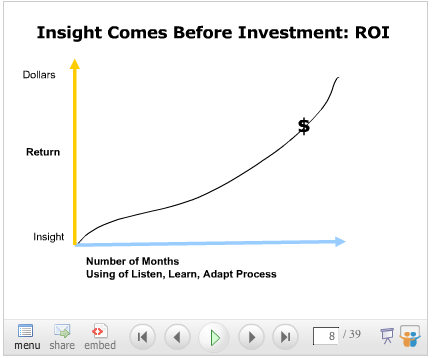
Beth Kanter shares her presentation on Mapping metrics to strategy (with slide show) focused on non-profits using social media:

The session will share an overview of why the sequence listen, learn, and adapt is critical to implementing a successful social media strategy. We’ll take a look at how to use both qualitative and hard data points to refine and adapt your strategy as well as the role of continuous listening and learning through implementation of pilots. We’ll examine what can and can’t be quantified as well as various metrics and analytics tools.

The main lessons in this presentation are that you have to know what you are measuring (and it isn’t always the same thing) and that you have to jump in and try things out and even make mistakes in order to learn (e.g. perpetual Beta). Slide 28 of Beth’s presentation gives a good snapshot of the lessons learned from two social media campaigns.

Using social media to connect to networks and engage communities requires improvisation. What I’ve learned about improv is the importance of listening, understanding others and leaving an opening to continue the conversation. Fixing a social media framework in stone doesn’t leave room for the community to change it to their needs. Flickr is an example of a social media platform that evolved to meet the needs of its users, as it wasn’t originally intended to be a photo-sharing platform.

Whether you’re developing a non-profit campaign or a business network, it’s important to develop a social architecture, not just a technical one:

Social architecture is the conscious design of an environment that encourages certain social behavior leading towards some goal or set of goals.

Referred to in Beth’s presentation are hard metrics via The Social Organization, such as – contributors, visitors, referrals, word count, etc.  Dave Duarte provides 20 additional subjective ways to measure the social interactions in a network, including – recommendations to peers, and acknowledges the contributions of others. Measurement in social networking is not a single lens but a series of perspectives that evolve through time. It’s essential to have ongoing conversations about measurement as the network, community or campaign grows. Effective measurement becomes a critical feedback loop to check that you have the right social architecture.

Learning as a Network

Mohamed Amine Chatti extends the framework on personal knowledge networks with his post on Learning as a Network (follow link for graphic):

The Learning as a Network (LaaN) perspective draws together some of the concepts behind double-loop learning and connectivism. It starts from the learner and views learning as the continuous creation of a personal knowledge network (PKN). For each learner, a PKN is a unique adaptive repertoire of:
– One’s theories-in-use. This includes norms for individual performance, strategies for achieving values, and assumptions that bind strategies and values together (conceptual/internal level) Tacit and explicit knowledge nodes (i.e. people and information) (external level

Here is Chris Argyris’ double-loop learning theory in a nutshell:

“There are four basic steps in the action theory learning process: (1) discovery of espoused and theory-in-use, (2) invention of new meanings, (3) production of new actions, and (4) generalization of results. Double loop learning involves applying each of these steps to itself. In double loop learning, assumptions underlying current views are questioned and hypotheses about behavior tested publically. The end result of double loop learning should be increased effectiveness in decision-making and better acceptance of failures and mistakes.”
double-loop

And here is George Siemens’ Connectivism theory:

Connectivism is the integration of principles explored by chaos, network, and complexity and self-organization theories. Learning is a process that occurs within nebulous environments of shifting core elements – not entirely under the control of the individual. Learning (defined as actionable knowledge) can reside outside of ourselves (within an organization or a database), is focused on connecting specialized information sets, and the connections that enable us to learn more are more important than our current state of knowing.

Finally, you can get a quick overview of the Cynefin model and complexity with this video from Anecdote.

So that’s: double-loop learning – connectivism – complexity; three concepts, each requiring some depth of understanding . No wonder this is a hard sell in the boardroom. Many people think of learning as school, training as something that is delivered, and complexity as problems that can be solved with effort and resources.

Like Mohamed, I am interested in these theories but my true passion is in implementing frameworks for the workplace.  I too think that merging learning and knowledge management into our work is a good way to help organizations deal with complexity.

Here’s a possible elevator pitch for learning as a network, or PKM:

Is your work becoming more complex? How much complexity is there in the markets or the environment? Can anyone predict what’s going to happen next? Obviously many of the world’s economists have been wrong about most things. Looking backwards hasn’t helped us much.

In a complex world we cannot predict outcomes but we can engage our environment and learn by doing. That makes constant learning a critical business skill. But how do we help people develop that skill?

Giving tools and teaching by example is a good way to start. People need to make connections and see patterns and then reflect, criticize and detect errors. Only in a trusting, collaborative workplace can this happen.

Want to know more? Well let me you tell a story …

Twitter potpourri

I’m still figuring out how best to integrate Twitter to my personal knowledge management processes. I post some things I find directly to Delicious and others I mark as favourites. Here are some of my recent favourites, a follow-on from a related post last month [I’ve added some letters and words to make it more coherent]:

@davecormier RT @arvind: @davecormier Hard core social network research: danah boyd

@c4lptnews Leveraging Human Networks to accelerate learning | CLO magazine

How to opt out of cookie sniffing and trading – painless – via Seth Godin

Shai Agassi: A bold plan for mass adoption of electric cars (TED) Inspiring, Hopeful, Fantastic!

The movement from a public service that is opaque by 21st Century standards to one that is transparent is going to be gut-wrenching – David Eaves

RCMP and Vatican: The downfall of the hierarchical and opaque organization – David Eaves

Via @neternity Try 2-3 low-cost approaches instead of one big (expensive) project – that way you can afford to fail #learntrends

Via @neternity The biggest cultural change was breaking down organizational walls. This is an emerging “wirearchy” says @jonhusband #learntrends

@KathySierra Cut a few prime-time ads, use the money to hire fabulous usability & instructional design team to craft/implement a spectacular user learning “strategy”.

Composing Twitter messages using only brainwaves #learntrends – The Future?

On calculating ROI for human activities (economics, learning, marketing, etc.)  from a Nobel laureate

@nickcharney 17 Things we Used to Do (before Twitter): Andrew McAfee

Emergent practices need practice

“I think that one of the larger problems of our time, is that we we don’t even know how to think about many of today’s problems. We think that our reason or our effort will be enough to solve them. When in fact, these problems are of a different nature to the ones that we used to have. They are different because, we are so much more interconnected today that there can be no simple cause and effect.”

From Why we are lost? – How we can find ourselves, Rob Paterson explains the Cynefin framework, with a link to a concise explanatory video from Anecdote,  and goes on to show the problem in our workplaces:

“In short — some problems are Simple and are subject to simple cause and effect. I do this and that always happens. Some problems are Complicated and I need to know a lot to find the answer, say design a jet engine or put on a TV show, but once I have the body of knowledge again results are going to be there. The laws of Newtonian Physics apply.”

But many of the problems we face today are COMPLEX, and methods to solve simple and complicated problems will not work with complex ones. One of the ways we addressed simple & complicated problems was through training. Training works well when you have clear and measurable objectives. However, there are no clear objectives with complex problems. Learning as we probe the problem, we gain insight and our practices are emergent (emerging from our interaction with the changing environment and the problem). Training looks backwards, at what worked in the past (good & best practices), and creates a controlled environment to develop knowledge and skills.

To deal with increasing complexity, organizations need to support emergent work practices, in addition to their training efforts. They must support collaboration, communication, synthesis, pattern recognition and creative tension, all within a trusting environment in order to be effective. One method of supporting emergent work is the fostering of communities of practice (CoP).

I read today that communication does not equal collaboration, and that is a challenge in “building” communities of practice. Just because the communication tools are in place does not mean that people will automatically collaborate.  You can’t really build a CoP, it has to emerge through practice, but you can put in systems and processes to support CoP’s.  As I learned this week — you know you’re in a real community of practice when it changes your practice.

So if you wonder what all the hype over web social media is about, in my mind it’s the potential to support emergent work practices. Twitter, blogs, wikis and social networks are tools for communities of practice. They can be used effectively or not. How these tools get used is itself an emergent practice, but if you don’t practice, nothing will emerge.

Media and Messages

To paraphrase Marshall McLuhan, every message has its medium and every medium has its message. That sums up my impression of our LearnTrends web conference which finished yesterday. Selecting the appropriate messages and media is becoming an essential part of facilitating learning. The other component is building or connecting to networks, social or otherwise. The major trend in workplace learning that I see is the merging of Learning & Working. The main driver is our ubiquitous access to networks. Our global 24 hour conversation was in fact a global village, still composed mostly of innovators and early adopters, but the tip of a connected iceberg.

Personally, I enjoyed the sessions but of course this medium is only good for a certain type of interaction. It could not be all things to all people. For instance, there were several media involved:

Synchronous Sessions (Elluminate) – good to get acquainted, hear some new ideas and feel like part of a larger movement. The text chat enables more people to have input without interrupting the current speaker, but it can get off topic. The session by Heike Philp on Pecha Kucha showed another way to make this medium more interesting, and fun, by adding constraints for the presenters.

Twitter – gets the word out about upcoming sessions and allows wider publishing of impressions. Using Twitterfall, or search, one can see the collected observations from many people and from this see some patterns. These are some of my observations I passed on via Twitter:

“I knew I was in a community of practice when my practice had changed,” heard in a discussion.

“If you shut down the training department, would it be missed?” a general question

“Try 2-3 low-cost approaches instead of one big (expensive) project- that way you can afford to fail,” from a presenter.

“Twitter is for surfing an ocean of information, not trying to understand fluid dynamics,” my own observation.

Blogs – like this post, blogs provide a more permanent record of what happened and more thought-out individual impressions, plus the option to connect or comment.

Social Networks – the LearnTrends community site provides a place to add a profile which is a handy way to put a face to a name. The main limitation of using Ning is the lack of wiki, and obvious weakness when  creating a schedule on the fly with people in multiple time zones.

I’ve been attending, presenting and coordinating web conferences for over a decade now and each time I learn, or re-learn something. Whenever I go live on the Web I also realize that this active learning is necessary to really understand the medium. Looking back and observing is not enough to understand how networked learning can be facilitated. We learn through our practice.

Conversations about learning in organizations

We’re nine hours into our global (free) 24-hour online conversation about learning in the workplace. Ross Button is currently giving a great presentation on CGI: Bringing the internet inside for informal learning & transformation. He’s discussing all the details of bringing social software into a large multinational organization covering the social, data and technology dimensions. Ross suggests that when initiating these kinds of initiatives, it’s better to try 2 to 3 low-cost approaches instead of one big and expensive project. In this way you can afford to fail a few times. He also says that the biggest cultural change was breaking down departmental and organizational walls because social software ignores the chain of command. Jon Husband commented that this is an emerging wirearchy. Finally, Ross says that these kinds of projects take time, support and patience.

We started this morning (Pacific Time) with a good mix of people, though mostly from North America, and we have been averaging about 100 participants at any time.

There have been a lot of great conversations so far and more scheduled for the next +12 hours.

Marketing for Consultants

In the article So You Want to Be an E-learning Consultant… I discussed the pros and cons of consultancy as well as the various areas of practice in our field. One area I did not discuss was attracting and retaining clients. As the saying goes, when you’re working, you’re not finding new clients and when you’re looking for clients, you’re not working. I decided to look at a number (32) of my past projects and see how my clients had come to find me. I broke this down into three main categories, with the number of projects shown in brackets:

  1. Direct reference (20) from a member of my business community, defined as someone I know or have met or may have worked for or with previously. This includes follow-on projects.
  2. Indirect reference (9) through one of my professional networks, also known in social media as a “friend of a friend”.
  3. Client found me on the Web (3) via some form of search.

Obviously my closest connections are my best sources of client referrals. I haven’t calculated the revenues from all of these projects but I can say that the third category, while only three projects, generated a significant amount, so passive Web marketing should not be discounted.

Global 24-hour Workplace Learning Conversation

For 24 hours starting April 21 at 9:00 am Pacific time, LearnTrends will host a series of online conversations on boosting the performance of organizations through learning. We expect hundreds of people to attend the free, live, online sessions. Conversations will be recorded and made available on the web to foster reflection and continuing discussion. Our Twitter back channel will probably be hopping. The LearnTrends community now numbers more than a thousand members around the globe. Sign up if you are not a member to keep track of what’s going on.

Lots of people have signed on for this event and I’m sure that a good part of the +1,000 members of the LearnTrends community will drop in for some part of this 24 hour online conversation that is available to anyone interested in workplace learning.

Please note that the content is also what you bring to the party. We have some set topics to start and finish. In the interim, if you have some discovery you’d like to spotlight, bring it up in conversation. You can pick a spot on the agenda, click “suggest a topic,” and tell us what and when; we’ll put it on the schedule. Alternatively, you can simply check in during the event and request the microphone.

Communities, networks and etiquette

What’s the difference between a community and a network? Is a community of practice a network or a community?

Clark Quinn looks at social media, and asks, “… how often we call them online communities, but the question is: are they really?” I’m not going to go into network theory or definitions in this post but I think that the difference, perceived or otherwise, between networks and communities is of importance to anyone engaging with web social media, especially for professional purposes. Understanding what you define as a community or a network can help develop your personal rules for connecting, linking, friending, following and of course unfollowing.

Dave Cormier discusses social networking with Twitter and makes a clear distinction between his network and his community on this medium:

The final issue i wanted to discuss was the management of your network. There are many theories about this, and I wont claim any supremacy for mine other than to say that it is how i stay effective with the degree of networkedness that I have created for myself. I am a constant gardener of my network, following people, unfollowing people, paying more attention to some people for a while and then moving on to others. This is the critical difference between a network and a community… My community members i stay with, my network is something more practical.

Many of us are connected to people in our networks who over time have become members of a closer community, whether it be through shared experiences or shared interests. We probably didn’t notice when connections became colleagues or friends. It just happened.

I’m sure that most people don’t think too much about the distinction between networks and communities but they know when someone has crossed the line of acceptable behaviour. Making network habits explicit can help when your networks get very large or when someone challenges you on a behaviour – e.g. Gee, I never thought about that! The larger someone’s network, usually the more explicit their policy on connecting. If you don’t set some rules you will probably be overwhelmed by noise from the network.

If social media are going to be an integral part of our professional and personal lives, all of us will need to become more explicit about our online etiquette. I’m not sure we need an Emily Post type of online etiquette guide but I’m certain many people will make money telling others what to do in the Networked Age.

Photo by alana jonez