It’s Your Turn, New Brunswick

Massachusetts has led the way in embracing open standards, many of which are used in open source platforms and applications. According to CIO Today:

The State of Massachusetts is migrating to open-source software for all government documents. The move will come at the expense of Microsoft and other proprietary technology providers.
The latest iteration of the state’s technical reference guidelines states that the OpenDocument format will become the de facto platform for text, spreadsheets, charts and graphical documents produced by the government to ensure future access to the records.

OpenOffice.org uses the Open Document format. It is open source, free and with the impending release of version 2.0 (now in Beta Release 2), even easier to use. Just converting to OOo could save a significant amount in licensing fees and allow anyone, anywhere to use the same office suite for free.
New Brunswick’s "e" initiatives come under the umbrella of eNB. In looking at the site, as well as the latest draft of the eNB Action Plan, I cannot find any reference to open standards – a critical component for long-term accessibility to our own data. So come on New Brunswick, open up.
Update: And one more reason why standards are important is that – "The poor people from New Orleans and the Gulf, who drastically require access [to] the FEMA [Federal Emergency Management Agency] website can only do so with IE on Windows!" As Doc Searls puts it:

Without standards how would the Meter, a Gallon of gasoline or water or the weight of gold be measured? How many dead or hobbled sites does it take before your company wakes up and smells the truth?? I sincerely hope Mr. Balmer and Mr. Gates read web blogs. If they do, please make sure they see this.
We must comply to W3C standards. The whole world needs them. We have a responsibility to everyone, even the one who needs our help in such troubled times.
Oregon Targets Open Source Business

I have suggested this strategy to economic development folks in  Atlantic Canada for several years now, especially for learning-related OS. Open source can be a real accelerator for smaller players, as the barriers to market entry are much lower. It fell on deaf ears though.
Anyway, here’s what the Oregonian has to say:

Gov. Ted Kulongoski pledged Tuesday to do his part to make Oregon an attractive place for open-source software development, promising to raise the state’s profile within the open-source movement and to raise the movement’s profile inside Oregon.
"This is a growing segment of Oregon’s economy, and it’s the future. And it’s little-known outside the industry," Kulongoski told a roundtable discussion of 20 leaders from the state’s open-source community.
The governor said Oregon would contribute $40,000 in state economic development funds to help hire a "coordinator" to promote the state’s disparate open-source activities and reach out to businesses and software developers thinking about doing business in Oregon.

Commons-based Peer Production

In my previous post on Obsolescing the Middle Men, I had referred to commons-based peer production. From  George Siemens I learned that Irving Wladawsky-Berger, VP Technical Strategy & Innovation at IBM, takes this form of production very seriously. Wladawsky-Berger states that :

Clearly, despite having built a highly successful, profitable business on a proprietary model, IBM takes the open source movement in its many manifestations very seriously. Working in an open community is for us a no-nonsense business decision, made only after considerable analysis of the technology and market trends, and due diligence on the community, its licensing and governance, and the quality of its offerings.

I think that we are seeing the next phase of open source getting bigger and more serious. Even more traditional business publications, such as Knowledge@Wharton are discussing open source models. This is a practical and pragmatic way of doing business which can be profitable, but also idealistic in that it fosters the common good. This may be the new model that our antiquated managerial capitalist world needs.

Commons-based peer production is a BIG idea.

For the past several years I have participated in a number of regional economic and industry-focused development initiatives. They have focused on how a region can be more innovative, get more jobs, create wealth, etc. In all of these cases the status quo remains, in terms of power and wealth. I also don’t see much real innovation, especially the quantum type referred to by Franz Johansson.  The Commons could be the unifying idea that allows companies to make profits, individuals to opt-in on their own terms and non-profits to participate and benefit. However, to really make commons-based peer production work, the traditional power centres (corporations, executives, bureaucrats) will have to give up control, and that could prove to be  most difficult.

Perhaps it could start with the CBC?

ATutor 1.5 with Ewiki

First it was Moodle that came with a wiki and now ATutor has the ErfurtWiki included as an add-on. I have found wikis to be excellent tools for collaborative work and learning, especially the development  of policies and procedures with geographically distributed groups. There are now at least two open source learning systems with collaborative wikis included. I can only see this as a positive step for learners, as well as anyone looking for a "made in Canada" learning system.

Firefox goes Private

Over the past several months the Firefox browser has been gradually gaining market share (+8%) over MS Internet Explorer. According to Forbes.com , the Mozilla Foundation, owner of Firefox, is now creating a private company to take advantage of any business opportunities while still keeping Firefox open source. Firefox currently generates money on the drop-down search menus but there seems to be much more potential.
It’s going to be interesting in the near future when the Mozilla Foundation, a not-for-profit, becomes the major rival of Microsoft, Adobe, et al. This model of a private venture, owned by a non-profit and based on open source software may become the new technology business model. I think that there will be a lot to learn here for anyone looking at launching a new technology venture. It’s about time that things were shaken up a bit.

Drupal versus WebCT

Charlie Lowe asked his students, experienced with WebCT, how they felt about Drupal. The comments from the Business Writing course are anecdotal but sometimes a personal view is better than some dry statistcs.
The comments are generally more positive for Drupal but there are specific cases where WebCT seems to be a better tool, such as access to marks and grades.

Technologies of Cooperation

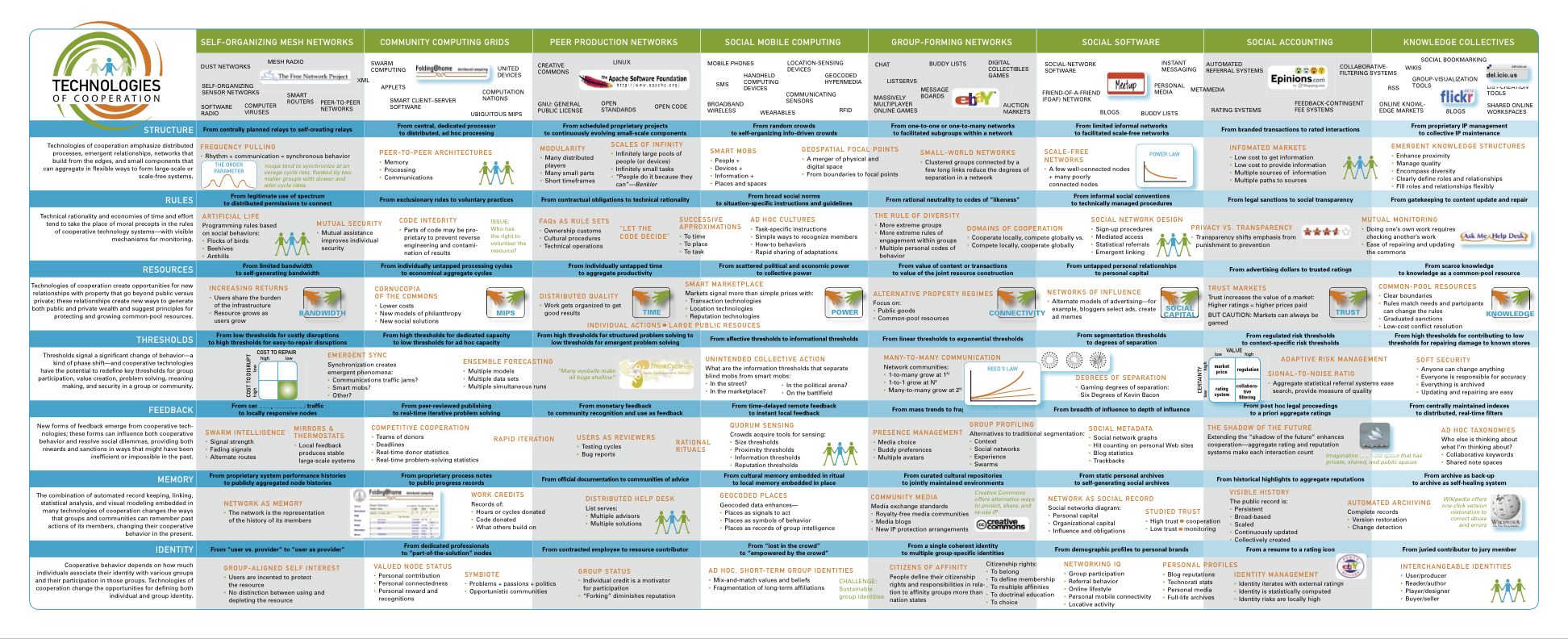
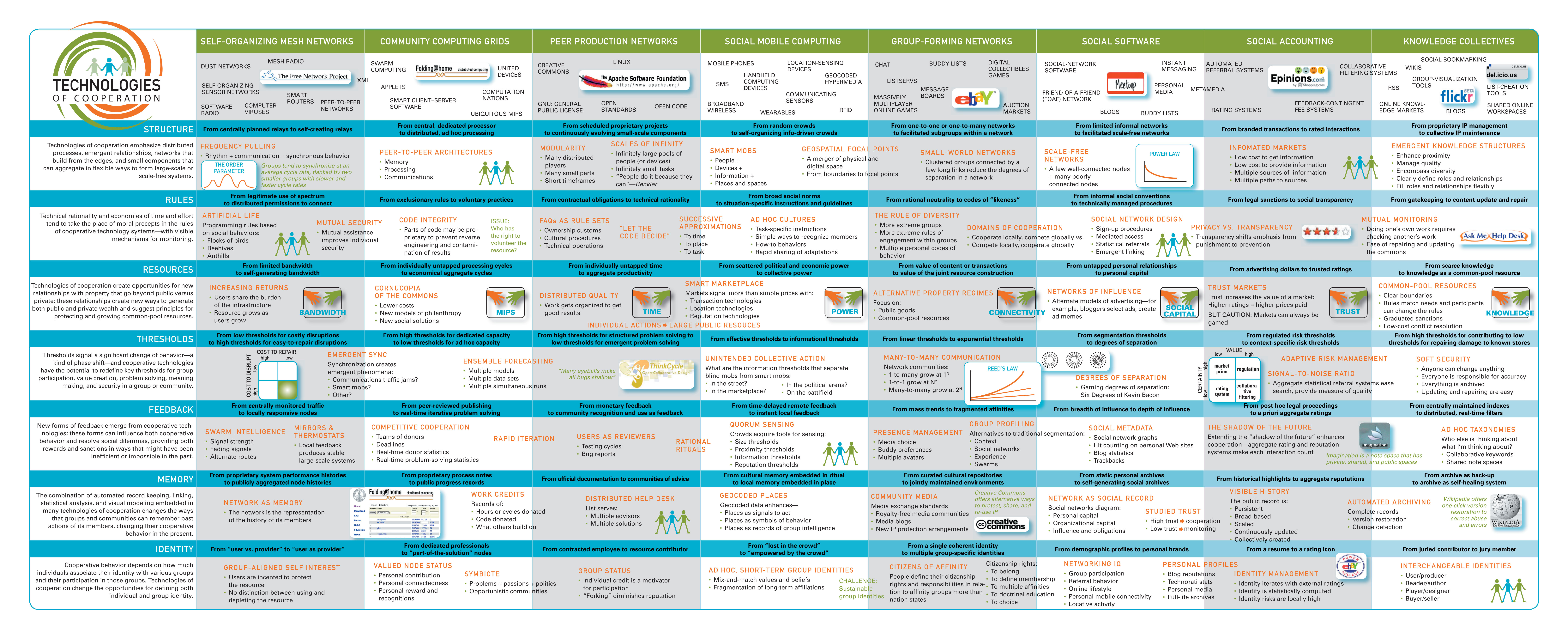
I’ve already referred this excellent document to two of my colleagues, so I guess that I’d better blog about it. Entitled Technologies of Cooperation, this paper from the Institute for the Future is available on Howard Reingold’s site as a PDF. A small or a large map is also available. The large map is great to read on your computer but a pain to print.
Technologies for Cooperation is a follow-up and a synthesis of a paper that I talked about last year, called Toward a New Literacy of Cooperation in Business. The recent document is worth a read for those immersed in Web 2.0 as well as anyone trying to get a handle on the two-way web and online communities.
What triggered me to read this report was the recent CCL e-learning workshop. I was reading the Executive Summary just as we were discussing how the CCL could facilitate the creation of communities. The strategic guidelines for the use of these coooperative technologies are covered in detail in the document:

  • Shift focus from designing systems to providing platforms
  • Engage the community in designing rules to match their culture, objectives, and tools; encourage peer contracts in place of coercive sanctions by distant authority when possible
  • Learn how to recognize untapped or invisible resources
  • Identify key thresholds for achieving “phase shifts” in behavior or performance
  • Track and foster diverse and emergent feedback loops
  • Look for ways to convert present knowledge into deep memory
  • Support participatory identity

The information in this report is useful to anyone starting or trying to maintain some type of online community. It also shows that top-down approaches and constrained spaces with explicit rules will not foster cooperation. Cooperation is becoming important for all organisations, as the authors conclude, "competition and cooperation will likely become a pair of evolutionary strategies for organizations".

Web 2.0

Web 2.0 is the common term used to refer to the new generation of web applications and systems that enable community or many-to-many relationships. BusinessWeek has a recent article that summarizes many of the converging and diverging factors influencing this next phase of the Web:

Indeed, peer production represents a sea change in the economy — at least when it comes to the information products, services, and content that increasingly drive economic growth. More than two centuries ago, James Watt’s steam engine ushered in the Industrial Revolution, centralizing the means of production in huge, powerful corporations that had the capital to achieve economies of scale. Now cheap computers and new social software and services — along with the Internet’s ubiquitous communications that make it easy to pool those capital investments — are starting to give production power back to the people. Says Benkler [Yale professor]: "This departs radically from everything we’ve seen since the Industrial Revolution."

Commerce is changing as a result of this new business platform, with successful examples such as e-Bay and more recently Skype. The graphic provided in the article is a good visual of the change from the Web 1.0 to 2.0, with Web 2.0 described as:

Many-to-Many: File-sharing, blogs and social networking services are connecting masses of people simultaneously. Their collective efforts are spawning new services including online encyclopedia Wikipedia and free netphone network Skype.

For an ongoing discussion of Web 2.0, including its influence on higher education, go to What’s Web 2.0? which is run by Will Pate.


Inkscape – Open Source Graphics Editor

Open source applications are slowly crawling "up the software stack", making proprietary enterprise software development more and more difficult. Inkscape is an open source scalable vector graphics editor affiliated with the Open Clip Art Gallery project.

Inkscape is an open source drawing tool with capabilities similar to Illustrator, Freehand, and CorelDraw that uses the W3C standard scalable vector graphics format (SVG). Some supported SVG features include basic shapes, paths, text, markers, clones, alpha blending, transforms, gradients, and grouping. In addition, Inkscape supports Creative Commons meta-data, node-editing, layers, complex path operations, text-on-path, and SVG XML editing. It also imports several formats like EPS, Postscript, JPEG, PNG, BMP, and TIFF and exports PNG as well as multiple vector-based formats.

Comments from any users would be appreciated. I’ve just downloaded it and will test it out when I get a chance.