First it was Moodle that came with a wiki and now ATutor has the ErfurtWiki included as an add-on. I have found wikis to be excellent tools for collaborative work and learning, especially the development of policies and procedures with geographically distributed groups. There are now at least two open source learning systems with collaborative wikis included. I can only see this as a positive step for learners, as well as anyone looking for a "made in Canada" learning system.
Technology
information & communication technology
Firefox goes Private
Over the past several months the Firefox browser has been gradually gaining market share (+8%) over MS Internet Explorer. According to Forbes.com , the Mozilla Foundation, owner of Firefox, is now creating a private company to take advantage of any business opportunities while still keeping Firefox open source. Firefox currently generates money on the drop-down search menus but there seems to be much more potential.
It’s going to be interesting in the near future when the Mozilla Foundation, a not-for-profit, becomes the major rival of Microsoft, Adobe, et al. This model of a private venture, owned by a non-profit and based on open source software may become the new technology business model. I think that there will be a lot to learn here for anyone looking at launching a new technology venture. It’s about time that things were shaken up a bit.
Edublogs
From James Farmer is this notice about Edublogs, a "totally unique project aimed at teachers, researchers, writers and educators the world over. Basically you get to set up a free WordPress blog, 10MB of upload space (extending to much much more down the line), an enormous stack of beautiful themes and to be part of a unique community. You could use a blog to record and annotate important resources and ideas, to propose and discuss anything under the sun, to progressively develop your thesis, to publicise and discuss your publications with the world or just to develop your digital identity. Either way, http://edublogs.org is a no-strings-attached, open source, ongoing and freely available service for you and you’re invited to take part! If you’ve got any questions, please feel free to contact James Farmer at james[at]edublogs(dot)org".
If you are an educator and have not taken the plunge into blogs for learning, then this supportive community, including knowledgeable and friendly James, is the best place to start. James has helped me out many times with advice and information and is very passionate about learning.
Small Business Blogging
I had previously mentioned how traditional businesses could use blogs. Small Business Trends now reports that one in ten small businesses in the US are planning on using blogs in their marketing strategy.
As a micro-business, I have no doubt about the value of blogging, especially for free-agents. Most business blogs seem to be in IT-intensive fields but they can also work for more traditional businesses. Two examples – Landfair Furniture in Oregon and The Lincoln Sign Company .
Like e-mail, I think that blogs will become ubiquitous in the near future as the Early Adopters have already moved to blogs.
Are there other examples of more traditional small businesses using blogs? I know about the consultants, writers and techies, but what about companies with less than 100 employees who are blogging in order to have real conversations with people?
Marketing Hype & Reality – Connection Speed
I previously complained that my ISP, Aliant (a Bell company), was only providing me with 10 MB of e-mail space for my $45 per month while Gmail now gives me 2428 MB of storage for free. My peeve right now is advertised versus real connection speeds.
According to the Aliant website, my Highspeed Ultra is supposed to give me "up to" 5 Mbps. Jay Cross has recently referred to this connection speed checker and my connection speeds are 1.2 Mbps down and 0.44 up, a far cry from the advertised speed. Another speed checker is Wugnet, with a neat visual interface, which clocked me even slower at 1.06 down and 0.18 up.
If you are in Atlantic Canada and have a highspeed internet connection, I’d appreciate it if you checked your speed and posted it, either here or somewhere else. If my case is not an anomally, then Aliant and its competitors should know about it.
Update: I checked with tech support at Aliant and was informed that one of the issues could be that my telephone extension cable was too long. According to Aliant, my ethernet cable can be almost any length but the phone cable extension from the jack to the DSL modem should not be more than 10 feet. I changed this last night but it hasn’t affected my connection speed. Aliant also recommended that I use the speed test for Aliant clients which clocked me at 134 kbps and 1.02 mbps throughput – slow for their High-Speed Ultra clients.
Drupal versus WebCT
Charlie Lowe asked his students, experienced with WebCT, how they felt about Drupal. The comments from the Business Writing course are anecdotal but sometimes a personal view is better than some dry statistcs.
The comments are generally more positive for Drupal but there are specific cases where WebCT seems to be a better tool, such as access to marks and grades.
Marratech Free
I’ve been using the synchronous online collaboration system, Marratech, for the past six months and so far I’m pretty impressed (Disclosure: Mancomm Performance, with whom I’m associated, is a reseller of Marratech). The compression for video and audio is excellent and the latest version 5.1 comes with application sharing and co-browsing. However, some of the buttons are not the most intuitive and the built-in browser lacks some functionality.
Overall, it’s one of the better systems that I’ve used (and I’ve used many systems over the past years). The pricing model is also clear, simple and reasonable and you can even make an outright purchase, without annual license fees.
The company has recently introduced Marratech Free which is a limited version for 5 users. You can use it for a whole year so there is no reason to purchase or rent until you’ve had a good chance to test it out. This is also an excellent solution for small businesses looking for a quick and easy collaboration system with more functionality than other freeware and with a much longer trial period than the usual 15 to 30 days.
Harry Potter Injunction is Unconstitutional
Michael Geist, Canada Research Chair in Internet & E-commerce Law at the University of Ottawa’s Faculty of Law has reviewed a recent BC court decision. The court forces people who have legally purchased an inadvertently available copy of a Harry Potter book to return the book or face legal action.
Having spent much of the day discussing the Harry Potter case, I find myself becoming increasingly troubled by the scope of the injunction issued by the B.C. Supreme Court. The injunction represents more than just a remarkable misuse of copyright law. Quite simply, it is an attack on freedom.
* The freedom to read (the order restrains reading the book).
* The freedom of expression (the order restrains discussing any aspect of the book).
* The freedom associated with personal property (the order compels anyone who has the book to return it, along with any notes, to Raincoast books).
This is all done purely in the name of furthering commercial interests. In Canada, we have some narrow restrictions on hate speech and child pornography. But we do not issue court orders that prohibit children from reading books.
For a judge to issue such a blantantly unconstitutional order is appalling. For a book publisher and a children’s author to request such an order, is shameful. We should tell them so.
* The freedom to read (the order restrains reading the book).
* The freedom of expression (the order restrains discussing any aspect of the book).
* The freedom associated with personal property (the order compels anyone who has the book to return it, along with any notes, to Raincoast books).
This is all done purely in the name of furthering commercial interests. In Canada, we have some narrow restrictions on hate speech and child pornography. But we do not issue court orders that prohibit children from reading books.
For a judge to issue such a blantantly unconstitutional order is appalling. For a book publisher and a children’s author to request such an order, is shameful. We should tell them so.
I agree with Geist. Why should commercial interests be put ahead of our constitutional rights? If the courts don’t look after the rights of those without the money to appeal this decision, then who will? Perhaps this is something that our Senate should look into, since the Senate purports to represent minority rights, such as those of children.
You can contact Raincoast Books.
17 July: Michael Geist follows up with more bad news for our constitutional rights.
Development Gateway
The Development Gateway is a comprehensive, non-profit resource on issues related to economic and social development with a particular focus on information and communication technologies. It includes 28 online communities, such as ICT for Development. I came across this site because I was looking for specific information on ICT’s and Indigenous communities and Development Gateway listed 61 articles on the subject. This is a very easy to use and substantial web resource.
Technologies of Cooperation
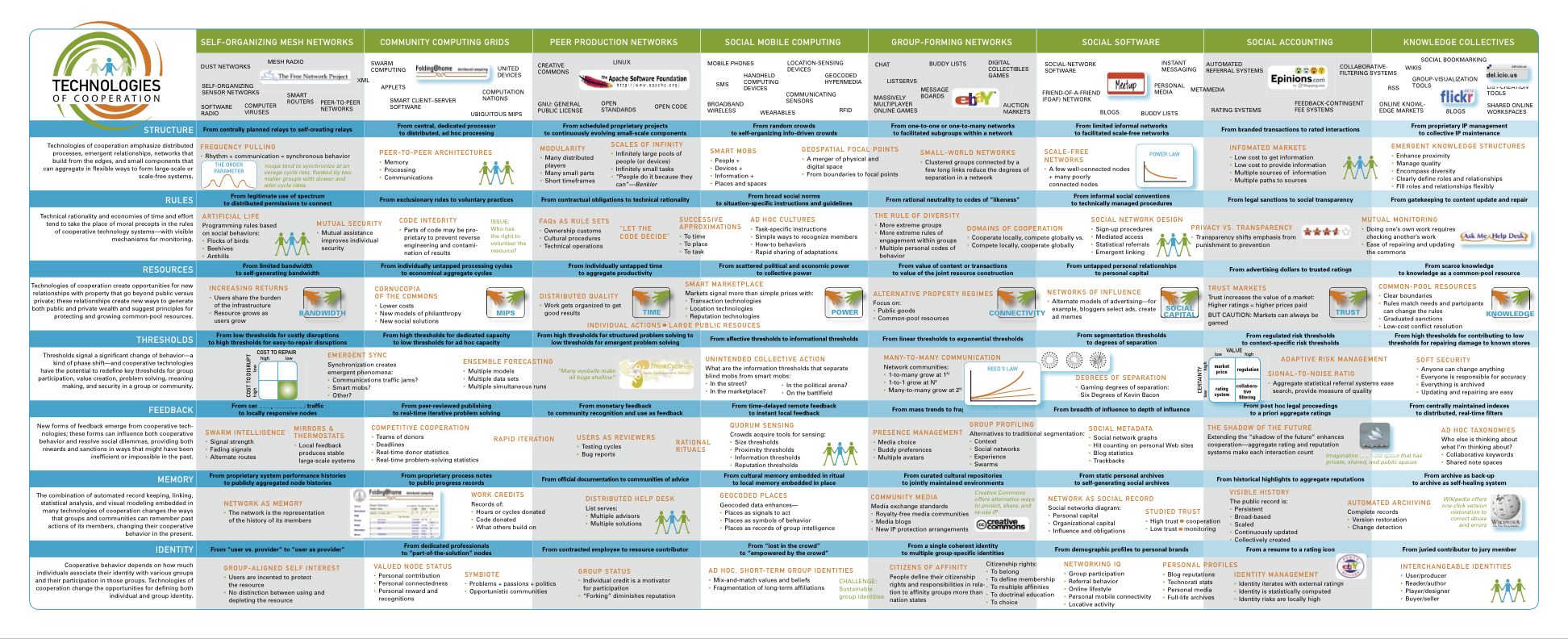
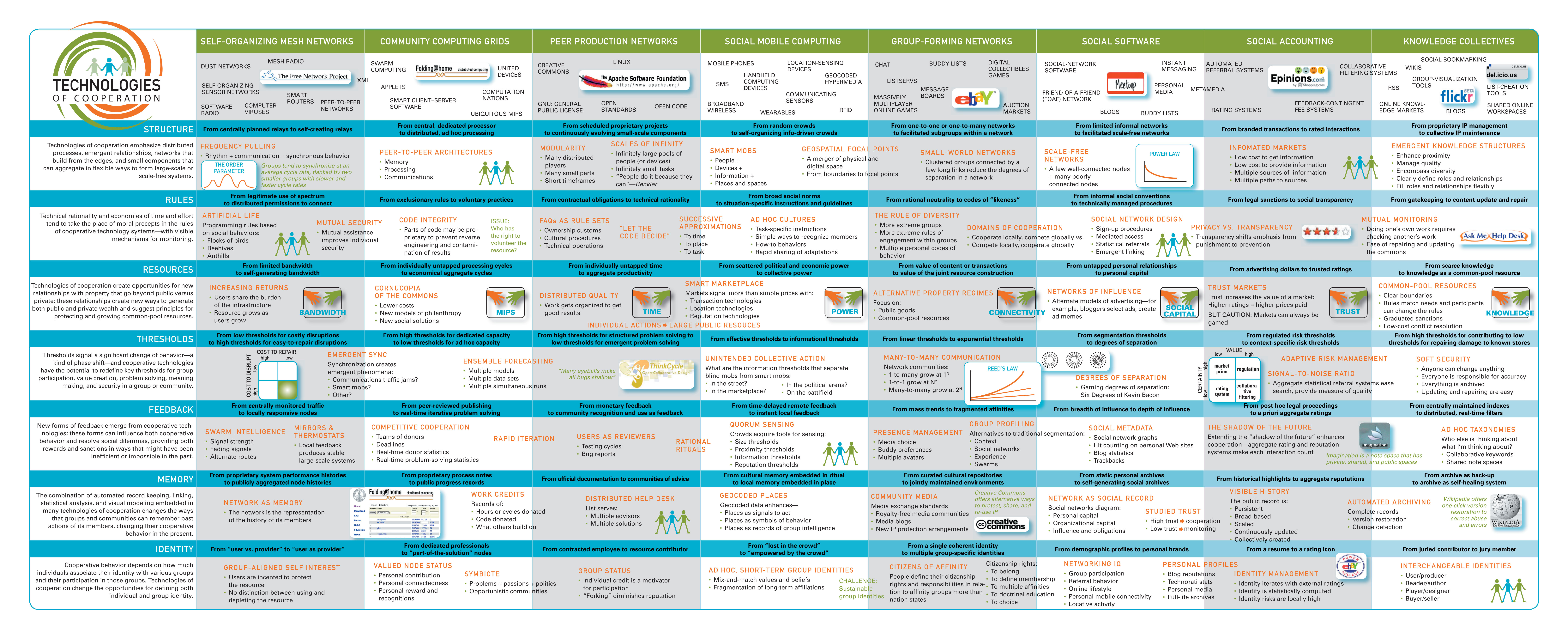
I’ve already referred this excellent document to two of my colleagues, so I guess that I’d better blog about it. Entitled Technologies of Cooperation, this paper from the Institute for the Future is available on Howard Reingold’s site as a PDF. A small or a large map is also available. The large map is great to read on your computer but a pain to print.
Technologies for Cooperation is a follow-up and a synthesis of a paper that I talked about last year, called Toward a New Literacy of Cooperation in Business. The recent document is worth a read for those immersed in Web 2.0 as well as anyone trying to get a handle on the two-way web and online communities.
What triggered me to read this report was the recent CCL e-learning workshop. I was reading the Executive Summary just as we were discussing how the CCL could facilitate the creation of communities. The strategic guidelines for the use of these coooperative technologies are covered in detail in the document:
- Shift focus from designing systems to providing platforms
- Engage the community in designing rules to match their culture, objectives, and tools; encourage peer contracts in place of coercive sanctions by distant authority when possible
- Learn how to recognize untapped or invisible resources
- Identify key thresholds for achieving “phase shifts” in behavior or performance
- Track and foster diverse and emergent feedback loops
- Look for ways to convert present knowledge into deep memory
- Support participatory identity
The information in this report is useful to anyone starting or trying to maintain some type of online community. It also shows that top-down approaches and constrained spaces with explicit rules will not foster cooperation. Cooperation is becoming important for all organisations, as the authors conclude, "competition and cooperation will likely become a pair of evolutionary strategies for organizations".