From James Farmer is this notice about Edublogs, a "totally unique project aimed at teachers, researchers, writers and educators the world over. Basically you get to set up a free WordPress blog, 10MB of upload space (extending to much much more down the line), an enormous stack of beautiful themes and to be part of a unique community. You could use a blog to record and annotate important resources and ideas, to propose and discuss anything under the sun, to progressively develop your thesis, to publicise and discuss your publications with the world or just to develop your digital identity. Either way, http://edublogs.org is a no-strings-attached, open source, ongoing and freely available service for you and you’re invited to take part! If you’ve got any questions, please feel free to contact James Farmer at james[at]edublogs(dot)org".
If you are an educator and have not taken the plunge into blogs for learning, then this supportive community, including knowledgeable and friendly James, is the best place to start. James has helped me out many times with advice and information and is very passionate about learning.
Communities
communities of interest and practice
Small Business Blogging
I had previously mentioned how traditional businesses could use blogs. Small Business Trends now reports that one in ten small businesses in the US are planning on using blogs in their marketing strategy.
As a micro-business, I have no doubt about the value of blogging, especially for free-agents. Most business blogs seem to be in IT-intensive fields but they can also work for more traditional businesses. Two examples – Landfair Furniture in Oregon and The Lincoln Sign Company .
Like e-mail, I think that blogs will become ubiquitous in the near future as the Early Adopters have already moved to blogs.
Are there other examples of more traditional small businesses using blogs? I know about the consultants, writers and techies, but what about companies with less than 100 employees who are blogging in order to have real conversations with people?
Culture is Everything
Anyone who has worked as a consultant or on an external/internal project knows about culture and change. It’s what can make or break a project. Fast Company has a quick note on the importance of culture, it’s organisational DNA, and gives this how-to list:
Something to try:
Consider the team/group/organization you’re leading
1. Look at your vision/mission statement and jot down the behaviors that everyone supposedly follows.
2. On a second list jot down the behaviors that everyone actually follows.
3. Pick the one discrepancy that annoys you the most.
4. Make it a top priority to change it.
5. Have a conversation with colleagues on why each of you think the discrepancy exists.
6. Agree on some structures to put in place to ensure that change happens (communication, processes, rewards etc).
Consider the team/group/organization you’re leading
1. Look at your vision/mission statement and jot down the behaviors that everyone supposedly follows.
2. On a second list jot down the behaviors that everyone actually follows.
3. Pick the one discrepancy that annoys you the most.
4. Make it a top priority to change it.
5. Have a conversation with colleagues on why each of you think the discrepancy exists.
6. Agree on some structures to put in place to ensure that change happens (communication, processes, rewards etc).
I’m not sure that it’s ever this easy to address culture issues but these "discrepancies" can spell the death of any project. If you can spot them early, they can also be indicators of projects to avoid.
Seb is Loose!
Seb Paquet has just become a free-agent, leaving behind the NRC-IIT in Moncton (bonne chance mon ami!). I’ll miss having Seb close by but look forward to the possibilities of working together in Montreal, hopefully through Mancomm.
Seb’s post is a great indicator of how blogs can work for your professional development. He has basically created a reverse job posting, telling the world that he is available and under what conditions. Instead of roaming the streets with his CV in hand, Seb’s blog is a central location to get to know him or to catch-up on what he’s been up to. I think that these kinds of between-job postings will become popular on the web and I’m sure that someone will even give them a name and sell services around them ;-)
Marratech Free
I’ve been using the synchronous online collaboration system, Marratech, for the past six months and so far I’m pretty impressed (Disclosure: Mancomm Performance, with whom I’m associated, is a reseller of Marratech). The compression for video and audio is excellent and the latest version 5.1 comes with application sharing and co-browsing. However, some of the buttons are not the most intuitive and the built-in browser lacks some functionality.
Overall, it’s one of the better systems that I’ve used (and I’ve used many systems over the past years). The pricing model is also clear, simple and reasonable and you can even make an outright purchase, without annual license fees.
The company has recently introduced Marratech Free which is a limited version for 5 users. You can use it for a whole year so there is no reason to purchase or rent until you’ve had a good chance to test it out. This is also an excellent solution for small businesses looking for a quick and easy collaboration system with more functionality than other freeware and with a much longer trial period than the usual 15 to 30 days.
FluWiki
FluWiki is a site that endeavours to create a sharing community to prepare for the next flu pandemic.
No one, in any health department or government agency, knows all the things needed to cope with an influenza pandemic. But it is likely someone knows something about some aspect of each of them and if we can pool and share our knowledge we can advance preparation for and the ability to cope with events. This is not meant to be a substitute for planning, preparation and implementation by civil authorities, but a parallel effort that complements, supports and extends those efforts.
This site interests me because we used wikis with internal communities of practice, and the ability to co-edit pages was greatly appreciated by the social workers who developed an online knowledge base. The community seems to be just gearing-up but there is a lot of information already available, including a basic primer on influenza.
Via Denham Grey
Development Gateway
The Development Gateway is a comprehensive, non-profit resource on issues related to economic and social development with a particular focus on information and communication technologies. It includes 28 online communities, such as ICT for Development. I came across this site because I was looking for specific information on ICT’s and Indigenous communities and Development Gateway listed 61 articles on the subject. This is a very easy to use and substantial web resource.
Technologies of Cooperation
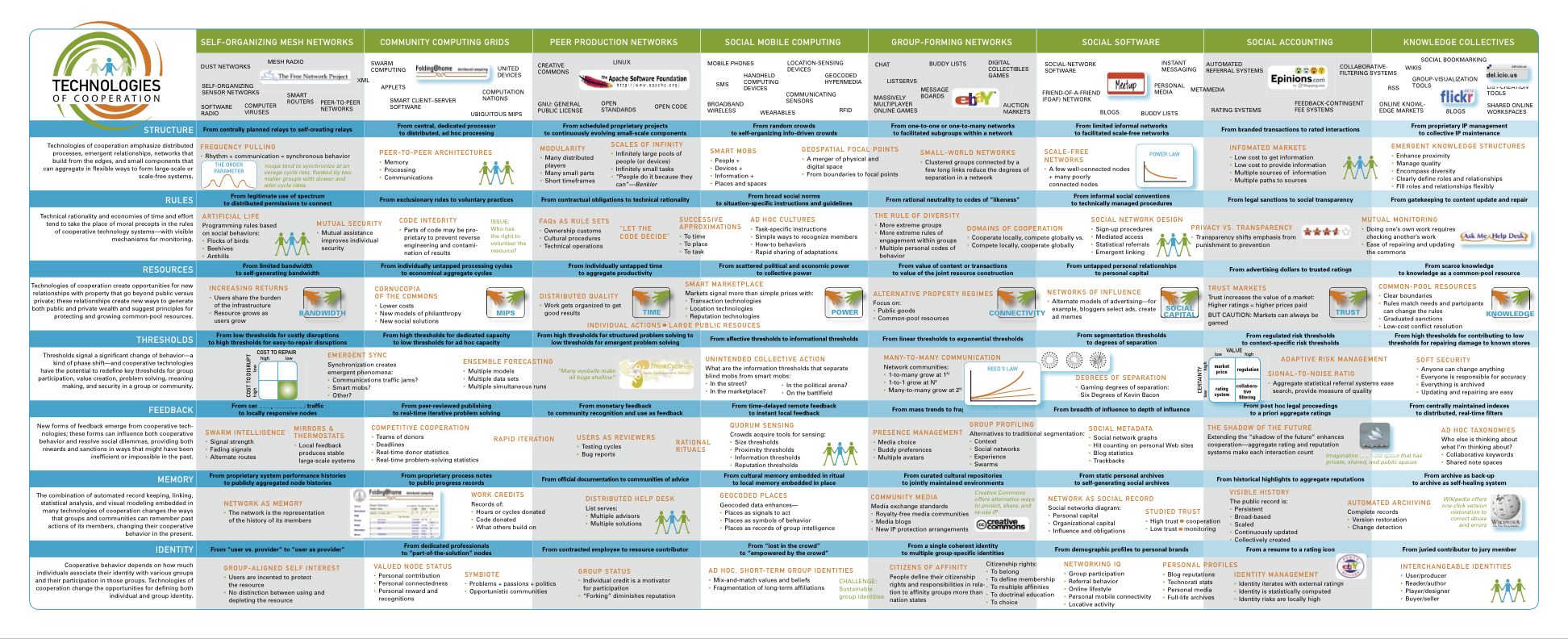
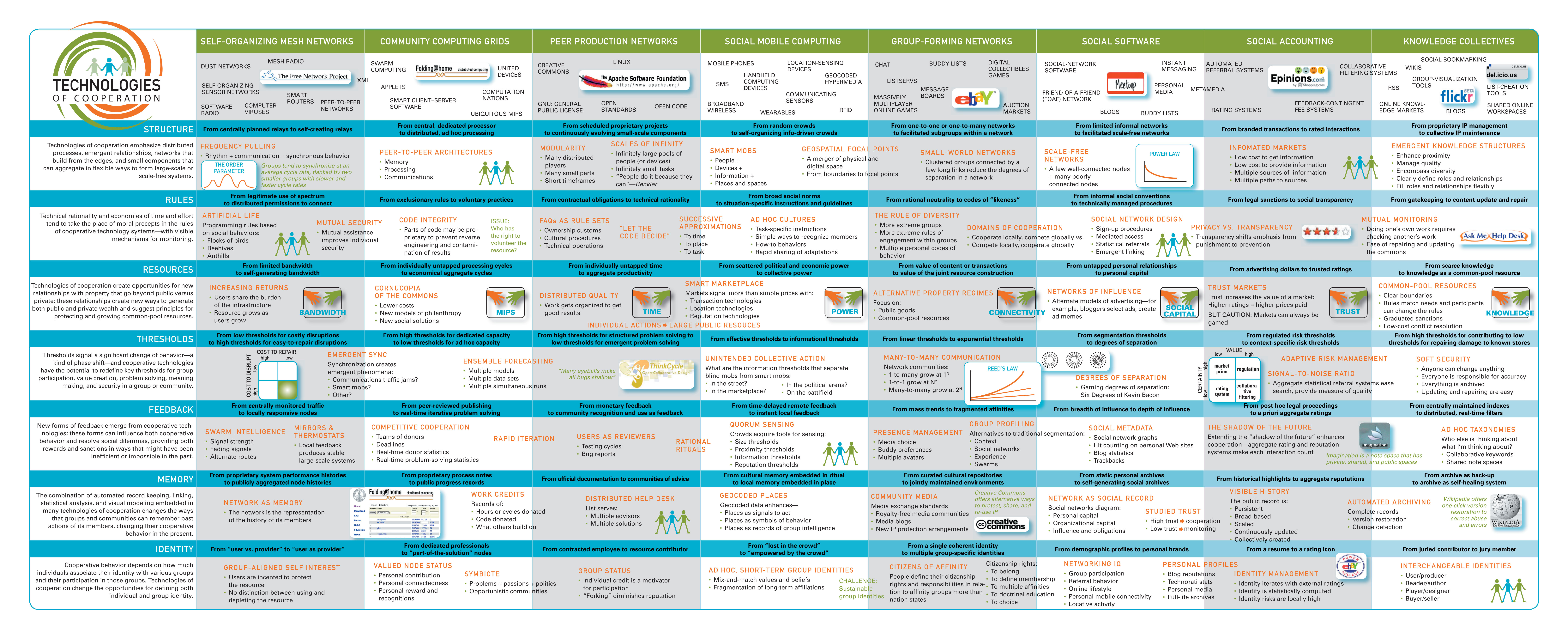
I’ve already referred this excellent document to two of my colleagues, so I guess that I’d better blog about it. Entitled Technologies of Cooperation, this paper from the Institute for the Future is available on Howard Reingold’s site as a PDF. A small or a large map is also available. The large map is great to read on your computer but a pain to print.
Technologies for Cooperation is a follow-up and a synthesis of a paper that I talked about last year, called Toward a New Literacy of Cooperation in Business. The recent document is worth a read for those immersed in Web 2.0 as well as anyone trying to get a handle on the two-way web and online communities.
What triggered me to read this report was the recent CCL e-learning workshop. I was reading the Executive Summary just as we were discussing how the CCL could facilitate the creation of communities. The strategic guidelines for the use of these coooperative technologies are covered in detail in the document:
- Shift focus from designing systems to providing platforms
- Engage the community in designing rules to match their culture, objectives, and tools; encourage peer contracts in place of coercive sanctions by distant authority when possible
- Learn how to recognize untapped or invisible resources
- Identify key thresholds for achieving “phase shifts” in behavior or performance
- Track and foster diverse and emergent feedback loops
- Look for ways to convert present knowledge into deep memory
- Support participatory identity
The information in this report is useful to anyone starting or trying to maintain some type of online community. It also shows that top-down approaches and constrained spaces with explicit rules will not foster cooperation. Cooperation is becoming important for all organisations, as the authors conclude, "competition and cooperation will likely become a pair of evolutionary strategies for organizations".
Canada Day 2005
Dominion Day is now called Canada Day – July 1st, the 138th anniversary of Confederation. I still prefer the old appellation, but life goes on.
Forty years ago we also got a new flag, the Maple Leaf, which replaced the red ensign (also the flag for the Canadian Army).
The flag debate in the Commons was rather heated and consensus seemed to be impossible. Many people were upset when the new maple leaf flag was adopted (similar to our recent same-sex marriage debate).
Today, there are few people who would deny the distinct nature of our flag. I wore it proudly as a soldier. Travellers sew them on their backbacks and it is recognised throughout the world.
Sometimes you have to do what is right. This is what Prime Minister Pearson and 162 other Members of Parliament did after forcing closure on the issue. The tyranny of the majority can prevent us from doing what is right. Luckily we have some visionaries from time to time who bring us the likes of universal health care and a distinct flag.
I’m proud to be Canadian, and I like our distinct Maple Leaf. Vive le Canada.
Now it’s time to start our vacation :-)
Canadian Council on Learning
The CCL had its first elearning workshop today, and I attended from the NRC-IIT video conference facility. The major problem was the technology – we couldn’t get a real conversation going as about 20% of the time we were fighting with the technology. I’m told that the main issue was that users did not know how to use the technology (an open source system, run mostly over the mega-bandwidth CA*Net).
I’m still formulating my thoughts on CCL. Here is what I know so far.
It has received $85M to establish five knowledge centres:
- Adult Learning in Atlantic Canada
- Early Childhood Learning in Quebec
- Work and Learning in Ontario
- Aboriginal Learning in the Prairies, Northwest Territories and Nunavut
- Health and Learning in British Columbia and Yukon
I don’t want to appear too cynical but my first impressions were – It’s a new organisation with a new pot of money, but the same players from other initiatives that have gone by the wayside, with the same issues and agendas as well as the same barriers. That being said, upon further discussion it became evident that CCL could play a pivotal role for learning. That role would be as an objective advocate (since the CCL is not a government agency) to advance good learning practices. Already, the CCL is advocating open source technologies and methodologies within the elearning sphere. This is a good thing, and will enable us to help developing countries and vice-versa.
On the other hand, I don’t see a sustainable business model with CCL. What will happen when the money runs out? I used to work for the Centre for Learning Technologies. We were 85% self-sufficient but it wasn’t enough for the university, so the CLT was closed after five years. How will the CCL continue when the $85M runs out? My experience with not-for-profits is that you have to work on the business model just as hard as you do with any other private sector start-up. I don’t see how the CCL will generate revenue after the initial funding is over. So my basic question is – Is this another flash in the pan?
Any comments here are greatly appreciated, since the CCL does not have a blog/wiki or other collaborative medium (yet).