Jury Duty 2006

Just received a summons for jury duty today. Not sure if I should be pleased to be doing my civic duty or perturbed that I’m going to be missing five days of work. I’m not a dentist, lawyer, veterinarian etc., so I’m not officially ineligible to serve as a juror. As a self-employed consultant, five days of lost productivity is significant. Maybe it’ll just mean working on my business at night, unless we’re sequestered in some motel where I’m not allowed Internet access. But then, as Admiral Nelson once said [which I had to memorise], “Duty is the great business of a sea-officer; all private considerations must give way to it, however painful it may be.” And it will be painful, as jurors are only compensated $40 per day of duty, less than a teenager flipping burgers.

The summons has raised some issues that I never really gave much time to consider. Why is a dentist ineligible to serve, when most people have a choice of dentists and one dentist being out of the office would not create significant harm to society? The same goes for doctors and veterinarians. I can understand a busy surgeon being exempt, but what about the family practitioner whose office is only open two or three days a week? I also consider my own work history. During my 21 years of active military service I was exempt from jury duty. Other than those periods when I was deployed, I could easily have taken off a week without degrading the operational capacity of the armed forces. There are many desk-bound military personnel who could do the same.

I’m wondering if our justice system needs to get out of the industrial era, “one size fits all”, approach to jury duty. Wouldn’t it make more sense not to provide blanket exemptions for professions, other than those in the justice system itself? I also feel that the $40 per day allowance is a visable indicator of how little our government values jury duty.

Training: A Solution Looking for a Problem

While listening to the radio the other day, the person being interviewed spoke about the need for training for those responsible for ensuring clean water in many remote Canadian communities. Now, I’m not going to say that training is not required, but making the leap from a performance issue (lack of skills, abilities, knowledge; lack of access to appropriate data and resources; etc) directly to training as the only solution, is the wrong approach and the most costly. As a taxpayer, I don’t want government to slap training band-aids on any problem that involves work performance. Some barriers to performance that are often overlooked when prescribing training include:

  • Unclear expectations (such as policies & guidelines);
  • Inadequate resources;
  • Unclear performance measures;
  • Rewards and consequences not directly linked to the desired performance.

In some cases, these barriers could be addressed and there would be no further requirement for training. Where there is a genuine lack of skills and knowledge, training may be required, but it should only be in cases where the other barriers to performance have been addressed. A trained worker, without the right resources and with unclear expectations, will still not perform up to the desired standard, and the drinking water supply may still be in danger.

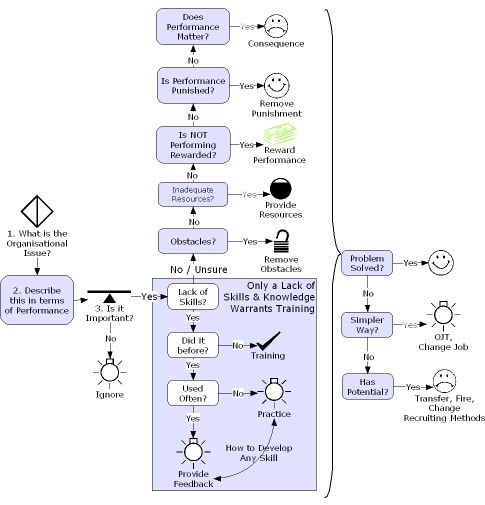
I have noticed that many large organisations have this tendency to slap on the training band-aid once any issue has been labelled a human performance issue. Training that is not directly related to performance wastes time, bores workers and costs money. Here is a general diagram of the high level process of performance analysis. These posts, and the diagrams, are Creative Commons licensed, so go ahead and use them. You might even save some money.

performance analysis process by Robert Mager

2nd Anniversary

Many bloggers reflected on what they had learned on the arrival of the new year. I’m doing it now because 1) I have some time as I sit in a Montreal hotel hoping that the freezing rain won’t cancel my flight home and 2) the second anniversary of this blog is on Sunday, the 19th, but I’d rather not turn on my computer this weekend, after two weeks away from home.

On reflection, I can confirm how powerful informal learning is becoming, in a ubiquitously connected & pervasively proximate, world. Many people are using their expanded networks to learn and collaborate. On the other side, there is still a large segment of the population trapped in hierarchial organisations where information, knowledge and decisions trickle through layers of filtration. I’ve also realised that the digital divide, or digital immigrants vs digital natives, is not generational, it is attitudinal. As a baby boomer, I thought that my generation was way behind younger generations. However, I have met many university-educated people, 20 years younger than me who don’t have a clue about the basic operations of computers and the Internet. Even school-age children don’t have basic information search capabilities, and many do not understand how to evaluate a source of information. We have a long way to go in becoming a society of autonomous knowledge workers.

On a positive note, I’m excited about being part of Education Bridges and I’ve seen some real progress in extending our research and education network at the Atlantic Wildlife Institute, where I volunteer as the Director of Education. These grassroots projects are stimulating, even though they don’t pay the bills.

I’m also finding that this year I have not had to go out and market my services. All of my projects to date have been referrals and I believe that this is partly due to my blog. I continue to promote blogging for free-agents, and those considering going out on their own, as the most effective marketing tool there is.

So I guess it’s one more year of interesting conversations for me …

Learning Technology Consulting

In the learning business there are plenty of enabling technologies. First, we had a few learning management systems, like WebCT, which were developed at academic institutions. There wasn’t much choice then, and most in the field were cheering these advances. Then we had the elearning bubble with hundreds of LMS, LCMS, CMS & VLE. Now we have personal learning environments (PLE) and eportfolios vying for the spotlight.

When I worked for a technology vendor I soon learned that it was more important to sell licenses than to enhance performance & learning. Licenses paid the bills. That’s why I still urge my clients to separate their technology provider from their learning services. You cannot serve two masters.

Is it the same situation with open source learning applications? If I develop a platform, will I offer independent advice, such as switching to another system? Once we get attached to our favourite system, or one that we helped to develop, then it may be hard to pack up and leave. However, being open to adopt new systems is in the client’s best interest. On one recent project we went through three major content management systems before settling on Elgg Learning Landscape, which didn’t even exist at the beginning of the project.

As much as I like Elgg, I have to keep on the lookout for other products that may meet my clients’ needs. I believe that in this constantly changing web environment, there is a need for third-party service providers who are technology neutral. There may be a temptation to affiliate with only a few select technologies, and perhaps earn a little extra cash, but that doesn’t serve the client. For instance, a new system can come along and give your client a quantum leap in performance. You have to stay current in your research in order to give the right advice for the current situation. Being technology neutral is the difference between a vendor and a consultant.

Rx for NB Learning

One of New Brunswick’s only learning technology development companies is in the process of being sold. Not sure if this is good or bad for the local industry. Ensemble Collaboration started up a few years ago and developed a collaboration platform for learning. The website is currently down, pending the sale.

I came to this province in 1995 and really became part of the industry in 1998. Since then we have had a few technology companies come and go. These are some of the ghosts of LMS past – Crescent Studio, IP Global, e-com and BKM. Today, the largest companies in the sector provide custom content development – Vitesse, PulseLearning and Innovatia. I think that there is a more sustainable business model on the services side of the industry, however I see these companies competing in a marketplace that is starting to view their services as commodities. I see more learning content companies competing by offering the lowest price per courseware development hour, or whatever other measure you wish to use. Because of this market tendency, companies need to grow their higher-end services in order to stay competitive. These are not evident in New Brunswick at this time.

As someone who has worked with many of the companies, academic institutions and government departments in the province, I’ll give my prognosis for this industry. First of all, there are only 740,000 people in New Brunswick and due to our size we will never grow any industry that is sustainable on its own. We definitely cannot do this without serious partnering or strategic alliances. However, we can capitalise on our small size by encouraging start-ups and sowing many seeds that will grow and survive, or even wither and die. It is through the act of creating new companies that we will improve our ability to create more. We need to develop a way to fail early and fail often. Failure in new business cannot be generally viewed as failure in business. Few entrepreneurs succeed on their first attempt. This Province has the resources, and connections, to create an environment that is friendly for start-ups, especially those that don’t require huge sums of money (e.g. Flickr before it sold to Yahoo).

This flies in the face of efforts to attract larger companies that can offer more jobs to local people. I believe that using the “job” as an economic indicator is a crucial flaw in our economic development policy. Instead, we should be helping to create many small, innovative companies. This will foster a more diverse economic foundation, where one failure will not bring down the entire industry. We have some learning expertise and we used to have some technology development capabilities. What we need now is a way to allow a thousand flowers to blossom. Some of these start-ups may even get purchased by larger corporations and move away, but their creation will be our secret sauce. I am suggesting moving from an indentured servitude model (the salaried employee) to an entrepreneurial model. This has its risks but it puts the means of production into the hands of more people (sounds socialist, doesn’t it?).

To enable this entrepreneurial renewal, without the need for huge amounts of venture capital, we must leverage open source software. Individuals and companies must get involved in the global communities created by open source. That is why I am concerned about the lack of technology companies. A viable learning industry also needs to be in control of its enabling technologies.

As I said, our advantage is our size. It’s easy to contact someone in government here. For instance, the Province has a unique regulation for the creation of online universities. To be a fertile ground for innovation, we need more of this type of unique legislation; not more subsidies or government sponsored trade missions.

So here are some concrete recommendations for my colleagues in this industry. First, get involved in the global community. Personally, I champion Elgg Learning Landscape, Moodle and ATutor. I am involved with the Education Bridges project, initiated by Dave Cormier on PEI. Through blogging, I am also speaking with others around the world. This can yield some interesting connections. For example, Indian companies may be looking for partnerships or involvement in other communities, as mentioned recently on the Learned Man blog. I would be keen to see a webcast of our LearnNB activities done in cooperation with some Indian companies. I’m sure that we have much to learn from each other.

Basically, we can’t focus on this Province alone and we need to use our small size to our advantage. If we stay small, we remain nimble. In a flat world, that may be the right prescription.
Why AdSense makes NoSense (for me)

I’ve toyed with the idea of advertising on this site, as it might pay my hosting costs, but Guy Kawasaki’s Total BS (Blog Statistics) post has set me straight. For instance, Guy’s blog is ranked #289 on Technorati while mine is #43,064. His site has about 100 times more visitors than I do (well-deserved I might add).
So what is the main lesson for me? It’s that Guy earns an average of $9.85 a day with Google’s AdSense. Were I to use AdSense, I could possibly make a few pennies a day. This is definitely not worth the effort and potential scorn of the few readers that I have.

Individual and Company Blogs

I recently received an invite from Ankush Gupta, who has the Learned Man! blog, to look at the company blog of Tata Interactive Systems. I’ve read Ankush’s blog on and off for a while and found that he provides some solid commentary on elearning, so I checked out the Tata Blog. It’s a multi-user effort with posts so far from the CEO and various instructional design consultants. The review of Allison Rossett’s First Things Fast is worth a read, as this is an excellent handbook for performance improvement.
It will be interesting to see how this corporate, multi-user blog evolves over time. One successful multi-user blog, though not from a single company, is the Learning Circuits Blog. Whether a company blog can have the same depth of conversation remains to be seen. So far, I like the initial posts on the Tata Systems blog, especially on their work for learning disabilities and participation in the Mumbai marathon.
A different approach to company blogging is SilverOrange, a web-systems company on Prince Edward Island. There are no direct links from the company website, but the individual bloggers proudly link back to their company. SilverOrange bloggers include Dan James, Daniel Burka and Steven Garrity.
Here are two approaches to blogging and work. In one the blogger is part of a corporate blog while in another the blogger is an individual who happens to work (or own) a company. The use of blogs is evolving over time and there may be a day when a company blog is identified (by the majority) as a separate entity from an individual blog. Does it matter? I think that the level of comments and interaction, especially when controversial subjects arise, will show if there is a difference. Dan James has even stated that "Companies don’t blog, people do".
My interest in all of this is how this medium is being used and what its effects will be. Will blogs become the equivalent of the e-mail scourge of the next decade? Will employees be forced to blog on the company site? These are the early days of blogging for the mainstream and it’s still fun to watch the field change and read new blogs.

Montreal during a Winter Election Campaign

Currently sitting in downtown Montreal on a client project. Typical consulting gig – fly in; check into the hotel; spend a long day in a meeting room; repeat; fly out. I happened to be in the same hotel as the Liberal Party of Canada (the French leaders’ debate was last night) so there was more traffic than usual for a week day in January. Speaking of political campaigns (and I try not to) Rob Wall has an interesting post on a candidate who really blogs.
Perhaps during the next election the two-way web will be the norm and TV/Radio will be ignored. For myself, I’ve ignored the mass media and have read a few blog posts, including this one from Dave Pollard. I see elections like final exams; you have to do your homework prior to the end of the coursework, not during the pressure of exams.

World is Flat – Streaming Video

I just listened to Thomas Friedman’s presentation at MIT which is available online as a streaming video. It’s over an hour long and covers the first three chapters of his book, The World is Flat, which I have previously mentioned. Having read the book, I’d recommend the video as a good overview (including some of the same stories) and then you can decide whether you want more information and purchase the book. Friedman is quite entertaining in this lecture and you can tell that he’s been on the speaking circuit for a while.

Local paper reports on blogging

I was interviewed this week by a reporter from the Telegraph-Journal, one of our provincial papers. The article, "Small business picks up on blogging", appeared in today’s Business Section and included a reference from Mark Federman of the McLuhan Institute. The article offered no new information for bloggers but it’s heartening to see some good press on blogging for business. Beats all those guys in pyjamas jokes [BTW, my PJ’s are blue]. As the journalist, Nina Chiarelli notes:

Web logs can be valuable as a firm’s "human face"

All in all a positive article but it could have been enhanced with some URL’s so that readers could further delve into the subject online. Hyper-linking to references is one of the key enhancements that blogs offer as a medium. Some other small business blogs, not mentioned in the article, can be found here.