Revolutionary Wealth – Review

The Toffler’s continue their series of books on the rise of the Third Wave, or knowledge economy, with Revolutionary Wealth. As with several of their other books, this one looks at the larger and deeper patterns affecting our economies and societies as certain parts of the world make the transition from the second wave (industrial) economic structure. The three deep fundamentals that most economists do not examine are said to be – time, space and knowledge. Changes in each of these are having profound effects on us. Even more so, we are seeing conflicts between first wave (agrarian) societies with second and third wave ones. In many countries, all three co-exist and tensions occur as each has fundamentally different values, priorities and institutional needs.

I thoroughly enjoyed this book which is bound to expand anyone’s perspectives on the state of the world. It is neither pessimistic nor optimistic. The discussions on energy use are a refreshing change from much of the hyperbole in the media and the few references to education are clear and succinct. “The coming clash will set defenders of our existing educational factories against a growing movement committed to replacing them – a movement comprising four key elements … Teachers …  Parents … Students …  Business.”

Probably the best audience for this book would be our politicians and corporate leaders, as it provides a good overview of the “big picture”, which is missed by many in these two groups.

Other books I would recommend.

Confusing Means and Ends

Ends are what you are trying to achieve while means are how you get there. Sometimes these get confused. For example, these are means:

  • Process Improvement
  • Education & Training
  • Compensation
  • Technology
  • Quality

So anyone pushing training (including e-learning) is selling a means to an end. First, you have to know what ends you’re trying to achieve. Ends can be 1) outcomes, 2) outputs or 3) performance. Training can help improve performance, but before you put on your instructional designer hat and get down to creating stuff, you need to align the means with the ends. That’s where performance analysis comes in.

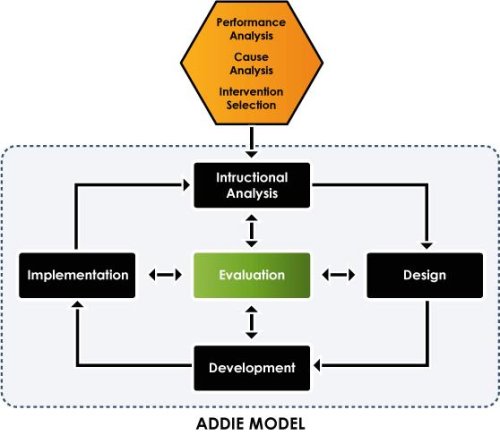
If you subscribe to the ADDIE process, or some variant of it, you still have to get to the point of establishing (or confirming)  the ends that you are trying to achieve. For training development shops, the model should look something like this:

first-base.jpg

And so “ends” my series over the past couple of weeks on performance improvement (for now).

Adding performance support to the trainer’s toolbox

The way that people work in any organisation is influenced by several factors. When I conduct a performance analysis I look at factors such as expectations, capacity, incentives, feedback, tools and skills.

If you put a group of people in a room and ask them to describe a performance problem at work and then to classify these, you will find that about 15% are due to a lack of skills & knowledge. I’ve seen this on several occasions and my own experience with workplace performance analysis bears it out as well.

Training is an effective instrument to address a lack of skills and knowledge, but not any other performance factors. That means that at best, training helps with less than 1/5 of an organisation’s human performance issues. On the other hand, performance support tools can be used to address a lack of information resources. By just adding performance support (non-instructional interventions) to a training designer’s toolbox, you are likely doubling your value to your organisation or your clients.

My own performance toolbox is a start to learn more, and here are some basic reference books I’ve used over the years:

DIF Analysis

Previously, I had mentioned DIF (difficulty, importance, frequency) Analysis as a tool that I used in the military to determine if job tasks required training. I finally got around to creating the expanded model in a digital format, so here it is.

expanded-dif.jpg

In making these tools available online some people ask if I’m giving away some secrets to the trade. I don’t think so, because these are pretty basic tools which I’ve been using for over a decade and many others use as well. Also, the world of work is getting to a point where performance improvement may not be the best approach. In knowledge-intensive workplaces, procedures and tasks can’t be easily quantified. Tools like DIF analysis only work when there are similar jobs done by several people. They won’t help in a creative work environment like a design shop.

My own interest is to develop new tools and methods, beyond human performance technology and instructional design. Methods like online personal knowledge mastery are of current interest.

In Canada, salaried work is a mug’s game

If you ever needed a reason to work on your own and join the growing ranks of the self-employed, a recent report by the Canadian Centre for Policy Alternatives may give you a clear financial reason. According to the Financial Post (not exactly a socialist paper):

The prolonged period of economic prosperity that Canada has enjoyed resulted in a 72-per-cent increase in economic output between 1975 and 2005, growth that has continued since, it [CCPA] noted.

The benefits of the growth, however, have not been reflected in workers’ paycheques, it added. “Canadians’ average real wages, which are wages adjusted for inflation, have not increased in more than 30 years.”

Corporations have had continuous profits while workers have seen none of it. Trickle down economics doesn’t work. One of the few options for individual workers is to establish a new work contract. However, unions are losing influence and collective bargaining hasn’t done much for workers’ wages.

It’s getting easier for individuals to connect with social applications like Facebook and we are also seeing tools like Linked-In for business. The tools for individual workers to connect and collaborate are now available, though we don’t have the culture or mindset to fully embrace them yet.

Given that corporate profits have been made at the expense of the labour force, free-agentry should be looking  like a better option for a lot of people. Places like work commons can support this shift but other models are necessary. For example, we have a green builders’ cooperative here in town. More flexible taxes could also help new micro-businesses, but first we’ll have to educate the politicians. The data from the CCPA are a start.

Job Aids & Performance Support

I’m currently working on a project that requires me to get back to some performance and training analysis. Of course, my initial outlook is that training can often be a problem looking for a solution.

I had to review the basics and decided to read Rossett & Schaffer’s, Job Aids & Performance Support. This is a good introduction to performance support, and more up to date than Gery’s classic EPSS. The section on when performance support is appropriate is a good reminder for everyone in our field:

  • When performance is infrequent
  • When the situation is complex
  • When the consequence of errors is intolerable
  • When performance depends on a large body of information
  • When performance is dependent on knowledge or information that changes frequently
  • When performance can be improved through self-assessment
  • When there is a high turnover rate
  • When there is little time or money for training

Sound like any workplace you know?

There is an excellent sidebar in the book by Marc Rosenberg, author of Beyond e-Learning:

This is our challenge when we blend interventions to solve performance problems. We must recognize that relying solely on blending instructional solutions is not always the best way to meet the economic worth test for long-term, sustainable and valued performance improvement. Including performance support in the mix lowers overall investment, reduces time to competence, and makes the solution more durable over time …

I’m still amazed that performance support is not seen as a standard intervention for all training and learning organisations. The data are there; it works.

Learning 2.0 value chain

I made my comments last week about R/WW’s All you need to know about e-learning 2.0, and the discussion has been picked up by several people in our community, most notably Tony Karrer. A recent comment on R/WW , #24, by Hank Horkoff of ChinesePod, is perhaps the most insightful on the real effects of “2.0”:

First, I want to second Tony’s assertion that the changes in learning are paralleling the impact of Web 2.0 on mass media. This fundamental shift, re-constructing the value chain around the needs of the end user/student, rather than the needs of producers of content or educational institutions, will reverberate through the learning industry for decades to come. I just wonder why the label isn’t a little more ‘digital native-esque’ as simply Learning 2.0.

Second, with ChinesePod we have been able to build a business model around a three-point strategy that provides a more integrated learning experience for students. One, provide an attraction (free daily podcast lessons, in our case) to compensate students for their attention. Two, facilitate community involvement through use of a variety of software tools and active human participation to build out a community of practice. Three, continually experiment with a number of paid services to generate the revenue necessary to sustain the service many years into the future. Even though Chinese-training for English-speaking markets is only a ‘small niche business’ in Richard’s words, ChinesePod will do more than a million dollars in revenue this year.

ChinesePod gets it right by understanding the user/learner. This three step model is one that any Web learning business should critically examine, so let me reiterate:

  1. Reward attention, because it’s everything on the Web
  2. Community (not content) is king
  3. Keep tweaking the business model

What do you want people to do?

I’ve been looking at some training documentation and it seems that when we get into complicated (not complex) cases of lots of stuff to examine, we miss the forest for the trees. Dave sums it all up quite nicely:

Even if the client’s model of training involves only lectures and PowerPoint, “What do you want people to do?” shifts the focus to the reason they’re on the job – the results they’re supposed to accomplish. (If the client focuses only on how they perform, you can ask about the results they produce – whatever’s left over when the workers go home.)

There are lots of tools to help see the forest in my toolbox.

Higher Education Funding & Economic Productivity – Negative Correlation

Stephen noted this study on Higher Education Facts and Fiction by Prof. Richard Vedder, distinguished professor of economics at Ohio University. Inside Higher Ed provides an overview of the report and some of the controversy around statements that higher education may not be such a boon to the economy:

Looking at all 50 states over more than 20 years and using at least 1,000 data points, the study found that more state funding to higher education doesn’t necessarily lead to higher growth, and in fact correlates negatively with high growth rates. Building on previous research – which Vedder has done over the years on the topic – the study operates under the theory that students will take some time between the years they enroll and the moment they contribute fully to the economic growth of society. The study looks at three intervals – 5, 10 and 15 years – between the “input” of state funding levels in a particular year and the economic output that comes as a result of students’ education and development later on in life. And instead of finding the kind of positive correlation between increases in state funds and economic impact that colleges like to talk about, he found the opposite.

Higher education is not the engine of economic growth as some would have us believe. For instance, Canadians have the highest rates of formal education in the world, but most studies do not show us as the most productive.  Many more Canadians feel that a university education is not necessary to succeed at work than those who do.

Universities may not be the best organisations for us to entrust our economic future. Here’s Chris Sessum’s view of the ivory tower:

The more I think about it, the more I come to see universities as the last place to change what they do. Academics are mostly a reactionary, turf-protective bunch that really don’t like change. When I give talks and demonstrations to colleagues in higher education re: the power of the Read/Write Web, I often feel like Plato’s allegorical friend who shows others that they are looking at shadows on the cave wall and not what’s really going on outside. They laugh and tut-tut and a few approach me when no one is looking (usually via email) and ask if I could come over and show them more in the privacy of their office or home.

The Industry that Could

New Brunswick, in the great scheme of things, is a small player on the world stage. There are only 740,000 of us, split up in three urban centres and many rural areas. For the most part, this province, established in 1785, has produced hewers of wood and drawers of water.  Forestry and fishing are still big.

But back in the mid-1990’s NB was re-branded as “the” place for the new information highway and especially for online learning. Dozens of companies sprang up and several more from out of province set up shop here.  However, the subsequent dot com bomb saw many companies close shop. A few chugged along, especially in Fredericton.

Last night I attended the opening of Bluedrop Performance Learning’s  Fredericton office. What caught my attention was that Bluedrop (head office in St. John’s, NL) had not really intended to open another branch office. Bluedrop was looking for a couple of people for the St. John’s office and just happened to be in Fredericton at the time of Provinent’s bankruptcy protection filing and office closure. As a result, many experienced people were looking for work. Bluedrop seized the opportunity and hired an additional 7 employees (all from Provinent) and found office space in Fredericton. The company says that they plan more controlled growth.

The NB learning industry now has a certain competitive advantage in this business. Where else can you find a significant number of instructional designers with over 10 years experience? Ten years ago, many of the people in attendance last night were employed by a different company. Several, myself included, have changed employers more than once. These people, with different business cards, have remained and grown an industry. This was a different crowd from the large NB contingent that attended OnlineLearning 1998 in Los Angeles. These were seasoned, experienced and maybe even battle-scarred professionals.

The core group that remains in this field is doing some pretty amazing stuff. For instance, the team from Red Hot Learning was also there, following the successful launch of a unique online game, The Redistricting Game. RHL headed the programming and development in collaboration with USC’s Interactive Media Division. This is a fine example of using gaming theory and technology to create a tool that can explain the complexities of drawing electoral boundaries in the US. As the opening video says, “When I, as a mapmaker, have more of an impact on an election than the voters – the system is out of whack.” Try it out, it’s free.

Serious games, serious people, serious business. This is what’s happening in New Brunswick today. [I’m also supposed to get some pictures of the serious party, too, which I’ll post here.]