NB advanced learning technologies sector

If you read the Telegraph-Journal you’ll find my comments in today’s story, Technology solution must be industry led:

Harold Jarche … who has long worked in the sector, authored two previous reports for government on advanced learning technologies and now consults largely outside New Brunswick, took issue with that suggestion.

“What we really need is start-ups,” Jarche said, pointing to industry’s close connection with several government funding institutions.

“We should be planting lots and lots of seeds,” Jarche said.

“Waiting for some saviour to come in and give us jobs, I think that’s the wrong focus.”

Back in 2004 I suggested more of a focus on European markets in Going Euro:

There is some focus on the European market but this is miniscule compared to our single-minded fixation with that marketplace to our South. I’m not saying that we should avoid US markets, but that we are not taking advantage of our “middle power” position.

In 2005 I recommended that we focus less on large companies and more on individuals to grow Our local learning industry:

I believe that the sustainability of the regional industry will depend on the knowledge workers and entrepreneurs who remain here to weather the next economic downturn. This could be difficult without a larger and more diverse group of small and nimble companies, developed during the good years.

My quotes in the Telegraph-Journal article are pretty close to what I said but I wrote a longer observation on the NB Learning Industry last November, with this conclusion:

Finally, I think that a non-profit chaordic organisation (PDF), as recommended by Rob Paterson on the Fast Forward Blog, might be a better structure than the some of the models tried already. I hope that the asset map that is being developed will be published and that it will be made freely available for open discussion and even for remix.

In this report, of which I have only read what is available in the executive summary, the call centre industry has been lumped in with learning technologies, which is a bit of a stretch. Therefore, this is not the same industry that I examined in 1999 and 2004, but some of the same problem areas are cited – R&D and effective marketing. In addition, there is a recommendation for a – leader or ‘champion’ – to represent the industry. I would suggest that there is already a group of people in this province who have been having serious conversations about industry and/or learning technologies for several years. They include:

Stephen Downes

David Campbell

Jacques Cool

John Gunn at MonctonITA

Jeff Roach at PropelICT

Please add more in the comments

Maybe it’s time the C-suites visited the e-suites and joined in the conversation.

Twitter potpourri

I’m still figuring out how best to integrate Twitter to my personal knowledge management processes. I post some things I find directly to Delicious and others I mark as favourites. Here are some of my recent favourites, a follow-on from a related post last month [I’ve added some letters and words to make it more coherent]:

@davecormier RT @arvind: @davecormier Hard core social network research: danah boyd

@c4lptnews Leveraging Human Networks to accelerate learning | CLO magazine

How to opt out of cookie sniffing and trading – painless – via Seth Godin

Shai Agassi: A bold plan for mass adoption of electric cars (TED) Inspiring, Hopeful, Fantastic!

The movement from a public service that is opaque by 21st Century standards to one that is transparent is going to be gut-wrenching – David Eaves

RCMP and Vatican: The downfall of the hierarchical and opaque organization – David Eaves

Via @neternity Try 2-3 low-cost approaches instead of one big (expensive) project – that way you can afford to fail #learntrends

Via @neternity The biggest cultural change was breaking down organizational walls. This is an emerging “wirearchy” says @jonhusband #learntrends

@KathySierra Cut a few prime-time ads, use the money to hire fabulous usability & instructional design team to craft/implement a spectacular user learning “strategy”.

Composing Twitter messages using only brainwaves #learntrends – The Future?

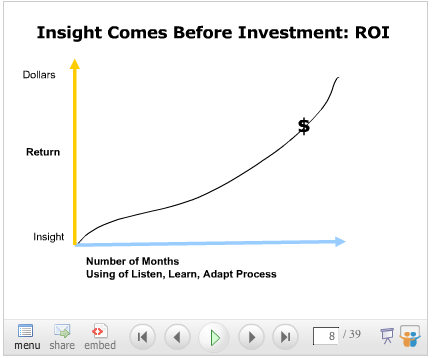
On calculating ROI for human activities (economics, learning, marketing, etc.)  from a Nobel laureate

@nickcharney 17 Things we Used to Do (before Twitter): Andrew McAfee

Learning products

Heike Philp recently made this comment in response to Media & Messages:

What I am sorely missing right now are ‘learning products’. To me a product has product specifications (specs) just as much as a computer has a list of specs or software has a list of features.

The fascination of Pecha Kucha for me is, that this simple idea could be patented and that it is a ‘product’, it has specs, the specs are ‘20 slides auto advancing 20 sec’.

In the light of lots of IM software out there, a Tweet is a ‘product’ because it has 140 characters.

So, where right now in the vast ocean of fuzzy connectivism and informal learning experiences are the products?

We are always talking about tools. Is this because these seem to be “the products” out there right now?

I use my personal knowledge mastery (PKM) process for some of my own sense-making, involving several internally (sort, categorize, make explicit, retrieve) and externally (connect, exchange, contribute) focused activities:

Here’s a first look at some of the learning “products” that can be created:

Sort & Categorize: lists; taxonomies; topic maps; mind maps

Make Explicit: constrained note-taking; written observations; graphical representations; audio recordings; video recordings

Retrieve: problem-solving; pattern-sensing

Each of these can be made more explicit; such as creating specific lists for a project. The resulting products can all be aggregated as part of a personal learning environment.

Individuals can also Connect – Exchange – Contribute with others through their learning “products”. For example:

  • Bookmarks (and any comments or tags) become a way of connecting to other lists & topics when they are put on the Web and made social.
  • Moving from reading and viewing content to making comments is a way of exchanging information, instead of just consuming it.
  • Developing new ideas and posting these on the Web as blog posts, slide shows, or recordings contributes to the ongoing conversation that may become part of a field of interest or even a discipline.

Looking at this from the perspective of a learning professional, I would suggest combining the use of tools with an understanding of the higher processes shown in the diagram above. That means that you don’t really have to decide upon particular tools and can leave that to individual preferences. For instance, if you want to use blogs for teaching, you can specify the “learning products” you are looking for, but it does not matter what blog platforms are used. I can see a large number and wide variety of learning products that can be developed around these PKM processes.

Emergent practices need practice

“I think that one of the larger problems of our time, is that we we don’t even know how to think about many of today’s problems. We think that our reason or our effort will be enough to solve them. When in fact, these problems are of a different nature to the ones that we used to have. They are different because, we are so much more interconnected today that there can be no simple cause and effect.”

From Why we are lost? – How we can find ourselves, Rob Paterson explains the Cynefin framework, with a link to a concise explanatory video from Anecdote,  and goes on to show the problem in our workplaces:

“In short — some problems are Simple and are subject to simple cause and effect. I do this and that always happens. Some problems are Complicated and I need to know a lot to find the answer, say design a jet engine or put on a TV show, but once I have the body of knowledge again results are going to be there. The laws of Newtonian Physics apply.”

But many of the problems we face today are COMPLEX, and methods to solve simple and complicated problems will not work with complex ones. One of the ways we addressed simple & complicated problems was through training. Training works well when you have clear and measurable objectives. However, there are no clear objectives with complex problems. Learning as we probe the problem, we gain insight and our practices are emergent (emerging from our interaction with the changing environment and the problem). Training looks backwards, at what worked in the past (good & best practices), and creates a controlled environment to develop knowledge and skills.

To deal with increasing complexity, organizations need to support emergent work practices, in addition to their training efforts. They must support collaboration, communication, synthesis, pattern recognition and creative tension, all within a trusting environment in order to be effective. One method of supporting emergent work is the fostering of communities of practice (CoP).

I read today that communication does not equal collaboration, and that is a challenge in “building” communities of practice. Just because the communication tools are in place does not mean that people will automatically collaborate.  You can’t really build a CoP, it has to emerge through practice, but you can put in systems and processes to support CoP’s.  As I learned this week — you know you’re in a real community of practice when it changes your practice.

So if you wonder what all the hype over web social media is about, in my mind it’s the potential to support emergent work practices. Twitter, blogs, wikis and social networks are tools for communities of practice. They can be used effectively or not. How these tools get used is itself an emergent practice, but if you don’t practice, nothing will emerge.

Media and Messages

To paraphrase Marshall McLuhan, every message has its medium and every medium has its message. That sums up my impression of our LearnTrends web conference which finished yesterday. Selecting the appropriate messages and media is becoming an essential part of facilitating learning. The other component is building or connecting to networks, social or otherwise. The major trend in workplace learning that I see is the merging of Learning & Working. The main driver is our ubiquitous access to networks. Our global 24 hour conversation was in fact a global village, still composed mostly of innovators and early adopters, but the tip of a connected iceberg.

Personally, I enjoyed the sessions but of course this medium is only good for a certain type of interaction. It could not be all things to all people. For instance, there were several media involved:

Synchronous Sessions (Elluminate) – good to get acquainted, hear some new ideas and feel like part of a larger movement. The text chat enables more people to have input without interrupting the current speaker, but it can get off topic. The session by Heike Philp on Pecha Kucha showed another way to make this medium more interesting, and fun, by adding constraints for the presenters.

Twitter – gets the word out about upcoming sessions and allows wider publishing of impressions. Using Twitterfall, or search, one can see the collected observations from many people and from this see some patterns. These are some of my observations I passed on via Twitter:

“I knew I was in a community of practice when my practice had changed,” heard in a discussion.

“If you shut down the training department, would it be missed?” a general question

“Try 2-3 low-cost approaches instead of one big (expensive) project- that way you can afford to fail,” from a presenter.

“Twitter is for surfing an ocean of information, not trying to understand fluid dynamics,” my own observation.

Blogs – like this post, blogs provide a more permanent record of what happened and more thought-out individual impressions, plus the option to connect or comment.

Social Networks – the LearnTrends community site provides a place to add a profile which is a handy way to put a face to a name. The main limitation of using Ning is the lack of wiki, and obvious weakness when  creating a schedule on the fly with people in multiple time zones.

I’ve been attending, presenting and coordinating web conferences for over a decade now and each time I learn, or re-learn something. Whenever I go live on the Web I also realize that this active learning is necessary to really understand the medium. Looking back and observing is not enough to understand how networked learning can be facilitated. We learn through our practice.

Conversations about learning in organizations

We’re nine hours into our global (free) 24-hour online conversation about learning in the workplace. Ross Button is currently giving a great presentation on CGI: Bringing the internet inside for informal learning & transformation. He’s discussing all the details of bringing social software into a large multinational organization covering the social, data and technology dimensions. Ross suggests that when initiating these kinds of initiatives, it’s better to try 2 to 3 low-cost approaches instead of one big and expensive project. In this way you can afford to fail a few times. He also says that the biggest cultural change was breaking down departmental and organizational walls because social software ignores the chain of command. Jon Husband commented that this is an emerging wirearchy. Finally, Ross says that these kinds of projects take time, support and patience.

We started this morning (Pacific Time) with a good mix of people, though mostly from North America, and we have been averaging about 100 participants at any time.

There have been a lot of great conversations so far and more scheduled for the next +12 hours.

Marketing for Consultants

In the article So You Want to Be an E-learning Consultant… I discussed the pros and cons of consultancy as well as the various areas of practice in our field. One area I did not discuss was attracting and retaining clients. As the saying goes, when you’re working, you’re not finding new clients and when you’re looking for clients, you’re not working. I decided to look at a number (32) of my past projects and see how my clients had come to find me. I broke this down into three main categories, with the number of projects shown in brackets:

  1. Direct reference (20) from a member of my business community, defined as someone I know or have met or may have worked for or with previously. This includes follow-on projects.
  2. Indirect reference (9) through one of my professional networks, also known in social media as a “friend of a friend”.
  3. Client found me on the Web (3) via some form of search.

Obviously my closest connections are my best sources of client referrals. I haven’t calculated the revenues from all of these projects but I can say that the third category, while only three projects, generated a significant amount, so passive Web marketing should not be discounted.

ASTD: Blowing Up the Training Department

Join most of the togetherLearn gang on ASTD’s Pulse of the Profession Webcast:

Blowing Up the Training Department: Make Learning a Management Priority

Are training departments REALLY necessary? Leveraging social networking, informal learning and e-learning are just a few ways to manage learning/training in the 21st Century. The real message–traditional courses are not the best way to link learning with the business or to engage learners.  When will we GET it?

Panelists: Clark Quinn, Jay Cross, and Harold Jarche Moderator: Kevin Wheeler

April 22, 2009, 2:00 P.M.-3:15 P.M. ET

Register here. Member/Non-Member $39.95 (all proceeds support ASTD)

Global 24-hour Workplace Learning Conversation

For 24 hours starting April 21 at 9:00 am Pacific time, LearnTrends will host a series of online conversations on boosting the performance of organizations through learning. We expect hundreds of people to attend the free, live, online sessions. Conversations will be recorded and made available on the web to foster reflection and continuing discussion. Our Twitter back channel will probably be hopping. The LearnTrends community now numbers more than a thousand members around the globe. Sign up if you are not a member to keep track of what’s going on.

Lots of people have signed on for this event and I’m sure that a good part of the +1,000 members of the LearnTrends community will drop in for some part of this 24 hour online conversation that is available to anyone interested in workplace learning.

Please note that the content is also what you bring to the party. We have some set topics to start and finish. In the interim, if you have some discovery you’d like to spotlight, bring it up in conversation. You can pick a spot on the agenda, click “suggest a topic,” and tell us what and when; we’ll put it on the schedule. Alternatively, you can simply check in during the event and request the microphone.

Effective knowledge sharing

The mainstream application of knowledge management, and I would include learning management, over the past few decades has got it all wrong. We have over-managed information because it’s easy and we’re still enamoured with information technology. However, the ubiquitous information surround may put a stop to this. As enterprises become more closely tied to the Web, the principle of “small pieces loosely joined” is permeating our industrial walls. More and more workers have their own sources of information and knowledge.

Following on from yesterday’s post, connecting and communicating through effective conversations, I’d like to quote again from Dave Pollard’s experience with knowledge management:

So my conclusion this time around was that the centralized stuff we spent so much time and money maintaining was simply not very useful to most practitioners. The practitioners I talked to about PPI [Personal Productivity Improvement] said they would love to participate in PPI coaching, provided it was focused on the content on their own desktops and hard drives, and not the stuff in the central repositories.

We can add to Dave’s anecdotal evidence the research from  Wharton’s Haas & Hansen in Does Knowledge Sharing Deliver?, via Tony Karrer. The researchers found that the two types of organizational knowledge – codified in a knowledge base and interpersonal sharing – are appropriate to different tasks. Generally speaking, codified knowledge does not help teams to produce any better unless the team is rather inexperienced. Interpersonal sharing can be more effective for some teams but it is time-consuming. According to Haas:

“We find that using codified knowledge in the form of electronic documents saved time during the task, but did not improve work quality or signal competence to clients, whereas in contrast, sharing personal advice improved work quality and signaled competence, but did not save time,” Haas says. “This is interesting because managers often believe that capturing and sharing knowledge via document databases can substitute for getting personal advice, and that sharing advice through personal networks can save time. But our findings dispute the claim that different types of knowledge are substitutes for each other. Instead, we show that appropriately matching the type of knowledge used to the requirements of the task at hand — quality, signaling or speed — is critical if a firm’s knowledge capabilities are to translate into improved performance of its projects.”

The inability of expensive enterprise knowledge management systems to deliver broad results is similar to the 80-20 funding ratio between formal and informal learning. We’ve been putting too much money in the wrong place.

A way forward for KM and Informal Learning 2.0

We should move away from central digital information repositories (KM, Doc Mgt, LCMS, etc.). I’m not advocating tearing down any existing IT infrastructure; just enabling a parallel system, which may exist already, to grow. Some suggestions:

  • Develop measures that can help experienced knowledge workers capture and make sense of their knowledge.
  • Support the sharing of information and expertise between knowledge workers, on their terms, using personalized knowledge management methods & tools.
  • Keep only essential information, and what is necessary for inexperienced workers, in the organizational knowledge base – keep it simple.