Performance, training, education and learning

Updated 31 May

This thread starts with a presentation by Clark Quinn, which includes an examination of what he calls ePerformance tools. I think Clark’s work adds some clarification to the field and I agree with the intent to move away from the all-encompassing “learning” word, which is overused and misused.

Tony Karrer picks up on the ePerformance theme and notes:

I like the way he [Clark] stepped through the transition from thinking in terms of courses to thinking about broader uses of technology to support performance. His terminology around elements of what goes into ePerformance is a bit different than what I discussed in the learning circuits articles. The concepts are fairly similar.

This is followed by Stephen Downes take on the subject:

The main benefit of a term like ‘ePerformance’ for employers, I would say, is that there is no chance that learners will think that there is any intrinsic value to themselves in the transaction. Because if they did, then they would want to own the process, which is totally not what corporate e-learning is about.

I disagree with Stephen because a move toward performance and away from learning as the main objective of organisational interventions is much clearer. Performance is measurable, whereas learning is much fuzzier. organisations may say that they promote a learning culture, but all they really do is offer training. Sticking to performance also keeps the organisations out of the learning area

A performance-oriented intervention is focused on some type of desired performance that is made clear to both the organisation and the worker. The organisation wants stuff done and wants to be able to measure it. The worker wants to be able to show that it has been done and in return there is a financial transaction.

A focus on performance does not preclude organisation-sponsored learning activities. Many learning activities are obviously beneficial to the organisation, but usually not in an obvious and direct manner. Of course individual learning should be encouraged in the modern workplace where much knowledge work can not be finitely described in performance terms. But a focus on performance would have the advantage of avoiding “fire and forget” training/learning activities that waste everyone’s time.

There are many types of work performance that can be supported through tools, processes, incentives, training or other methods. A performance approach helps to ensure that what is done by the organisation is related to something that is articulated as beneficial to the organisation and the work that is done there. Human performance technology methods are one way of looking at these.

Learning is something that should be supported, but for the most part directed by the individuals. People who are not used to directing their learning will need support. I liken learning to morale. You cannot create an intervention, such as training, that will increase morale. Neither can you make people learn. You can have a work environment that supports individual learning, and there is no shortage of evidence that shows that this is good for the organisation as a whole.

My own working definitions of these terms [these are not robust, dictionary definitions, but just my own way of putting each term], which I often discuss here and with clients are:

Performance – something measurable and observable to achieve an agreed-upon objective.

Performance Support – tools and processes that support the worker in the desired performance, including, but not limited to, job aids.

Training – an external intervention, designed only to address a lack of skills and/or knowledge.

Education – a process with its main aims of socialization, a search for truth and/or the realisation of individual potential.

Learning – an individual activity, though often within a social context, of making sense of our experiences.

This means that training does not directly equate to performance improvement. Well-designed and conducted training can increase skills and knowledge if the individual is motivated and has the requisite abilities. So I would say that performance can be defined at the organisational level and training can be conducted by organisations. On the other hand, education is a social activity, usually run by the state or a non-for-profit institution. Learning remains an individual activity, with all of the variables of the human experience and much less clearly defined or controlled.

Organisations should get out of the learning business and focus on performance. Organisations can direct performance but they should only support learning. Individuals should be directing their own learning.

Zero Training

Via Green Chameleon, I came across Nathan’s blog post on his project methodology of Clarify, Simplify, Implement – great advice, and so simple. Later in the same post, Nathan gives some more advice that should have anyone in the training business questioning their value proposition:

Zero training

Every user is time poor. They have no interest or time for attending training sessions. Training is the first and biggest hurdle to adoption of your new system and process. While complexity exists and training is required, users can always reject or work around the process with a politically acceptable excuse – “It’s too hard”.

Our aim, through simplification, is to make people’s life easier, reduce the burden on their time and remove all the excuses. The reward is adoption, engagement and relief that that finally it’s been done the way everyone always thought (individually) it should be.

Training is the last resort, and usually the most expensive solution, when all other performance support options won’t work.

How clear is your business case?

Stock markets are shaky and a financial crisis seems inevitable. What does that mean for e-learning or learning 2.0? Will the training department be seen as a critical business function and will online collaboration skills be viewed as essential for maintaining a flexible learning organisation? Or will training and education be seen as luxuries in a time of belt-tightening, layoffs and uncertain markets?

I think that it will be difficult for training and education to be heard above the clamour for scarce resources and investments. Much of the e-learning market is still courses online and it’s hard to give a direct measure of value per course in times when each dollar is counted. Just think, what are the perceived business costs if a course is canceled or put on hold? Learning-related initiatives will need to have clear long and short-term value so that executives will not be able to ignore them. Whether you’re a vendor or inside an organisation, are you ready?

On the other hand, creating performance support tools can be a much more obvious business case. If you’re not in the performance improvement field, you may have to be soon.

Going to get me some learnin’

Coining the term eLearning was the beginning of a problem that is the root of the issue in Tony’s post, where he looks for better terms to describe different interventions, suggesting ePerformance.

And the answer is that there is not a well known term to describe kinds of eLearning solutions that are not typical courseware. I talked about definitions of eLearning a while ago and the basic conclusion I came to is that when you say the term, while it could mean a wide variety of possible solutions – most people think of formal training delivered electronically (virtual classroom, courseware).

The term elearning has been co-opted, especially by software vendors, to only mean courses online, when it could mean much more. However, if one wants to really question our terms and definitions, there is an inherent flaw in using the word “learning” anyway. More accurate descriptors of our various endeavours would be instruction, training, education or performance improvement. I don’t see any great value in creating new terms for interventions that don’t help with our understanding.

For education and training via the Internet we have courses online, and can further describe these as synchronous, asynchronous, instructor-led, facilitated, collaborative, etc.

Barry Raybould’s 1991 definition of performance support as “a computer-based system that improves worker productivity by providing on-the-job access to integrated information, advice, and learning experiences“, only needs to be updated to include network-based systems.

pa-process.jpg

I’ve used the above diagram before to show how I describe the difference between instructional and non-instructional interventions, with the course being a prime example of an instructional intervention while an information job aid is a good example of a non-instructional intervention. Allison Rossett, in Job Aids and Performance Support, provides this definition:

A helper in life and work, performance support is a repository for information, processes, and perspectives that inform and guide planning and action.

Rossett’s definition could easily describe communities of practice or personal knowledge management as performance support. I believe that the main reason behind any confusion in our terms is because we used learning and elearning to describe what is really instruction. There is a clear difference between instruction (whether it be in the form of training or education) and performance support. We don’t really need a new term, we need to get rid of the old one – learning – which is an internal process and cannot be something that is done to us externally. And yes, I am also guilty of using the term learning inappropriately.

Information overload or just the wrong tools?

Information overload is supposed to be the scourge of 2008, reports Ars Technica, and one way to address it, according to this news article referencing the same report, is to be smarter with our e-mail.

e-mail.jpg

E-mail is like cars in an urban metropolis; neither effective nor efficient due to the fact that there are just too many of them. Instead of optimizing an almost-dead technology, I’d suggest using better tools. Set up blogs for one-to-many communications; have wikis for projects, teams and departments; and use instant messaging for quick person-to-person communications. Then keep track of it all with a feed aggregator. With these tools and practices in place, e-mail can be reserved for more official traffic, like sending an invoice or a proposal.

The kids know this already. E-mail is only used to communicate with your parents.

Agendas, Assets & Assumptions

Seth Godin discusses his early approach to doing business on the Web and shows how a fixed perspective didn’t help with a market that is in constant transition. A pre-determined agenda, combined with the desire to use the assets on hand plus an assumption that nothing would change, spelled failure.

How about education?

  • Agenda: We need to follow the curriculum.
  • Assets: Let’s keep our classrooms full and teachers employed.
  • Assumption: Everything happening outside the classroom is not influencing the students, parents or legislators.

How about training?

  • Agenda: What can we deliver?
  • Assets: Fill up the LMS, since we paid lots for it.
  • Assumption: No one will ever notice that information delivery does not equate to performance improvement.

Informal Learning – Show me the money

Jay Cross has made Chapter 3 of Informal Learning: Rediscovering the Natural Pathways that Inspire Innovation and Performance available online. I went through my copy and noticed that I had  a note stuck in this chapter, when I had used it for a previous workshop:

The leading human performance authorities “have all demonstrated that most performance deficiencies in the workplace are not a result of skill and knowledge gaps. Far more frequently, they are due to environmental factors, such as lack of clear expectations; insufficient and untimely feedback; lack of access to required information; inadequate tools, resources and procedures; inappropriate and even counterproductive incentives; task interference and administrative obstacles that prevent achieving desired results” (Stolovitch & Keeps, 2002, p. 1).

I’ve discussed this before, but it’s worth repeating.

Innovations Outside of Learning (IIL07)

Tom Crawford opened the conference today with ” Innovations Outside of Learning: How external forces are changing our world”. It was a great way to get the ideas flowing and people thinking about the last 100 years of technology and learning. Tom listed his top 10 nine technologies of the past five years that have affected learning. I really liked his first pick, as I think that we have only touched the tip of the iceberg with performance support on the Web.

  1. Performance support
  2. Gaming and simulation
  3. Self-publishing
  4. Collaboration
  5. Web services and mash-ups
  6. High bandwidth to the hand
  7. New input devices (e.g. wii)
  8. Video and image search
  9. Embedded devices

Mozac

My thanks to Graham Watt for providing grist for my blog this week. I should be back with my own material next week.

In the meantime, you just might want to take some Mozac (compliments of Graham). [I think I put this post in the right category …]

mozac.jpg

Confusing Means and Ends

Ends are what you are trying to achieve while means are how you get there. Sometimes these get confused. For example, these are means:

  • Process Improvement
  • Education & Training
  • Compensation
  • Technology
  • Quality

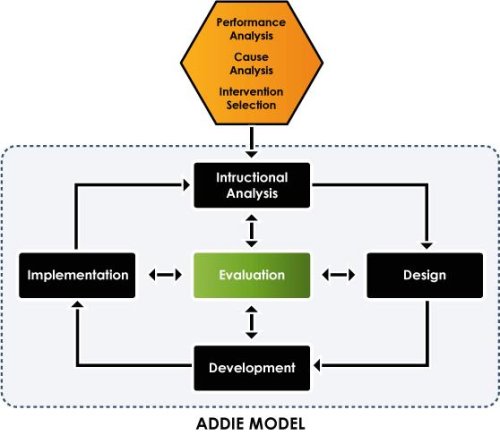
So anyone pushing training (including e-learning) is selling a means to an end. First, you have to know what ends you’re trying to achieve. Ends can be 1) outcomes, 2) outputs or 3) performance. Training can help improve performance, but before you put on your instructional designer hat and get down to creating stuff, you need to align the means with the ends. That’s where performance analysis comes in.

If you subscribe to the ADDIE process, or some variant of it, you still have to get to the point of establishing (or confirming)  the ends that you are trying to achieve. For training development shops, the model should look something like this:

first-base.jpg

And so “ends” my series over the past couple of weeks on performance improvement (for now).