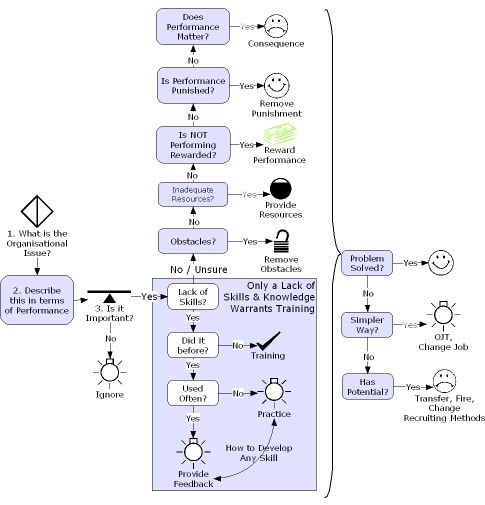
Analysis for Informal Learning

This is a follow-up to Informal Learning and Performance Technology. I’ve created this diagram to show a rather simplistic representation of how you would conduct an analysis to determine where informal learning might fit in to your organisation. This process is designed for larger organsisations, and there is much missing from this diagram that space won’t allow. Anyway, it’s designed as a conversation accelerator on how to start looking at opportunities for informal learning on an organisational basis.

informal-analysis.jpg

My PKM System

Note: Latest version: PKM in a Nutshell (2010).

In response to a post I made on Personal Knowledge Management (PKM), Tony Karrer recommended that I look at his post on Personal Learning for Learning Professionals. This had me review my posts on PKM and reflect on how I go through my process of triage. As a result, I created this picture.

pkm.jpg
I’m starting to use some other web tools but this is pretty well how I move from “interesting stuff” to “this is what I think”. For me, PKM is more about attitude than any given tools. My system works for me because I’m curious and because I have got into the habit of writing down my thoughts in a public forum. This develops into some interesting conversations about things that matter to me at the intersection of learning work and technology. Having a defined field of interest helps stop this blog from spreading too far and wide and keeps my PKM manageable.

Update: The diagram was slightly changed in response to Loretta’s suggestion (see comments). I would also encourage a look at Dave Pollard’s graphic on the same subject.

Army Knowledge Management

Federal Computer Week (FCW) reports how the US Army is implementing knowledge management at the operational and tactical level. Here is a prime example:

In this particular case, Iraqi insurgents placed an IED [improvised explosive device] behind a poster with anti-American slogans. A soldier noticed that the poster looked different from others he had observed, so he entered information about the suspicious sighting into BCKS. A threaded discussion developed online while specialists evaluated the potential threat. When they confirmed the soldier’s suspicions, the Army sent a message via the system to alert other units about the insurgents’ new method of concealing IEDs.

The article goes on to discuss the details of knowledge management activities that enable junior officers to share information based on the current operational reality. However, it seems that the Army hierarchy is not learning as quickly as the grass-roots:

The Army is a hierarchical institution in which a natural tension exists between junior officers and the Army brass, who want junior officers to follow Army doctrine to the letter. But junior officers who have been deployed in Iraq often feel that doctrine is out-of-date and that they know best based on their experiences on the battlefield.

A grass-roots movement to transform the service from the bottom-up has created tremendously valuable communities of practice, but Army doctrine has been slow to adapt.

There is a similar tension in large organisations in the civilian world. I recently tried to work with a large company in responding to a government Request for Proposals (RFP). Being outside the company, I knew who at the company had previous experience with similar projects, while the employees with whom we were working did not. I also knew the strategic value of this RFP, which was information not easily available to the employees with whom we were working. It seemed as if the company’s structure was designed to thwart us as we tried to develop a proposal.

In the end, it took over two weeks to get the information to the person who would have been interested and authorised to write a proposal, but by then it was too late. We didn’t respond to the RFP because it took too long to get the information up the chain of command. I wonder how many other opportunities have been lost by the company this year?

At some point in the future we will realise that our hierarchical organisational structures are outdated and do not work when you have cheap and easy communications and a relatively free flow of information. That will not happen until businesses experience great pain and, in the Army’s case, not until more soldiers have died.

chat_icon_01.png

Informal learning and performance technology

informl_member.jpg

Is informal learning just another flavour of the month that tries to be all things for all learners? Tony Karrer states that:

I’m becoming convinced that folks in the informal learning realm are quite willing to live with “free range” learning. It’s way too touchy-feely and abstract for me. If this stuff is important, then I want to:

* Know that it will work
* Know why it works
* Know that its repeatable

I don’t see free-range learning as a panacea, but neither do I believe that ISD can address informal learning needs. In the spirit of attempting to clarify the process, as Tony asks, here is one of my perspectives – human performance technology (HPT).

In HPT, one of the main areas of focus is the analysis; to determine what the performance gaps are. I was told by an experienced practitioner in the field that only 15% of organisational performance problems can be addressed by training. This is based on about 50 years of research and on the premise that “Instruction & Training” can only address a lack of skills or knowledge. The other 85% of organisational performance issues need other kinds of what are known as “performance interventions”. These can include, but are not limited to:

  • Career Development
  • Human Development System Design
  • Communication Systems
  • Documentation & Standards
  • Ergonomic Design
  • Feedback System Design
  • Information System Design
  • Management Science
  • Job & Workflow Design
  • Organisational Design & Development
  • Quality Improvement
  • Resource System Design
  • Reward & Recognition System Design
  • Selection System Design
  • Measurement & Certification Programs

As you can see, organisational and individual performance can be influenced by a wide variety of factors. Because we are humans, no one will ever create the perfect performance system.

Where does informal learning fit into all of this? First, if you accept that only 15% of performance issues can be addressed through instruction and training, you accept that there is significantly more to look at in any organisation. A larger piece of the puzzle would be all learning interventions, not just those that address a lack of skills or knowledge.

In HPT, learning interventions can be divided into two groups – instuctional and non-instructional. Instructional interventions can be designed using ISD or other methods of training development. Informal learning, in my mind, is that other, and larger, grouping of non-instructional learning interventions.

Here is a sample list of non-instructional performance interventions:

  1. Electronic Performance Support System (EPSS)
  2. Workplace Design
  3. Knowledge Management (KM)
  4. Just-in-Time Support
  5. Communities of Practice
  6. Multimedia
  7. Internet and Intranets
  8. Corporate Culture changes
  9. Process Re-engineering
  10. Job Aids

I don’t necessarily agree with this grouping, but I thought that I’d show that there are others who use the same terminology. Of particular interest to me is Item 7, because the Internet has changed the balance of power and control in many organisations. With the Internet, and now with cheap and easy ways to connect people (Web 2.0), we have more possibilities for non-instructional performance interventions. Each of these addresses a different performance need, so there is no single methodology for informal learning. Building job aids is quite different from nurturing a community of practice.

As a learning professional, I am comfortable in prescribing and designing training when there is a lack of skills or knowledge. For example, I developed all of the training programs related to the operation of a military helicopter. There was a clear lack of skills and knowledge and we developed training programs to address this. However, there are a lot of learning needs that cannot be addressed through instructional performance interventions. These include:

  • Feeling and acting as a member of a team.
  • Group learning from operational experiences (see post on Storytelling in the Army).
  • Building morale.

Informal learning systems may increase overall performance but these cannot be exactly measured nor quantified. But then, neither can successful business practices or military strategy be exactly defined. Good business and military leaders know that success is a blend of science and art. I see informal learning as a similar endeavour. There are ways of measuring effectiveness – see Estimating the Performance Situation – and evaluation needs to be directly linked to your analysis. For example, morale cannot be quantified, but you know when good morale exists or when it is missing in an organisation.

Currently, we are looking at how certain technologies can be used to foster informal learning. The body of knowledge is not large, but we have adequate evidence that blogs, wikis, online fora, or knowledge-sharing are effective in increasing organisational performance. Again, take the Army Storytelling example and ask why this unstructured, informal learning activity is so important to the soldiers and their unit’s combat effectiveness, even though every soldier is highly trained.

I am certain that a good analysis that involves the learners and brings a knowledge of non-instructional performance interventions can have a significant impact on organisational performance. It took a lot of work and a world war to develop ISD, so I’m sure that we still have a way to go in the informal learning field, if it even can be called a field.

I think that informal learning is a way of categorising a whole range of strategies that we now have available with the advent of cheap web access, powerful personal computers and low cost applications likes blogs, wikis, tags, etc. Informal learning offers a new array of tools for the learning professional’s tool box.

Estimating the Performance Situation

Last week I mentioned a few communication tools that I learned how to use in the Army. One of these is the Estimate, which is a problem-solving tool. As young officers, we were constantly told to “estimate the situation and never situate the estimate”. In many cases, when training is prescribed for a work performance issue, it is a case of situating the estimate. I can think of two recent examples in my own business experience.

In one case, e-learning was prescribed to address the performance needs of nurses changing to a new nursing care methodology. In that instance, I was able to convince the client that a quick performance analysis could be used to confirm the assumption that e-learning was the solution. As a result of the analysis, we changed the intervention to the development of an online diagramming tool, because we determined that nursing staff already had 80% of the necessary skills and knowledge, but they didn’t know how to use the new diagramming and reporting procedures. The initial e-learning program was greatly reduced.

In another case, training was prescribed in order to get staff up to date with a new organisation-wide policy. Each person received an average of 17 days classroom training. As an observer for part of the training, I would estimate that all of the training could have been done in less than a week, had the new procedures and some job aids been first developed. The total cost of training approached millions of dollars, plus the cost of missed work.

Recently, David Maister stated that training is often prescribed in the “hope” that performance can be improved, when a few pointed questions might better get to the root of the issue:

The correct process would be to sit top management down, ask: What are people not doing that we want them to be doing? – and then figuring out a complete sequence of actions to address the questions  – how do we actually get people to change their behavior? What measurements need to change? – what behaviors by top management need to change to convince people that the new behaviors are really required, not just encouraged? – what has to happen before the training sessions to bring about the change? What has to be in place the very day they finish?

A more detailed process is shown below. It shows that training only works in certain circumstances and that there are a number of other factors to look at first; such as barriers to performance and mismatched rewards & consequences.

A macro view of this process is that triage (sorting out priorities) should initiate the process, followed by a diagnosis (analysis), which can be as short as Maister’s questions, before prescribing some kind of treatment which may or may not include training. Using this method, I continue what my instructors told me many years ago – don’t situate the estimate.

performanceanalysis.jpg

Finally, here’s a job aid that I use in determining what the causes to performance problems may be:

  • Causes, Enablers and Obstacles:
    • Question the assumptions and potential solutions.
    • What is causing the problem?
    • What will prevent a solution?
    • What will make a solution easier?
  • Focus on Key Sources:
    • Find and focus on the people who are close to the problem and have perspective on the issues. Don’t try and reach everyone, especially in an initial performance analysis.
    • Focus on facts and results
  • Look for data, through observations, records, experiences:
    • What evidence is there?
    • Is it consistent?
    • What does it tell us?
    • Is there more?

Communication Tools from the Army

During my Army service I learned many things that I have already forgotten, such as the composition of a Soviet Motor Rifle Regiment, and a few things that I could never forget. Three tools that I used extensively during my military career were 1) the Estimate, 2) Battle Procedure, and 3) the Orders Format. All of these are communications tools.

The Estimate is a logical way of analysing a situation and making a plan. Battle Procedure is a logical method to get you on the road to your next mission, and the Orders Format is a standard form of conveying the details of your plan to those who are going with you.

Some specifics of these three tools have changed over the years, but these combat-tested tools for effective communication remain in use. If you strip away the military specific stuff, they are quite practical for civilian applications as well. The Combat Estimate is a short version of the detailed Estimate and is based around seven questions, which I have slightly revised:

  1. What are competitors and clients doing and why?
  2. What have I been told to do and why?
  3. What effects (these can be described as your specific tasks) do I want to have on the competition and/or my client?
  4. Where and how best can I accomplish each effect?
  5. What resources do I need to accomplish each effect?
  6. When and where do the actions take place in relation to each other?
  7. What control measures do I need to impose? (e.g. what detail of project management is necessary)

Here is a revised Battle Procedure, in non-military form, geared around a client project:

  1. Get a warning that a new project is going start.
  2. Pass this on to your team.
  3. Do some quick research into the sector, the competition, the client and the opportunity.
  4. Get the official go-ahead for the project [probably not as much detail as you would get from a military superior, but then your boss doesn’t know the Orders Format].
  5. Conduct a detailed analysis and research based on the available time.
  6. Figure out what you have to do, by when [do this by working backwards from your critical deliverable dates/times].
  7. Write a detailed message (see next paragraph), with your time estimate, to your team members and partners.
  8. Advise anyone else from whom you may need support during the project (printing, translation, etc.).
  9. Sit down with the whole team (or virtually) and ensure that everyone understands the project, the constraints, the deliverables and who is responsible for what.
  10. Ensure that all activities are coordinated (remember, it’s your project).
  11. Get going.

Finally here is a civilian version of the Orders Format, used to communicate your plan to others:

  1. What’s going on
  2. What we’re going to do and how success will be measured
  3. Who is going to be working with us
  4. Who has to do what and by when
  5. How we’re going to communicate over the course of the project
  6. Who’s responsible for making decisions

If twenty years of military service can be summed up by the mastery of three communication tools, I think that it shows the importance of effective communications in organizations. Since retiring in 1998 I have had three jobs — university-based researcher/consultant, dot com executive, and now freelancer. On reflection, I can say that almost all of my projects over the past 8 years have been about communication, such as:

  • explaining how to conduct training
  • coaching how to use technology
  • communicating through design
  • selling an idea through a business plan
  • telling how I would do a project through a proposal
  • putting together diverse opinions into a cohesive vision
  • connecting people through conversation

Basically, as more and more of us connect in our work, we need effective ways to communicate. Though not perfect or comprehensive for all business needs, these military tools have stood the test of time.

Training: A Solution Looking for a Problem

While listening to the radio the other day, the person being interviewed spoke about the need for training for those responsible for ensuring clean water in many remote Canadian communities. Now, I’m not going to say that training is not required, but making the leap from a performance issue (lack of skills, abilities, knowledge; lack of access to appropriate data and resources; etc) directly to training as the only solution, is the wrong approach and the most costly. As a taxpayer, I don’t want government to slap training band-aids on any problem that involves work performance. Some barriers to performance that are often overlooked when prescribing training include:

  • Unclear expectations (such as policies & guidelines);
  • Inadequate resources;
  • Unclear performance measures;
  • Rewards and consequences not directly linked to the desired performance.

In some cases, these barriers could be addressed and there would be no further requirement for training. Where there is a genuine lack of skills and knowledge, training may be required, but it should only be in cases where the other barriers to performance have been addressed. A trained worker, without the right resources and with unclear expectations, will still not perform up to the desired standard, and the drinking water supply may still be in danger.

I have noticed that many large organisations have this tendency to slap on the training band-aid once any issue has been labelled a human performance issue. Training that is not directly related to performance wastes time, bores workers and costs money. Here is a general diagram of the high level process of performance analysis. These posts, and the diagrams, are Creative Commons licensed, so go ahead and use them. You might even save some money.

performance analysis process by Robert Mager

Tactics, Strategy & Humanity

The opening session at the CSTD Knowledge Exchange in Toronto this week was by Dana Gaines Robinson on the subject of Strategic Business Partnering. This is a new term for me and at the end of the session my impression was that SBP is a new buzz-word for human performance technology, but with an emphasis on strategy. The words strategy and tactics were liberally sprinkled through her session.

This  reminded me of my +20 years in the military when strategy and tactics were my main work disciplines and got me to wondering why many in the learning field use military terms to describe their work. Gaines Robinson used another term that did not sit well with me – it is that one should “own the client relationship”. When I think of a relationship, the last thing that comes to mind is ownership. Does this kind of terminology frame the discussion in a certain way? Does it influence how we think about our profession? Anyway, it was good for me to listen to a presentation that raised these issues.

The strategic, or high level, theme was a thread throughout the conference. Larry Murphy, an attendee and past colleague, described our field as having two kinds of people, forest people and tree people. Some can see the forest and some have to focus on each individual tree. In Strategic Business Partnering I think that we’re focusing on too small of a forest. In SBP, the performance consultant is supposed to partner with the client and look at the next 1-5 years from the client’s perspective.

I prefer Roger Kaufman’s organisational elements model where he urges us to look at the Mega (societal) the Macro (organisational) and Micro (individual & group) levels in strategic planning. A focus on the Mega means taking an ethical, moral and value-based stand. This is the really big picture, not just the business microcosm. A Mega perspective to me means that you don’t try to maximize value for your clients’ profits if they are acting like Enron execs. This thought stayed in my mind through the day, but by Tuesday evening there were some answers, and more questions.

performance analysis process mega and macro

Stephen Lewis, UN Special Envoy for HIV/AIDS in Africa, presented the post-dinner speech. In his articulate and engaging way he laid out the enormous humanitarian disaster that is attacking 70 million people today. He described in case after case the spread of the disease and its effects, especially on women. After moving many in the audience to tears, Mr Lewis described what we could do. With his global  vision, he proposed that individuals and groups of learning professionals in Canada could go to Africa and help to retrain a population that has almost no teachers or trainers.

The need is great and even one person training a small group on basic skills, that we take for granted, would have an impact. When the head of a household is only 8 years old (because all of the adults are dead) there are a lot of skills and knowledge that he or she will need to succeed in life. The suggestion was that the training & development community here could start a real knowledge transfer to Africa.

The next morning, the CSTD board created a committee to begin a process of working with the Stephen Lewis Foundation in order to determine how CSTD can help an orphaned generation in Africa to learn essential skills. Stephen Lewis has shown how the strategic and the tactical levels can be aligned, but within a much larger humanitarian (mega) vision. More information on this initiative will be made available on the CSTD website.

Search Tips

Yesterday, Eliiott Masie stated that Google was one of the best learning tools around (anyway, that’s what he says he told Bill Gates). Following his presentation, Ben Watson said that Google search results are information overload and that he doesn’t find it a useful way to get just-in-time information. I use Google a lot (it’s how I’ve developed my limited skills with HTML) but I think that there are many people who do not know how to maximize the full potential of a search engine.
Marshall Kirkpatrick has just republished ten tips for searching the web, so now there is a ready performance support tool for anyone who wants to improve their search skills. That’s the power of networked communities. I Furled it too!
You can also go to Google’s advanced search tips.

Bureaucracy = Death

Seth Godin’s quotable Bureaucracy = Death raises a number of issues on why preventive actions are seldom taken by bureaucratic organisations. Seth talks about the effects of bureaucracy on marketing, but it also results in inertia in healthcare, education, et al. I doubt that his idea of a Chief No Officer would be embraced by many companies or institutions.
My belief is that it is the basic nature of managerial organisations that is the prime contributor to a reactive versus a preventive mindset. Why were the levees around New Orleans not maintained? Why is there no funding for programmes such as Canada’s Participaction, but we continue to add more expensive acute care machinery to our hospitals? Why is early childhood education ignored when it is a prime contributor to healthy, contributing citizens? And finally, what can we do to change this?