I had previously mentioned how traditional businesses could use blogs. Small Business Trends now reports that one in ten small businesses in the US are planning on using blogs in their marketing strategy.
As a micro-business, I have no doubt about the value of blogging, especially for free-agents. Most business blogs seem to be in IT-intensive fields but they can also work for more traditional businesses. Two examples – Landfair Furniture in Oregon and The Lincoln Sign Company .
Like e-mail, I think that blogs will become ubiquitous in the near future as the Early Adopters have already moved to blogs.
Are there other examples of more traditional small businesses using blogs? I know about the consultants, writers and techies, but what about companies with less than 100 employees who are blogging in order to have real conversations with people?
Work
business & working
Culture is Everything
Anyone who has worked as a consultant or on an external/internal project knows about culture and change. It’s what can make or break a project. Fast Company has a quick note on the importance of culture, it’s organisational DNA, and gives this how-to list:
Something to try:
Consider the team/group/organization you’re leading
1. Look at your vision/mission statement and jot down the behaviors that everyone supposedly follows.
2. On a second list jot down the behaviors that everyone actually follows.
3. Pick the one discrepancy that annoys you the most.
4. Make it a top priority to change it.
5. Have a conversation with colleagues on why each of you think the discrepancy exists.
6. Agree on some structures to put in place to ensure that change happens (communication, processes, rewards etc).
Consider the team/group/organization you’re leading
1. Look at your vision/mission statement and jot down the behaviors that everyone supposedly follows.
2. On a second list jot down the behaviors that everyone actually follows.
3. Pick the one discrepancy that annoys you the most.
4. Make it a top priority to change it.
5. Have a conversation with colleagues on why each of you think the discrepancy exists.
6. Agree on some structures to put in place to ensure that change happens (communication, processes, rewards etc).
I’m not sure that it’s ever this easy to address culture issues but these "discrepancies" can spell the death of any project. If you can spot them early, they can also be indicators of projects to avoid.
Marketing Hype & Reality – Connection Speed
I previously complained that my ISP, Aliant (a Bell company), was only providing me with 10 MB of e-mail space for my $45 per month while Gmail now gives me 2428 MB of storage for free. My peeve right now is advertised versus real connection speeds.
According to the Aliant website, my Highspeed Ultra is supposed to give me "up to" 5 Mbps. Jay Cross has recently referred to this connection speed checker and my connection speeds are 1.2 Mbps down and 0.44 up, a far cry from the advertised speed. Another speed checker is Wugnet, with a neat visual interface, which clocked me even slower at 1.06 down and 0.18 up.
If you are in Atlantic Canada and have a highspeed internet connection, I’d appreciate it if you checked your speed and posted it, either here or somewhere else. If my case is not an anomally, then Aliant and its competitors should know about it.
Update: I checked with tech support at Aliant and was informed that one of the issues could be that my telephone extension cable was too long. According to Aliant, my ethernet cable can be almost any length but the phone cable extension from the jack to the DSL modem should not be more than 10 feet. I changed this last night but it hasn’t affected my connection speed. Aliant also recommended that I use the speed test for Aliant clients which clocked me at 134 kbps and 1.02 mbps throughput – slow for their High-Speed Ultra clients.
Knowledge Work Job Evaluation
Jon Husband has been discussing the limitations of job profiles and evaluations and now has asked if our methods of inquiry for knowledge work analysis are too limited. For instance:
I suggest that Know-How today is also Know-Why, and Know-Who, and Know-Now, and Know-Where-To-Find-It, and Know-When, and Know-What-If. and Know-Yourself and a wide range of contextually-defined combinations of these components of pertinent and useful information and knowledge.
Similar themes appear in books like Emotional Intelligence , Social Intelligence , Career Intelligence and A Whole New Mind. The last book can perhaps explain the current state of job analysis as it is very much a “left brain” discipline. My experience with job evaluations is that they are hoops to be jumped through and few people really pay attention to them on the job.
If job analysis/evaluation was critical to business success then all small businesses would embrace them. What works for small businesses are that relationships are personal. When the organisation becomes larger and impersonal you use a formal job classification system. When I was in the military I found the job classification and evaluation system quite inflexible and it even led to bad operational decisions. I’m not sure what the answer is, but it’s not trying to pigeon-hole everyone in a job profile. The effort put into job evaluation could instead go into targeting barriers to work performance, such as the process shown here: Analysing Performance at Work.
Seb is Loose!
Seb Paquet has just become a free-agent, leaving behind the NRC-IIT in Moncton (bonne chance mon ami!). I’ll miss having Seb close by but look forward to the possibilities of working together in Montreal, hopefully through Mancomm.
Seb’s post is a great indicator of how blogs can work for your professional development. He has basically created a reverse job posting, telling the world that he is available and under what conditions. Instead of roaming the streets with his CV in hand, Seb’s blog is a central location to get to know him or to catch-up on what he’s been up to. I think that these kinds of between-job postings will become popular on the web and I’m sure that someone will even give them a name and sell services around them ;-)
Harry Potter Injunction is Unconstitutional
Michael Geist, Canada Research Chair in Internet & E-commerce Law at the University of Ottawa’s Faculty of Law has reviewed a recent BC court decision. The court forces people who have legally purchased an inadvertently available copy of a Harry Potter book to return the book or face legal action.
Having spent much of the day discussing the Harry Potter case, I find myself becoming increasingly troubled by the scope of the injunction issued by the B.C. Supreme Court. The injunction represents more than just a remarkable misuse of copyright law. Quite simply, it is an attack on freedom.
* The freedom to read (the order restrains reading the book).
* The freedom of expression (the order restrains discussing any aspect of the book).
* The freedom associated with personal property (the order compels anyone who has the book to return it, along with any notes, to Raincoast books).
This is all done purely in the name of furthering commercial interests. In Canada, we have some narrow restrictions on hate speech and child pornography. But we do not issue court orders that prohibit children from reading books.
For a judge to issue such a blantantly unconstitutional order is appalling. For a book publisher and a children’s author to request such an order, is shameful. We should tell them so.
* The freedom to read (the order restrains reading the book).
* The freedom of expression (the order restrains discussing any aspect of the book).
* The freedom associated with personal property (the order compels anyone who has the book to return it, along with any notes, to Raincoast books).
This is all done purely in the name of furthering commercial interests. In Canada, we have some narrow restrictions on hate speech and child pornography. But we do not issue court orders that prohibit children from reading books.
For a judge to issue such a blantantly unconstitutional order is appalling. For a book publisher and a children’s author to request such an order, is shameful. We should tell them so.
I agree with Geist. Why should commercial interests be put ahead of our constitutional rights? If the courts don’t look after the rights of those without the money to appeal this decision, then who will? Perhaps this is something that our Senate should look into, since the Senate purports to represent minority rights, such as those of children.
You can contact Raincoast Books.
17 July: Michael Geist follows up with more bad news for our constitutional rights.
Development Gateway
The Development Gateway is a comprehensive, non-profit resource on issues related to economic and social development with a particular focus on information and communication technologies. It includes 28 online communities, such as ICT for Development. I came across this site because I was looking for specific information on ICT’s and Indigenous communities and Development Gateway listed 61 articles on the subject. This is a very easy to use and substantial web resource.
Technologies of Cooperation
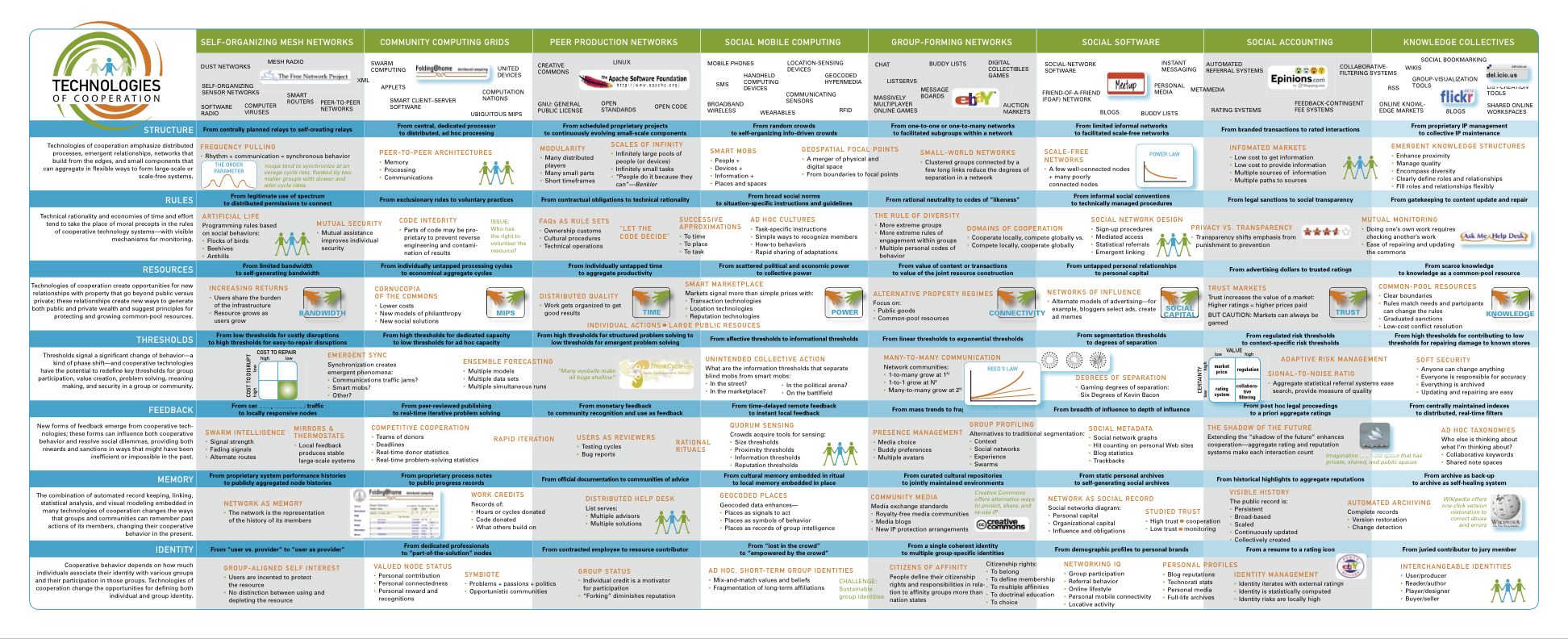
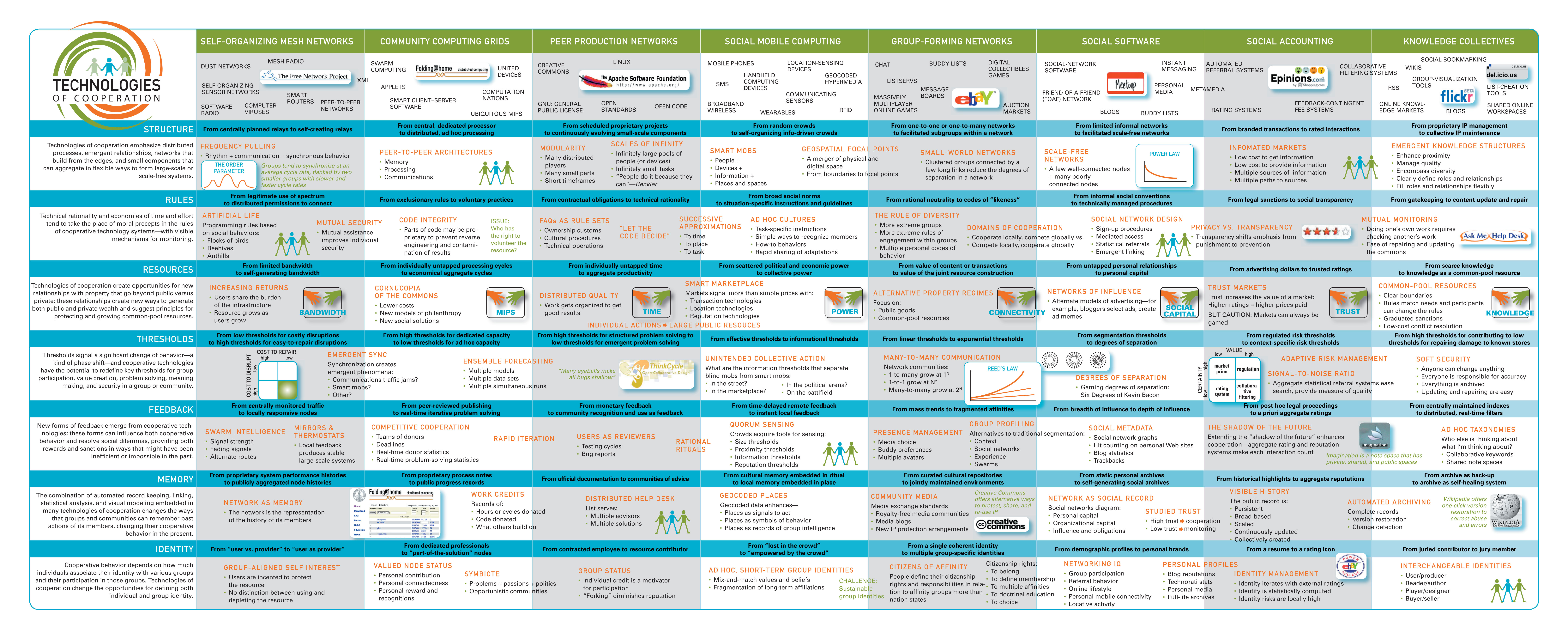
I’ve already referred this excellent document to two of my colleagues, so I guess that I’d better blog about it. Entitled Technologies of Cooperation, this paper from the Institute for the Future is available on Howard Reingold’s site as a PDF. A small or a large map is also available. The large map is great to read on your computer but a pain to print.
Technologies for Cooperation is a follow-up and a synthesis of a paper that I talked about last year, called Toward a New Literacy of Cooperation in Business. The recent document is worth a read for those immersed in Web 2.0 as well as anyone trying to get a handle on the two-way web and online communities.
What triggered me to read this report was the recent CCL e-learning workshop. I was reading the Executive Summary just as we were discussing how the CCL could facilitate the creation of communities. The strategic guidelines for the use of these coooperative technologies are covered in detail in the document:
- Shift focus from designing systems to providing platforms
- Engage the community in designing rules to match their culture, objectives, and tools; encourage peer contracts in place of coercive sanctions by distant authority when possible
- Learn how to recognize untapped or invisible resources
- Identify key thresholds for achieving “phase shifts” in behavior or performance
- Track and foster diverse and emergent feedback loops
- Look for ways to convert present knowledge into deep memory
- Support participatory identity
The information in this report is useful to anyone starting or trying to maintain some type of online community. It also shows that top-down approaches and constrained spaces with explicit rules will not foster cooperation. Cooperation is becoming important for all organisations, as the authors conclude, "competition and cooperation will likely become a pair of evolutionary strategies for organizations".
The Individual is the Organisation
Yesterday, at the QSC opening, I was able to have a much too short discussion with Robert Paterson about organisational change. The gist of our conversation was that since all change happens with the individual, why focus on the organisation for any cultural/organisational change? This has me thinking about my own business, which I have summed up by stating that my consultancy focuses on "Improving organisational performance at the intersection of learning, work and technology". Perhaps a better, and more pragmatic, focus would be on "Improving individual performance …". The lesson being that you should focus your energies on what you can change, and that would be by helping people, one person at a time. It’s pretty well what I am doing, I just haven’t stated it that way.
I think that a focus on individuals could also reduce some of the inherent frustration of consulting. Even if the organisation has not implemented the change, or just parked the report on a shelf, you can walk away from a project knowing that you have helped someone. It’s a parallel activity within a project but could be the most rewarding.
Queen Street Commons
The Queen Street Commons had its official opening in Charlottetown today and I had the opportunity to meet a lot of enthusiastic people. Robert, Cynthia and Dan were charming and excellent hosts. It’s really a simple idea – make some workspace available in the downtown area for a reasonable price. Then set some basic rules and let the members grow a common space to work, learn and share. So, for $35/month you can have some cool urban office space as well as a lounge, conference room and a kitchen to hang out in. On top of that, you get to talk to some interesting people whom you may not have otherwise met.
I look forward to the day that the next Work Commons is created – maybe in Sackville(?).