The Individual is the Organisation

Yesterday, at the QSC opening, I was able to have a much too short discussion with Robert Paterson about organisational change. The gist of our conversation was that since all change happens with the individual, why focus on the organisation for any cultural/organisational change? This has me thinking about my own business, which I have summed up by stating that my consultancy focuses on "Improving organisational performance at the intersection of learning, work and technology". Perhaps a better, and more pragmatic, focus would be on "Improving individual performance …". The lesson being that you should focus your energies on what you can change, and that would be by helping people, one person at a time. It’s pretty well what I am doing, I just haven’t stated it that way.
I think that a focus on individuals could also reduce some of the inherent frustration of consulting. Even if the organisation has not implemented the change, or just parked the report on a shelf, you can walk away from a project knowing that you have helped someone. It’s a parallel activity within a project but could be the most rewarding.

Queen Street Commons

The Queen Street Commons had its official opening in Charlottetown today and I had the opportunity to meet a lot of enthusiastic people. Robert, Cynthia and Dan were charming and excellent hosts. It’s really a simple idea – make some workspace available in the downtown area for a reasonable price. Then set some basic rules and let the members grow a common space to work, learn and share. So, for $35/month you can have some cool urban office space as well as a lounge, conference room and a kitchen to hang out in.  On top of that, you get to talk to some interesting people whom you may not have otherwise met.
I look forward to the day that the next Work Commons is created – maybe in Sackville(?).

Communities and Chaos

Peter Bond has a good article (with explanatory diagrams) that looks at communities of practice (CoP) from a biological perspective. He sees these communities as balancing between chaos and structure. The more chaotic, the more energy and innovation is evident. In chaos little gets done but as structure is added over the life of the community it loses its energy.

This suggests that the process of CoP development be approached as if they were transitory organisational phenomena that may act, but only for a finite period, as the source of the motivation for change and as the vehicles for change.

One inference I can make from Bond’s article is that loosely joined technologes would be more appropriate for CoP’s than single structures, like a CMS or web portal. If the nature of a CoP is temporary then it would be best to have individually-controlled pieces that can form and re-form over time. This ability is currently available from a combination of blogs, RSS, tags and feedreaders.
In my experience working with single structure CoP’s (password controlled access to a single site) I still find the much more open blogosphere is a better (more flexible) environment for community building because the tools are in the hands of the individual. This flexibility, and the absence of a controlling hand, help to maintain the balance between chaos and structure.

Fewer Left Brain Careers

Following up on my post on Productivity, I noted that Dan Pink has referred to this AP article about the decline in demand for traditional technology jobs:

"In this country, we need to train our engineers to be at the leading edge," Gray [executive director of the National Society of Professional Engineers] said. "That’s the only place there’s still going to be engineering work here."
At Stanford, career experts are urging engineering and science majors to get internships and jobs outside of their comfort zones — in marketing, finance, sales and even consulting. They suggest students develop foreign language skills to land jobs as cross-cultural project managers — the person who coordinates software development between work teams in Silicon Valley and the emerging tech hub of Bangalore, India, for example.

The writing is on the wall. If your work can be automated or outsourced to a cheaper labour market then you had better be looking for a new career.

Blue Ocean Strategy

Blue Ocean Strategy is a book with a similar theme to Christensen’s Seeing What’s Next. It states that the economic world is divided into two kinds of oceans, red ones and blue ones. The red oceans are existing markets while the blue ones are new markets. While red oceans account for more revenue, red ones generate greater profit. This is an interesting premise – and inherently makes sense – but I’ve only read the executive summary. Not sure if there’s any more meat in the book than you can find on the web site or in the summary. Any comments?

Productivity

Worthwhile’s Anita Sharpe mentioned productivity measures and how the US Government measures output instead of real productivity. Anita quotes Kevin Kelly (10 Rules for the New Economy) :

"Any job that can be measured for productivity probably should be eliminated from the list of jobs that people do. . .Where humans are most actively engaged with their imaginations, we don’t see productivity gains — and why should we? Is a Hollywood movie company that produces longer movies per dollar more productive that one that produces shorter movies?" 

A similar question came up at Nine Shift on whether "productivity is no longer a valid measurement".  Dan Pink sees the world moving from an Industrial/Information economy towards a Creative Economy. These new economic conditions, created by Asia, Automation and Abundance will require "right-brain" skills in design, synthesis and empathy. If you agree with Pink, which I do, then it becomes obvious that industrial era measurements will be useless in the next economy.
Unfortunately, most measures of creativity are not as clear-cut as those for more technical and physical skills. In the interim, we will have a mismatch between what is measured and what really matters.

Learning About Sharing

Note: This is a re-post from last week due to a system change (Drupal 4.4 to 4.6).
One interesting observation I made this week is that not everyone is as open to sharing their thoughts and opinions in a public way as my fellow bloggers are. Coming from a community of practice that shares ideas and uses sharing mechanisms like Creative Commons, public Furl and Bloglines archives, you sometimes take for granted that everyone has this outlook. I came across some strong opinions that knowledge is power and it must be kept to oneself or a small circle of people. I keep on learning :-)
Seb also referred to this related paper.

Web 2.0

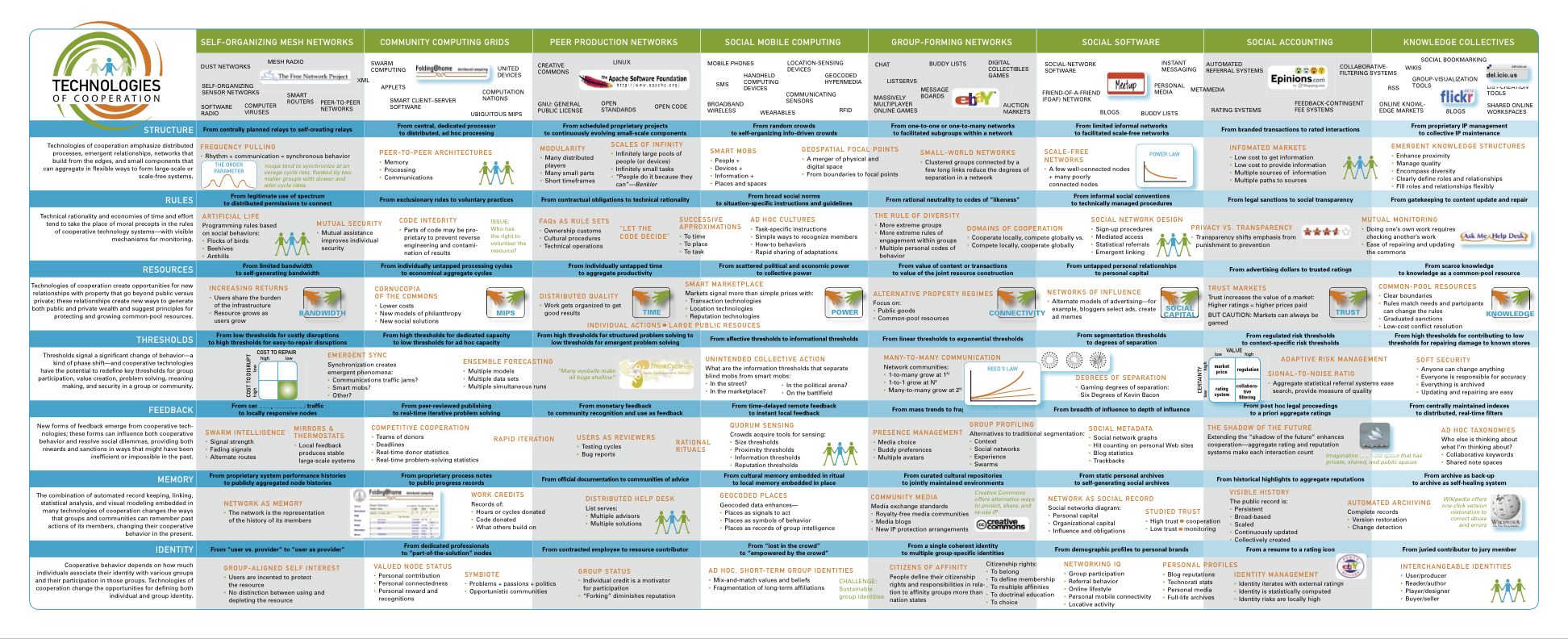
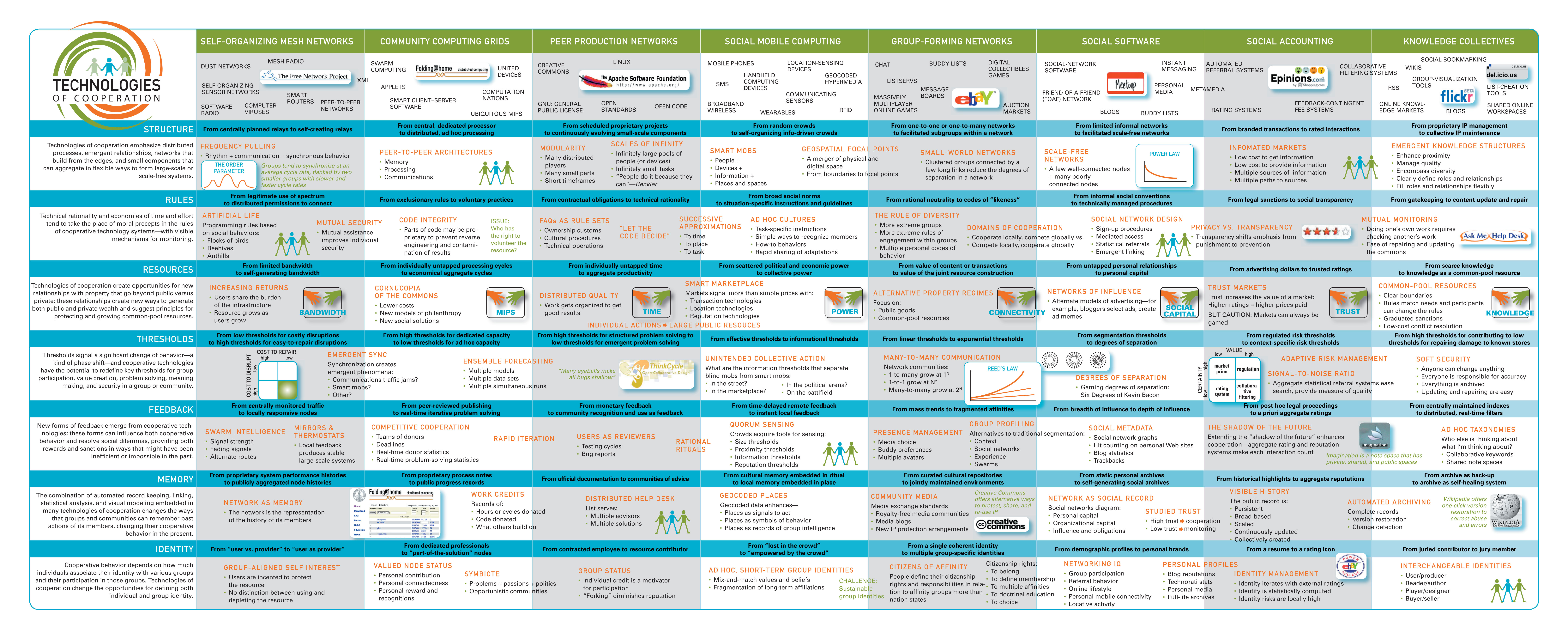
Web 2.0 is the common term used to refer to the new generation of web applications and systems that enable community or many-to-many relationships. BusinessWeek has a recent article that summarizes many of the converging and diverging factors influencing this next phase of the Web:

Indeed, peer production represents a sea change in the economy — at least when it comes to the information products, services, and content that increasingly drive economic growth. More than two centuries ago, James Watt’s steam engine ushered in the Industrial Revolution, centralizing the means of production in huge, powerful corporations that had the capital to achieve economies of scale. Now cheap computers and new social software and services — along with the Internet’s ubiquitous communications that make it easy to pool those capital investments — are starting to give production power back to the people. Says Benkler [Yale professor]: "This departs radically from everything we’ve seen since the Industrial Revolution."

Commerce is changing as a result of this new business platform, with successful examples such as e-Bay and more recently Skype. The graphic provided in the article is a good visual of the change from the Web 1.0 to 2.0, with Web 2.0 described as:

Many-to-Many: File-sharing, blogs and social networking services are connecting masses of people simultaneously. Their collective efforts are spawning new services including online encyclopedia Wikipedia and free netphone network Skype.

For an ongoing discussion of Web 2.0, including its influence on higher education, go to What’s Web 2.0? which is run by Will Pate.


Inkscape – Open Source Graphics Editor

Open source applications are slowly crawling "up the software stack", making proprietary enterprise software development more and more difficult. Inkscape is an open source scalable vector graphics editor affiliated with the Open Clip Art Gallery project.

Inkscape is an open source drawing tool with capabilities similar to Illustrator, Freehand, and CorelDraw that uses the W3C standard scalable vector graphics format (SVG). Some supported SVG features include basic shapes, paths, text, markers, clones, alpha blending, transforms, gradients, and grouping. In addition, Inkscape supports Creative Commons meta-data, node-editing, layers, complex path operations, text-on-path, and SVG XML editing. It also imports several formats like EPS, Postscript, JPEG, PNG, BMP, and TIFF and exports PNG as well as multiple vector-based formats.

Comments from any users would be appreciated. I’ve just downloaded it and will test it out when I get a chance.

Innovation & Disruption

If you were interested in my previous post about Clayton Christensen’s model of disruptive innovation in his book Seeing What’s Next, then read these two articles by Dave Pollard. Dave has taken Christensen’s theories a step further and integrated other models to come up with a more prescriptive strategy for companies to approach innovation. His recommendations are boiled down to six steps, which he explains in detail in his posts:

  1. Research the strategy canvas for your industry [based on Blue Ocean strategy];
  2. Find out from each segment of customers (including low-end and current non-customers) what they value and what their unmet needs are;
  3. Compare the strategy canvasses to the needs of each segment;
  4. Find the gaps;
  5. Brainstorm and ‘imagineer’ how you can effectively, competently and profitably fill them; and
  6. Experiment, test, qualify and then roll out the qualifying innovation opportunities.

Now I just have to put these ideas to work in our latest start-up initiative …