Photos you can use

A friend asked about online repositories of photos that can be used for academic presentations and I mentioned several sources. I realized after sending the list that many others may not know about the wealth of resources available, especially for  teaching and learning.

Online photo repositories (check usage rights for each):

Free images for your inspiration, reference and use in your creative work, be it commercial or not! http://morguefile.com/

Creative Commons search, but check license of each photo: http://search.creativecommons.org/

Commons project from various institutions, including The Library of Congress: http://www.flickr.com/commons/

Wikimedia Commons, with many public domain images: http://commons.wikimedia.org/wiki/Main_Page

Updated:

Most of the media in these collections are attached to generous copyright licensing. http://copyrightfriendly.wikispaces.com/

Love the low end

A while back I wrote about innovation and learning and especially how the recommendation by Scott Anthony to love the low end, makes a lot of sense for business and learning professionals. “The past 10 years have seen an unprecedented rise in the number of contract positions and freelance workers (previous post) ,” with 2.6M self-employed Canadians in 2008 (StatsCan), compared to 1.7M manufacturing production & administration workers in 2007 (StatsCan).

The self-employed are like start-ups in permanent bootstrap mode.  My experience and those of many folks I know is that we keep our costs as low as possible. We don’t go for expensive office space and many of us use open source software or free web applications. We’ll buy something when it makes solid business sense. That is usually a top end computer or mobile device and perhaps a good car if we travel a lot by road. We love the low end and I believe this will be a long-term trend. If you’re offering business products or software as a service, you had better have a low end version that does the basic job. Some folks will go for the premium edition but only if it is absolutely essential.

Sale

As freelancers and contract workers become more of the norm, forget about selling high-end stuff that larger businesses used to buy. Find that sweet spot that the growing, and highly networked, part of the workforce will not only use but will probably do the word-of-mouth marketing for you.

What training can learn from advocacy

On the Net, everyone is competing for attention, but two things seem to increase your signal strength – 1) make the media appealing 2) talk to people on their terms.

Here’s an excellent resource that shows how to get your message across – Visualizing Information for Advocacy:

Advocacy organizations tend to collect a lot of information.

They often package this information into detailed written reports. While these reports support policy recommendations and are valuable reference tools, they may not be the most effective way to make an impact within a campaign.

We live in an information-rich environment and in our daily lives constantly receive messages conveyed through design. Many of these messages seek to influence as well as inform, serving a variety of commercial and non-commercial interests. How do you make your message heard?

It’s packed with good examples of information design, as shown by the cover which has visuals from a campaign that developed an analogy between federal land grants and use of the airwaves (read the booklet for more information):

info for advocacy

The message here is that all the information in the world won’t help if it’s not received, which is what the marketing and advertising industry has known for a long time. For those in non-profits, or in training, this is something that should be considered in all of our work. It’s especially important when people have the option of paying attention. As the authors say:

You’ve got data, now what to do with it?

How do you tell your story more effectively?

How can you move your audience?

Another example of getting your message across is a recent video by Canada’s Sons of Maxwell: United Breaks Guitars. It shows how a message can go viral on YouTube, much to the chagrin of United Airlines, whose employees broke the band’s guitar and the company would not pay compensation. This video got the attention of over 2.5 million people in less than a week. Though well-produced, it was the timing and the grassroots appeal that really spread this video. This is almost impossible to plan for and I wouldn’t trust anyone who “guaranteed” that my message would go viral.

Face it, even if your organizational marketing or instructional video is informative and professionally done, it probably won’t attract 2.5 million visits or ever go viral. That reinforces the need to also talk to people on their terms. This is especially pertinent if your audience is online and can click away at any time (Captive audiences are a different situation).

Communicating with people on the Internet means engaging in meaningful conversations, one at a time. As the Cluetrain Manifesto informed us 10 years ago:

  1. Markets are conversations.
  2. Markets consist of human beings, not demographic sectors.
  3. Conversations among human beings sound human. They are conducted in a human voice.
  4. Whether delivering information, opinions, perspectives, dissenting arguments or humorous asides, the human voice is typically open, natural, uncontrived.
  5. People recognize each other as such from the sound of this voice.
  6. The Internet is enabling conversations among human beings that were simply not possible in the era of mass media.
  7. Hyperlinks subvert hierarchy.
  8. In both internetworked markets and among intranetworked employees, people are speaking to each other in a powerful new way.
  9. These networked conversations are enabling powerful new forms of social organization and knowledge exchange to emerge.

So gather all that useful data, tell a compelling story using good design and understand your audience well enough to speak on their terms.

Here’s another fine example: the credit crisis visualized.

Mind Map: The Networked Society

Over the years of writing this blog I’ve reorganized, added tags, categories and the Key Posts & Toolbox pages in order to help make sense of over 1,500 posts. A major theme in my writing has been our shift to a networked society and what that means in how we work and learn. I’m especially interested in the fact that working and learning are merging in many contexts. Learning (often viewed from the limited perspective of training or education) is not a separate activity, removed from work.

This mind map links several concepts and related articles around the theme of the networked society:

Networked Society

Working

Structures

Living

Learning

Blogs: Social Media’s Home Base

I’ve called my blog my persistent presence on the Web. It’s the one place that hasn’t changed over the years — it’s just a bit bigger. As more social media applications come and go and we see value in some of them and maybe even use them more than our blogs, it becomes even more important to have a spot that doesn’t change too much. Here at jarche.com is where you will always be able to find me. The look has changed over the years, as has the underlying system (from Drupal to WordPress).

I noted that it’s important to know where’s your data but you also need some control over all the social media you’re using. The problem is that you’re on somebody else’s platform. A blog can be used as the more stable node in your social media ecosystem. For example here are several social media applications I’ve used but have pretty much discarded for one reason or another — Furl, Magnolia, Spoke, Xing, Blogflux, Eduspaces (insert your own list). However, my blog hasn’t changed — it’s my social media home base. In addition, blogging also helps to develop meta-cognitive processes and as Tom Peters says in this interviewno single thing in the past 15 years has been more important to my professional life than has blogging”.
blog-homebase
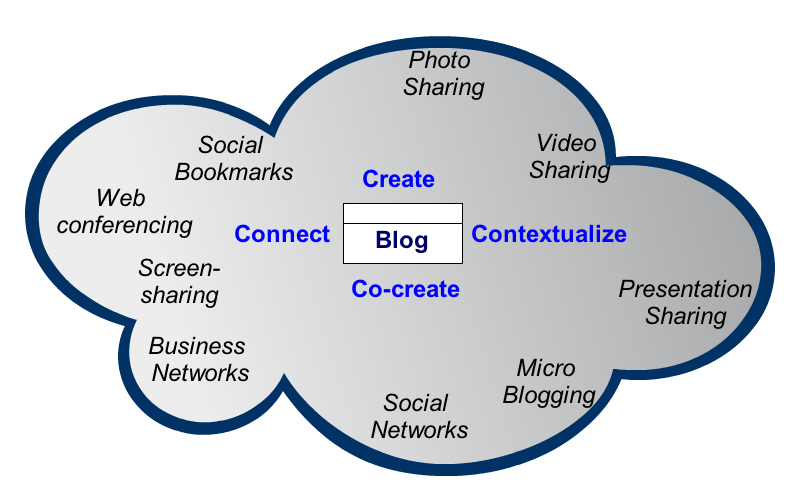
My four C’s of social media can be addressed through many social media applications but these processes do not need to be owned by any single application. I would say that it would be a mistake to use a single SaaS (software as a service) platform as your only way to engage in these processes. You can create, contextualize, connect and co-create in many ways; most of which can, and perhaps should, be linked back to your blog. Having watched MySpace get marginalized while Facebook dominates for now, it’s only a matter of time before more new platforms that we don’t own come along and lure the next bunch of digital sharecroppers. To see where blogging may be headed (Blogs 2.0?) check out Om Malik’s The Evolution of Blogging.

Four C’s of digital media

Gaurav Mishra wrote a guest blog post at Beth Kanter’s blog, on the 4 C’s of social media, complete with explanations and possible uses of this framework:

  1. Content
  2. Collaboration
  3. Community
  4. Collective Intelligence

I like the way that Gaurov puts these on the axes of becoming more visible and at the same time more difficult, as one progresses from content creation to collective intelligence. His rationale for the framework:

If you are a journalist, analyst or academic in the business of understanding social media initiatives, you’ll find the 4Cs Framework really useful. What are the boundary conditions needed to succeed at each layer? What are the boundary conditions needed to move from Content to Collaboration, from Collaboration to Community, and from Community to Collective Intelligence? Can you think of other digital activism or social media initiatives that leverage the Community or Collective Intelligence layers?

Clark Quinn and I have discussed frameworks for social media before and we came up with four C’s from a different perspective in a bit of a back-of-the-napkin exercise. I put them on a scale that made sense to me, with particular regard to network effects, the essence of Web 2.0:

a network effect  is when a good or service has more value the more that other people have it too … Examples include e-mail, IMing, the blogosphere, and even the Web itself.  But what’s not clear from this description is the raw power that is caught up in and represented by network effects.  Most rigorous studies and mathematical formulations reveal that there is tremendous geometric power in network effects.

inducingnetworkeffects

The figure below is what Clark and I developed as an initial concept on the digital artifacts of social media. As one moves from content creation to contextualization (through grouping, tagging or rating), the potential network effects increase. This gets greater as people connect to the artifacts (through comments, linking or discussion) and then to co-creation, such as mashups or remixes. The basic idea is that as more people manipulate digital objects and give them meaning and context then these objects will gain in value. A YouTube video of an unknown person lip-syncing a popular song has little original value, but when that video (e.g. Numa Numa) gets over 30 million views, links & comments, network effects increase its value to perhaps more than the original song. The creator gets tangible value through the network in the form of guest appearances or fees for another video.

Picture 2
This is still an idea in progress but is another example of why giving up part of your value chain and letting it loose may actually increase value for the creator.

Web 2.0: A Strategy Guide | Review

Web 2.0: A Strategy Guide by Amy Shuen covers many of the business aspects of Web 2.0 and is aimed at the general business reader. As Shuen says in the introduction, “you don’t need an M.B.A. or a degree in computer science” to understand the book. It starts by comparing Flickr’s business model with Netflix’s and goes on to discuss concepts such as network effects and the Bass Diffusion Curve. I found Chapter 4, Companies Capitalize Competences the most interesting, as it discusses collaboration and working across the Web:

Even in new projects, creating value often means letting some of that value flow elsewhere. The creative energy of mashups appears in large part because the companies providing the services being mashed up no longer insist on total control over their products. That flexibility allows a different dynamic than the usual system of “create, patent, and license” that has dominated intellectual property for the last few decades.

My experience with several clients over the years is that they do not understand network effects and have great difficulty ceding any control. This book would have been good for them, but then again, I’ve noticed that many business leaders do not have or make the time to read about their business or the forces that affect it. Don’t worry, I’m doing that for you ;-)

I would recommend this book as an overview of Web 2.0 with a strong business perspective and a lighter treatment of the actual technologies (fine for me). The easy-to-read End Notes provide more information for those who wish to further investigate an item. The final chapter includes a template and explanation of how to develop a Web 2.0 Business Plan, that many may find useful.

Where’s your data?

I wrote about the importance of owning your data for blogging a while back and last week’s Twitter crash coupled with the demise of an URL shortener only reinforce that in my mind. The case of tr.im may not be so obvious to some, but whenever you use a URL shortener, that connection gets stored in the cloud and if the service goes down, you won’t be able to trace back the link. This is a real problem on Twitter where everyone uses URL shorteners and that’s why I write up  Friday’s Finds with real links.

The main issue is the increasing use of software as a service (SaaS) which is simple, easy and out of your control. SaaS provides ease of use to many of us, but in return we become dependent on that service provider, much as we do with proprietary software.

Anyone who uses social media for professional purposes should know what SaaS they are using and think about a backup plan.

Here’s mine:

  • Blog: hosted on an independent server, with tape backup, using open source software (WordPress)
  • Facebook: no backup, but nothing worth losing, IMO
  • LinkedIn: contact information copied to Hard Drive
  • Twitter: Weekly synthesis of important posts put on my Blog with ‘Friday’s Finds
  • Flickr: original photos on Hard Drive
  • Slideshare: copy of presentation on Hard Drive
  • Delicious: OPML file downloaded monthly

own your data

PS: I also backup my Hard Drive ;-)

Communication

Jay Cross brings back some advice from Peter Drucker on how to manage knowledge workers and much of this advice is predicated on the concept of effective communication. Knowledge workers need to understand their role as assets in an organization and need to know what is going on while both learning and teaching as part of their work. I would say that all of my work is about communication. I’m not a communications specialist per se, but that’s almost all I do. I analyze communications and I sense patterns in what may be perceived as chaotic communications and I spend a lot of time talking, listening, reading, writing and presenting.

espace_internet_by_dalbera

I noted a while back that over 20 years of military service could be distilled into the mastery of three processes in communications tools from the Army. Like most writers will tell you, the only way to become a good writer is to write. The same goes for knowledge workers. Spend more time communicating and master the wide variety of tools necessary for your networks. I’ve realized that writing a blog on a regular basis takes a different skill-set than writing reports or essays. The same goes for Twitter. Certain types of communications are well-suited for 140 characters and others are not. One of my objectives is to get better at creating videos and podcasts. Of courses, I’ll have to practice.

Photo by dalbera

Tetrads

According to Derrick de Kerckhove, Director of the McLuhan Program in Toronto, the McLuhans’ tetradic Laws of Media state that every new medium (or technology in the broader sense of the word):

extends a human property (the car extends the foot);

obsolesces the previous medium by turning it into a sport or an form of art (the automobile turns horses and carriages into sports);

retrieves a much older medium that was obsolesced before (the automobile brings back the shining armour of the chevalier);

flips or reverses its properties into the opposite effect when pushed to its limits (the automobile, when there are too many of them, create traffic jams, that is total paralysis)

For example, I looked at the emerging practice of commons-based peer production, such as open source software projects, with this perspective and saw that this democratization of work:

  • Extends each individual’s reach worldwide
  • Obsolesces the middle men (accountants, lawyers, traders, brokers)
  • Retrieves the barter system or the bazaar – (I can set my own rules for buying & selling)
  • and Flips, when extended to its limits, the Commons into a whuffie economy

Tom Haskins uses the tetradic framework to examine the effects of pervasive connectivity, with this image:

Haskins_Tetrad

What I find most interesting is that with new lenses we can see the world in a different way. Finding appropriate lenses and metaphors to help make sense of our world is an important part of facilitating learning. Too much training and education consists of information delivery (e.g. key content areas in the curriculum) but getting people to look at something from a new perspective enables change. This may be something to consider when first developing course material.

Here is another lens that helps to view disorientation in learning and is especially useful for adult learners.