Barriers to Collaboration

In Why Businesses Don’t Collaborate, Stewart Mader and Scott Abel ask 523 workers about their information sharing habits. In reading through the responses and sample comments, it becomes obvious that there are two technologies that limit workplace collaboration – e-mail & meetings. Both can do certain tasks well but these “technologies” have become overused and abused.

Most of us who work with social media already know that e-mail can be replaced by more appropriate tools such as wikis, instant messaging, blogs or micro-blogs for a number of tasks. Also, we free-agents know only too well how much time we’ve saved by being outside an organization and not having to attend useless meetings [I would say that by avoiding meetings & commuting, I gain 2-3 hours of productivity per day].

Some highlights from Why Businesses Don’t Collaborate (PDF):

The comments indicate that people consider email a significant time management issue, and the important information often gets lost in the volume of email.

… people … recognize that trying to conduct group collaboration and revision by email is not optimal.

75% of respondents … know that a wiki can be used for documents that require group input …

Only 6% regularly request changes to a meeting agenda.

A simple strategy to give workers some time back would be to require that all meetings have agendas (on a wiki) with accompanying minutes. Then take one task that is currently done by e-mail (request for input) and replace it with a wiki, blog or other more suitable medium. These are just two small steps that could save a lot of time and frustration.

Integrating Learning and Work

Tom Gram discusses the integration of learning and work (my professional passion) and gives a list of ten strategies for integration, of which three are discussed in detail in Part 1 (I’m already looking forward to Part 2):

1. Understand the job
2. Link Learning to business process
3. Build a performance support system

Of Tom’s 10 suggestions, not one is related to creating a course. That shows how relevant training is to the integration of working & learning and something to consider at the dawn of the learning age.

Look at “understand the job” and see how much of a challenge that could be in today’s workplace. What do you do when everyone’s job is unique? The learning professional must be in constant contact with the realities of the everyone’s work. Interventions and support will likely be incremental, addressing changing circumstances, but using multipurpose platforms for information and knowledge-sharing. Understanding work needs good two-way communications.

As jobs become more unique (I think the notion of the job may disappear over time), training either becomes a very expensive option or must be focused on specific skills that are used by several people. The result in the latter case is increasingly smaller units of training, which merges training into performance support, making training in the traditional sense less relevant.

In a complex or changing workplace (yours perhaps?), with shifting roles and responsibilities, Tom’s other seven strategies make even more sense:

4. Build a community of practice
5. Use social media to facilitate informal learning
6. Implement a continuous improvement framework
7. Use action learning
8. Organizational learning tools
9. Design Jobs for natural learning
10. Bring the job to the learning

I would say that these ten strategies would be excellent preparation for the networked workplace.

Bridging innovation and commercialization

Events during the past week have re-focused my attention on research, innovation and commercialization, especially as it pertains to learning technologies. I was engaged for my second time as the Scientific & Technical Evaluator for the SynergiC3 project, on behalf of the funding agency:

The main objective of the SynergiC3 project [a joint venture between l’Université de Moncton, the National Research Council of Canada and Desire2Learn] is to create a productivity enhancement framework that will allow a content development team to effectively manage its resources as well as provide tools that will significantly decrease production times and costs of developing learning resources while augmenting quality.

Meanwhile, David Campbell asked about the potential for a research campus in our region, “I’m always on the lookout for interesting economic development examples that may have relevance to us here in New Brunswick.” Several years ago I had completed a “diagnostic assessment” for the Miramichi region on the potential for “applied research, development and innovation options”, and recommended two economic development strategies – Community Wellness & Sustainable Living, with details on how the public and private sectors could work together. Each option included information, communication and learning technologies.

Here is some of the background material from that report on bridging research and commercialization.

In a series of three articles [not available online], Alan Cornford stated that increasing public R&D spending will not increase innovation capacity, as only 3% of public R&D spending results in measurable innovation. The only way to measure innovation is through the outputs of R&D – specifically local wealth generation. Cornford stated that there is plenty of venture capital money available, but not enough finance-worthy ventures. The key to driving innovation is having the right people.

Even more interesting is that Cornford showed that private sector investment has 15 times the return on investment as that of the public sector. His main recommendation was not to weaken public R&D spending, but to strengthen it through private partnerships, especially with small and medium sized businesses (SMB). Cornford favoured enhanced R&D tax credits and the channeling of government investment into “community innovation idea outreach” to communities and SMB’s.

Pertinent to any discussion on our region, Cornford believed that where local SMB R&D receptor capacity is limited (as in most of Canada), the universities, polytechnics and colleges can conduct applied R&D for local SMB’s and therefore benefit from these increased R&D investments, while community SMB innovative capacity grows. Closer to home, in 2002, Dr. Alan Cornford produced a report for ACOA – Innovation and Commercialization in Atlantic Canada [emphasis added]:

The four provinces of Canada’s Atlantic region face several challenges in achieving their competitive potential. Advancements in communications and information technologies can remove some of the region’s barriers associated with the small population base and geographic distance from major markets. Nevertheless, growth of a knowledge-based economy that either capitalizes on existing natural resources or supports new industry sectors will require significant changes in culture, attitudes and approaches to innovation and commercialization. With only a small foundation and infrastructure upon which to establish this new economy, Atlantic Canada must build partnerships and collaborate more than ever before.

Cornford went on to say:

Atlantic Canada requires an aggressive investment program, with funding increases focusing predominately on industry-driven applied R&D. An appropriate balance of relative capacity in each of the stages of the innovation process is also critical to accelerating competitiveness and creating a robust and innovative economy.

The table below is based on Cornford’s synthesis of innovation and commercialization development. It shows that both Innovation and Commercialization are supported by culture, awareness and understanding – key components of our educational systems. Cornford shows the stages of Innovation and Commercialization as separate but related.

I concluded that Stage 4, where Innovation and Commercialization meet, may be the “sweet spot” for any regional initiative on research development & innovation, helping to bridge university and college research (Innovation) with the needs of SMB’s (Commercialization). What is most interesting is that this is a core component of the SynergiC3 project – proofs of concept, prototypes and pilots.

Stage Innovation

Using know-how to develop a new product or process

Commercialization

Applying the results of R&D in a commercial setting

1 Basic Research
2 Dissemination
3 Applied Research
4 Proof of Concept Prototype, Pilot, Pre-seed Investment
5 Pre-commercial Seed Investment
6 1st Venture Investment
7 2nd Venture Investment

I suggested that the community college, on whose behalf I was developing options, should focus on Stages 3 & 4. Areas of overlap occur in these stages and this is where a college can create the most value. In order to work at these stages, the college needs “upstream” and “downstream” partners. These include research universities and NRC upstream with industry and investors downstream. Staking out a niche that enhances the work of universities, NRC and NRC-IRAP would be easier than going into a perceived competitive role.

Manage what matters — collaboration

Knowledge is personal and it cannot really be managed, though we continue to try. Artifacts of knowledge can be managed and in many cases they can be helpful to others. Learning is the same, I can’t directly transfer my learning to you, but I can try to teach or even train you, based on some good practices. We each have to learn for ourselves, though we can take advantage of the knowledge artifacts passed on by generations of people. It’s also getting easier to take advantage of what other people know as we get more connected online.

My own focus has been on personal knowledge mastery because managing how each of us makes sense seems to be the required foundation of anything resembling organizational knowledge management. The same goes for organizational learning – it cannot even be conceived to exist without individual learning. When it comes to learning and knowledge, we may be going down the wrong path when we try to put these into organizational buckets and manage them.

As Dave Jonassen has said many times:

Every amateur epistemologist knows that knowledge cannot be managed. Education has always assumed that knowledge can be transferred and that we can carefully control the process through education. That is a grand illusion.

We need people in organizations who can learn and gain knowledge themselves, though not necessarily by themselves. At the organizational level we need people who can work together or in concert on solving problems. Organizations should focus their efforts on helping people work together. It’s about work, or performance, not learning and not knowledge. “How can we help you work?” should be the mantra of all workplace support departments.

Learning and becoming knowledge-able are now basic requirements for every worker. These are basic requirements for life, as much as food and water. We don’t manage what or how our employees eat and we don’t need to manage their knowledge or learning. We can make it easier for them to learn and share knowledge though, just like putting in a cafeteria or a water fountain. Workers need support and tools to develop these personal processes but the organization should stay out of the business of knowledge and learning and instead focus on collaboration.

As Stephen Downes wrote on one of my previous posts:

collaboration means ‘working together’. That’s why you see it in market economies. markets are based on quantity and mass.

cooperation means ’sharing’. That’s why you see it in networks. In networks, the nature of the connection is important; it is not simply about quantity and mass …

You and I are in a network – but we do not collaborate (we do not align ourselves to the same goal, subscribe to the same vision statement, etc), we *cooperate*

In a networked society, we are re-learning how to co-operate as we take our networks with us, wherever we go. Once inside an organization it is necessary to focus our group work on a task or mission and that requires collaboration. Collaboration is what organizations should primarily focus on. Successful collaborative efforts are the measure of a successful organization. All of that focus and energy on managing knowledge and learning is wasted because it can’t really be managed anyway.

Workers, Management and Work Support

Learning professionals are facing similar issues that others (HR, KM, IT & Marketing) do, but in many ways it’s a case of the blind men and the elephant. We are constrained by the blinders of our profession’s models. That’s one reason I like to take my models from a variety of fields, not just training or HPT. I previously wrote that we should integrate our work support departments and Tom Gram shows how this can be done by designing an organizational effectiveness function or creating internal management consultants, though these approaches can create their own bureaucracies as well, as Tom recognizes.

As effective as these approaches may be for now, I don’t think they’re adequate for the future. Everyone is struggling to keep up with change but most are using outdated tools and models. As Lou Sagar commented on Umair Haque’s post, ” … the emergence of new business models are ahead of the organizational framework to embrace and manage the impact.” That pretty well sums up the problem in my mind. We are all blind men unable to understand the new realities of work. Look at a business model as new as e-Bay’s, which many companies have yet to understand, and then add in the fact that it is already outdated and may even be declining.

The real conversation has yet to surface in the mainstream about the organizational change needed to address complexity and networks. There are models surfacing but as yet to be embraced, such as Haque’s work, wirearchy or valence theory. Creating a Chief Performance Officer out of the previous HR/Training/OD/KM functions may seem like progress but not if the realities of networked wealth creation don’t need a Chief “X” Officer any more.

Models such as chaordic organizations (PDF) show that command & control is not always necessary to be effective, especially within networks:

Given the right circumstances, from no more than dreams, determination, and the liberty to try, quite ordinary people consistently do extraordinary things.

Here’s the model that I’ve constructed on how training should adapt to a world where working and learning are synonymous, but even this shows a difference between management and workers, and perhaps that distinction is no longer pertinent.

In complex environments and networks, if workers need to be managed, they should not be hired in the first place, but then neither should managers.

Co-operation for Networks

Stephen Downes took me to task for my suggestion that collaboration was the optimum type of group work in networks:

collaboration means ‘working together’. That’s why you see it in market economies. markets are based on quantity and mass.

cooperation means ’sharing’. That’s why you see it in networks. In networks, the nature of the connection is important; it is not simply about quantity and mass …

You and I are in a network – but we do not collaborate (we do not align ourselves to the same goal, subscribe to the same vision statement, etc), we *cooperate*

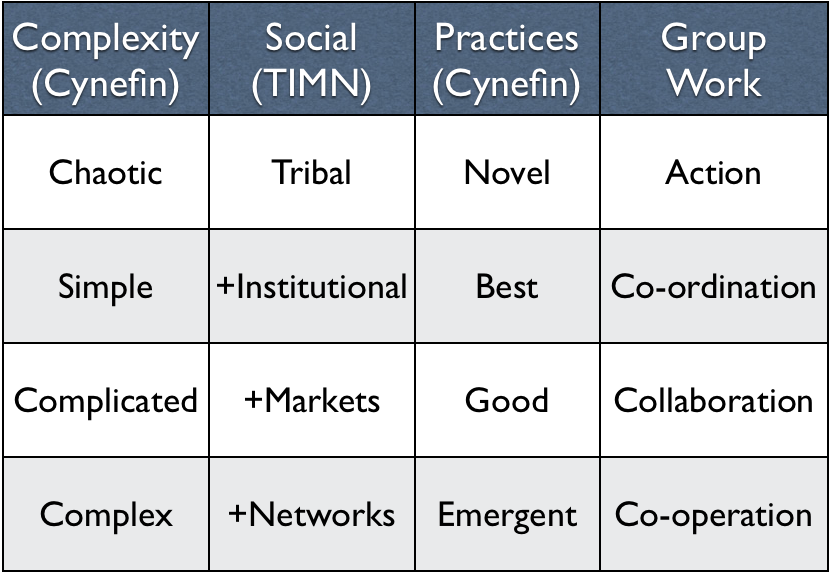
I began to see that co-operation makes more sense as the term to describe working together in a networked  and non-directed relationship. So is the distinction important? I think so. Jérôme Delacroix provides another confirmatory post on “co-operation” as the suitable term for what we do in networks [in French]. Jérôme explains why his site is called Cooperatique and not Collaboratique – collaboration happens around some kind of plan or structure, while co-operation presumes the freedom of individuals to join and participate. He also says that co-operation, not collaboration, is a driver of creativity. That’s quite an important distinction when looking at work analysis and design.

Here is my revised table, for the record:

Social tools for networks

Effective knowledge sharing is what many organizations do not do well, or as Lew Platt past-CEO of Hewlett-Packard said, “if only HP knew what HP knows, we would be three times more productive”. But HP will never know what the employees of HP know, so wouldn’t it be better to let the workers share what they know in the best way possible? That’s the key benefit of personal knowledge management, in my opinion. If each person can better manage knowledge creation and capture, then it becomes easier to share it.

For example:

Social bookmarks let me tag and search a wide array of bookmarks and by making them public they are shared with others, but through no extra effort on my part.

Writing this blog gives me a knowledge-base of my thoughts which become articles and presentations but in being public I find others who can add to my knowledge. I also make available information and perhaps knowledge that is useful to others.

By posting on Twitter I answer questions, share links and opinions and get to know others with similar interests, with the same effort as chatting in the office but with a much broader reach. On the Net, chance favours the prepared mind.

Just providing access to knowledge creation and capture tools is a relatively easy first step in moving the organization to Enterprise 2.0; an essential step in working in complex networks versus complicated markets. During the initial implementation of these tools, there is no need to talk about collaboration. Many Web 2.0 tools can be sold on their value to the individual. Let collaboration emerge from the individual practices of workers, most of whom want to do a better job anyway.

The powerful aspect of most Web 2.0 tools is that they are designed for knowledge-sharing as well. However, collaboration is difficult with the imposed barriers to communication created by Enterprise 1.0 IT policies. The major obstacle to social learning (and working) today is the IT department and it’s time that management takes back control of information sharing. This post was inspired by Dave Pollard’s practical guide to implementing Web 2.0 which gives more information on how to accomplish this.

The transition to networked accountability

At the expense of being repetitive, I keep seeing this same pattern that Tom Haskins got me started on and which he summarized in reading situational responses:

Then I read Charles Jennings’ post on accountability for business results and saw a similar four part process, but Charles shows how the transition from one structure to the next is not linear at all when viewed from the perspective of the two axes of Autonomy & Strategic Alignment.

Charles’ C-Curve is a model in practice, based on his experience as CLO of Reuters. I see a parallel between this migration of the learning and development (L&D) department and the social order necessary to do certain types of group work:

  1. L&D Autonomous = taking action as a Tribe of its own
  2. L&D aligned with organization = coordinated with the Institution
  3. L&D with governance structure = able to work in a cooperative collaborative Market
  4. L&D strategically aligned = a collaborative co-operative member of (a) Network(s)

Note: I’ve re-thought my use of the terms co-operation & collaboration here.

I wonder if this curve describes other departments in different organizations. It is evident that there is greater freedom either as a tribe or in a network, while institutions and markets restrict freedom. Could it also hold that previously tribal organizations (1) may thrive best in networks (because they are used to more freedom) if they can successfully make the transition between the other two stages? I have noticed that it is difficult to convince organizations steeped in the institutional model (2) that the networked model may be better. Those who already have to respond to markets (3) understand the value of networks (4) much better, in my experience.

Learning and Working in Complexity Workshop

Over several online and on-site presentations this past year, I’ve noticed a need for organizations to develop practical tools and contextual processes to manage information, knowledge and learning. I am offering a one-day workshop that encapsulates several years of “learning & working on the Web”.

Learning & Working in Complexity Workshop

One day (on-site or online)

Part 1: Overview of issues and forces that are fundamentally changing workplace learning

Part 2: Discussion & Examples from various fields

Part 3: Personal Knowledge Management (PKM) overview

Part 4: Setting up your own PKM system

References:

Skills 2.0 for learning professionals

PKM

Future of Training

Integrating work support systems

Here’s a good article in TrainingZone (behind a free registration firewall) on OD in the 21st Century that describes many of the issues discussed in Training for the 21st Century, but from an organisational development perspective. Anne Marie McEwan describes her work with the Johnson Controls Mobility Network which is for senior IT, HR and Facilities Management executives for exploring the practical implications of global workplace trends:

These busy executives do not have time to keep up with developments. Having researchers source, summarise and contextualise content from the internet is already a benefit. Sessions are informal.

And this sure sounds like the development of emergent practices:

In collaboration with the team, the executive engages in action learning and critical reflection of the external environment and internal structures, systems and processes. New knowledge, frameworks and tools the support team members introduce, in a just-in-time way, are of course valuable.

However, Anne Marie notes:

In the author’s experience, functional walls between HR, IT and FM are as strong as they ever were and this will threaten enterprise viability.

It’s obvious that the same workplace issues are being faced by HR, IT, OD, KM and T&D tribes departments and that similar strategies are being co-developed in these fields. Given my multi-faceted consulting work, I would even consider myself a peripheral member of all of these communities and would now include Marketing.

Reflecting on my last post on working together it becomes clear to me that using cross-functional teams is not enough for Net Work. We really need to get away from our self-imposed tribes and adopt network thinking and practices.