Friday’s Finds 200th Edition

friday2Friday’s Finds:

Every second Friday I review what I’ve noted on social media and post a wrap-up of what has caught my eye. I do this as a reflective thinking process and also in order to take some of what I’ve learned and put it on a platform I can control, my blog. This is the 200th of a continuing series of posts, especially for my friend Hans deZwart, who seems to appreciate this eclectic mix of views and news.

@ffunch“If you merely follow a fellow, a hello is hollow. But jump off together, enquire in choir, and even a glance will advance.”

@flowchainsensei“For the majority of folks, organisational silos are all they have ever known.”

“Google’s most famous perk—that engineers could work on side projects 20% of the time—no longer exists.” – via @yayitsrob –  Original Quartz Article  + Google Engineers’ Response : “Apparently, 20% time is jokingly referred to within Google as “120% time” to indicate that, while engineers have the opportunity to pursue their own projects, it’s only on top of their existing (often quite demanding) schedules.

@dsearlsBig Data will remain a Big Dud until individuals have their own

But we’ve seen this movie before and we know how it starts: with assumptions that it can’t be done. It can, and it will.

We are going to be able to do far more with our own data — and data, period — than big organizations ever could.

@oscarbergOur future relies on our social networks

The greater the challenges we face, the more we need to extend and enhance our social networking, communication and collaboration abilities. Our social networks, and thus the means we have to support these (such as online social networks and social technologies in general), are key ingredients in any approach to deal with challenges we need to face ahead.

@JMOChicagoCulture VS. Structure [lots of first-hand examples of how to use minimal organizational structure, as well as advantages & disadvantages]

One thing that caught me off guard early on when I was hired into the Human Resource Development group was the complete absence of an organizational chart.

Three Amigos

What happens when four independent consultants get thrown together and are told they are now a team? Sometimes, everything clicks and a wonderful new relationship begins. That’s what happened in Riyadh this week. Four of us were invited to work with a relatively new governmental organization focused on renewable energy, K.A. CARE:

“The world depends on energy and is moving inexorably towards more sustainable sources than fossil fuel as they are a non-renewable resource. Saudi Arabia is no exception  to this; it has the vision and drive to ensure the introduction of renewable sources of energy. To provide a sustainable and efficient energy future for the Kingdom, KA CARE has recommended a sustainable energy mix taking into account: the economics of the hydrocarbons saved; electricity and water demand patterns; technology choices; regulatory and physical infrastructure requirements; human capacity development; and value chain enhancement.”

Coordinated by Alan Kantrow, a seasoned professional, the remaining three of us were challenged to work together to weave together a single narrative on institutional memory and storytelling over two days. On the third day, it would be presented to the executive leadership. The three amigos improvisational team — Alex Barrera, David Hutchens, and myself — had to quickly understand each other and then develop a coherent narrative that made business sense for the client. Needless to say, there were many things to take into consideration, including the client’s cultural context. So a Spaniard, an American, and a Canadian walk into a Saudi organization, and …. [see the photos]

As Alex and David presented, I learned a lot about storytelling from these experts. First of all, don’t confuse story with narrative, said Alex, as stories contain emotion. Stories are how we best remember and a story can be thought of as what happens in the gap between expectations and results. David provided an excellent structure for stories, discussing story mining, crafting & telling, and sharing & sense-making. It reminded me of PKM‘s Seek-Sense-Share.

storytelling frameworkMy presentation was based on several of the posts on institutional memory & knowledge management that I’ve shared here over the past few weeks, particularly looking at the different ways to deal with implicit and explicit knowledge. Our client commented that implicit knowledge is the glue that connects explicit knowledge together. I think our gluing together of the explicit knowledge that we presented was aided by the fact that we could spend several days together, get to know each other, and try to share some implicit knowledge, such as our perspectives on life, the universe and everything. The answer of course, was 42 ;) press42-logo-smallAfter our presentation to the senior leadership on Wednesday, one participant asked to confirm that we were not all from the same company and had never worked together. He did not believe that three individuals, from different backgrounds and countries could come together so quickly and speak with a unified voice. I think our collective participation in social media made this a lot easier, as were were able to integrate our networked thinking into a larger network. It seemed quite natural to all three of us.

The End (for now)

stop

Dismantling hierarchies

Can organizations still function if we dismantle hierarchies?

childs-eye

In the social imperative, Jay Cross asked me how can organizations restructure in order to deal with complexity. In other words, how can they loosen hierarchical (direct) control and strengthen network (indirect) control?

“So essentially, we need to rely on others (via networks) to thrive above the midline of Verna’s chart, but we must become flexible in order to deal with the left hand side. Dave Snowden implies that mistaking the left for the right is fatal, since they require different responses.

Harold, is this a tipping point phenomenon or can organizations dismantle bureaucracy incrementally? What drives the lessening of top-down control to enable the flex to deal with the increasingly complex world?”

Read more

A portrait of a conversation

I talk a lot about the narration of work, how it can help implicit knowledge to flow, and how our collective words can become a force for change. Recently, I’ve been watching a most interesting narration of the art of painting, from the perspective of the subject. This is not any subject, but a professor emeritus of art and an established art critic.

Virgil Hammock is narrating a series of blog posts on how Stephen Scott is painting Virgil’s portrait. It’s a fascinating read. In Stephen Paints a Picture: Part One, we learn about the inspiration behind the project.

I told him [Stephen]  about a book, Man with a Blue Scarf, I had read written by British art critic, Martin Gayford, of sitting for a portrait by Lucian Freud and how interesting it was to follow their conversation over the very long time it took Freud to complete the painting. One thing led to another and we decided to repeat the idea with me as the subject

In Part Two, we learn about a painting of Stephen’s that Virgil had used in a show this Spring.

It was a portrait of Stephen’s based on photographs, that of the poet Alden Nowlan (2009, 125cm x 100cm), that was included in an exhibition I curated at the Beaverbrook Art Gallery, Art Treasures of New Brunswick, earlier this year that made me want to learn about how the artist worked. Stephen did the painting as a commission for the University of New Brunswick Library. What drew me to the painting was the evidence of the artist’s struggle. This was no slick photo realist painting or usual university official portrait. I have seen plenty of both. They are all over the place at universities, mine included, which look like painted photographs of really boring people. I had known Alden and he wasn’t boring and Stephen’s painting made him look like how he was, a very interesting person.

alden nolan by stephen scott

As Virgil describes his conversations with Stephen, we learn about the artist’s particular craft, techniques and perspectives. There is a lot to discover. I think a lot of work is like that – easy to see the surface but much more difficult to perceive the undercurrents. Having a knowledgeable second party narrate the work in progress is also effective in ensuring that things are not taken for granted. Virgil asks questions that Stephen may not have offered up on his own. It shows the power of conversation in sharing knowledge.

These posts also highlight the need for reflective conversations, done while working, but with a goal in mind, to draw out better understanding. I think it is a good example for anyone involved in organizational knowledge management. Sharing knowledge takes time, usually one conversation at a time, and over an extended period of time. Management has much to learn from artists.

Stay tuned to the continuing story to find out how the portrait turns out.

the social imperative

Dr. Robert Sapolski has been studying baboons for thirty years. While many researchers took for granted the hierarchical nature of baboon life, with dominant males attacking those next down the social ladder and then the process repeating itself down to infants and females, Sapolski did not. One thing his research showed was that the baboons on top were less stressed (lower stress hormones) and had lower blood pressure than those lower down the social ladder.

But then a most interesting event occurred with a certain troop that Sapolski was observing. The baboons started feeding from a garbage dump and many became infected with tuberculosis. Nearly half the males in the troop died, mostly the aggressive and non-social ones. Every alpha male was gone! As a result, the atmosphere of the troop changed and became much less aggressive and more social. Not only that, but any new males who joined the troop were discouraged from being aggressive and adopted more pro-social behaviours within six months.

In this more social and less hierarchical environment, the troop as a whole became healthier and less stressed. It is currently thriving. The fundamental lesson that Sopolski came back with was that “textbook social systems that are engraved in stone” can be changed in one single generation. There may be hope for the human race, it seems.

Recent research shows that evolution is on the side of those who cooperate.

“We found evolution will punish you if you’re selfish and mean. For a short time and against a specific set of opponents, some selfish organisms may come out ahead. But selfishness isn’t evolutionarily sustainable.”

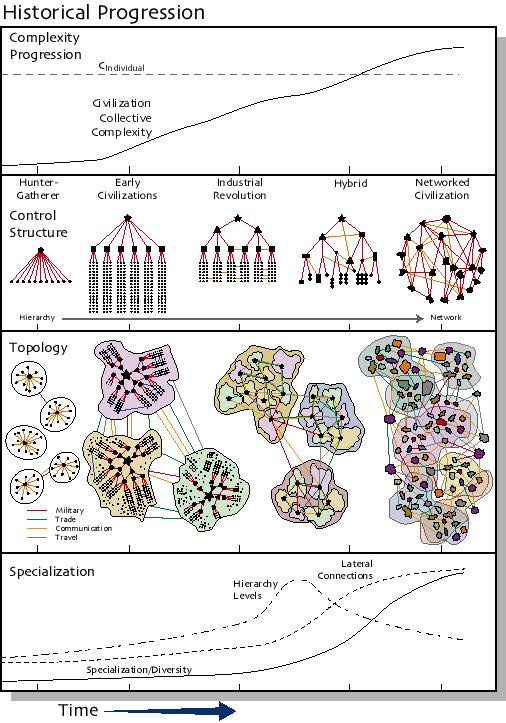
The natural world is composed of complex systems and it makes sense that the best strategies for any population are ones that take complexity into account. This is a limitation of hierarchical organizational models. They cannot address large-scale levels of complexity, as explained in Complexity Rising, a 1997 paper on complexity profiles.

“In summary, the complexity of the collective behavior must be smaller than the complexity of the controlling individual. A group of individuals whose collective behavior is controlled by a single individual cannot behave in a more complex way than the individual who is exercising the control. Hierarchical control structures are symptomatic of collective behavior that is no more complex than one individual. Comparing an individual human being with the hierarchy as an entirety, the hierarchy amplifies the scale of the behavior of an individual, but does not increase its complexity.”

As Yaneer Bar-Yam explains in Complexity Rising, hierarchies have diminishing usefulness as complexity increases.

“At the point at which the collective complexity reaches the complexity of an individual, the process of complexity increase encounters the limitations of hierarchical structures. Hierarchical structures are not able to provide a higher complexity and must give way to structures that are dominated by lateral interactions.”

rp_historical-progression.jpg
Image: Complexity Rising, UNESCO

Many of these lateral interactions are what we would call social relationships. They are outside the official hierarchy. As Verna Allee has noted, for complex environments, or ‘un order’, we need stronger networks and looser hierarchies. But most of our organizations are designed for ‘complicated order’ only. Or you could say that we need more lateral interactions.

Better social relationships (non-hierarchical and not based on the dominance of others) can make for healthier populations. In addition, networks are the only way our collective intelligence can be used to address increasing complexity. Becoming more social is not just a business driver but also a societal imperative.

rp_cynefin-networks-verna-allee.jpg
Image: Verna Allee

New Jobs People will have in 2025

CORPORATE DISORGANIZER
Big companies want to be more like startups, seeing innovation as vital to future profits. Young says they’ll want “corporate disorganizers” who can introduce a little “organized chaos.” Young says: “The disruptor will be tapping into the new systems of the collaborative economy, creating greater fragmentation and a more distributed ecosystem.” – Terry Young, CEO Sparks & Honey, in FastCoexist

I would say this role already exists!

Continuing the subversion, one post at a time

friday2Friday’s Finds:

Quote of the Fortnight:

@nestguy – “Writing for Medium is like joining a hip gym where all the benefits of your workouts are transferred to the gym owner’s body.

« La séparation des sciences et des lettres est un artefact universitaire, créé de toute pièce par l’enseignement. – Michel Serres » – via @zecool [The separation of the sciences and the arts is a created fiction by the higher education system.]

Today in 1986, Charles Bukowski wrote a great letter to the man who rescued him from his ‘9 to 5’ job – via @raesmaa

And what hurts is the steadily diminishing humanity of those fighting to hold jobs they don’t want but fear the alternative worse. People simply empty out. They are bodies with fearful and obedient minds. The color leaves the eye. The voice becomes ugly. And the body. The hair. The fingernails. The shoes. Everything does.

The intelligent, the bandits, the helpless and the stupid – by A Man with a PhD

One hallmark of the bandits when they run a company is that they are mostly concerned with how Wall Street sees them, focused on quarterly earnings instead of long term growth, looking at market share rather than profitability. All in order to maximize the money they get. Short term manipulation is better than long term growth.

Selfishness doomed while cooperation evolves, study says –  via @dinoboy89

In their study, released Thursday in Nature Communications, they created theoretical populations of organisms in which some were selfish and some were “suckers,” as Adami put it. If the two personality types were unable to tell each other apart, the selfish individuals would attack one another and the suckers and eventually go extinct, and the suckers would win. However, if the selfish ones could recognize the suckers but not vice versa, then the selfish ones would win, playing nice with one another while killing off the suckers.

Co-operation beats competition in natural selection. “Maybe we should teach ourselves how co-operate better?” – @paulgslatter

“We found evolution will punish you if you’re selfish and mean. For a short time and against a specific set of opponents, some selfish organisms may come out ahead. But selfishness isn’t evolutionarily sustainable.”

Institutional Memory and Knowledge Management

This is a follow-up post on building institutional memory. The basic premises are stated in sense-making for decision memories. This presentation includes additional details and more explanations. It adds many new slides to help with the flow of the narrative, limited as it is with this medium.

The main themes are:

Memories are captured as knowledge artifacts, each limited by what it can convey, depending on its nature and the knowledge of the recipient.

Decision memories have a certain importance for organizations; to understand why decisions were, or were not, taken.

Knowledge management can provide a structure to capture institutional memory, but it requires more than a single approach.

Complex work, which is growing in importance in networked organizations, requires the sharing of implicit knowledge and this presents certain challenges.

We should take complexity into account and develop frameworks for sharing knowledge and storing institutional memory to help organizations deal with current events and prepare for an uncertain future.

institutional_memory

The New How – Review

The New How: Creating Business Solutions through Collaborative Strategy is a how-to book for anyone involved in strategy development in a large organization. It’s a toolkit for implementing a more collaborative workplace. It’s about the How and not so much the What or Why, though there are many anecdotes shared by the author Nilofer Merchant, from her experiences with companies like Apple, Adobe, Nokia and HP. Co-creation of strategy, especially the How part it, is a major theme here. As Nilofer explains:

Once upon a time, some firms had more access to data and information than others. Some firms had more skills at slicing and dicing. In that time, heavy-duty data analysis was enough to form a competitive advantage. Today, everybody has access to vast amounts of high-quality information and the tools to crunch it. What matters now is the ability to act on that information: to conceive – now – the nugget of hidden opportunity in a given situation. The key is being able to work with one another and come up with new ideas, build on those ideas, and then add insights based on the data that empower us to act in unique and differentiated ways.

Another reason that collaboration is so important is that the notion of the great leader, or what Nilofer describes as The Chief Answer Officer, cannot handle the complexity of the current hyper-connected business environment. Here is her advice to GMs, VPs and others in high management places:

The answer to today’s specific question is only that – part of the solution to today’s problem. Next week’s problem will require a different solution. And next month’s question will need yet another answer. Crowning yourself the Chief of Answers puts you in a difficult position, one with very little advantage. It sets your team up to be the Tribe of Doing Things. And, at the end of the day, you end up feeding the very counterproductive cycle you need to alter.

As a bonus, the book is amply illustrated by Hugh MacLeod, which makes it an even more interesting read.

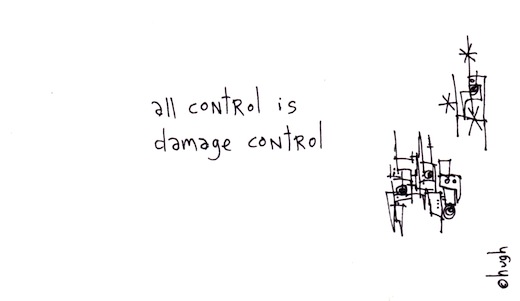
0711allcontrolA good part of the book covers the Quest method of strategy development, with plenty of examples and aids. I found the “MurderBoard” the most interesting section. This section alone makes the book worth buying. The MurderBoarding sequence is simple: 1) Decide what  matters; 2) Sort; 3) Test; 4) Choose. The last step is critical, for “If you don’t choose, you don’t have a strategy; you just have a set of options.” Or, to make it as clear as possible,  “MurderBoarding: It’s not how many ideas you have. It’s how many good ideas you kill.

This is a detailed and practical book. It is not a high-concept tome where at the end you feel good but don’t know what to do next. There is enough pragmatic advice in this book for any executive or manager to run with. It’s a valuable addition for people with management responsibilities in large organizations or anyone consulting to such an organization. Here is one final quote that succinctly describes the end goal of The New How:

“Permission to innovate without asking happens when the strategy is co-owned.”

A mobile workforce needs better on-site conversations

The future of workplace learning is social, cooperative and especially mobile. One approach for this type of workforce is to support their mobility with something like a ‘genius bar’, instead of having to request a support ticket from IT or get an appointment with HR. There is a growing array of enterprise software tools to support the emerging workforce, but it takes more than technology, as Dion Hinchcliffe warns.

We forget at our peril that collaboration is a fundamentally human activity. This implies that any use of enabling technology without taking into account how people actually conduct their work, their inclinations to share information and interact with each other, and in particular how the proposed technology will empower them and alter their collaborative behavior for the better/worse, is bound to disappoint.

Providing mobile access for work and learning just makes sense today. Clark Quinn says that mobile technology makes a lot of sense, as “it decouples that complementary capability from the desktop, and untethers our outboard brain“. Sense-making is a critical skill for most knowledge workers today, and frameworks like PKM can help. When I refer to personal knowledge management, especially my blog, I often call it my outboard brain. Supporting mobile technologies can leverage every worker’s outboard brain and free up cognitive load for pattern recognition, the stuff that machines are not as good at.

clar quinn on mobileWhile sales of tablets are increasing, and mobile business is an expanding sector, there is still a lot of work to be done on how people actually conduct their work. Legislating mobile collaboration is probably not the best solution, but it does underline the huge cost-savings of abandoning the industrial age concept of being paid for merely putting in time. As Nancy Dixon writes, “The only reason to come together face-to-face is for people to be in conversation with each other!” Too often though, the workplace is not designed to enable conversations. While mobile technologies may be part of the solution to a more agile workforce, another component is improving the workplace environment so that people can do what they do best face-to-face — converse.

If you replace the word “learner” with “worker’ in this article on the SPATIAL model, you can see that there is a lot that can be done to make work environments more open. More open environments can encourage conversations [AKA, participation in complex work].

Participation is a critical variable in nonmandated education; thus, the physical environment’s impact on participation rates can be especially important in educational and training efforts outside of school settings.

Mobile work and learning proponents should also be looking at changing the physical workplace to further support a more nomadic workforce that is empowered with mobile technologies. Let me finish with another example from Nancy Dixon, a case study called The Hallways of Learning, where a change in the physical layout of a hallway significantly increased in-depth professional interactions.

The learning that occurred in Researcher’s Square did not come from presentations, rather the knowledge gained was through conversation. When we think about learning from others our first thought is to have someone make a presentation. But as ubiquitous as presentations are, they are a poor way to learn from peers. Typically, a presenter offers what happened in his or her own situation, but that is not what learners need to hear. Learners are interested in knowing how to adapt the lessons to their situation and for that they need to have a conversation so that the other person can understand their context, and they also can understand the context of the other.

This post is brought to you by Mobile Enterprise 360 Community and Citrix

Note: I retained editorial control and take full responsibility for what is posted. Contract writing is one of the ways I make my living.