Toyota worries that automation means it has too many average workers and not enough craftsmen and masters. But if you increase Talent and decrease Labour, what else needs to change? Pretty well the entire management/leadership system and particularly ‘human resource’ management.
Harold Jarche
PKM and small business
There is one group that probably has the most need for professional development but has the least time – owners of small businesses. My parents owned a small business. They worked seven days a week. They never took any training courses. I am sure that if they were working today, they still would not take any formal instruction, but they might be active searchers on Google or YouTube. They might use Facebook or a website to stay in touch with their customers.
Several years ago I tracked small business blogs with some interesting examples such as a sign company, a coffee roaster, and a metal fabricator. Some have gone out of business and others have stopped blogging but there a few that continue. One was highly successful. A lot can be learned from all of these. I wonder if many small business owners have looked at what others have done with blogging over the past decade. It’s not about SEO (search engine optimization) it’s about staying connected to customers, suppliers and communities, and continuously learning.
Good Friday Finds
Which Comes First: Engaged Employees or Customer Success? via @OscarBerg

You want to have tools to help employees get work done. Those tools are no longer the HR systems of performance management and compensation. — those don’t help to get your work done. What we’re seeing is heavy adoption of work management tools, task management, collaboration, file-sharing and so forth. People need tools to connect, to share knowledge, to build community and culture and, ultimately, to get their work done, which is about serving customers.
@AndrewJacobsLD – One Man’s Magic …
If you have a washing line, do you need to continually update your tumble dryer?
Does not having a tumble dryer put you at a disadvantage?
Is this a problem that learning technology suppliers have – how to sell us a more efficient tumble dryer?
Does knowing which clothes dry best in which circumstances make THAT much of a difference?
Organizing Talent
The opposite of ‘routine’ is ‘original’
Labour is routine. Talent is original. Even advanced technical Labour can be in essence routine. As Labour, once you learn how to do something, you are able to repeat it. Labour is the capitalist dream for human effort, because it can be quantified, controlled, and replaced. Labour is viewing humans as resources. What is becoming blindingly obvious is that Labour is increasingly getting automated which is disrupting how most people have worked for the past century, by doing a job.
On the other hand, original work has high task variety and requires continuous learning, as well as significant tacit knowledge that cannot easily be codified. Talent that does original work is difficult to replace. This means that Talent is much more difficult to push around.
Ten Years, Ten Thoughts
In compiling my ebook, Seeking perpetual beta: a guidebook for the network era, I tried to cover all the posts that resonated with readers, clients, and colleagues over a decade. Here are some highlights, representing one thought per year.
-
- Taking control of our learning is a challenge for individuals used to working inside hierarchies that demand conformity and compliance.
- The mainstream application of knowledge management and learning management over the past few decades was mostly wrong; we over-managed information, knowledge, and learning because it was easy to do.
- The basic structure of the job presumes common skills and the mechanistic view that workers can be replaced without disruption.
Knowledge sharing paradox revisited
The knowledge sharing paradox is that enterprise social tools can constrain what they are supposed to enhance. People will freely share their knowledge if they remain in control of it because knowledge is a very personal thing. Knowledge workers care about what they need to get work done, but do they care about the organizational knowledge base?
So my conclusion this time around was that the centralized stuff we spent so much time and money maintaining was simply not very useful to most practitioners. The practitioners I talked to about PPI [personal productivity improvement] said they would love to participate in PPI coaching, provided it was focused on the content on their own desktops and hard drives, and not the stuff in the central repositories. —Dave Pollard (2005)
seeking perpetual beta
New! Purchase all five e-books, ‘seeking perpetual beta’ – ‘finding perpetual beta’ – ‘adapting to perpetual beta’ – ‘working in perpetual beta’ ‘life in perpetual beta’- for €29.
After 10 years of blogging here, I have compiled my best posts into an ebook. It’s called Seeking perpetual Beta: a guidebook for the network era. Instead of digging through over 2,500 posts on this site, now you can read a cohesive narrative that covers learning, working, and managing in the emerging network era. This ebook is the result of a decade of seeking, sense-making, and sharing knowledge on the Web.
“the best $25 you’ll ever spend on yourself” – Susan Scrupski
“One of the best purchases you’ll do this year!” – Luis Suarez
“masterful synthesis of 10 years of blogging about networks” – Jon Husband
“Harold knows just how to harness the power of equal, open collaboration in the networked economy.” – Ian Chew
Scroll down to read the introduction and table of contents.
Back on sale by popular demand, seeking perpetual beta is available for $20.
Introduction
The following essays are abridged and updated posts as well as combinations of posts made over the course of a decade. When I started my blog, I had three categories: learning; work; and technology. Today there are many others, as my professional interests have expanded and changed. My perspective on work and learning has been one of perpetual Beta, which also could be called strong beliefs, loosely held. Alpha is a mindset of pumping out flavour of the month drivel. Beta is more than Alpha, as you have to affirm to principles and actually commit to something, while remaining open to change. I have been observing the signs and indicators of the shift to the network era for the past decade. These articles have stood the test of time, and have been refined and discussed many times in order to be suitable for Beta.
The Network Era
The fundamental nature of work is changing as we transition into the network era. Creative work is beginning to dominate industrial work as we shift to a post- job economy. The major driver of this change is the automation of routine work, especially through software, but increasingly with robots. Valued work is in handling exceptions, dealing with complex problems, and doing customized tasks.
The products of this work are often intangible and not physical. As a result, our industrial work structures need to change. Organizations have to become more networked, not just with information technology, but in how workers create, use, and share knowledge.
The workplace of the network era requires a different type of leadership; one that emerges from the network as required. Effective leadership in networks is negotiated and temporary, according to need. Giving up control will be a major challenge for anyone used to the old ways of managing. An important part of leadership will be to ensure that knowledge is shared throughout the network.
Learning is a critical part of working in a creative economy. Being able to continuously learn, and share that new knowledge, will be as important as showing up on time was in the industrial economy. Continuous learning will also disrupt established hierarchies as no longer will a management position imply greater knowledge or skills. Command and control will be replaced by influence and respect, in order to retain creative talent. Management in networks means influencing possibilities rather than striving for predictability. We will have to accept that no one has definitive answers anymore, but we can use the intelligence of our networks to make sense together.
The shift to the network era will not be easy for many people and most organizations. Common assumptions about how work gets done will have to be discarded. Established ways of earning education credentials will be abandoned for more flexible and meaningful methods. Connections between disciplines and professions are growing and artificial boundaries will continue to crack. Systemic changes to business and education will happen. There will be disruption on a societal level, but we can create new work and learning models to help us deal with this next phase in human civilization. The statistician George Box wrote that, “essentially all models are wrong, but some are useful”. We will never know unless we try them out.
Table of Contents
(65 pages for tablet version)
Introduction
1. THE NETWORK ERA
The Changing Nature of Work
Complication: The Industrial Disease
A Networked Market Knows More
Job is a Four-letter Word
Knowledge Artisans
Working Socially
Figure 1 The Connected Enterprise
Tapping the Creative Surplus
2. WORK IS LEARNING & LEARNING IS THE WORK
PKM and the Seek > Sense > Share Framework
Figure 2 PKM = Seek > Sense > Share
PKM and Competitive Intelligence
PKM and Innovation
Managing Organizational Knowledge
Training and Complex Work
Narrating Our Work
Collaborate to Solve Complex Problems
3. LEADING & MANAGING IN NETWORKS
Network Thinking
Figure 3 Trust Emerges Through Openness and Transparency
The Connected Enterprise
The Knowledge Sharing Paradox
Managing Automation
Flip the Office
Connected Leadership
Figure 4 Connected Leadership
4. THE GLOBAL VILLAGE
Figure 5 Organizing Characteristics
Figure 6 TIMN (David Ronfeldt)
Figure 7 Tetrad of a Networked Society
Colophon
Layout and design by Tantramar Interactive
Medicine, Mistakes and the Reptilian Brain
Pasteur said that discovery favoured the prepared mind. A diagnosis, also a discovery, must favour the prepared mind. Yet medical schools have been inattentive to preparing the mind to meet the patient, inattentive to errors, inattentive to attention, inattentive to inattention, and inattentive to the study of the self which is to be inattentive to the minefield within. —JMM
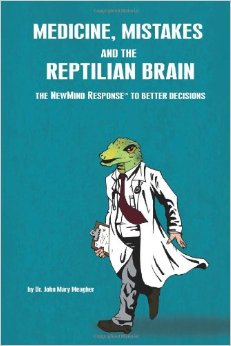 Dr. John Mary Meagher has over 40 years experience as an emergency physician. In Medicine, Mistakes and the Reptilian Brain, he combines lessons from health care, aviation, and some of the greatest thinkers in history to examine why mistakes are made and how to develop methods to overcome the reptile within all of us. While focused on physicians, there are many lessons that anyone can take from this book.
Dr. Meagher identifies three core tendencies that increase errors in medical practice:
- Apathy
- Haste
- Egoism
Three elements of digital transformation
Altimeter released a new report yesterday, called Digital Transformation: Why and How Companies are Investing in New Business Models to Lead Digital Customer Experiences.
For those of us in this field or related ones, much is not new, but confirmatory.
- Benefits:
- Leadership and employees feel empowered through education.
- Decision-making and processes become more efficient across departments.
- We found that businesses often remodel or bolt on mobile, social, and digital functionality to an aging offline/online infrastructure that is counterintuitive to customer behavior.
- Team members want to feel empowered to do the work that’s necessary while feeling a sense of ownership in the process.
- In its own way, digital transformation is making businesses more human.
Enterprise knowledge sharing requires trusted relationships
As the economy gets more networked, open organizations are becoming a necessity. Businesses are increasingly dependent on complex social interactions. Products are becoming services, as we can see with web apps, software, and even books. Trading intangible goods and services today requires trusted relationships, and often across distances. Internally, work teams that need to share complex knowledge require tighter social bonds. These are developed through time, with experience, and most often informally. Trust is a human quality. But the major barrier to encouraging informal social relationships at work often comes down to a question of control.