The New Social Learning – Review

Let me say just two words about The New Social Learning by Marcia Conner & Tony Bingham – buy it.

OK, that’s for people who want it short and sweet. Let me add a bit of explanation. This book covers not only the why of social media for learning but also the how, with plenty of examples and case studies. Marcia and Tony have mined the collective knowledge of hundreds of specialists and practitioners and blended it all together with their own insight. This is an impressive work and it is just as accessible to the novice as the expert (if there is such a thing in this new field).

The book starts with just enough theory to cover the rationale of why networked learning is so powerful and includes detailed notes and references for those who want to dig further. The companion website offers more information, videos and links. You can also connect via Twitter to @NewSocialLearn. However, there is enough information in the book to get you started, convince your boss, or dig deeper into a particular medium, like micro-sharing or immersive environments.

As they write in the book, the time has come for social learning :

The convergence of three key trends accelerates the need for social learning. Although some of these trends have been observable for decades, their influence compounds.

Three Converging Workplace Trends

  • Expanding opportunities for personal connection.
  • Emerging expectations from shifting workforce demographics
  • Increasing reach of customized technology.

If you liked the ideas discussed in A Framework for Social Learning or The Evolving Social Organization, then The New Social Learning provides greater depth and many resources all under one cover (without the hyperlinks, but that’s the limitation of print). It’s like a snapshot of a field just on the cusp of major growth and publicly perceived relevance. I think that this book will be seen as key to workplace learning, much like Gloria Gery’s Electronic Performance Support Systems (1995); Marc Rosenberg’s e-Learning (2000); and Jay Cross’s Informal Learning (2006). All of these books contribute to the understanding of workplace learning as much more than the delivery of courses.

Hierarchical conversations

Imagine a conference room in a convention centre in some metropolitan area [I’m sure you can]. It’s just after lunch and you’re stuffed on hotel food and wired from half a dozen cups of barely drinkable coffee. This morning you survived three presentations, each consisting of PowerPoint slides (at least Keynote slides have better default fonts) and the dreaded bullet points. Three presentations, 20-30 slides each and 5 to 20 bullet points per slide.

Quick Aside: Elliott Masie wrote a book, The Computer Training Handbook and discussed VCP  analysis. When teaching, he recommended: Vocabulary: limit new words to 6-8 per hour. Concepts: no more than 3 per hour. Procedures: More, but make memorization unnecessary.

Anyway, you’ve already been inundated with dozens of new words, while concepts are just dropped like buzzwords and there is obviously no common understanding of concepts. For example, my idea of a network is quite different from someone who has never experienced being a member of an online professional network.

The presenter [facilitator, director, cheerleader or whatever name is used] has now told everyone that it’s time for conversation. Let’s open things up!

Here’s a bird’s eye view:

This is how the conversation goes. A participant raises their hand, the presenter recognizes it and nods approval and then the participant asks a question or makes a comment. The presenter almost always makes a comment or a response, no matter the experience of the other participants. If the presenter disagrees with a statement or a perspective, he or she is able to shoot it down or deflect it before it gains any momentum.

It looks like this:

Meanwhile, the communication and understanding of the folks distributed about round conference tables (so very conducive for collaboration) remains in question. However, the presenter remains in charge, just like the school teachers who set the example so many times.

After some time listening to the same sub-group of extroverts in the audience, the presenter runs out of time and sums up with some statement of how productive this has all been.

Imagine trying to add a comment on the nature of networks in this setting. How can you imagine a learning network when all you’ve experienced are hierarchical conversations?

Now here’s the transcript of the last #lrnchat conversation on Thursday evening, where I jumped in as “asker of questions” when the regulars weren’t able to show up. In this type of conversation, everybody can talk at once and each person reads what they want. If you like a comment you add something to it, or “retweet” it to show you agree. People on the sidelines get brought into the conversation and there is no middle or gatekeeper, other than those who initiate questions. We ran out of prepared questions and participants just added more.

Many people say, “it’s not about the technology”, but the technology of the conference room with screen & presenter at the front has a significantly different effect on conversation than does the micro-blogging virtual “tweetchat”.

I always recommend that we choose our technologies with care but we have to have experienced the options in order to see the differences. That was my great challenge. How do you explain networks and networked learning to people who have never experienced them?

Friday, the end the line?

I’m not sure why this last week was so different than previous weeks, but few things on Twitter caught my attention. Maybe this brings to a close my regular weekly activity of Friday’s Finds, which I’ve produced every Friday since May 22nd 2009. Anyway, I’ll see what happens next week. I’ve put together a few items of interest though I usually have dozens of items to pick from. Perhaps I need to pay more attention.

Still worth checking out though:

A thought during #lrnchat last week: The status quo is maintained by formal learning; revolutionaries embrace the informal.

@jonhusband “Much consulting involves the application of models to a system, as opposed to getting involved in the system as a positive change agent.”

Scathing & quite funny rant about MBTI, Belbin, Honey & M, etc by Paul Kearns – well said, Paul Kearns; via @drmcewan [in case you missed the link on my blog post]

Having taught and trained many, many people over the last 30 years myself, and as an evaluation specialist, I have never ever regarded happy or smile sheets (known as level 1 questionnaires in the trade) as evidence of anything.  Happiness is not evidence of learning and unhappiness is not evidence of failure (learning is often initially painful and starts with resistance). Even if I make participants take a test (level 2) and they can tell me what Belbin’s 9 team roles are does not mean they know what to do with them. Even a level 3 visit (to see if they are applying it in the workplace) might reveal them putting labels on hapless managers but it does not offer evidence that having a defined role, in a particular team dynamic, at a particular time and place, produces better team results.

Taking Stock: “What other profession would go about its business in such an amateurish & unprofessional way as university teaching?” via @MTA_KT [yes, I know that’s me]

Exploring and free ranging

Whatever happened to “free range learning”? Jay Cross  used the term free range learning for a while in reference to informal learning and Tom Haskins picked up on the free range chicken metaphor. I even suggested a logo, but I don’t hear much talk about it any more. I think it’s still a great descriptor for learning and working on the Web, especially for events like #lrnchat on Twitter.

Free range learning may help deal with the disorientation that is more and more common in our complex lives and workplaces. Marilyn Taylor developed a model of learning, based on classroom experience, that has workplace implications as well, I believe. Her work has not been widely published but there is a reference in this PDF from NALD [dead link] (see page 53). You can also read about the model in Making Sense of Adult Learning.

Taylor observed university students in classrooms, and saw a pattern of continuous Disorientation, Exploration, Reorientation & Equilibrium. Each stage took different periods of time with each student and not all students completing a cycle during a formal course. The successful students were the ones who could work through the entire process and continue into another cycle. When students are shown the cycle, many get an “ah ha ” moment and realize that their confusion (disorientation) is quite normal.

According to Taylor, disorientation is a natural state in formal education:

Stage 1 – Disorientation: The learner is presented with an unfamiliar experience or idea which involves new ideas that challenge the student to think critically about his/her beliefs and values. The learner reacts by becoming confused and anxious. Support from the educator at this point is crucial to the learner’s motivation, participation and self-esteem.

Working and learning in our information-rich environments with constantly changing tools and business rules presents us with frequent and longer periods of disorientation.

Leaders and managers today should be helping fellow workers with their disorientation and exploration . A first step would be to show that disorientation is quite normal. It’s OK to be confused, but the strategy is not to close up but to be open to free range learning. Instead of looking for a simple solution, sometimes it’s necessary to poke around and explore to reorient our thinking. Consider what implications this has for training and workplace norms. Maybe I’ll go for a walk or perhaps I’ll check out Twitter or Facebook. How many workplaces encourage that? In the long run, it may be best to allow for a fair degree of exploration. Aren’t workers constantly encouraged to think outside of the box?  That’s where the free range chickens are.

Join Internet Time Alliance for a Day in SFO

The day following DevLearn, Saturday, November 6th, the five members of the Internet Time Alliance are holding a retreat to share insights and plan for the forthcoming year. We’re meeting at the Internet Time Lab, across the Bay from San Francisco in Berkeley.

We originally intended for this to be a private session for challenging one another’s views on what’s important in social learning, enterprise learning governance, working smarter, the impact of mobile learning, taking advantage of personal knowledge environments, breakthroughs in brain science, revised views of motivation, growing awareness of emergence, the shift from push to pull models, rethinking the role of the LMS, and breaking down barriers to change. We’d swap our views on recent thoughts emanating from Altimeter, IBM, Dan Pink, JSB, and others we listen to.

Then we spotted a potential pitfall: the echo-chamber effect. When it’s just us, there’s an ever-present danger that we’ll fall into griping about how most corporations simply don’t have a clue, leave gobs of money on the table, and look for salvation in all the wrong places. Name-calling isn’t going to help us make progress.

We decided to invite half a dozen outsiders to take part in our one-day retreat. It will keep us honest.

Our ground rules:

No competitors. If Fiat attends, Volkswagen can’t. Our choice.
Small group. This session will be intimate and participatory. No more than six outsiders can attend. Again, our choice.
No consultants. We’re the consultants (ugh). You’re the practitioners.
Big payback. Bring a problem to solve; you’ll receive individualized advice from thought leaders.

Everyone will share in the day’s activities, which will probably include:

Lunch at the Cafe at Chez Panisse
Walk in the redwoods in the Berkeley Hills
Books such as The Working Smarter Fieldbook, Informal Learning,Engaging Learning
Video records of the proceedings

Fee for the day is $1,200. Two from a single organization, $1,000 each. (Yes, you are essentially funding our plane tickets and picking up the tab for meals.)

Interested?

DevLearn2010

Join me and my colleagues at the Internet Time Alliance at DevLearn in San Francisco next month. We all plan to be there.

Jane Hart provides a snapshot of the State of Learning in the Workplace Today on at 10:45 am on Wednesday, November 3.

At 4:00 pm on Wednesday, we all will be engaged in a conversation entitled Work Smarter: Learning is the Real Work.

We expect to pop up at a few other places as well. (Surprise!)

Different – Review

Different, by Youngme Moon, discusses how market competition creates a herd mentality amongst competitors and results in a wide array of very similar products. The more mature a market category, the less deviation there is. I see this in the learning management system (LMS) market. Basically, they’re all the same and currently all are adding “social” to the mix, as they try to keep up with each other.

Tim Kastelle, who writes on innovation, was also struck by what I would describe as the key graphic in the book.  It shows what happens when you benchmark yourself against your competitors. Over time, everybody starts to look the same. A radical, and different, approach would be to emphasize your strengths and ignore, or even celebrate, your weaknesses.

The herd mentality is to keep up with the competition, but as the author writes, ” … if you’re looking for a unique solution, the last thing you should do is ask for a vote”. Youngme Moon describes three major types of idea brands that don’t try to compete: reverse, breakaway and hostile. Descriptions and examples are provided in this book filled with anecdotes from the professor at Harvard Business School.

Just being different is not enough for business success though. The difference has to have meaning, such as Harley Davidson creating a real community of bikers, numbering over a million. Difference has to resonate, not just be superficial.

I like the author’s approach in writing this book, as it reminds me of life in perpetual Beta or the process of blogging, where the final product never really gets out.

This book is very much a working draft, which is another way of saying that I have tried very hard to approach it with the same lack of self-consciousness that I feel if I were simply thinking out loud, on paper. I think I’ve gotten some of it right, but I’m sure I’ve gotten some of it wrong, too. It is a leaky, leaky boat, this book of mine.

This book is an easy read and different from many management books in the sense that it does not offer a specific  formula for success. I would recommend Different for anyone working in marketing or product development. There are also many insights for entrepreneurs and freelancers.

Being social for learning and performance

Social learning has been a theme here for some time [my first post on the subject in 2005: from e-learning to s-learning]. Recent research by CMU, MIT & Union College shows that being social is also a key to group performance:

That collective intelligence, the researchers believe, stems from how well the group works together. For instance, groups whose members had higher levels of “social sensitivity” were more collectively intelligent. “Social sensitivity has to do with how well group members perceive each other’s emotions,” says Christopher Chabris, a co-author and assistant professor of psychology at Union College in New York.

“Also, in groups where one person dominated, the group was less collectively intelligent than in groups where the conversational turns were more evenly distributed,” adds Woolley. And teams containing more women demonstrated greater social sensitivity and in turn greater collective intelligence compared to teams containing fewer women.

However, many OD, HR and training departments still focus on individual skill development and the perennial favourite, leadership training. How often do people work in total isolation today? Why are skills taught separately from the workplace and co-workers? As for leadership, how can you decontextualize it from the workplace? Easy cookie-cutter solutions, like MBTI for leadership, are mainstream fare, even though MBTI is about as valid as astrology [I’m a reflector, completer finisher, ENTJ, inspirer – what are you?]

In the evolving social organization, we noted how knowledge workers get things done by conversing with peers, customers and partners, as they solve the problems of the day. Learning from these social interactions is a key to business innovation. To participate in their markets, organizations, customers and suppliers need to understand each other and this too, is social. Social learning is how knowledge is created, internalized and shared. It is how knowledge work gets done.

A serious re-focus is needed for organizations to take advantage of social learning in business and professional networks. Everything from team composition, job titles, performance evaluation and training approaches must be examined through the lens of [social] networks. There is solid research in social network analysis, value network analysis and social learning that can inform this shift. But leaders and managers must first put aside their old mental models, and that’s the real challenge.

With my ITA colleagues, we’re trying to start a shift to working smarter in networks, without some fancy, and unnecessary, software platform to enable it. It’s a cultural challenge to change mental models, not a technological one.

Related post: Let’s talk about work

Twitter and the law of the few

The Law of the Few, popularized by Malcolm Gladwell in The Tipping Point relates to the spreading of ideas & viruses in populations:

The attainment of the tipping point that transforms a phenomenon into an influential trend usually requires the intervention of a number of influential types of people. In the disease epidemic model Gladwell introduced in Chapter 1, he demonstrated that many outbreaks could be traced back to a small group of infectors. Likewise, on the path toward the tipping point, many trends are ushered into popularity by small groups of individuals that can be classified as Connectors, Mavens, and Salesmen.

Connectors are individuals who have ties in many different realms and act as conduits between them, helping to engender connections, relationships, and “cross-fertilization” that otherwise might not have ever occurred. Mavens are people who have a strong compulsion to help other consumers by helping them make informed decisions. Salesmen are people whose unusual charisma allows them to be extremely persuasive in inducing others’ buying decisions and behaviors.

Charlene Croft tipped me to the fact that Twitter is an amplifier for Mavens, Connectors & Salespeople:

Twitter is a social networking site predominantly used by individuals who are high-level communicators and organizations/businesses who want to reach those communicators.   Malcolm Gladwell’s The Tipping Point is a good lens through which to view Twitter users.  He talks about the Connectors, the Mavens and the Salesmen as being the three types of individuals which start and spread what he calls “social epidemics.”

Let’s look at some specific behaviours on Twitter.

Mavens: If you are already a writer or blogger, twitter amplifies your work to a wider audience. Posting your latest work, or having others tweet it, gets out your ideas. When someone as famous as Tim Berners-Lee signs up on Twitter, he automatically gets many followers and a new channel for communication, just as Margaret Atwood has done.

Twitter is becoming a great place to connect online, extending the reach of many bloggers. I’ve noticed that while my blog comments have decreased in the past year, links from Twitter have significantly increased.

People who tweet original ideas and comments tend to have a larger group of followers. This extends their influence and can lead to more speaking and writing opportunities. With more people following you, serendipitous moments have a greater chance of happening. For instance, I once tweeted that I was looking for new projects.  This was picked up by someone who followed me but I did not know previously. It led to paid work.

Connectors: These valuable people to know can make introductions across disciplines. They often follow many people and post lots of “retweets” [RT]. The more they give, the more influential they become in the network. Connectors are well-suited to be online community managers, a vocation that is in demand today.

Salespeople: Direct selling on Twitter usually doesn’t work, as most people will not follow a pure sales pitch. However, Twitter is an excellent resource for salespeople to find out what people are looking for or if they’re unhappy with a competitor. I think Twitter is one of the best free competitive intelligence tools on the web.

I remember when web pundits thought that some day everybody would have a blog. Today, many people have an online website, Facebook or LinkedIn profile, but relatively few blog regularly. It takes discipline to write year after year, especially if it’s more than a personal journal. Twitter, or micro-blogging in general, may be the current web darling but this too will fade. While Twitter, like blogging, is not for everyone, it can be quite useful for a certain segment of the population. This aspect of Twitter should be seriously examined by leaders and managers who want their organizations to work smarter.

Work is learning; so what?

“Work is learning, learning work” – that is all

Ye know on earth, and all ye need to know.

(once again, apologies to Keats)

I rewrote the above lines a while back and they sum up how networks have changed the relationship between learning and working. They’re one and the same thing, as the ubiquitous network merges work and learning.

Why?

Networks – Our workplaces, economies and societies are becoming highly networked. The transmission of ideas can be instantaneous. There is little time to pause, go into the back room for a while and develop something to address our challenges. The problem may have changed by then.

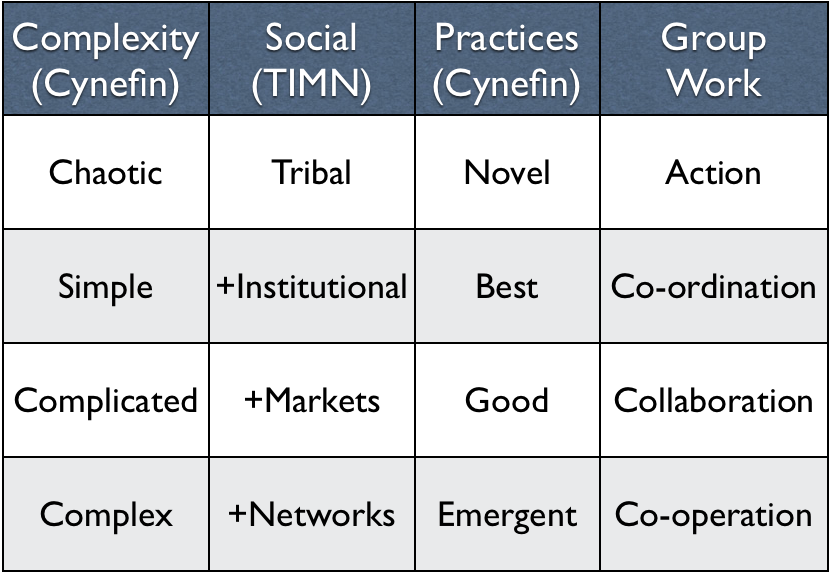
Complexity – The Cynefin framework is one way to examine established practices at work. For example, most simple and complicated work today is being automated and outsourced. Higher paid work often involves solving complex problems where there are no established answers and we need to engage the problem and learn by probing. Complexity is the new norm in the modern workplace.

Life in Perpetual Beta – Not just rapid change, but continual change, requires practices that evolve as they’re developed. In programming, this has meant a move from waterfall to agile methods. Beta releases are the norm for Web applications and as we do more on the Web, other practices are following.

The integration of learning and work is not some ideal, it is a necessity in a complex world.

Current models for managing people, training and knowledge-sharing are insufficient for a workplace that requires emergent practices to keep up with change. Looking back at best practices will only cause us to fall further behind. Formal training has only ever addressed about 20% of workplace learning and this was acceptable when the work environment was relatively stable. Knowledge workers today need to connect with others to learn and solve problems in real time.

Emergent practices can be developed collaboratively while solving problems for which there are no definitive answers. For instance, what’s the “best” Internet business model? Where once we could document knowledge and develop guidelines and practices to be followed by most workers, we now need to let workers develop their own practices, according to their particular context, which is constantly in flux. This is a very different approach from the way we designed jobs and training in the past.

So what?

Training, as a separate function from work, will become a luxury. It’s time to re-think your training strategies.

Supporting the development of emergent practices throughout the workforce will become critical to survival. Social media are tools that can help us develop emergent practices. They enable conversations between people separated by distance or time. Social media can facilitate the sharing of tacit knowledge through conversations to inform the collaborative development of emergent work practices. It’s time to master social media for your workplace.

With constant learning and unlearning required to do our work, the idea of a fixed job description and and core competencies becomes antiquated. Those who cannot adapt will be bypassed or ignored by the network. It’s time to rethink your ‘job’.