Friday’s Finds #13

This week I made the leap back to Identi.ca, so who knows how many more Friday’s finds on Twitter I’ll be posting. From the past week [dead links and unsafe sites removed]:

An open letter from an actual Starbucks front-line employee (good read for all leaders) via @AmandaFenton

When it comes to social media, military is anything but uniform – Hint same thing inside government of Canada via @nickcharney

The real reason why you, the individual, should blog via @jocenado @FrancoisGuite @williamu @marcottea

Microblogging has become too important for one company to rule the field via @johnt @RobinGood

Lego hops off the Cluetrain onto the tracks in front of it

Consciousness Capitalism! The private appropriation of human consciousness as a “nonmaterial asset” via @jonhusband

Like prisons & mental hospitals, classrooms captured & constricted bodies in order to render them as docile subjects via @gwoodill

The Canadian Government’s War on Science via @david_a_eaves

Doc Searls: Every student that takes a class has to create or improve a Wikipedia page to the topic of the class

Aware Organizations

Mark Dowds has released a white paper (PDF) on his new software venture, Brainpark, and knowing Mark, I’m sure it will be something completely different from the run of the mill software being sold for organizational productivity:

If the twentieth century was shaped by automation and mass production, the twenty-first will be defined by those who can best curate knowledge. To get there, we need to rethink the management approaches—and underlying tools—around which businesses are organized.

There are two big challenges to overcome along the way: context and awareness. Knowledge workers need to be able to grasp what’s going on rapidly if the organization is going to be adaptive and agile; and they’ll need to know what’s going on across geographic and functional boundaries in order to re-use work that’s already been done and avoid duplicating effort.

Brainpark looks like a productivity tool that combines the flexibility of social media with some integrated rigour of business processes for knowledge work. Adding context to all of our work is very important as we do more distributed work, we change jobs and companies come and go more quickly. The ideas discussed in the white paper reflect many of my own and those of togetherlearn around complexity, working in networks and integrating learning and work.

knowledge work

Four C’s of digital media

Gaurav Mishra wrote a guest blog post at Beth Kanter’s blog, on the 4 C’s of social media, complete with explanations and possible uses of this framework:

  1. Content
  2. Collaboration
  3. Community
  4. Collective Intelligence

I like the way that Gaurov puts these on the axes of becoming more visible and at the same time more difficult, as one progresses from content creation to collective intelligence. His rationale for the framework:

If you are a journalist, analyst or academic in the business of understanding social media initiatives, you’ll find the 4Cs Framework really useful. What are the boundary conditions needed to succeed at each layer? What are the boundary conditions needed to move from Content to Collaboration, from Collaboration to Community, and from Community to Collective Intelligence? Can you think of other digital activism or social media initiatives that leverage the Community or Collective Intelligence layers?

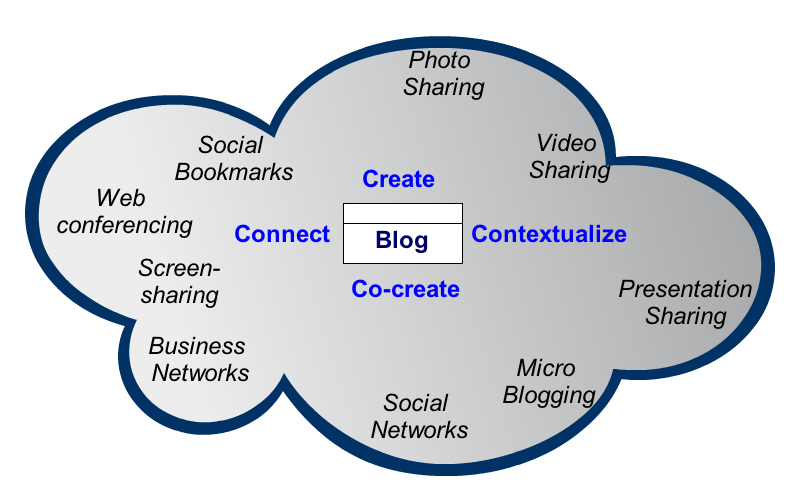
Clark Quinn and I have discussed frameworks for social media before and we came up with four C’s from a different perspective in a bit of a back-of-the-napkin exercise. I put them on a scale that made sense to me, with particular regard to network effects, the essence of Web 2.0:

a network effect  is when a good or service has more value the more that other people have it too … Examples include e-mail, IMing, the blogosphere, and even the Web itself.  But what’s not clear from this description is the raw power that is caught up in and represented by network effects.  Most rigorous studies and mathematical formulations reveal that there is tremendous geometric power in network effects.

inducingnetworkeffects

The figure below is what Clark and I developed as an initial concept on the digital artifacts of social media. As one moves from content creation to contextualization (through grouping, tagging or rating), the potential network effects increase. This gets greater as people connect to the artifacts (through comments, linking or discussion) and then to co-creation, such as mashups or remixes. The basic idea is that as more people manipulate digital objects and give them meaning and context then these objects will gain in value. A YouTube video of an unknown person lip-syncing a popular song has little original value, but when that video (e.g. Numa Numa) gets over 30 million views, links & comments, network effects increase its value to perhaps more than the original song. The creator gets tangible value through the network in the form of guest appearances or fees for another video.

Picture 2
This is still an idea in progress but is another example of why giving up part of your value chain and letting it loose may actually increase value for the creator.

Web 2.0: A Strategy Guide | Review

Web 2.0: A Strategy Guide by Amy Shuen covers many of the business aspects of Web 2.0 and is aimed at the general business reader. As Shuen says in the introduction, “you don’t need an M.B.A. or a degree in computer science” to understand the book. It starts by comparing Flickr’s business model with Netflix’s and goes on to discuss concepts such as network effects and the Bass Diffusion Curve. I found Chapter 4, Companies Capitalize Competences the most interesting, as it discusses collaboration and working across the Web:

Even in new projects, creating value often means letting some of that value flow elsewhere. The creative energy of mashups appears in large part because the companies providing the services being mashed up no longer insist on total control over their products. That flexibility allows a different dynamic than the usual system of “create, patent, and license” that has dominated intellectual property for the last few decades.

My experience with several clients over the years is that they do not understand network effects and have great difficulty ceding any control. This book would have been good for them, but then again, I’ve noticed that many business leaders do not have or make the time to read about their business or the forces that affect it. Don’t worry, I’m doing that for you ;-)

I would recommend this book as an overview of Web 2.0 with a strong business perspective and a lighter treatment of the actual technologies (fine for me). The easy-to-read End Notes provide more information for those who wish to further investigate an item. The final chapter includes a template and explanation of how to develop a Web 2.0 Business Plan, that many may find useful.

Where’s your data?

I wrote about the importance of owning your data for blogging a while back and last week’s Twitter crash coupled with the demise of an URL shortener only reinforce that in my mind. The case of tr.im may not be so obvious to some, but whenever you use a URL shortener, that connection gets stored in the cloud and if the service goes down, you won’t be able to trace back the link. This is a real problem on Twitter where everyone uses URL shorteners and that’s why I write up  Friday’s Finds with real links.

The main issue is the increasing use of software as a service (SaaS) which is simple, easy and out of your control. SaaS provides ease of use to many of us, but in return we become dependent on that service provider, much as we do with proprietary software.

Anyone who uses social media for professional purposes should know what SaaS they are using and think about a backup plan.

Here’s mine:

  • Blog: hosted on an independent server, with tape backup, using open source software (WordPress)
  • Facebook: no backup, but nothing worth losing, IMO
  • LinkedIn: contact information copied to Hard Drive
  • Twitter: Weekly synthesis of important posts put on my Blog with ‘Friday’s Finds
  • Flickr: original photos on Hard Drive
  • Slideshare: copy of presentation on Hard Drive
  • Delicious: OPML file downloaded monthly

own your data

PS: I also backup my Hard Drive ;-)

Friday’s Finds #12

This week saw Twitter crash due to a distributed denial of service attack that also affected Facebook to some extent, but now (via @MiNutrition) you can find out if twitter is down at any given time. In spite of the outage, there were still several finds:

Working longer has become No. 1 retirement-planning strategy for the future (HR Executive Online) [seems that the “problem” of retiring Baby Boomers has been solved by the financial crisis] via @pkassner @DrDavidBallard

I was looking for information on insects and @z_rose sent me this link “for all your bug-related queries” What’s that bug?

Classic piece of official [US] air force anti-troll PR strategy [could even be considered humourous] via @drewmack

A Look At What Young People Are/Are Not Willing To Pay For Online via @MarioAsselin @tomkrieglstein

The Industrial Age is crumbling so quickly that new infrastructure for society has to be planned & built soon via @nineshift

Sackville Local Food Day

We’re having our first Sackville Local Food Day on Saturday August 15th from 9:00 am to 1.30 pm at the Farmers Market on Bridge Street.

  • taste the produce of our local region
  • meet some local farmers
  • buy from local artisans
  • listen to local music
  • win great door prizes

If you’re a new vendor or want to come out for Local Food Day only contact Cathy at the Bridge Street Café; tel 506-536-4428

Natures Route Farm

The marginalized training function

Tony Karrer clarifies his comments about traditional training becoming “marginalized”, which is worth a full read but I’d like to pick up on this comment:

If you look at what makes a good situation for formal learning:

  • Large Audience
  • Similar Level / Needs
  • Known/Stable Content
  • Few Out of Bounds cases

How many organizations have these conditions and are they increasing or decreasing? Are there many “large audiences” of “similar needs and levels of experience” in your organization? How about content that is known and stable? Even compliance training changes as new regulations try to counter every unique case.

I have little doubt that most knowledge work is becoming more complex if for no other reason than the fact that we have squeezed out most redundancy in our systems and have automated any tasks we can. The only good-quality, high-paying work that is left requires contextual knowledge, problem-solving and creativity for those “out of bounds cases”. Training, other than in basic processes, does not address these skills.

cynefin and training

Knowledge workers need to learn from the emergent processes they  continuously create to deal with a complex environment. That means making things up (creativity) based on best guesses and collaboration and making parts of these processes tangible enough to pass on for their ever-shortening half-lives.

I would agree that training is getting marginalized but someone (or some department) in the organization will be taking responsibility for getting work done. For instance, at  Intuit, training is part of marketing and involves the customer directly. Your own organizational experience in the next few years may differ, but dealing with complexity will definitely be part of it.

Defining the Big Shift

John Hagel has developed a number of “from-to” contrasts to illustrate the Big Shift. It’s great to get confirmation from someone like John Hagel that what I’ve been saying here for the past five years appears to be on track. Hagel cites several shifts in his post.

Knowledge stocks to flows – my take on learning stocks and flows (2005):

If learning is conversation, then online conversations are the essential component of online learning. Online communication can be divided into two parts (Lee Lefever):


Flows = Timely & Engaging (e.g. radio, speeches, e-mail, blogs)
Stocks = Archived, Organized for Reference (e.g. web site, database, book, voice mail)


One reason that blogs are so engaging is because they allow flow. On the other hand, stock on the Net is everywhere. In the case of digital learning content, fewer people are willing to pay for plain old stock, such as self-paced online courses. Learning content is now a commodity and over time the price of commodities tends to zero.

Some more comments on Flow.

Explicit knowledge to tacit knowledge (or knowledge that is in the early stages of emergence). This is the core of my always-in-development PKM process and also behind the idea that online content is not as important as the context in which it is used.

From push programs to pull platforms, which is how I felt in don’t push my learning (2006).

From stable environments to dynamic environments or what I called life in perpetual Beta (2006).

Take the time to read all of Hagel’s post and follow the link to the Big Shift as well.

Communication

Jay Cross brings back some advice from Peter Drucker on how to manage knowledge workers and much of this advice is predicated on the concept of effective communication. Knowledge workers need to understand their role as assets in an organization and need to know what is going on while both learning and teaching as part of their work. I would say that all of my work is about communication. I’m not a communications specialist per se, but that’s almost all I do. I analyze communications and I sense patterns in what may be perceived as chaotic communications and I spend a lot of time talking, listening, reading, writing and presenting.

espace_internet_by_dalbera

I noted a while back that over 20 years of military service could be distilled into the mastery of three processes in communications tools from the Army. Like most writers will tell you, the only way to become a good writer is to write. The same goes for knowledge workers. Spend more time communicating and master the wide variety of tools necessary for your networks. I’ve realized that writing a blog on a regular basis takes a different skill-set than writing reports or essays. The same goes for Twitter. Certain types of communications are well-suited for 140 characters and others are not. One of my objectives is to get better at creating videos and podcasts. Of courses, I’ll have to practice.

Photo by dalbera