Work 2.0

I have little doubt that industrial management and all that it has created (chain of command, human resources, line & staff, production, etc.) are the wrong models for the emerging, networked workplace. This is a workplace with increasing numbers of free-agents and permanent employees who don’t have a job for life, especially as the average lifespan of corporations decreases while those of workers increases. Many workers, including white collar ones, can’t afford to retire. Existing management models and support functions were developed to keep things stable and ensure that people conformed to corporate culture. There is much less time to do that as workplace culture evolves with society, markets and technology.

Look at what Web 2.0 and the resulting network effects have already changed in our workplaces:

The job search has become fluid; no longer a discrete event, with social communities like LinkedIn providing a platform for ongoing conversations between those offering to work and those looking for workers. A job seeker one day may become a hiring agent the next day and vice versa. The roles and boundaries in recruiting and hiring are blurring, just as the reverse job post is on the rise.

Learning has become part of work. Access to much of the world’s information, coupled with online professional social communities has turned us into grazers and foragers, no longer content to feed our intellect only at the corporate trough. As anthropologist Michael Wesch has said, “when media change, then human relationships change“. People of all ages are now digital content creators, no longer satisfied with being supplied with learning programs but creating tutorials, explanatory videos and everything that can be conceived and explained. This empowerment is changing how workers value and perceive professional development.

Today, workers need the workplace less for their social needs. Even when we change jobs or communities, we can now keep our social networks. It used to be that the only place you could meet new people was at work or through family or perhaps at church. Today, our social networks are an always-on connection to trusted friends and colleagues. That means less influence from employers.

These three examples are indicators of a changing relationship between workers and employers, enabled by the Web. In larger companies that relationship is the responsibility of HR. However, if asked, few of us would consider ourselves “human resources”, but that’s how workers are officially viewed by many employers. That top-down, controlled relationship is getting strained. You can learn about this from the thousands of “human resources” who are blogging, podcasting or vlogging, like the articulate Starbuck’s employee. This memo to the CEO was not massaged by any manager, because hyperlinks subvert hierarchies, no matter how many internal policies are created to the contrary. Just ask United Airlines about their policy on damaging guitars. It’s probably changed a bit in the last month.

To get work done in this networked, Web 2.0 environment, a more resilient organizational framework is required, like wirearchy (a dynamic two-way flow of power and authority based on information, knowledge, trust and credibility, enabled by interconnected people and technology). Based on such an open framework, support functions like HR have to figure out how they can best help the organization. Here are some suggestions:

  • Think and act at a macro level (what to do) and leave the micro (how to do it) to each worker or team. The little stuff is changing too fast.
  • Engage with Web media and understand how they work. The Web is  too important to be left to IT, communications or outside vendors.
  • Use social media to make work easier or more effective. Use them to solve problems for you.
  • Make yourself and your function  redundant. Teach people how to fish and move on to the next challenge. If you’re maintaining a steady state then you’ve failed to evolve with the organization and the environment.

Aware Organizations

Mark Dowds has released a white paper (PDF) on his new software venture, Brainpark, and knowing Mark, I’m sure it will be something completely different from the run of the mill software being sold for organizational productivity:

If the twentieth century was shaped by automation and mass production, the twenty-first will be defined by those who can best curate knowledge. To get there, we need to rethink the management approaches—and underlying tools—around which businesses are organized.

There are two big challenges to overcome along the way: context and awareness. Knowledge workers need to be able to grasp what’s going on rapidly if the organization is going to be adaptive and agile; and they’ll need to know what’s going on across geographic and functional boundaries in order to re-use work that’s already been done and avoid duplicating effort.

Brainpark looks like a productivity tool that combines the flexibility of social media with some integrated rigour of business processes for knowledge work. Adding context to all of our work is very important as we do more distributed work, we change jobs and companies come and go more quickly. The ideas discussed in the white paper reflect many of my own and those of togetherlearn around complexity, working in networks and integrating learning and work.

knowledge work

Defining the Big Shift

John Hagel has developed a number of “from-to” contrasts to illustrate the Big Shift. It’s great to get confirmation from someone like John Hagel that what I’ve been saying here for the past five years appears to be on track. Hagel cites several shifts in his post.

Knowledge stocks to flows – my take on learning stocks and flows (2005):

If learning is conversation, then online conversations are the essential component of online learning. Online communication can be divided into two parts (Lee Lefever):


Flows = Timely & Engaging (e.g. radio, speeches, e-mail, blogs)
Stocks = Archived, Organized for Reference (e.g. web site, database, book, voice mail)


One reason that blogs are so engaging is because they allow flow. On the other hand, stock on the Net is everywhere. In the case of digital learning content, fewer people are willing to pay for plain old stock, such as self-paced online courses. Learning content is now a commodity and over time the price of commodities tends to zero.

Some more comments on Flow.

Explicit knowledge to tacit knowledge (or knowledge that is in the early stages of emergence). This is the core of my always-in-development PKM process and also behind the idea that online content is not as important as the context in which it is used.

From push programs to pull platforms, which is how I felt in don’t push my learning (2006).

From stable environments to dynamic environments or what I called life in perpetual Beta (2006).

Take the time to read all of Hagel’s post and follow the link to the Big Shift as well.

Learning to work smarter

Anne Marie McEwan’s Smart Working nicely summarizes the shift that is taking place in how we work. These shifts have happened before – when we developed agriculture, moved into cities, or created powered machines. Now we are becoming networked.

The term ‘smart working’ has in recent years been associated with flexible and mobile working, that is ‘anytime, anywhere’ ways of working enabled by communication technologies. Another view, broader than the narrow focus on location and time independence, is that smart working is about flexibility and autonomy in where, when and how people work.

In my view, smart working is the outcome of designing and putting in place systems, working environments and governance principles that are known to be associated with effective business performance, including workforce autonomy and self-determination, and which seek to maximise opportunities to use and develop people’s knowledge, skills.

I’m in the process of putting together several threads as a single article, and this is where I do my thinking in public.

In The Learning Age I said that business models and work practices are becoming networked and global, speeding the rate of time to implementation. The lines between work and leisure are blurring, as with work and learning. Today, about 16% of us can be described as hyperconnected but that is expected to grow to 40%, and I would say those people will be the main drivers of our economies and societies.

Effective knowledge sharing is essential for all organizations today but the mainstream application of knowledge management, and I would include learning management, over the past few decades has got it all wrong. We have over-managed information because it’s easy and we’re still enamoured with information technology. However, the ubiquitous information surround may put a stop to this. As enterprises become more closely tied to the Web, the principle of “small pieces loosely joined” is permeating our industrial walls. More and more workers have their own sources of information and knowledge.

At an individual level we need to make sense of the ever-increasing signals coming from our networks, while reducing the noise. This is why I developed sense-making with PKM which I am continuing to refine. Just yesterday I explained social bookmarks, feed readers and using Twitter as a search engine to a “digital immigrant” the same age as me. The light went on when I showed how she could connect with a worldwide cooperative community that shared several of her professional interests.

The power of micro-blogging with Twitter so far is quite impressive and I was one who adopted this medium with a fair bit of skepticism. I just noticed that in the past few months Twitter has replaced Google as the prime referring site for visitors here, surpassing Google.

With some individual skills in using social media, the next question an organization may ask is how to start an online community. Of course starting one doesn’t mean it will grow or be useful. Communication does not equal collaboration, and that is a challenge in “building” communities of practice (CoP). Just because the communication tools are in place does not mean that people will automatically collaborate.  You can’t really build a CoP, it has to emerge through practice; but you can put in systems and processes to support CoP’s.  You know you’re in a real community of practice when it changes your practice.

Taking advantage of social networks for business can give a temporary advantage (everything in business is temporary anyway) and help to develop disruptive business models. So that’s it – there are significant shifts in how we work which will require new skills and if used effectively can create new ways of generating wealth. The information age status quo isn’t the same for the learning age.

Management Rewired – Review

Management Rewired: Why feedback doesn’t work and other surprising lessons from the latest brain science by Charles Jacobs covers many of the areas discussed here, such as learning, management models and democracy in the workplace. Jacobs covers a variety of studies in science and management but this book is not a dry academic treatise but a good read sprinkled with many of the author’s personal stories. Much as Gary Hamel’s The Future of Management showed the need for new business models, Jacobs shows leaders what actually works when dealing with other people. A consistent theme is to let people manage themselves, because that works:

Rather than limit decentralization to the top of the hierarchy, why not drive it down into the organization as far as possible? Modern information technology makes such “radical decentralization” much easier now than it was in [Alfred] Sloan’s day.

Such an approach enables people to control their own destinies. From a Darwinian perspective, it’s aligned with the urgings of our selfish genes. From a market perspective, it’s more efficient and effective. From a cultural perspective, virtually every organizational innovation since the Western Electric Hawthorne studies has been aimed at fostering democracy and initiative in the workplace because it’s good for both people and the business. Moving to an entrepreneurial organization is just the next step.

Jacobs shows the overwhelming evidence that “reward, punishment and feedback don’t produce the results we intend or produce the opposite” (now there’s a message for the HR department).  Methods that work are creating cognitive dissonance in order to get a shift in thinking that changes behaviour. Changing behaviour is not enough. Transforming an organization means shifting our paradigm and this is best done through stories. The most effective stories are about plans and expectations gone awry. Forget pay and bonuses, or better yet, let workers decide amongst themselves; communication is the only effective tool that leaders have.

Becoming more participative may be easier said than done, as the author shows how most 360-degree reviews have managers consistently ranking themselves as more participative than their employees do. We’re not as open as we think we are.

Management Rewired is a welcome addition to the field and should be read by anyone working in or with organizations. It’s nice to get corroboration, and a good set of reference notes, to reinforce my own work on the new nature of the firm.

Workers, Management and Work Support

Learning professionals are facing similar issues that others (HR, KM, IT & Marketing) do, but in many ways it’s a case of the blind men and the elephant. We are constrained by the blinders of our profession’s models. That’s one reason I like to take my models from a variety of fields, not just training or HPT. I previously wrote that we should integrate our work support departments and Tom Gram shows how this can be done by designing an organizational effectiveness function or creating internal management consultants, though these approaches can create their own bureaucracies as well, as Tom recognizes.

As effective as these approaches may be for now, I don’t think they’re adequate for the future. Everyone is struggling to keep up with change but most are using outdated tools and models. As Lou Sagar commented on Umair Haque’s post, ” … the emergence of new business models are ahead of the organizational framework to embrace and manage the impact.” That pretty well sums up the problem in my mind. We are all blind men unable to understand the new realities of work. Look at a business model as new as e-Bay’s, which many companies have yet to understand, and then add in the fact that it is already outdated and may even be declining.

The real conversation has yet to surface in the mainstream about the organizational change needed to address complexity and networks. There are models surfacing but as yet to be embraced, such as Haque’s work, wirearchy or valence theory. Creating a Chief Performance Officer out of the previous HR/Training/OD/KM functions may seem like progress but not if the realities of networked wealth creation don’t need a Chief “X” Officer any more.

Models such as chaordic organizations (PDF) show that command & control is not always necessary to be effective, especially within networks:

Given the right circumstances, from no more than dreams, determination, and the liberty to try, quite ordinary people consistently do extraordinary things.

Here’s the model that I’ve constructed on how training should adapt to a world where working and learning are synonymous, but even this shows a difference between management and workers, and perhaps that distinction is no longer pertinent.

In complex environments and networks, if workers need to be managed, they should not be hired in the first place, but then neither should managers.

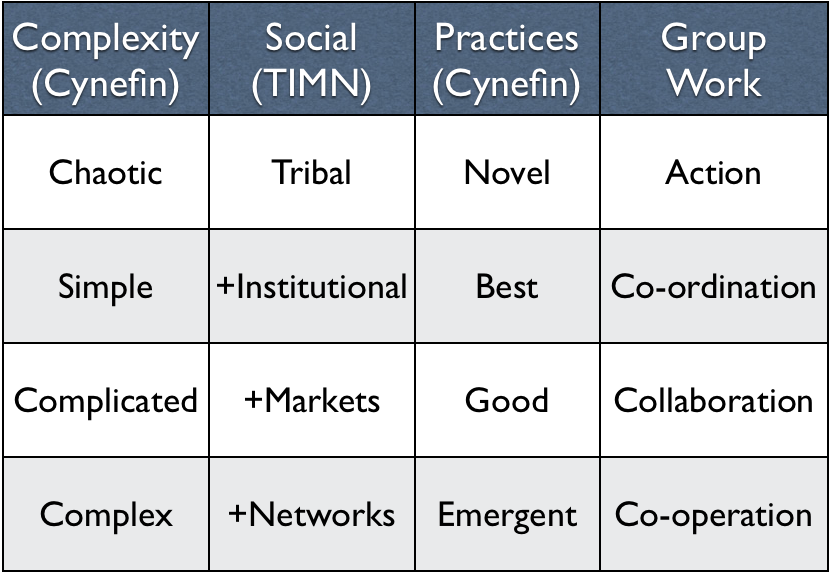
Co-operation for Networks

Stephen Downes took me to task for my suggestion that collaboration was the optimum type of group work in networks:

collaboration means ‘working together’. That’s why you see it in market economies. markets are based on quantity and mass.

cooperation means ’sharing’. That’s why you see it in networks. In networks, the nature of the connection is important; it is not simply about quantity and mass …

You and I are in a network – but we do not collaborate (we do not align ourselves to the same goal, subscribe to the same vision statement, etc), we *cooperate*

I began to see that co-operation makes more sense as the term to describe working together in a networked  and non-directed relationship. So is the distinction important? I think so. Jérôme Delacroix provides another confirmatory post on “co-operation” as the suitable term for what we do in networks [in French]. Jérôme explains why his site is called Cooperatique and not Collaboratique – collaboration happens around some kind of plan or structure, while co-operation presumes the freedom of individuals to join and participate. He also says that co-operation, not collaboration, is a driver of creativity. That’s quite an important distinction when looking at work analysis and design.

Here is my revised table, for the record:

Social tools for networks

Effective knowledge sharing is what many organizations do not do well, or as Lew Platt past-CEO of Hewlett-Packard said, “if only HP knew what HP knows, we would be three times more productive”. But HP will never know what the employees of HP know, so wouldn’t it be better to let the workers share what they know in the best way possible? That’s the key benefit of personal knowledge management, in my opinion. If each person can better manage knowledge creation and capture, then it becomes easier to share it.

For example:

Social bookmarks let me tag and search a wide array of bookmarks and by making them public they are shared with others, but through no extra effort on my part.

Writing this blog gives me a knowledge-base of my thoughts which become articles and presentations but in being public I find others who can add to my knowledge. I also make available information and perhaps knowledge that is useful to others.

By posting on Twitter I answer questions, share links and opinions and get to know others with similar interests, with the same effort as chatting in the office but with a much broader reach. On the Net, chance favours the prepared mind.

Just providing access to knowledge creation and capture tools is a relatively easy first step in moving the organization to Enterprise 2.0; an essential step in working in complex networks versus complicated markets. During the initial implementation of these tools, there is no need to talk about collaboration. Many Web 2.0 tools can be sold on their value to the individual. Let collaboration emerge from the individual practices of workers, most of whom want to do a better job anyway.

The powerful aspect of most Web 2.0 tools is that they are designed for knowledge-sharing as well. However, collaboration is difficult with the imposed barriers to communication created by Enterprise 1.0 IT policies. The major obstacle to social learning (and working) today is the IT department and it’s time that management takes back control of information sharing. This post was inspired by Dave Pollard’s practical guide to implementing Web 2.0 which gives more information on how to accomplish this.

The transition to networked accountability

At the expense of being repetitive, I keep seeing this same pattern that Tom Haskins got me started on and which he summarized in reading situational responses:

Then I read Charles Jennings’ post on accountability for business results and saw a similar four part process, but Charles shows how the transition from one structure to the next is not linear at all when viewed from the perspective of the two axes of Autonomy & Strategic Alignment.

Charles’ C-Curve is a model in practice, based on his experience as CLO of Reuters. I see a parallel between this migration of the learning and development (L&D) department and the social order necessary to do certain types of group work:

  1. L&D Autonomous = taking action as a Tribe of its own
  2. L&D aligned with organization = coordinated with the Institution
  3. L&D with governance structure = able to work in a cooperative collaborative Market
  4. L&D strategically aligned = a collaborative co-operative member of (a) Network(s)

Note: I’ve re-thought my use of the terms co-operation & collaboration here.

I wonder if this curve describes other departments in different organizations. It is evident that there is greater freedom either as a tribe or in a network, while institutions and markets restrict freedom. Could it also hold that previously tribal organizations (1) may thrive best in networks (because they are used to more freedom) if they can successfully make the transition between the other two stages? I have noticed that it is difficult to convince organizations steeped in the institutional model (2) that the networked model may be better. Those who already have to respond to markets (3) understand the value of networks (4) much better, in my experience.

Learning and Working in Complexity Workshop

Over several online and on-site presentations this past year, I’ve noticed a need for organizations to develop practical tools and contextual processes to manage information, knowledge and learning. I am offering a one-day workshop that encapsulates several years of “learning & working on the Web”.

Learning & Working in Complexity Workshop

One day (on-site or online)

Part 1: Overview of issues and forces that are fundamentally changing workplace learning

Part 2: Discussion & Examples from various fields

Part 3: Personal Knowledge Management (PKM) overview

Part 4: Setting up your own PKM system

References:

Skills 2.0 for learning professionals

PKM

Future of Training