Revolutionalize Learning & Development

Work is learning and learning is the work, says Clark Quinn. I agree.

Clark gives a clear path forward for today’s learning and development profession on the cusp of revolution or extinction in his latest book. Revolutionize Learning & Development is required reading for anyone involved in training, instruction, or corporate education. I have known Clark for many years and in this book he makes the case for change very clear. He maps the path to align learning with work. If learning is the solution to the business situation, then this book will explain how to make it so.

Read more

Reinventing Organizations – Review

What is a “Teal Organization”? Frédéric Laloux, in Reinventing Organizations, uses a colour scheme, based on Integral Theory, to describe the historical development of human organizations: Red > Orange > Green > Teal. Laloux lists three breakthroughs of Teal organizations:

  1. Self-management: driven by peer relationships
  2. Wholeness: involving the whole person at work
  3. Evolutionary purpose: let the organization adapt and grow, not be driven

Read more

Organize for Complexity

Niels Pflaeging read my ebook Seeking perpetual beta and said that “after reading the book one yearns for more from you about the right learning architecture, about how to develop organizations applying this thinking, about how to build learning programs and infrastructure.” Well I think Niels has answered much of that question himself, in his recent book Organize for Complexity. Since I promote the fact that today work is learning, and learning is the work, then if you create better ways of working, you are also improving organizational learning. As Niels writes about the “learning riddle”:

Mastery is the human capability to solve new problems. It can only be developed through practice. We call this “disciplined practice”.

Fads like business analytics, knowledge management, and big data will never make organizations fit for complexity.

This is why I now call PKM: Personal Knowledge Mastery; to separate it from much of the traditional practice of  knowledge management. #PKMastery is disciplined practice.

Read more

Medicine, Mistakes and the Reptilian Brain

Pasteur said that discovery favoured the prepared mind. A diagnosis, also a discovery, must favour the prepared mind. Yet medical schools have been inattentive to preparing the mind to meet the patient, inattentive to errors, inattentive to attention, inattentive to inattention, and inattentive to the study of the self which is to be inattentive to the minefield within. —JMM

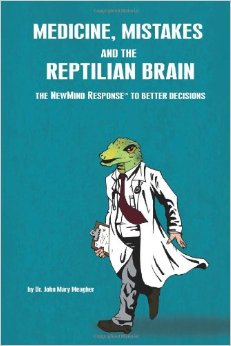
medicine mistakes reptilian brainDr. John Mary Meagher has over 40 years experience as an emergency physician. In Medicine, Mistakes and the Reptilian Brain, he combines lessons from health care, aviation, and some of the greatest thinkers in history to examine why mistakes are made and how to develop methods to overcome the reptile within all of us. While focused on physicians, there are many lessons that anyone can take from this book.

Dr. Meagher identifies three core tendencies that increase errors in medical practice:

  1. Apathy
  2. Haste
  3. Egoism

    Read more

Riding the Current by Finding the Right Crew

In Riding the Current: How to deal with the daily deluge of data, Madelyn Blair provides an excellent manual for knowledge workers, managers, and executives. The advice and insight in this book is the closest that I have seen that aligns with my PKM Seek > Sense > Share framework. There is a lot in the book, which is filled with anecdotes, concepts, frameworks, and exercises. It covers both knowledge seeking from a formal and an informal perspective, and I would recommend it for any organization.

Madelyn, who sent me the book after we had a few of conversations over the past couple of months, uses a journey metaphor of Setting Out; Selecting the Vessel; Finding the Right Crew; Stocking Supplies; Equipping for the Dive; Deciding to Dive Deep; and Taking Charge. In Finding the Right Crew, there are three key roles:

Accompanier: Facilitates accomplishment of the task by providing information and/or contacts.

Practice Partner: Creates a learning environment of conversation, listening, and questioning, all with an appreciative attitude.

Fellow Seeker: Is a seeker just like the primary seeker, willing to engage in conversation and think critically and appreciatively.

Finding people to fill these roles can greatly assist our own sense-making. We should find Accompaniers who are more knowledgeable or experienced than we are in our journey. They are like mavens. A practice partner can connect us to the work to be done and help keep us focused. They understand our work or life context. Fellow seekers are the most open to our sharing and are often not judgemental as they are trying to make sense themselves.

PKM Finding the Right CrewHere is what Madelyn has found that others have said about finding the right crew:

  • Seek out those who are expert in your areas of need or simply practice in them
  • Seek out and join new communities of practice
  • Create a community of practice
  • Attend conferences and listen carefully
  • Keep looking for ideas, not just perfecting skills
  • Call in peers to assist you in the next challenge
  • Make it a habit to regularly ask the question, “What am I assuming about this?”
  • Find a ‘thinking partner’ and learn together how to be each other’s thinking partner – Nancy Kline: Time to Think

I would highly recommend this book if you are in any way interested in personal knowledge management.

Open – Review

“How do our minds cope with the torrent of information coming at us from every angle today? How do we convert so much knowledge into socially productive wisdom? What can we do to close the gap between those who have access to open learning, and those who (still) do not?

The genuine democratisation of knowing is still being fought over.”
David Price in Open: How we’ll work live and learn in the future

I really enjoyed reading “Open” as it flowed well and was full of interesting stories, all bound into a singular framework. The core of this book is David Price’s SOFT model and I have highlighted some components in this summary table, with further explanations below.

Open SOFTSociety

A Global Learning Commons is “… essentially a shared resource, which works through carefully balancing rights and responsibilities. As it is with air, or water, so should it be with learning. Your right of access to the knowledge and skills of others is balanced with a responsibility to share what you can offer.”

Three characteristics of a GLC are participation, passion, and purpose. “The enthusiasm and ability of small groups of self-organising citizens to respond to respond to challenges makes bigger, better funded, organisations look slow and cumbersome in comparison.”

Business

A commitment to sharing radically alters the culture of organisations.” On the subject of open for business, the CEO of Ingenious media, an investment and advisory group, states, “The reason why we don’t worry about giving that knowledge away is because most people can’t implement what they know. The capital value of something these days is the ability to implement it rather than to create it originally.” Freedom to fail is what enabled 3M to invent post-it notes and Google to develop new products through Google Labs. Finally, trust needs to be a core business value; “The lesson to be learned from IBM is that trust demands courage; the courage to let go, the courage to trust others, and, more than anything, the courage to jump the knowing-doing gap.”

Education

“[Innovators cited in the book] believe in education as a force for social equality – Marc Lewis sees his school as a catalyst for diversity and equality in the communications industry (a notoriously white, male, middle-class occupation). They believe in values-driven learning – Larry Rosenstock is fond of quoting Thomas Jefferson, ‘The purpose of public education isn’t to serve the public; the purpose of public education is to create a public.’ And they see it as a duty to ensure that the ideas behind their successes don’t remain in the petri dish, but spread virally throughout the system – witness Anne Knock’s sense of responsibility to educators across Australia. They all see themselves as part of a social movement to redefine education, not simply to lead it in their own schools.”

I recommend this book and would see it as a good one to keep a couple of extra copies, so you can give them away to those on the other side of the Open adoption chasm.

Seeing What Others Don’t – Review

Following Gary Klein on his search to find out how insight happens is a pleasurable, even mind-blowing experience. In Seeing What Others Don’t, Klein begins with an open mind and decides that he needs to stay out of the laboratory of puzzle-solving, described in the chapter on how not to search for insights. His perspective is based on what has been my professional practice for almost two decades: performance improvement. Klein says that PI is a combination of reducing errors & uncertainty PLUS increasing insights. Too often in organizations, management only focuses on reducing errors. Klein cites the overemphasis on practices like Six Sigma over the past 30 years as being detrimental to overall innovation; “Six Sigma shouldn’t be abandoned, it needs to be corralled.”

performance improvement klein

In examining 120 cases, Klein found that there are three main paths that insight can follow. [My overview lacks the depth of Klein’s explanations, so please read the book if you really want to understand this.] Klein’s Triple Path Model neatly describes the phenomena of gaining insights. I find the connection path the most interesting because I think it can be enhanced through practices like personal knowledge mastery. Also interesting is that gaining insight is about changing one’s stories. We have stories that we use to explain why we do things. These can be good anchors that give us the right perspective on a situation or they can weigh us down and stop us from gaining insight. For example, the prevailing theory of miasma stopped researchers from seeing that cholera was waterborne or that yellow fever was mosquito borne. It was when some people paid attention to the contradictions, that they gained insight. Once you have insight, that’s it. Klein quotes the author Hilary Mantel; “Insight cannot be taken back. You cannot return to the moment you were in before.” Which of course can make those with new insights seem like such a bother to the status quo.

triple path model kleinKlein has some advice on how “to strengthen the up arrow”, or improve insight. He sees stories as a strong way of sharing insight. Loosening the filters through which information and knowledge pass in the organization is another suggestion. I’d call that democracy. He also says that organizations need to increase their willpower to act on insight. This takes a shift in the corporate mind-set.

Klein counters some of the contemporary perceptions around insight in the research community.

The heuristics-and-biases community has provided us with a stream of studies showing how our mental habits can be used against us and make us look stupid and irrational. They don’t offer a balanced set of studies of how these habits enable us to make more discoveries.

I see the examples in this book as a collective celebration of our capacity for gaining insights, a corrective to the gloomy picture offered by the heuristics-and-biases community. Insights help us escape the confinements of perfection, which traps us in a compulsion to avoid errors and in a fixation on the original plan or vision.

I strongly recommend Seeing What Others Don’t, which provides new perspectives for a wide range of disciplines and practices. Finally, one of the best features of this book is the Story Index, making each one easy to find, even in the paper copy.

You can read more about the ideas in this book on Gary Klein’s blog posts at Psychology Today [thanks to Kenneth Mikkelsen for the tip].

Working the Past – Review

Maintaining a useable past takes work. It is as much work as maintaining a useable building, though very different work, using very different tools. The work of this book has been to demonstrate the existence and nature of this work – mundane, daily, and utterly essential to any group that considers it has an identity.

So concludes Charlotte Linde in Working the Past: Narrative and Institutional Memory. This book is based on a study of institutional memory at a US-based insurance company. However, it is written by a researcher who has delved deep into the subject, so it is much more than just an anecdotal study.

There are important patterns both in the ways stories are reproduced and the ways they are changed, and the patterns observed in an insurance company can inform us about the ways in which very different collectivities work their past.

I have become professionally interested in institutional memory, story-telling and decision memory, as well as how these are connected to knowledge management and how knowledge-sharing frameworks can be developed. Institutional memory becomes very important when organizations are going through significant change, such as changing market conditions or major growth.

… we came to MidWest at a time of change … we had a brief opportunity to see the earlier form of organization before the changes … times of change are rich in occasions when the past is invoked. The past is used to reaffirm a sense of identity, to provide a ground from which to assess the effect and meaning of changes, and to provide a basis for critique of changes … And as people talk about change, they tell stories about this past to understand the present and predict the future.

In this book I learned about the importance of “occasions” in sharing institutional memory. “Without the occasion, the story rarely or never gets told”; Linde writes. Later, she concludes; “A story not having a proper occasion on which it can or must be told exists in an archive if it exists at all. An institution not having a range of occasions for telling stories is not likely to be working its past very hard.” My own experience in the military reflects many different occasions, from formal to very relaxed, in which to share stories.

While any company’s institutional memory should be what Linde refers to as an open canon, or one that has new stories added over time, there is still a place for an official version of certain stories. An example is the first authorized history of MidWest, published in 1955 and still printed for internal use. Linde at first wondered if the book was more for show than use.

I began to wonder whether the book was displayed as a talisman of loyalty or whether it really was read. When I mused on this question to a district manager I had come to know, she assured me that she used it all the time. I asked what she used it for. Her answer was that she “mined it for stories” for speeches, since she had come to the company relatively recently, and that she didn’t know the history “by blood”, that is, she did not come from a MidWest family, and had joined MidWest in the middle of her career.

working the past - lindeThe book is comprehensive in both its treatment of the situation at MidWest and its delving into the foundational concepts of institutional memory. There is a chapter on “paradigmatic narrative”, another on telling one’s story within a textual community, and one dedicated to “noisy silences” or stories that are not told. This book is for those who want to dig deep into what institutional memory is about and the many ways it can be supported. While written more for sociologists, there is much here for any large organization and those working in knowledge management, narrative, or storytelling.


Experience, Exposure, Education

70-20-1070%: Experience

20%: Exposure

10%: Education

The 70:20:10 Framework Explained is a holistic framework, a “reference model”, and not a recipe. “A reference model is an abstract framework consisting of an interlinking set of clearly defined concepts produced by an expert or body of experts in order to encourage clear communication.” —p.17. Charles Jennings explains the framework in detail so that organizations can use it to improve how people work and learn at work. Each organization will have to add its unique context in order to implement the framework, but this book provides an excellent start. The 70:20:10 institute can provide more contextual feedback.

The book gives clear guidance on dealing with the changing nature of work and organizations, such as:

  • Flattening organizations
  • Softening structures
  • Increasing complexity
  • Globalization pressures
  • Decrease in the half-life of knowledge
  • Rapid changes in business conditions
  • Increasingly dynamic market for expertise
  • Shifting and diminishing role of managers

The 70:20:10 Framework is based on learning at work, not in a classroom and not in a lab. Charles describes workplace learning as based on four key activities:

  1. Exposure to new and rich experiences.
  2. The opportunity to practice.
  3. Engaging in conversation and exchanges with each other.
  4. Making time to reflect on new observations, information, experiences, etc.

In today’s workplace, work is learning and learning is the work. This book helps you get there. Not only do I recommend this book, I think most organizations should buy several and keep them around so that everyone can read them. Why? Because experience with the framework, “tells us that reductions of 50% of spend on formal development are not unreasonable to expect.” That’s one good reason, and there are many more.

The New How – Review

The New How: Creating Business Solutions through Collaborative Strategy is a how-to book for anyone involved in strategy development in a large organization. It’s a toolkit for implementing a more collaborative workplace. It’s about the How and not so much the What or Why, though there are many anecdotes shared by the author Nilofer Merchant, from her experiences with companies like Apple, Adobe, Nokia and HP. Co-creation of strategy, especially the How part it, is a major theme here. As Nilofer explains:

Once upon a time, some firms had more access to data and information than others. Some firms had more skills at slicing and dicing. In that time, heavy-duty data analysis was enough to form a competitive advantage. Today, everybody has access to vast amounts of high-quality information and the tools to crunch it. What matters now is the ability to act on that information: to conceive – now – the nugget of hidden opportunity in a given situation. The key is being able to work with one another and come up with new ideas, build on those ideas, and then add insights based on the data that empower us to act in unique and differentiated ways.

Another reason that collaboration is so important is that the notion of the great leader, or what Nilofer describes as The Chief Answer Officer, cannot handle the complexity of the current hyper-connected business environment. Here is her advice to GMs, VPs and others in high management places:

The answer to today’s specific question is only that – part of the solution to today’s problem. Next week’s problem will require a different solution. And next month’s question will need yet another answer. Crowning yourself the Chief of Answers puts you in a difficult position, one with very little advantage. It sets your team up to be the Tribe of Doing Things. And, at the end of the day, you end up feeding the very counterproductive cycle you need to alter.

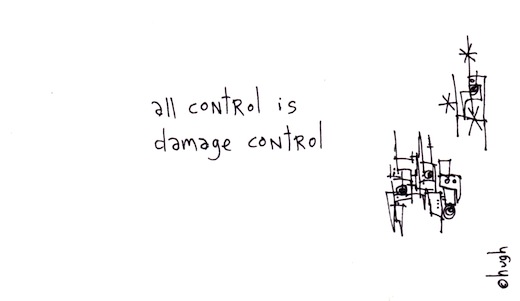
As a bonus, the book is amply illustrated by Hugh MacLeod, which makes it an even more interesting read.

0711allcontrolA good part of the book covers the Quest method of strategy development, with plenty of examples and aids. I found the “MurderBoard” the most interesting section. This section alone makes the book worth buying. The MurderBoarding sequence is simple: 1) Decide what  matters; 2) Sort; 3) Test; 4) Choose. The last step is critical, for “If you don’t choose, you don’t have a strategy; you just have a set of options.” Or, to make it as clear as possible,  “MurderBoarding: It’s not how many ideas you have. It’s how many good ideas you kill.

This is a detailed and practical book. It is not a high-concept tome where at the end you feel good but don’t know what to do next. There is enough pragmatic advice in this book for any executive or manager to run with. It’s a valuable addition for people with management responsibilities in large organizations or anyone consulting to such an organization. Here is one final quote that succinctly describes the end goal of The New How:

“Permission to innovate without asking happens when the strategy is co-owned.”