Thriving in networks that are smarter and faster than you are

industrial era

Many of today’s larger companies have overly complicated, hierarchical structures. As they grew to their current size, control processes were put in place to create efficiencies. To ensure reliable operations and avoid risk, work became standardized. New layers of supervision appeared, more silos were created, and knowledge acquisition was formalized, all in an attempt to gain efficiency through specialization.

These organizations are now facing increasingly complex business environments that require continuous learning while working. Typical strategies of optimizing current business processes or reducing costs only marginally influence the organization’s overall performance. Faster  market feedback challenges the organization’s ability to react to customer demand. Decision-making becomes paralyzed by process-based operations and the formal chain of command. Agility is almost non-existent.

We are seeing growing complexity both inside and outside the enterprise, so can anyone really predict what’s going to happen next in their market? Even most of the world’s economists have been wrong about where we are headed. Looking backwards has not helped us much.

In this complex and connected world we cannot predict outcomes, but we can engage our environments and markets and then learn by doing. This makes constant learning a critical business skill. It requires do-it-yourself learning as well as social learning skills. How can we help people in the organization develop these skills?

Providing good tools and teaching by example is a start. While communication does not equal collaboration, social media have the potential to support emergent work practices. In changing complex environments, it’s not much use to rely on previous best practices. Social media can provide a space to develop new practices. How these tools get used is itself an emergent practice, but if workers are not allowed to practice, nothing will emerge.

In an age when information is no longer scarce and connections are many, organizations must let all workers actively manage their knowledge networks. Systemic changes are sensed almost immediately in an interconnected world. Therefore reaction times and feedback loops have to get faster. Workers need to know who to ask for advice at the moment of need. However, this requires a certain level of trust, and we know that trusted relationships take time to nurture. The default action in emergencies is usually to turn to our friends and trusted colleagues; those people with whom we have shared experiences. Workers have to start sharing more of their work experiences now, in order to grow their trusted professional networks to deal with new and more complex situations. This is called working out loud. It helps build trust.

Sharing complex knowledge in trusted networks does not happen over night. It requires a combination of actively engaged knowledge workers, using optimal communications tools, all within a supportive organizational structure. Continuing to use industrial era structures and concepts will only lead to irrelevance in the network era.

It’s all about thriving in networks that are smarter and faster than you are. It’s all about being utterly screwed if you don’t know what I’m talking about. – Hugh MacLeod

Solo change agents set you free

Here is what Domino’s Pizza learned about implementing personal knowledge management practices, after their recent pilot project:

First, learners want some guidance about the changing boundaries of professional development. Traditional models of learning involve taking a chunk of time to step out of the workplace. PKM makes learning a real-time activity within the flow of work. The company needs to clarify what people are allowed and expected to do in terms of learning during the workday.

Second, information services, particularly information security, needs to be a partner in the effort. The director of information security consulted throughout the effort and attended the workshop, where he was able to offer some valuable insights.

Finally, as learning practitioners, we’re awash in information about social tools and technology-enabled learning. It can be easy to overlook how unfamiliar busy professionals are with some of these technologies—especially in a work context. We need to take the time to help familiarize them with new tools, using practical, realistic examples. – Eric Kammerer

There were three key considerations: 1) how to take control of your professional development; 2) how to do this within a particular organizational structure, and 3) how to do this with the available tools and abilities of users. Unlike PKM at an individual level, in a corporate implementation there needs to be a balance found between organizational objectives and personal ones. In this case, I helped set the stage, provided some initial guidance, and then Eric and his team continued on their journey.

A key difference between a solo change agent and a corporate consultant, is that the former is there to set you free, not chain you to proprietary methods and processes. Had I been working for one of the big name consultancies on this PKM project I would likely have lost my job for not selling an ongoing engagement to my client at Domino’s. Instead, I provided enough support to get them going on their own. I am not selling fish, and I am not teaching people how to fish. I help people learn for themselves how to fish. This is social consulting and it does not scale the way traditional consultancies do. Instead, it grows through transparency, authenticity, results, and especially trust.fishing-nets

I have said before to beware of anyone trying to sell cookie cutter solutions for complex organizational issues. Companies have to do the hard part of organizational change themselves by putting in the effort. As a solo change agent, I can get you started, give coaching and advice, and provide ongoing resources. I cannot do it for you. Domino’s is an excellent example of a company that understands this. Is your company getting the best value from its consultants?

Future of work is complex, implicit and intangible

The relationship between intangibles and tangibles reminds me of the implicit/explicit knowledge continuum. The explicit/tangible side is easier to measure, so that is where most management methods have concentrated their efforts. But as organizations, markets, and society become networked, intangibles create more of our value and this is much more difficult to measure. With the increasing complexity that networks bring, implicit knowledge-sharing becomes more important as well, but this is often ignored by both training and knowledge management programs.

Today, intangible assets are over 80% of current market value. Because intangible assets do not have to be shipped and stored like real assets do, they increase the volatility of the marketplace, with larger and more frequent fluctuations over perceived value. Unlike tangible assets, intangible assets can be lost and gained quite quickly. At the same time, we are witnessing that company lifespans are decreasing, which also increases market volatility.

Smarter Companies offers methods to look at intangible asset calculations. I recently spoke with Jay Deragon at Smarter Comanies about intangibles and the influence of technology on learning. A recent example of an intangible asset calculation is Mary Adams’ summary of Twitter’s valuation.

“Human Capital: 2,000 employees. No clear leader. No woman in senior leadership
Relationship Capital: +100 million Daily Active Users, +Advertisers, 3 million websites that integrate Twitter, 6 million Registered Twitter Apps.
Structural Capital: 6 patents, the platform, and related data about use of the platform
Strategic Capital: 85% revenue on advertising; 5% sale of data. Model still isn’t profitable.”

Mary Adams concludes that Twitter is most dependent on its relationship capital, which could be lost if investors try to extract too much tangible value that detracts from it. Another perspective on intangible, or intellectual capital is from Jay Cross, who says that; “Intellectual capital is largely a matter of mind and relationships”.

“Intellectual capital comes in several forms. Human Capital is the know-how and abilities of an organization’s people; Relational Capital is personal and business links to customers, partners, and suppliers; and Structural Capital is the infrastructure, processes, culture, and intellectual property that define how the organization operates.”

From an operational perspective, we can see that improving relationship capital is important for companies that offer intangible services. These types of companies need to invest in structuring work so that implicit knowledge can flow, not just between employees, but throughout the ecosystem. If most goods and services are intangible, the only way to stay current with their true value is to remain connected to those who influence relationship capital. These are employees, customers, suppliers, and partners.

To do this effectively, all support systems (OD, HR, Finance, Sales, Marketing, IT) need to understand how to support the implicit knowledge-sharing that is essential in creating the intangible value. Almost all valued work today is customized. We have seen this shift over the past three decades, as middle-skill jobs have disappeared. Low-skill (standardized work) jobs still exist where the work cannot be automated, but these are jobs with little advancement. High-skill (customized work) jobs have also increased and it is from these workers that much intangible value is derived. The new workplace of intangible assets is a complex environment, and one where traditional analytical methods no longer work. The future of work is complex, implicit, and intangible.

complex implicit intangible

Doing the right thing

Here is a letter I wrote to the local newspaper, which was published today. I think it has broader application, so I’ve posted it, with additional links and photos.

Doing the right thing

It’s easy to do things right. Today, machines and software can be designed to do things right. But in complex, human relationships, it’s better, and more difficult, to do the right thing. Even with modern technology, machines cannot be programmed, nor laws written, to ensure that we always do the right thing.

Town Council and the Tantramar Planning Commission did things right by enforcing by-laws and revoking the patio licence for the Black Duck Coffee House this week. However, they did not do the right thing.Sarah and Al by DeeSquaredSarah & Al, BDCH owners: Photo by DeeSquared

The right thing would have been subtle and nuanced. It would have considered that the owners, in less than one year, have purchased their coffee cups from a local potter, bought only local produce, hired a stone mason, as well as carpenters, labourers, and baristas, all the while injecting money into the local economy. The right thing would have been to understand the influence that one small café has had in bringing together people and attracting many others from out of town. The right thing would have been to see that the Black Duck Coffee House is a signal of potential economic growth for Sackville, bringing new people and new ideas to a town in desperate need of them. The right thing would have been a human, not a mechanical response. The right thing would have involved many conversations.

I ask our public servants and those who represent us to try to do the right thing. It may be difficult, complex, multi-faceted, and even fuzzy. But doing the right thing is something only people can do.

black duck coffee house doorNote: After all the positive feedback from the community [above], the coffee house will re-open on 30 September, after some renovations.

the social imperative

Dr. Robert Sapolski has been studying baboons for thirty years. While many researchers took for granted the hierarchical nature of baboon life, with dominant males attacking those next down the social ladder and then the process repeating itself down to infants and females, Sapolski did not. One thing his research showed was that the baboons on top were less stressed (lower stress hormones) and had lower blood pressure than those lower down the social ladder.

But then a most interesting event occurred with a certain troop that Sapolski was observing. The baboons started feeding from a garbage dump and many became infected with tuberculosis. Nearly half the males in the troop died, mostly the aggressive and non-social ones. Every alpha male was gone! As a result, the atmosphere of the troop changed and became much less aggressive and more social. Not only that, but any new males who joined the troop were discouraged from being aggressive and adopted more pro-social behaviours within six months.

In this more social and less hierarchical environment, the troop as a whole became healthier and less stressed. It is currently thriving. The fundamental lesson that Sopolski came back with was that “textbook social systems that are engraved in stone” can be changed in one single generation. There may be hope for the human race, it seems.

Recent research shows that evolution is on the side of those who cooperate.

“We found evolution will punish you if you’re selfish and mean. For a short time and against a specific set of opponents, some selfish organisms may come out ahead. But selfishness isn’t evolutionarily sustainable.”

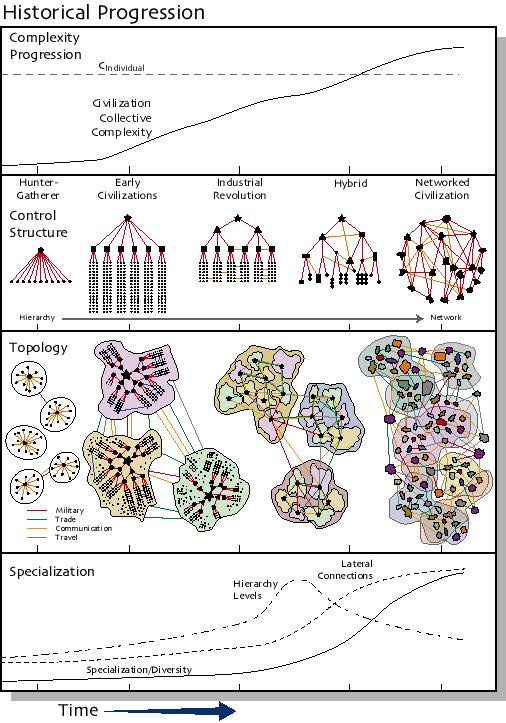
The natural world is composed of complex systems and it makes sense that the best strategies for any population are ones that take complexity into account. This is a limitation of hierarchical organizational models. They cannot address large-scale levels of complexity, as explained in Complexity Rising, a 1997 paper on complexity profiles.

“In summary, the complexity of the collective behavior must be smaller than the complexity of the controlling individual. A group of individuals whose collective behavior is controlled by a single individual cannot behave in a more complex way than the individual who is exercising the control. Hierarchical control structures are symptomatic of collective behavior that is no more complex than one individual. Comparing an individual human being with the hierarchy as an entirety, the hierarchy amplifies the scale of the behavior of an individual, but does not increase its complexity.”

As Yaneer Bar-Yam explains in Complexity Rising, hierarchies have diminishing usefulness as complexity increases.

“At the point at which the collective complexity reaches the complexity of an individual, the process of complexity increase encounters the limitations of hierarchical structures. Hierarchical structures are not able to provide a higher complexity and must give way to structures that are dominated by lateral interactions.”

rp_historical-progression.jpg
Image: Complexity Rising, UNESCO

Many of these lateral interactions are what we would call social relationships. They are outside the official hierarchy. As Verna Allee has noted, for complex environments, or ‘un order’, we need stronger networks and looser hierarchies. But most of our organizations are designed for ‘complicated order’ only. Or you could say that we need more lateral interactions.

Better social relationships (non-hierarchical and not based on the dominance of others) can make for healthier populations. In addition, networks are the only way our collective intelligence can be used to address increasing complexity. Becoming more social is not just a business driver but also a societal imperative.

rp_cynefin-networks-verna-allee.jpg
Image: Verna Allee

Institutional Memory and Knowledge Management

This is a follow-up post on building institutional memory. The basic premises are stated in sense-making for decision memories. This presentation includes additional details and more explanations. It adds many new slides to help with the flow of the narrative, limited as it is with this medium.

The main themes are:

Memories are captured as knowledge artifacts, each limited by what it can convey, depending on its nature and the knowledge of the recipient.

Decision memories have a certain importance for organizations; to understand why decisions were, or were not, taken.

Knowledge management can provide a structure to capture institutional memory, but it requires more than a single approach.

Complex work, which is growing in importance in networked organizations, requires the sharing of implicit knowledge and this presents certain challenges.

We should take complexity into account and develop frameworks for sharing knowledge and storing institutional memory to help organizations deal with current events and prepare for an uncertain future.

institutional_memory

Knowledge Management for Decision Memories

Institutional decision memories can describe how and why we, as an organization, chose one course of action over another. As Brian Gongol notes:

“If a capital project has an expected service life of 20 to 30 years, it’s entirely possible that people working in an institution in their 20s will be middle or upper-level managers in the same institution by the time the project has to be replaced or upgraded. Unless someone documents the process by which the original decision was made, including notes on the alternatives not taken, the 50-year-old manager who’s been with the institution all along will usually be guided more by 25 years of habits and built-in bias than by a fresh look at the available alternatives. And the situation is likely to be even worse if the 50-year-old manager making the decisions came into the institution recently and doesn’t even have a memory for when the original project was completed in the first place.”

Over time, these memories can be codified and institutionalized. This is Big Knowledge Management, leveraging the power of enterprise software platforms to store decision, process, and event memories. Process and event memories, like project outputs, are relatively easy to capture and codify. But decision memories are often hampered by our tendency to justify decisions after they have been made, and even create elaborate, and often fictional, stories around them. For this reason, it is important to capture decisions as they are being made, not after the fact.

Explaining why other decisions were not made, should also be normal practice. For example, I was working with a client that made decisions on which chemical compound to develop out of a possibility of thousands. There was a cost to initially create any compound, so not all possibilities could be attempted. Decisions were made by a committee on which compound to pursue. However, the decisions on why the other compounds were not developed were never recorded. Several years later, the situation had changed due to improvements in technology and new research findings, and now some of the rejected compounds may have had potential for development. Unfortunately, no records were available to search the rejected compound database and find ones that met the new criteria. Sometimes our decisions not to do something are just as important as our selected course of action, from the perspective of the future. But we never know this in advance.

Recording and sharing our knowledge on a regular basis is what Little Knowledge Management is about, as it focuses on providing ways for groups to try new methods safely. Examples include curation, communities of practice, and mentoring. For complex work, Little KM is critical, as most of the knowledge required is implicit, and not easy to codify. According to the Cynefin framework, in the Complex domain “the relationship between cause and effect can only be perceived in retrospect, but not in advance, the approach is to Probe – Sense – Respond , and we can sense emergent practice.” Teams working in the complex domain have to make “probes” on a regular basis in order to understand the changing environment. It then becomes essential to develop ways to capture and share the decisions made with each one.

decision memories

Institutional memory, especially the decisions taken over time, has to be part of the workflow of any knowledge worker doing complex work and making decisions. Ewen Le Borgne writes that, “Institutional memory feeds off strong personal knowledge management among individual staff members“. I define PKMastery as a set of processes, individually constructed, to help each of us make sense of our world and work more effectively. PKM is an ongoing process of filtering information from our networks; creating knowledge individually and with our teams, and then discerning with whom and when to share the artifacts of our knowledge. As Roger Schank states, “Comprehension is mapping your stories onto mine.” PKM helps to put your maps out there for others to see.

We have to remember that all of this “knowledge management” is nothing without people engaged in the process. Viola Spolin, creator of the “Theater Games” actor training system, says that, “Information is a weak form of communication.” But, it can be improved, as Gary Schwartz notes, “Story becomes important in the ordering of all this information.” Stories are the glue, holding information together in some semblance of order, for our brains to process into knowledge.

stories are personal

Related Posts

Institutional Memory
The Storytelling Animal
Building Institutional Memory
An Organizational Knowledge Sharing Framework

Network Era Fluency

Today, it’s all about networks, something you were most likely not taught about in school. This means that most of our education is useless in understanding the world as it currently exists. Yes, useless.

If you were raised during the past several decades you probably understand tribes and institutions. You likely heard a lot about market forces, especially in 2008. But that is a triform society. What happens as we become a quadriform society (Tribes +Institutions +Markets +Networks)?

There are some interesting things that happen when hyperlinks subvert hierarchy, as the writers of the Cluetrain Manifesto said in 1999 (that long ago). For example, United Breaks Guitars, a video that gave a whack on the side of the head to United Airlines, adversely affected United’s stock price. Wikileaks published some documents and enormous state resources were put against one person, now holed up in an embassy, at significance expense to those who pay the guards. Arab Spring became a force overnight, confusing intelligence agencies (the same ones who never saw the collapse of the Soviet bloc in advance). The Occupy movement came and some say has gone, but it’s likely a field test for more movements to come.

In education, the current subversion is called a MOOC, which has already been subverted by corporate interests, but will likely rise again in another name or form. In the labour movement we are seeing things like alt-labour as well as a growing shareable economy. CSA’s are becoming the norm. Networked, distributed businesses, like AirBNB, are disrupting existing models, with the inevitable push-back as they become successful.

Big data is also networked data. Data is the new oil, according to Gerd Leonhard. While my personal data may not be that important in the great scheme of things, networked data drive advertising, brands, and security systems. To negotiate the network era we need to understand networks – social networks, business networks, government networks, and information networks. We need network fluency.

Tony Reeves wrote a recent post about the 21st century skill set, showing that global fluency could be developed through certain skills like critical thinking, in addition to some key literacies, like information literacy. I have taken these ideas but describe them slightly differently, as shown in the image below.

network era fluencyNetwork era fluency could be described as individuals and communities understanding and being part of global networks that influence various aspects of our lives. For individuals, the core skill is critical thinking, or questioning all assumptions, including one’s own. People can learn though their various communities and develop social literacy. Information literacy is improved by connecting to a diversity of networks. But control of networks by any single source destroys the ability for people and communities to develop real network era fluency, which is not good for society in the long run and may kill innovation and our collective ability to adapt.

Mass network era fluency can ensure that networks remain social, diverse, and reflect many communities. This kind of fluency, by the majority of people, is necessary to deal with the many complex issues facing humanity. We cannot deal with complex issues and  networked forces unless we can knowledgeably talk about them. This requires fluency.

Related: The Network is the Solution

Networked individuals trump organizations

2005 was the year when more than 50% of US workers’ occupations involved non-routine cognitive work, that long-awaited milestone. Stowe Boyd

jobs and work“Work has become distributed, discontinuous, and decentralized, hence, 3D”, says Stowe. As hyperlinks subvert hierarchy, so does work fragmentation subvert organizations. Given the nature of 3D work, it may be possible that we are witnessing the end of the corporation as a wealth-generation machine, just as its current power seems to have no limits.

In knowledge-based work the primary unit of value creation has shifted from the organization to the individual. Work is modularized and distributed globally across algorithms and human work.Ross Dawson

Stowe Boyd calls this the rise of the emergent business. We can look at this change from the perspective of knowledge networks, in which most of us will be working, whether we are farmers or software engineers. A knowledge network in balance is founded on openness which enables transparency. This in turn fosters a diversity of ideas, and promotes innovative thinking. The emergent property of all of these exchanges is trust.

In an economy based on trusted knowledge networks of individuals, the role of the organization may revert to merely a supporting one. We might even see corporations bidding for the privilege of supporting knowledge networks. This is quite the opposite from today, where someone recently stated on a forum that 95% of companies are not in the top 5%, yet they all demand the top 5% of talent. Perhaps in the future companies will have to fight for talent.

open societiesAs more people work in distributed networks they may realize how little they have to gain from organizations. If autonomy, mastery, and a sense of purpose motivate people to work, as Dan Pink says, then networks are a much better vehicle for rewarding work than organizations can ever be. It’s the difference between intrinsic and extrinsic motivation. While the industrial era, based on the principles of scientific management, used extrinsic rewards, the network era requires personal motivation. Organizations, driven by external and formal direction, cannot compete with self-motivated and connected workers in the network era.

industrial management

The new work

All work today can be reduced to just four basic types of jobs, according to Lou Adler. His company identified four prototypical jobs after developing thousands of job descriptions over the years.

Everything starts with an idea. This is the first of the four jobs – the Thinkers. Builders convert these ideas into reality. This the second job. Improvers make this reality better. This is the third job. Producers do the work over and over again, delivering quality goods and services to the company’s customers in a repeatable manner. This is the fourth job. And then the process begins again with new ideas and new ways of doing business being developed as the old ones become stale.

While I am not a fan of job competencies, I think this article can tell us something about the future of work in general. For instance, Gary Hamel identified obedience, diligence, and intellect as industrial/information economy competencies. Today, initiative, creativity, and passion are essential skills for what Hamel describes as the Creative Economy. I view this new creative economy as a property of the Network Era which is bringing about the rise of knowledge artisans. So I began to map Hamel’s essential work competencies against Adler’s job types.

Another factor in the changing nature of work is the changing perception of value. In the creative economy, more value is coming from intangible assets than tangible ones. For example, the S&P stock index in 2009 was 81% intangible assets, up from 17% in 1975. I recently discussed intangibles and organizational dynamics with Jay Deragon, as part of the Smarter Companies initiative. As the Smarter Companies website explains:

Despite its enormous importance today, most businesspeople lack the basic knowledge and tools needed to optimize intangible capital. This leads to blocked learning, suboptimal performance, stifled innovation and stagnant growth.

Learning to better deal with intangibles is the next challenge for today’s organizations and workers. I developed the following graphic to describe the four job types in relation to 1) work competencies and 2) economic value. It appears that an economy that creates more intangible value will require a greater percentage of Thinkers and Builders.

jobs value competenciesAs we move into a post-job economy, the difference between labour and talent will become more distinct. Producers and Improvers will continue to get automated, at the speed of Moore’s law. Those lacking enough ‘Talent’ competencies may get marginalized. I think there will be increasing pressure to become ‘Thinkers + Builders’, similar to what  Cory Doctorow describes as Makers in his fictional book about the near future.

What is relatively certain is that ‘Labour’ competencies, which most education and training still focuses on, will have diminishing value. How individuals can improve their Thinking and Building competence should be the focus of anyone’s professional development plan. How organizations can support Thinking and Building should be the focus of Organizational Development and Human Resources departments. While Producing and Improving will not go away, they are not where most economic value will be generated in the Network Era.

As with all models, this one simplifies reality, but it may be useful for thinking about the future of work.