The Nature of the Future – Review

Nature of the FutureWhat will the future look like? Here are some glimpses.

  • Genomera: Crowdsourcing clinical trials.
  • BioCurious: Hackerspace for biotech.
  • Lending Club: “We replace the high cost and complexity of bank lending.”
  • ScholarMatch: Connect under-resourced students with resources, schools, and donors to make college possible.
  • Foresight Engine: How would you reinvent the process of medical discovery?
  • Open PCR Machine: Do it yourself thermocycler for controlling Polymerase Chain Reactions for DNA detection and sequencing.

These are all discussed in the book, The Nature of the Future, by Marina Gorbis, executive director of the Institute for the Future.

We are quickly finding out that when we go from a centralized communications infrastructure to a distributed one, when we connect everything and everyone, the result is not just to make things faster, better, and bigger. The social system itself acquires a fundamentally different quality: it becomes more diversified, more emergent, and often unpredictable.

This book provides probably the best background, and foreground, reading for most of the ideas discussed on this blog: complexity; the changing nature of work; the need to integrate learning into our work; and the primacy of cooperation in networks. Dedicated chapters cover money, education, science, governance, and health, with interesting future scenarios supported by current examples. While automation and robotics may be taking many jobs away, Gorbis identifies unique human skills which will continue to be important. These should be the core of any public education program.

  • Sensemaking
  • Social and emotional intelligence
  • Novel and adaptive thinking
  • Moral and ethical reasoning

As Gorbis writes, and I wholeheartedly agree, “Learning is social”.

We need to learn how to work better with machines, letting machines do what they are good at. Gorbis shows how machines and average people can outperform experts at playing chess. “Weak human + machine + better process was superior to a strong computer alone and, more remarkably, superior to a strong human + machine + inferior process.”

On the future of health care, Gorbis sees a new role for doctors. “In a socialstructed health care system, the doctor is not an omniscient God but a great conversationalist, astute observer, and insightful partner, that is, she is less a robot and more a real human being.” Doctors will be more like nurses, and with increasingly advanced technology, nurses will be more like doctors. I wonder if in the future, their roles will merge?

Gorbis identifies a major disconnect in our economy.

  1. Our technology tools and platforms are highly participatory and social.
  2. Our business models, by contrast, are based on market, i.e., monetary rewards.
  3. conflicts [between these two priorities] are likely to grow simply because the number of such endeavors [Twitter, Facebook, etc] is growing exponentially.

Gorbis concludes that “much new value and innovation will move from commodity-or-market-based production to socialstructed creation.” This reminds me of the T+I+M+N framework. A networked economy is not a mere modification of a market economy, but a form in itself that can address issues beyond the capabilities of markets.

Would I recommend this book? Yes. There are few people who would not benefit from this synthesis of the forces of technological, economic, and societal change coming at us. I will close with some practical advice, applicable to all, but especially for anyone entering the workforce.

In a world where people’s jobs will not be given to them, each individual will need to look deeply and understand what she or he is good at, how she or he can contribute to multiple efforts and navigate multiple roles and identities as a part of different communities.

The Connected Workplace

The Connected WorkerToday’s digitally connected workplace demands a completely new set of skills. Our increasing interconnectedness is illuminating the complexity of our work environments. More connections create more possibilities, as well as more potential problems.

On the negative side, we are seeing that simple work keeps getting automated, like automatic bank machines. Complicated work, for which standardized processes can be developed, usually gets outsourced to the lowest cost of labor.

On the positive side, complex work can provide unique business advantages and creative work can help to identify new business opportunities. However, complex work is difficult to copy and creative work constantly changes.

But both complex and creative work require greater implicit knowledge. Implicit knowledge, unlike explicit knowledge, is difficult to codify and standardize. It is also difficult to transfer.

Implicit knowledge is best developed through conversations and social relationships. It requires trust before people willingly share their know-how. Social networks can enable better and faster knowledge feedback for people who trust each and share their knowledge. But hierarchies and work control structures constrain conversations. Few people want to share their ignorance with the boss who controls their paycheck. But if we agree that complex and creative work are where long-term business value lies, then learning amongst ourselves is the real work in organizations today. In this emerging network era, social learning is how work gets done.

Becoming a successful social organization will require more than just the implementation of enterprise social technologies. Developing, supporting, and encouraging people to use a range of new social workplace skills will be just as important. Individual skills, in addition to new organizational support structures, are both required.

Personal knowledge mastery (PKM) skills can help to make sense of, and learn from, the constant stream of information that workers encounter from social channels both inside and outside the organization. Keeping track of digital information flows and separating the signal from the noise is difficult. There is little time to make sense of it all. We may feel like we are just not able to stay current and make informed decisions. PKM gives a framework to develop a network of people and sources of information that one can draw from on a daily basis. PKM is a process of filtering, creating, and discerning, and it also helps manage individual professional development through continuous learning.

Collaboration skills can help workers to share knowledge so that people work and learn cooperatively in teams, communities of practice, and social networks. In order to support collaborative working and learning in the organization, it is important to experience what it means to work and learn collaboratively, and understand the new community and collaboration skills that are involved. “You can’t train someone to be social, only show them how to be social.” Practice is necessary.

The power of social networks, like electricity, will inevitably change almost every existing business model. Leaders need to understand the importance of organizational architecture. Working smarter in the future workplace starts by organizing to embrace networks, manage complexity, and build trust. The 21st century connected enterprise is a new world of work and learning.

For example, traditional training structures, based on institutions, programs, courses and classes, are changing. Probably the biggest change we are seeing is that the content delivery model is being replaced by more social and collaborative frameworks. This is due to almost universal Internet connectivity, especially with mobile devices, as well as a growing familiarity with online social networks.

Work is changing and so organizational learning must change. There is an urgent need for organizational support functions (HR, OD, KM, Training) to move beyond offering training services and toward supporting learning as it is happening in the digitally connected workplace. The connected workplace will not wait for the training department to catch up.

#itashare

Making sense of complexity and innovation

Friday’s Finds:

friday2Gall’s Law: A complex system that works is invariably found to have evolved from a simple system that worked. A complex system designed from scratch never works and cannot be patched up to make it work. You have to start over with a working simple system. – John Gall

@euan : “My discomfort with case studies is the inclination to force things to make sense in retrospect when they didn’t in advance!”

@Cory_Foy“Innovation comes from slack. Slack comes from saying no. If you’re afraid of both, no startup bubble technique is going to help you.”

Deconstructing Innovation: a complex concept made simple; by @ShaunCoffey

So it is important to understand that there is no one-size-fits-all philosophy in terms of successful innovation. The one constant is that you have to be open to change and new points of view. Innovation is continuous.

Successful innovators and entrepreneurs all embrace change and the risks that they pose. In fact, innovation is the poster child of the mantra that there are no rules. Only by trying out new things, by failing, by discovering what works and what doesn’t, do you gain answers to the innovation question.

Knowledge Leadership in the Era of Convergencevia @JonHusband

In an environment where speed, access, and tools allow workers to seamlessly collaborate across time zones, store massive amounts of data, and crowdsource the answers to difficult organizational issues, organizations that trend toward openness in the knowledge management arena will be better able to use new technologies and react to cultural and business changes. This makes leaders responsible for developing an open, collaborative culture, and suggests that inspiring these attitudes toward knowledge management will have positive individual and organizational consequences.

No cookie cutters for complexity

Five years ago I noted that big consultancies were jumping on the Web 2.0 bandwagon but more nimble upstarts (like me) could now significantly engage in a conversation with our markets using our own tools, like blogs, with which we have developed a certain advanced level of expertise. Jon Husband had written a good observation on how large consultancies work:

Big firms either 1) develop standardized methodologies and practices (their business models depend upon it), or 2) if their business model does not depend upon the standardization, they will charge you a mint and a half (McKinsey?)

The organization(s) [clients] will in my opinion get better advice rooted in critical thinking and experience and focused on results, as opposed to maintaining an expensive dependency on canned rhetoric that may not be based in much experience. For example, what exactly is “Advanced” Web 2.0 technology ? Blogs with lots of colourful widgets?

Five years later, Dave Snowden makes a similar observation, sparked by a KPMG marketing brochure on “cutting through complexity”. Dave concludes:

If a consultancy firm really wants to help their clients then they should support them in living with complexity, riding its potential, avoiding reductionist approaches, engaging customer and staff in a sensing network.  The trouble is that would not allow large teams of recently graduated MBA’s to reuse recipes and documents from over codified knowledge management systems.

cookie-cutterSo while we upstarts may now have a greater voice online, there is still a large demand for cookie cutter solutions. As social learning, collaboration, and even complexity become mainstream concepts, the array of products and services around them are becoming commoditized. Making a value proposition around behaviour and culture change is therefore very difficult.

I have noted in the past year clients wanting more products and fewer customized services. Some of this is due to their own difficulties in facing complexity and not having the time or energy to dig into these concepts. It’s just easier to buy a product, and nobody makes shinier products, such as case studies, than the big consultancies.

Case studies abound in business and many sell for a significant amount. But other than for general education, they’re rather useless. Each organization’s situation is not only different, it’s changing. Case studies and best practices in business are like the arbitrary subjects in our schools. They’re easy to package but don’t transfer well into real life.

Few managers ask the tough questions, like what are the underlying assumptions of how we do business and do they make sense? Are any of our practices self-defeating?

Complex problems require different thinking. In the book, Getting to Maybe, the authors say that in complex environments:

  • Rigid protocols are counter-productive
  • There is an uncertainty of outcomes in much of our work
  • We cannot separate parts from the whole
  • Success is not a fixed address [what I call perpetual Beta]

Rigid protocols are prescriptive and tell you what to do. To understand complex systems one must marinate in them, as John Seely Brown advocates. The problem with best practices is they presume simplicity, like being able to ‘cut through complexity’. The next time you pick up a report on best practices, ask yourself:

  • Has anything changed since this report was written?
  • How is my organization different from these?
  • Who stands to gain from the report?

Many best practices are self-evident. They’ve worked for years and address relatively simple systems. But the business issues that consume us are most likely complex. Instead of looking for best practices, take that time and money to invest in an experiment (a probe).

Beware the cookie-cutter salespeople. They abound, and are aided by marketing departments that do not have a clue about complexity. There are some real advantages in avoiding the large consultancies and going with smaller companies and free-agents. These include:

  • Personal relationship based on knowledge and trust
  • Work is usually done by senior consultants
  • Responsiveness and flexibility
  • Ability to innovate faster
  • Fewer costs to pass on (shareholders, marketing, advertising, bonuses)

One should never bring a knife to a gun fight, nor a cookie cutter to a complex adaptive system.

Only open systems are effective for knowledge sharing

Seth Godin makes a very good point about trusting the select few to curate information, whether they be leaders, managers, certified professionals, researchers, or any other group of experts.

We have no idea in advance who the great contributors are going to be. We know that there’s a huge cohort of people struggling outside the boundaries of the curated, selected few, but we don’t know who they are.

When it comes to knowledge, we often do not know in advance what will be useful in the future. I discuss this when coaching people how to narrate their work, an essential part of encouraging social learning in the workplace. Overly editing one’s own work is similar to overly editing who does the curation of our knowledge flows. Seth Godin explains it with this graphic.

open v curationIn software programming, the saying is that with enough eyes, all bugs are shallow. Or put another way, the more people who look at a problem, fewer errors will get through. In the case of enterprise knowledge-sharing, an incredibly inexact practice; with enough voices quality will emerge. Only an open system can ensure this, which is why I highlighted the knowledge sharing paradox.

When it comes to knowledge, and learning, only open systems are effective. All closed systems will fail over time, especially if discovery and innovation are happening outside that system. The question for organizational leaders is whether they think they can create an artificial, closed system that can compete with almost 3 billion people connected to that hive mind called the internet.  The good news is that they do not have to. Encouraging cooperation, along with workplace collaboration, ensures more open knowledge sharing.

collab coop

The knowledge sharing paradox

An effective suite of enterprise social tools can help organizations share knowledge, collaborate, and cooperate – connecting the work being done with the identification of new opportunities and ideas. In an age when everything is getting connected, it only makes sense to have platforms in place that enable faster feedback loops inside the organization in order to deal with connected customers, suppliers, partners, and competitors. It takes a networked organization, staffed by people with networked mindsets, to thrive in a networked economy.

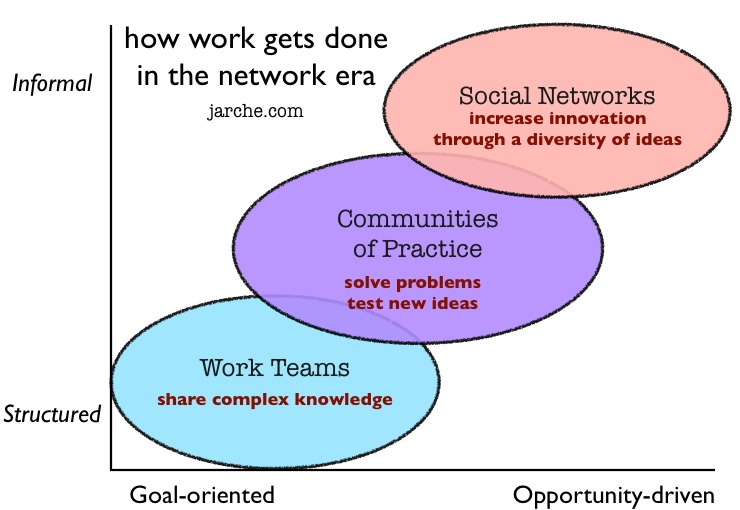
enterprise social toolsGetting work done today means finding a balance between sharing complex knowledge (collaboration) and seeking innovation in internet time (cooperation).

how work gets doneIndividual workers can develop sense-making skills, using frameworks like PKM, to continuously learn and put their learning to work. For example, they can seek new ideas from their social networks; make sense of these ideas by connecting with communities of practice; try new ideas out alone or with their work teams, and then share these ideas and practices.

PKM at workBut there is a major issue that gets ignored, by software vendors, managers, IT departments, and most everyone except the workers themselves. People will freely share their knowledge if they remain in control of it. Knowledge is a very personal thing. Most workers do not care about organizational knowledge bases. They care about what they need to get work done. However, if we are going to build organizational knowledge from individual knowledge-sharing, we have to connect the two.

The knowledge sharing paradox is that enterprise social tools constrain what they are supposed to enhance. Why would someone share everything they know on an enterprise network, knowing that on the inevitable day that they leave, their knowledge artifacts will remain behind? I could not imagine having this blog (AKA my outboard brain) cut off from me. I would not put anywhere near the effort I do now if someone else controlled my access to this blog.

The elephant in the room is human nature. Enterprise knowledge sharing will never be as good as what networked individuals can do. Individuals who own their knowledge networks will invest more in them. I think this means that innovation outside of organizations will continue to evolve faster than inside. It may mean that the half-life of organizations will continue to decrease, as more nimble businesses continuously emerge to compete with incumbents. Whoever creates an organizational structure that bridges the individual-organizational knowledge sharing divide may have significant business advantages.

first structure the work system

org characteristics
I first developed the above table in 2009 to explain that working together [follow link for background info] requires different types of group work according to the complexity of the environment. The tension I see in workplaces today is a direct result of two (almost) opposing principles for organizational design that are necessary in workplaces that deal with complex environments, networks, emergent practices & cooperative work.

First, complex work requires strong ties and high levels of trust to enable work teams to function. On the other hand, innovation needs loose ties and a wide network to get diverse points of view. In these loose networks, cooperation (sharing freely without any quid pro quo) is the order of the day, not collaboration (working together toward a common objective).

The problem is that in a TIMN world, one cannot focus only on networks and complexity and ignore the rest. Therefore there is no single answer on how diverse a work team should be, or the right balance between time spent with loose networks and time spent focused on projects. It’s not as simple as tacking on 20% time. Work and learning are in dynamic tension at all times. While some action and coordination in the workplace can be automated with performance support systems, collaboration and cooperation are still intensely human and require continuous learning.

My recommendation has been to support workplace activities that are both cooperative and collaborative and also to provide the necessary support structures. However, my observations to date show that a third piece is required, and that is the fostering of communities of practice to connect the two. These communities, internal and external; are a safe place between highly focused work and potentially chaotic social networking. I also see the support of communities of practice, through skill development and structural support, as a primary role for learning & development staff.

Enabling people to work in all three spaces is more natural than boxing work as a separate activity from learning and development. John Bordeaux has had similar thoughts about the need to focus on organizational design instead of process design. I think humans, with their complex brains, can develop processes that work, if they are in organizations that allow them to be natural. I also think that this model can work with junior employees, if they are treated like adults. John asks a key question, “Why do we work in organizations where natural interactions and instincts are discouraged?”

“Others have written about new organizational structures, such as heterarchy, wirearchy, et al.  We cannot fall into the trap of the last decade, where “flat organizations” were supposed to destroy hierarchy.  Sociology is not extinct.  But radical new organizations are possible and are in fact happening.  A dear friend now works for a consulting firm where people come together into ad hoc teams to tackle projects.  The firm itself is just the backplane, providing health care, office space, etc – in exchange for a percentage of revenue.  The consultants/engineers/developers/project managers self-organize around opportunities.  The morale is high, the reputation is strong, and the life balance is exquisite.  This model does not suit junior employees, and would not work for many areas outside professional services – but it represents a triumph of natural systems over machine processes.  It maximizes crew methodologies for client value.”

perpetual beta is the new reality

When I discuss life in perpetual Beta, it is often from the perspective of the individual. My interest in personal knowledge mastery (PKM) started with my own need to stay up to date in my field. It has since become a core part of my professional services. Sometimes it seems it’s the workers who are always spinning around, trying to find or keep work, while organizations move at a glacial pace, or even seemingly backwards.

A recent article in Businessweek shows that companies are facing life in perpetual Beta as well.

“A study by economists Diego Comin and Thomas Philippon showed that in 1980 a U.S. company in the top fifth of its industry had only a 10 percent risk of falling out of that tier in five years; two decades later, that likelihood had risen to 25 percent. In finance, banks are losing power and influence to nimbler hedge funds: In the second half of 2010, in the midst of a sharp economic downturn, the top 10 hedge funds—most of them unknown to the general public—earned more than the world’s six largest banks combined. Multinationals are also more likely to suffer brand disasters that clobber their reputations, revenues, and valuations, as companies from BP (BP) to Nike (NKE) to News Corp. (NWS) can all attest. One study found that the five-year risk of such a disaster for companies owning the most prestigious global brands has risen in the past two decades from 20 percent to 82 percent.”

Disaster may be just around the corner, it seems.

PKM, through seeking, sensing & sharing, can help networked individuals deal with the complexity of the network age. We’re finding that this is not a nice-to-have, optional set of skills but core to business survival. BP, Nike & News Corp. could have handled things better if people were actively and openly sharing their knowledge.

Soft skills, like collaboration and cooperation, are now more important than traditional hard skills. While cooperation is not the same as collaboration, they are complementary. Collaboration requires a common goal, while cooperation is sharing without any specific objectives. Teams, groups and companies traditionally collaborate. Online social networks and communities of practice cooperate. Working cooperatively requires a different mindset than merely collaborating on a defined project. Being cooperative means being open to others outside your group. It also requires the casting-off of business metaphors based on military models (target markets, chain of command, strategic plans, line & staff).

Cooperation, sharing with no direct benefit, is needed at work so that we can continuously develop emergent practices demanded by increased complexity. Collaborating on specific tasks is not enough. We have to be prepared for perpetual Beta. What worked yesterday may not work today. No one has the definitive answer any more but we can use the intelligence of our networks to make sense together and see how we can influence desired results.

Work in networks requires different skills than in directed hierarchies. Cooperation is a foundational behaviour for effectively working in networks, and it’s in networks where most of us will be working. Cooperation presumes the freedom of individuals to join and participate so that people in the network cannot be told what to do, only influenced. If they don’t like you, they won’t connect. In a hierarchy you only have to please your boss. In a network you have to be seen as having some value, though not the same value, by many others.

As we transition from a market to a network economy, complexity will increase due to our hyper-connectedness. Managing in complex adaptive systems means influencing possibilities rather than striving for predictability (good or best practices). No one has the definitive answer any more but we can use the intelligence of our networks to make sense together and see how we can influence desired results. This is life in perpetual Beta. Get used to it. Preparing for this will require time, social learning, and management support.

Find out more about the skills needed for PKMastery.

pB

The future is connected, messy, loose and open

Why is self-directed learning and professional development so important today? Rawn Shah, commenting on one of my presentations, said that knowledge is evolving faster than can be codified in formal systems and is depreciating in value over time. This pretty well sums up the situation.

Think about the fact that knowledge is evolving faster than can be codified in formal systems … and what does that mean for all of our formal systems? Schools, government, and even religion are no longer stable bastions of knowledge. The logarithmic curve of knowledge, like our population, has hit us like the proverbial hockey stick it portrays.

World_population_growth_(lin-log_scale)

 Image by Waldir

One of the ways to deal with this knowledge explosion is to use what we have, our humanity. We have developed as social animals and our brains are wired to deal with social relationships. By combining technology with our brainpower, we can figure things out. We are naturally creative and curious. We just have to build systems that nurture our inherent abilities. Schools do not do that. Most workplaces do not. Our economy does not. Most of our governance systems do not. The answers to our problems are within us, collectively. We have more creativity (for good and bad) than any other creature. We need to harness it.

This is what social learning is all about. Not just solving problems, but creating new ways of working. There are amazing technological inventions and discoveries every day, yet we and our media focus too often on our problems. On the edges of society people are experimenting with new ways of working and living together. What is most amazing is that now we can learn about these things with a simple search or click. Two billion people connected to each other is absolutely amazing, yet many of us cannot see the forest for the trees.

Here are just a few examples:

Learn about almost anything, with excellent commentary, from A Man with a PhD

Find out about the new economy from Shareable and Fast Co-exist

Follow what is happening in learning and education with Stephen Downes and his extensive daily newsletter

The Internet is a cornucopia of people sharing what they know. All one needs is the interest and a few skills to filter this. Don’t have the skills? Ask somebody. There are many people willing to help.

It seems so obvious to me, but most organizations are trying to deal with this complexity in simplistic ways. Humans have the ability to deal with some very complex things, yet too often our cultural and organizational barriers block us from using our innate abilities The future is connected, messy, loose, and open. Anything else will be sub-optimal.

It’s the worldview, stupid

I have written on various topics on this blog over the years. For example, I believe that it is only by working (and learning) interdependently, retaining our autonomy, co-developing our mastery and feeling a shared sense of purpose that we will be truly motivated. Imagine my surprise when I watched the movie, Crossroads: Labor pains of a new worldview, when it began with interdependence and then went on to discuss recent mass, decentralized, social world events; the need for cooperation; the Stanford Prison Experiment; and how our social networks influence our behaviour.

This documentary clearly shows that if we change our worldview, we can change the future, for good. However, institutional, business, and political leaders are too committed to the status quo. Meanwhile, the global poor are too busy surviving. That leaves those in the middle, and I would surmise that would be most of the people reading this blog. It’s up to us. As noted in the video, research shows that it only takes 10% of a population to spread an idea. If you understand that we are all connected and that only together will we get ourselves out of the messes we have created, then this video is for you.

Watching this movie was like seeing many of my thoughts put together in a single narrative. I have seen several future-looking videos in recent years but this one really covers the complexities of our current situation. It is worth the one hour of your time. I strongly recommend it. Changing our worldview will be a process of social learning.

VideoCrossroads: Labor Pains of a new worldview