Learning, in spite of ourselves

Here are some of the things I learned via Twitter this past week:

We spend a billion dollars globally on training …. and what we get is worth shit.From Training to Learning in the New Economy c.1996

Discontent is the first step in the progress of a man or a nation – Oscar Wilde; via @JenniferSertl

Whenever you find yourself on the side of the majority, it is time to pause and reflect – Mark Twain; via @micahariel

“My mom has zero buzz, but when she says something, I listen” ~ CEO Zappos; via @blindgaenger

The internet forces us to deliver value to our customers before our customers pay for anything. ~Bob Pike; via @splove1

Coevolution of brain and hand in development of higher-level cognition: toolmaking a key; via @hreingold

“Making a hand axe appears to require higher-order cognition in a part of the brain commonly known as Broca’s area,” said Emory anthropologist Dietrich Stout, co-author of the study. It’s an area associated with hierarchical planning and language processing, he noted, further suggesting links between tool-making and language evolution.

Learning, when your organization isn’t into it: Why PKM/PLN/PLE (networked learning) is critical in today’s workplace – You’re on your own, folks! by @michelemmartin

I know from experience that while there are many companies and organzations (usually the larger ones) that take learning pretty seriously, reality is that most workers cannot count on their employer as the primary avenue for improving their skills. They may get some training to learn how to use proprietary systems or processes, but the kinds of skill-building that make people effective and marketable are just not going to happen.

formal, informal & social learning: aiding & abetting organizational evolution; by @dpontefract

When technology companies begin talking collaboration, social ‘whatever’ or Enterprise 2.0 … I can’t help but think they’re missing the chips and malt vinegar of the order. C’mon chefs, organizations are changing from a behavioral perspective (as society evolves too) and thus we need those tools and technologies to help drive the new organizational behaviors right across the org. It cannot be simply the technology; we need the organizational evolution and new behavior model in the mix. (aided and abetted by formal, informal and social learning constructs – malt vinegar)

Richard Branson on what they don’t teach you in business school: shift from quarterly sales targets to longer term goals and focus on “creativity, intuition & empathy”; via @raesma

PLENK 2010

I was not able to attend any of the sessions at PLENK (Personal Learning Environments & Networked Knowledge)  2010, a Massively Open Online Course (MOOC), other than the one I facilitated on personal knowledge management.  PLENK 2010 was conducted by Stephen Downes, George [Clooney] Siemens & Dave Cormier, three fellow Canadians and two who live pretty close by. However, Zaid Ali Alsagoff provides a comprehensive overview of the most awesome course on planet earth, offered via the intergalactic gaga network.

Partnerships and the organization

This is the third part of my response. See Part 1: Corporate Learning’s Focus & Part 2: Integrating learning into the business.

Inspired by Jay Cross, Amanda Fenton asks how her Corporate Learning department could better meet the needs of employees. I think these are excellent questions and the answers form the basis of addressing how to integrate work and learning in the enterprise.

Q7) How can we help support learning environments (resources and tools, relationships and networks, training and education, supervisor and company support) in a way that is highly efficient and scalable across the country? What are the programs and services that are supported centrally and what do we support through consulting? Through self-serve resources? What capacity needs to be developed in the organization to support all these areas? How can we better advocate the use of social software to enable high performance?

Jane Hart, in the state of learning in the workplace, sums up a more efficient & scalable approach; do-it yourself (DIY):

With the easy availability of tools, people are now “doing their own thing”. This is not just the case for those who are designing and/or delivering training or education for formal learners, but also by many to address their own learning and performance needs. There is a huge amount of evidence that shows that individuals (and teams) are using these tools for their own personal, informal learning. Instead of going to the LMS to find answers to their questions or solve problems, they are using tools like Google, Wikipedia or YouTube, or simply posting questions to their networks on Twitter or Facebook in order to get immediate, up-to-date and relevant answers. It is interesting to note that the success of their “learning” is measured in how well it helps them to address the learning or performance issue in hand, not in course completion data in the LMS. In very many cases, individuals are therefore now directing and managing their own learning primarily though the use of these new tools.

All these factors are influencing the look of learning in the workplace …

As Charles Jennings shows in this very articulate presentation, 8 reasons to focus on informal & social learning, that learning happens as a process, not a series of events. Studies have shown that up to 90% of workplace learning happens outside of formal training. This is what needs to be supported, but not controlled, by the organization. Informal learning is generally more effective, less expensive and better received than formal training. Informal is more scalable than formal. Central control is only necessary for about 10% of workplace learning and this is the portion of resources that should be allocated to it. The graphic below (slide 32) clearly shows how ineffective typical formal training can be:

The data and research are available. Advocating for a better balance of learning options inside the enterprise depends on how well the training department understands its own organization.

Q8) What would an integrated OD, HR, IT, KM, Marketing/Communications and L&D partnership look like? How would our roles, responsibilities and structure change? Who does the manager or employee call when they run into a performance problem? What big organizational beliefs do we need to let go of to support these changes?

Euan Semple has tarred HR, Communications and IT with the same brush. Euan says that:

  • HR are “maintainers of order, rather than enablers of staff”;
  • Communications manages rather than enables communication;
  • IT controls risk instead of enabling the business.

These are generalizations, but expose the weaknesses of our current management systems.

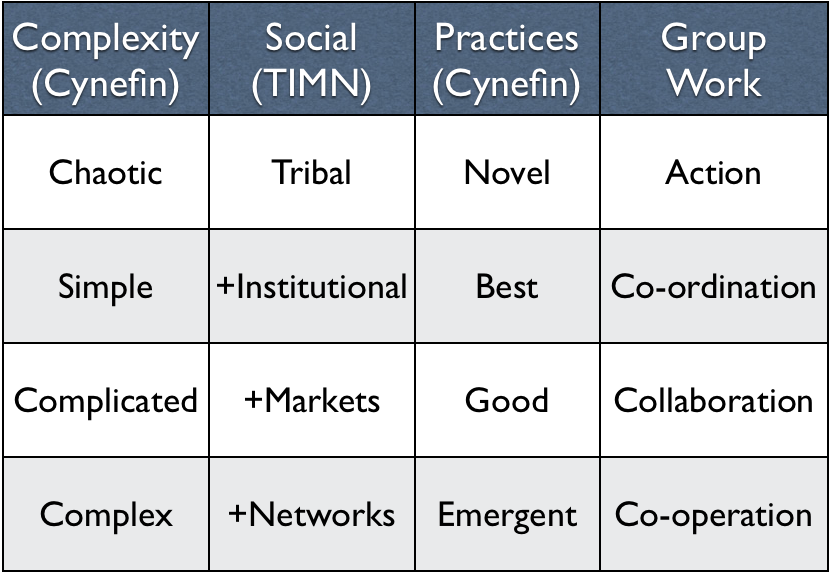
The same workplace issues are being faced by HR, IT, OD, KM, Marketing/Communications and T&D departments. Similar complaints and parallel strategies are being developed in isolation in each of these areas. We really need to get away from our self-imposed tribes and adopt network thinking and practices. All levels of complexity exist in our world but more of our work (especially knowledge-intensive work) deals with complex problems, whether they be social, environmental or technological. Complex environments and problems are best addressed when we organize as networks; our work evolves around developing emergent practices; and we collaborate to achieve our goals.

With hyper-linked information and access to expertise, not only are all internal support departments of less value, they can actually subvert the organization’s future by not responding quickly and appropriately. We need to look to business models on the fringes that foster a sense of community and focus on agility and autonomy. No single, sure-fire, cookie-cutter approach can be implemented in a top-down or consultant-driven manner to create a networked workplace performance model that works. There are no best practices, only next practices.

We can start by recombining organizational DNA, breaking down silos and inverting the organizational pyramid.

Integrating learning into the business

This is the second part of my response. See Part 1: Corporate Learning’s Focus.

Inspired by Jay Cross, Amanda Fenton asks how her Corporate Learning department could better meet the needs of employees. I think these are excellent questions and the answers form the basis of addressing how to integrate work and learning in the enterprise.

Questions on the role of managers and integrating learning into the business:

Q5) How can we facilitate the line managers’ ability to identify the root cause of a performance problem, own it, and know what to do about it (e.g. managing performance problems)?

The situation has gone beyond the case of  helping managers develop a few new skills for their professional toolbox. Transformational, not incremental, changes are needed.

The basic premises of most current management and organizational models no longer apply. These frameworks are based upon work that is being automated and outsourced every day. There is little time to prepare people for this change. Any scenario that I consider – peak oil, global warming; globalization; Asian dominance – still requires that the developed world’s workforce deals with more complexity and even chaos. We need to skill-up for emergent and novel practices and that means a completely different mindset toward work and the “supervision” of work. Knowledge artisans don’t need supervision as much as the reduction of barriers to communication and connection. That’s the role of the “supervisor”.

Here are two other examples.

Ev Williams, co-founder of Twitter, is doing everything he can to keep the company BELOW 150 people. He understands both the old (primates & Dunbar’s numbers) as well as the new (agility & networks). For the past century, the key has been to grow companies. It’s celebrated and rewarded by markets and pundits. Not any more. This company is not growing and not hiring more managers and supervisors. In the new organization, everybody is an independent contributor because there is no need for layers of command and control. Everyone talks to everyone else in this hyperlinked world.

This is one the fastest growing occupations today – community manager. The skills needed here are completely different from traditional command and control supervision. Soft skills are now the hard skills. Supervision is not needed when all work is transparent.

Q6) What if we closed the training department and became mentors, coaches and facilitators, where our focus was on improving core business processes, supporting communication and collaboration to help people perform better, faster, cheaper? Where we worked with managers to fund and develop appropriate tools and processes for employees? How could this be successful?

I would reword this question to: when the training department closes, what do we do? That’s what most people in the business of organizational training should be asking. This will happen with or without the training department. The future of the training department is to stop delivering content and focus on conversations and collaboration. Here’s an example of one of the best “training” programs developed by people who are not instructional designers: CommonCraft “In plain English” videos. There are thousands like this on the Net (e.g. Wiki-How). Add in just-in-time answers to questions on Twitter or Facebook and you have a learning ecosystem. Many workers no longer need the training department to learn. In fact, the training department is often a barrier to learning.

Trainers had better become mentors, coaches and facilitators very soon, or they will become irrelevant in an age of ubiquitous access to content and expertise.

Corporate Learning’s focus

Inspired by Jay Cross, Amanda Fenton asks how her Corporate Learning department could better meet the needs of employees. I think these are excellent questions and the answers form the basis of addressing how to integrate work and learning in the enterprise.

Q1) Close to 80% of learning happens informally and 20% formally, yet we spend most of our time and money on the 20%. How could we better support this and shift our time and money?

There are a few ways to address this imbalance.

The organization can adopt a performance improvement perspective and ensure that all formal training meets a need. HPT (human performance technology) is a broader design approach and should be seen as an enabler to get to instructional systems design (ISD). Without the proper analysis of the organizational needs, constraints and performance factors, a “learning” project may be doomed from the onset, because too often, training is a solution looking for a problem. By doing a performance analysis, it becomes obvious that many performance problems do not require training. I have developed a performance analysis job aid which is available for non-commercial use.

Another approach would be to divert or expand training funds to support informal learning. This could start small but would show that informal learning is important to the organization.  Starting small makes sense because the essence of implementing informal learning is giving up control. This can be scary for managers used to tight command and control. Start with the message that training  addresses less than ten percent of workplace performance. That might get somebody’s attention. Then look at ways to help with the other 90% of work.
One final note, don’t try to formalize informal learning.

Q2) Novices and experts have very different needs (curve from formal to informal). What needs to be in place to better support those differences? How can we support these differences across diverse business units (sales, service and specialized functions)?

Jay Cross and Clark Quinn have used this to explain the formal/informal mix by level of experience:
The above graphic is a good rule of thumb but should not be adhered to slavishly, as there are cases where informal learning works for new hires. I would look at ways to support do-it-yourself learning at all levels.

Q3) How can we shift from teaching content to developing search & find skills, critical thinking skills, creative thinking skills, analytical skills, networking skills, people skills, and reasoning and argument skills?

Organizations should start with Dan Pink’s advice – create an environment where workers have autonomy, mastery and a sense of purpose. A key factor in innovation is to allow people to do meaningful work, in their own way.  The skills listed in this question directly relate to critical thinking. Teaching critical thinking skills may take some time for people used to getting content served on a platter and then being tested on short-term mastery of that content. I don’t see these changes happening overnight.

There are web tools that can be used for critical thinking skills, but tools are not enough. Good informal learning skills are directly linked to critical theory – to question authority, seek the truth and question our own perceptions of reality. All workers need to be good learners but learning cannot be controlled externally, only supported. I like this quote from an unlikely source, Margaret Atwood’s The Year of the Flood: “I was going to Martha Graham [College] partly to get away from Lucerne, but also I had to do something so I might as well get an education. That’s how they talked about it, as if an education was a thing you got, like a dress.
Start by giving up total control of the training process and focus instead on connecting & communicating.

Q4) What training programs do we need to provide, at minimum,  for legal compliance purposes?

Compliance training is a symptom of the current disconnect between learning and working. Meeting compliance training objectives is usually not a worthwhile goal for the organization, though it may keep executives out of jail. Ray Jimenez summed up the issues with this type of training when he commented on my post, compliance of an industry:

“This is bold, cut and dry and thanks for the exposition.

I see debilitating effects across the training industry when many of our training colleagues accept “compliance” as the norm for training. a good example is the blind loyalty to testing for retention with little concern for applications in real-job situations.

Why not fight this culture? I might be wrong, but our industry might be too “onion-skinned” to accept self-reflections and self-criticisms that we rather continue to hide the dirty linens than confront them.

How do we lift ourselves out of this mindset?”

In subsequent posts, I look at Amanda’s other questions on:

Media, Messages & Mobility

Anthropologist Michael Wesch, noted for his studies of YouTube and video sharing states, “when media change, then human relationships change”.

Today, at the DevLearn2010 social media camp, I will be conducting a discussion with my Internet Time Alliance colleagues on mobile learning, but I would like to focus on how the mobile medium changes our relationships with sharing knowledge, connecting with others and getting things done.

For example, what does mobile technology do to how we seek knowledge, make sense of it and share with others?

Video [created and shared via mobile devices] is becoming an important medium of personal communication, evidenced by John Seely Brown’s example of a surfing community of practice as well as Chris Anderson’s examination of how web video powers innovation.

The big question is NOT how to blend mobile learning into our suite of existing tools, but rather what effect does this significant shift in the power of knowledge creation and sharing have on our understanding of workplace learning?

A curved path to social learning

When I was introduced to Charles Jennings’ C-Curve for learning & development (L&D) I wrote about it in the transition to networked accountability.

Charles’ C-Curve is a model in practice, based on his experience as CLO of Reuters. I see a parallel between this migration of the L&D department and the social order necessary to do certain types of group work [Refs: CynefinTIMN]

  1. L&D Autonomous = taking action as a Tribe of its own
  2. L&D Aligned with organization = coordinated with the Institution
  3. L&D with governance & guidelines = able to work in a collaborative Market
  4. L&D strategically aligned = a co-operative member of (a) Network(s)

I wondered if tribal organizations may be able to thrive in networks because they are already used to more freedom. I have noticed that it is difficult to convince organizations steeped in the institutional models that the networked model may be better to deal with growing complexity. Also, those who already have to respond to markets may understand the value of networks much better than institutions. Hence the advantage of the private sector in adapting new work models before the public sector.

In organizations and complexity, I discussed three archetypal organizational models and some of their defining characteristics.

Simplicity Complication Complexity
Organizational Theory Knowledge-Based View Learning Organization Value Networks
Attractors Stakeholders (vision) Shareholders (wealth) Clients (service)
Growth Model Internal Mergers & Acquisitions Ecosystem
Knowledge Acquisition Formal Training Performance Support Social
Knowledge Capitalization Best Practices Good Practices Emergent Practices

I’ve combined the C-Curve [X=Autonomy, Y= Strategic Alignment] with the knowledge acquisition models from these three organizational types in the figure below. The question that I ask here is whether it is necessary to follow the curve or if one can leap from Stage 1 to 4.  If not, that means that organizations need to understand and implement something like a human performance technology model for L&D before they can move on to social learning. Perhaps this is why social learning is being resisted or put into a formal training box in many organizations. They have not made the move to Stage 3 (Performance Support) yet. It’s too much of a leap for organizations in Stage 2. On the other hand, social learning is only a short leap for more tribal start-ups that have not developed any structure at all for L&D as they are quite comfortable with autonomy and messy networks. Stage 2 seems like the worst place to be.

Patterns emerge over time

Andrew Cerniglia has an excellent article that weaves complexity, cynefin and the classroom together. It is worth the read for anyone in the teaching profession. I became interested in complexity as I moved outside the institutional/corporate walls and was able to reflect more on how our systems work. The observation that simple work is being automated and complicated work is being outsourced seems rather obvious to me now. Complex work has increasing market value in developed countries and that is where the future lies. However, our schooling, training and job structures do not support this.

Cerniglia explains how complex the classroom can be, when we factor in the outside that touches each student daily:

But there is another, most important factor, life outside of the classroom. What happens beyond the classroom walls, in other classes, and more significantly outside of school, affects each learner. The combination of these variables supports the idea that classrooms should be classified as “complex” with the Cynefin Framework. If we review the traits of “Complex” systems, it is clear that often times there is “no right answer” in terms of instructional choices, that classrooms are “systems in constant flux”, and that the “ability to understand” (from the teacher’s perspective) comes after class has been dismissed.

This is the situation for many people outside the classroom, whether at work or in general life: there is no right answer. Cerniglia has created an excellent concept map that summarizes the cynefin framework and is worth exploring.
Here is a detail from the map:

The patience to watch patterns emerge over time is almost non-existent, though it’s what I’ve been able to do as a freelancer, and perhaps less engagement on a job site is part of the future of work. Furthermore, there are organizations that send tacit and explicit signals which could  result in these dangers:

  • The desire to revert to simple strategies, like simple PowerPoint presentations, executive summaries and three-phased operations.
  • Impatience with results that take more than one fiscal quarter to materialize.
  • Over-control of staff and resources, negating workers’ innate need for autonomy, mastery and purpose.

A strategy of probe-sense-respond (P-S-R) means testing things out and taking action before all the data are available or fully analyzed. So far, one of the few places I’ve noticed a P-S-R approach is in web development, especially with software as a service, like Google, where not-fully-baked applications get released and are then relentlessly analyzed in action. P-S-R is the mindset for life in perpetual Beta.

Network Learning: Working Smarter with PKM

“In the period ahead of us, more important than advances in computer design will be the advances we can make in our understanding of human information processing – of thinking, problem solving, and decision making …” – Herbert Simon, Economics Nobel-prize winner (1968)

The World Wide Web is changing how many of us do our work as we become more connected to information and each other. In California, Ray Prock, Jr. (2010) uses a Web-based note system to store messages, manage his financial risk and stay on top of the multiple factors necessary to run a successful dairy farm. He is constantly learning as he works and has found a method to keep up, thanks to the Internet.

For many, however, keeping up isn’t easy. The amount of information flowing through the Internet today is measured in exabytes, or billions of gigabytes. We now create as much data in days as it took us centuries to create in the past.

This information overload has a direct impact on workplace learning. Workers have access to more information than ever before, but often don’t know if it’s the right information or if it’s current. In the industrial workplace, our training programs could prepare us for years of work, but much of what we learn today will be outdated in months or even weeks.

We need to re-think workplace learning for a networked society. Our organizational structures are becoming more decentralized, with individual access to almost unlimited information, distributed work teams, and digital media that can be copied and manipulated infinitely. In the interconnected workplace, who we know and how we find information are becoming more important than what we know.

As the Internet Time Alliance’s Jay Cross says, formal learning can be somewhat effective when things don’t change much and are predictable, but today’s world is the opposite in every way imaginable. Things are changing amazingly fast, and there’s so much to learn. Today’s work is all about dealing with novel situations (Cross 2010a).

Jane Hart, another colleague at the Internet Time Alliance, has examined social media and learning in the context of the workplace and has noted that much of it is informal (Hart 2010). Formal, structured learning plays only a small role in getting things done in the networked workplace. Research shows that about 80 percent of workplace learning is informal (Cross 2010b) and that less than 10 percent of what knowledge workers need to know for their jobs is in their heads (Kelley 1999).

Informal learning is nothing new, but it is of growing importance in the modern, digitally connected workplace. Making sense of information, both personally and in networks, is becoming a key part of work. Teams and organizations that can share information faster and make better sense of it are more productive. Social learning is about getting things done in networks. More attention must be paid to how we can support and encourage informal learning in the workplace. A “workscape” focus is  broader than the traditional training and development approach.

Personal Knowledge Mastery

Personal knowledge mastery (PKM) is an individual, disciplined process by which we make sense of information, observations and ideas. In the past, self-directed learning may have involved keeping a journal, writing letters or having conversations. These are still valid, but with digital media we can add context by categorizing, commenting on, or even remixing information. We can also store information for easy retrieval as we need it.

PKM, at the individual level, includes:

Personal directed learning – how individuals can use social media for their own (self-directed) personal or professional learning; and

Accidental and serendipitous learning – how individuals, by using social media, can learn without consciously realizing it (e.g., incidental or random learning).

At its core, PKM is a way to deal with an ever-increasing amount of digital information. It requires an open attitude toward learning and finding new things. Each worker needs to develop individualized processes of filing, classifying and annotating information for later retrieval.

Standard document management methods have been shown to fail over the years, as most workers do not personally adopt them. Developing good network learning skills, on the other hand, can aid in observing, thinking and using information and knowledge. Learning in networks also prepares the mind to be open to new ideas and can result in “enhanced serendipity.” As Louis Pasteur said, chance favors the prepared mind.

One way to look at network learning is as a continuous process of seeking, sensing and sharing.

Seeking is finding things out and keeping up to date. Building a network of colleagues is helpful in this regard—it not only allows us to “pull” information, but also have it “pushed” to us by trusted sources.

Sensing is how we personalize information and use it. Sensing includes reflection and putting into practice what we have learned. Often it requires experimentation, as we learn best by doing.

Sharing includes exchanging resources, ideas and experiences with our networks and collaborating with our colleagues.

Seeking: Using Filters

In seeking, we need to develop effective filters so we are not overwhelmed by too much information. A high signal-to-noise ratio is desirable.

We can use human filters, such as asking a close colleague for a good source of information on a subject. This often happens in open work environments, where someone asks the group, “Hey, does anybody know how to … ?” This is a naïve filter, in that the recommendations provided are not necessarily reliable. The closest people are not always the best sources of knowledge.

Another option is to find a known expert in a field and ask him or her for advice. It’s a better approach, but dependent on the expert.

The best option is to connect with a network of expertise and corroborate advice from a variety of experts. Twitter is an example of a platform that enables this. We can follow many people in a discipline and fine-tune the network by adding or subtracting from it until we have an optimal signal-to-noise ratio.

There are also tools that use mechanical filters, such as search engines or analytical engines that show trending topics. Using both human and mechanical filters can ensure a good flow of information without being overwhelmed. Keyword alerts can be set up with a variety of online systems, or regular searches can be conducted on social media platforms. With practice, we can find what we need when we need it (and sometimes before we need it).

Sensing: Validating, Synthesizing, Presenting, and Customizing

We make sense of data by using our existing knowledge to create more information. This is what writers do—they take various data and write a coherent narrative that becomes information for someone else. While this is an efficient way of transmitting information from one to many, it does not transfer knowledge, as a recipe book does not a chef make. Each person makes sense and builds expertise on his or her own terms.

As mentioned, filtering information is an easy way to start to make sense of digital information flows. Social bookmarking services, such as Delicious, enable us to categorize and annotate Web pages. Social bookmarks are searchable and can be shared within a group or made public. They are a good initial step toward moving information to the cloud. Making information public helps to validate it, as we can check references, analyze logic and compare sources.

Another level of value can be added by synthesizing information. This synthesized information can then be presented in various digital formats to facilitate understanding. For example, a good graphic may make more sense than several pages of text. A slide show with voice-over can help convey complex ideas. Information presentations can be further customized for specific contexts, such as an analysis of global trends and how they may affect a specific business.

These are examples of taking information and adding value to it for the individual, the group, the organization and the network. By treating information as grist for our cognitive mills, we can build knowledge bases that will help us get work done. Thus, a blog can become a place for small, coherent thoughts that, when aggregated, become a discussion document or a policy paper.

Without the ongoing process of sense making, we can fall into the trap of grabbing the easiest information that is available at the time.

Some Web tools for sense making include:

Note taking (e.g., EverNote)
Social bookmarks (e.g., Delicious)
Micro-sharing (e.g., Twitter)
Blogs (e.g., WordPress)
Presentations (e.g., Slideshare)
Videos (e.g., Vimeo)

Not everyone will use all of these tools, and there are many others, but it is important to develop methods of sense making that work on a day-to-day basis.

Sharing: Joining a Community

PKM practices are part of a social learning contract for better organizational learning. Sharing is an essential part of network learning. Without it, we become islands of knowledge that cannot take collective action.

The use of online media enables sharing and can result in exponential network effects. Because knowledge has no known limits, the potential return on investment in knowledge co-creation can be many orders of magnitude greater than traditional process improvement methods.

The most wonderful aspect of Web-based social media is that they are designed for sharing. We can start our sense-making journey in a completely selfish way, but by using Web tools we can easily share whenever we wish. This is network learning. For example, blogs can start as private journals, but after a while we may want to share our posts. As the blog is already online, it can be made public, and all of the information it contains is available for distribution. No extra programming is necessary.

By sharing information and engaging in online conversations, we become part of a community. We will discover that we are truly in a community of practice when it changes our practice.

By seeking, sensing and sharing on an individual basis, we create the building blocks for a dynamic community of knowledge workers, continuously pushing at the edges of our disciplines. Network learning lays the foundation for the ongoing process of idea management, a necessity in complex work environments that require continuous adaptation. This sharing and using of ideas is at the core of business innovation.

REFERENCES

Cross, Jay. 2010a. How to Support Informal Learning Informal Learning Blog.

Cross, Jay. 2010b. Where Did the 80% Come From? Informal Learning Blog

Hart, Jane. 2010. The State of Learning in the Workplace Today. Centre for Learning & Performance Technologies.

Kelley, Robert E. 1999. How to be a Star at Work. New York: Crown Publishing Group.

Prock, Ray, Jr. 2010. Ray-Lin Dairy: A Progressive California Dairy Farm Blog.

Note:

This article was published, with minor changes, as PKM: Working and Learning Smarter, in Information Outlook, The Magazine of the Special Libraries Association, Sept 2010.

The New Social Learning – Review

Let me say just two words about The New Social Learning by Marcia Conner & Tony Bingham – buy it.

OK, that’s for people who want it short and sweet. Let me add a bit of explanation. This book covers not only the why of social media for learning but also the how, with plenty of examples and case studies. Marcia and Tony have mined the collective knowledge of hundreds of specialists and practitioners and blended it all together with their own insight. This is an impressive work and it is just as accessible to the novice as the expert (if there is such a thing in this new field).

The book starts with just enough theory to cover the rationale of why networked learning is so powerful and includes detailed notes and references for those who want to dig further. The companion website offers more information, videos and links. You can also connect via Twitter to @NewSocialLearn. However, there is enough information in the book to get you started, convince your boss, or dig deeper into a particular medium, like micro-sharing or immersive environments.

As they write in the book, the time has come for social learning :

The convergence of three key trends accelerates the need for social learning. Although some of these trends have been observable for decades, their influence compounds.

Three Converging Workplace Trends

  • Expanding opportunities for personal connection.
  • Emerging expectations from shifting workforce demographics
  • Increasing reach of customized technology.

If you liked the ideas discussed in A Framework for Social Learning or The Evolving Social Organization, then The New Social Learning provides greater depth and many resources all under one cover (without the hyperlinks, but that’s the limitation of print). It’s like a snapshot of a field just on the cusp of major growth and publicly perceived relevance. I think that this book will be seen as key to workplace learning, much like Gloria Gery’s Electronic Performance Support Systems (1995); Marc Rosenberg’s e-Learning (2000); and Jay Cross’s Informal Learning (2006). All of these books contribute to the understanding of workplace learning as much more than the delivery of courses.