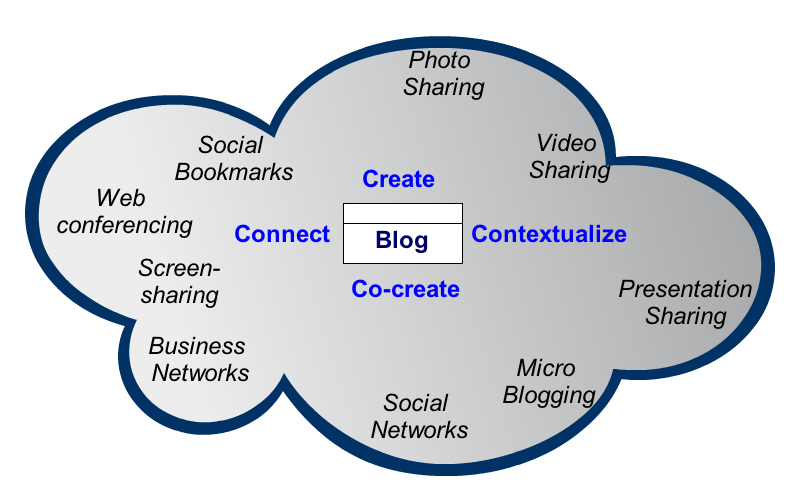
All of the hype around Google+ seems to have put me me into a social networking depression. Until recently I really liked Twitter but I know that it will become more advertising-centric as time goes on. Where Facebook is, Twitter will be. Along comes Google+ and it seems to address many of the issues of those who use several social platforms; a unified dashboard, coupled with the promise of Google Takeout. Of course the price for Google+ is free, so who’s really the customer? Not me; not you.
For several years, I have seen my blog as my central point on the Web, with peripheral platforms coming and going. I’d like to keep it that way and own my data. What happens if I don’t participate in Google+? Will I miss out on an increasing number of learning and business opportunities?
Stephen Downes has a good criticism of Google+ and what its dominance could mean: a data black hole:
Of course, Google+ is already a great source of connecting with more wonderful people and ideas. Dave Gray posted a detailed analysis of Google+ and how he uses his public and private social networks, with this graphic:
So I am going to lurk for a while and see what is happening. I don’t want to jump on any bandwagon but I have a responsibility to my clients and myself to understand this stuff. I’d like to just avoid it for a few weeks and see what transpires. Not sure if I’ll be able to do that, especially when I read comments, from people I respect, that Google+ “hangouts” enable people to learn more easily than any other medium. That’s pretty powerful.
For now, I’m going to try to not get rolled-over by the Google juggernaut and keep maintaining my little piece of the open Web. In the meantime, you may be seeing less of me on Twitter as I take more time for reflection on this potential social media inflection point. I also belong to several private networks that still need my attention and I may discuss some of my concerns there. My blog will continue to be where I post my half-baked ideas and air them in public.
So the social networking utopia is not coming, writes Mashable’s Chris Taylor on CNN. He cites one Dunbar number (now all the rage) and concludes:
Turns out we’re hardwired to get along best in tight groups of no more than 150, and have been since we were living on the African savannah. Armies take advantage of this hardwiring, as do the smartest corporations, not to mention wedding planners.
Dunbar’s research looked at relationships among primates and didn’t take into account loose ties or electronically mediated & enhanced communications. It is not a fair comparison. But Taylor’s words on Tribalism triggered an old connection for me:
A study released this month shows that digital tribalism is alive and well in the social network era. The tribes I’m talking about aren’t nations, corporations or sports teams, though clearly these brands all matter as much as they ever did.
I’m talking literally about tribes — as in the kind of village-sized small groups most of us lived among for nearly all of human history, right up until the 20th century. Small groups that we now seem to be organizing ourselves into again — virtually.
A few years ago I came across a framework of our four primary historical modes of organizing – Tribal; Institutional; Markets; Networks. The TIMN framework shows how we have evolved as a society. It has not been a clean progression from one mode to the next but rather the new form built-upon and changed the previous mode.
A key point of this framework is that Tribes exist within Institutions, Markets AND Networks. We never lose our affinity for community groups or family, but each mode brings new factors that influence our previous modes. So yes, tribalism is alive and well in online social networks. It’s just not the same tribalism of several hundred years ago.
We are in a transition from a market to network-dominated society, and according to David Ronfeldt, each transition has its hazards. While tribal societies may result in nepotism, networked societies can lead to deception, as Mashable itself has reported. It’s interesting that tribes of hackers are a potential counter to network deception.
Ronfeldt states that the initial tribal form informs the other modes and can have a profound influence as they evolve.
Balanced combination is apparently imperative: Each form (and its realm) builds on its predecessor(s). In the progression from T through T+I+M+N, the rise of a new form depends on the successes (and failures) achieved through the earlier forms. For a society to progress optimally through the addition of new forms, no single form should be allowed to dominate any other, and none should be suppressed or eliminated. A society’s potential to function well at a given stage, and to evolve to a higher level of complexity, depends on its ability to integrate these inherently contradictory forms into a well-functioning whole. A society can constrain its prospects for evolutionary growth by elevating a single form to primacy — as appears to be a tendency at times in market-mad America.
So tribes are not dead, and neither are institutions and markets, in a networked society. We need to understand all four modes as we make the current transition. Saying that tribes render social networks useless after 150 connections is a bit trite. The real work is in figuring out how best to create organizations, and societies, that balance combinations of all four modes, emphasize their bright sides and remain in perpetual Beta [what Ronfeldt calls incomplete adaptation].
The TIMN framework is very useful for having deeper conversations and increasing our understanding of what we’re going through as a society. It should be required reading for organizational leaders and politicians as well.
Social business offers businesses a major opportunity for redefining the nature of work and the structure of companies, freeing knowledge workers from organizational-only pressure and defining a new social contract between customers, workers, firms and their ecosystem. On a dark side, it also gives companies novel ways to enforce business-as-usual and to further exploit the outdated legacy of our industrial era. People-centric or IT-centric, the use of social technologies for enterprise is at a crossroad, and it might be time to face it without self-indulgence.
This is how my colleague, Thierry deBaillon, concludes his article on the two faces of social business. It’s not just social business, but the entire model of the Net that we need to critically examine. As Jaron Lanier wrote in You Are Not a Gadget:
The people who are perhaps the most screwed by open culture are the middle classes of intellectual and cultural creation. The freelance studio musician, the stringer selling reports to newspapers from warzones are both crucial contributors to culture. Each pays dues and devotes years to honing a craft. They used to live off the trickle down effects of the old system, and like the middle class at large, they are precious. They get nothing from the new system.
If you’re not one of the recognized leaders in your field, can you make a living online or are you just part of the long tail, valuable only to aggregators and their advertising revenues? As a content creator are you providing the fodder that lets Google, Facebook and YouTube earn huge market valuations?
Will there be a middle class in the networked economy? Is there a middle class in the social business?
Doc Searls says that the social web is nothing more than the commercial web:
I want liberation from the commercial Web’s two-decade old design flaws. I don’t care how much a company uses first person possessive pronouns on my behalf. They are not me, they do now know me, and I do not want them pretending to be me, or shoving their tentacles into my pockets, or what their robots think is my brain. Enough, already.
We’re definitely reaching a crossroad with net neutrality, open data, and personal social networks on one side and usage-based billing, controlled access, and gated communities on the other. As I’ve written elsewhere, democracy is our best structure for political governance and I believe it should be the basis of our workplaces as well. As work and learning become integrated in a networked society, I see great opportunities to create better employment models. I know that we can do better than cubicle farms, cookie-cutter job descriptions, generic work competencies and boring, dead-end jobs.
However, I see the darkness creeping in, ever so quietly. It was only one hundred years ago that we had widespread child labour in North America.
Child labour and other inhuman practices haven’t been eradicated but we have made huge strides. Are we letting society and our workplaces slip backwards? Any technology cuts both ways. The Net has the potential for much good. There is still an opportunity for a workplace reformation, but we have to seize it.
But it’s not about the technology. The real issue is getting people used to working at a distance. For instance, everything has to be transparent for collaborative work to be effective online. Using wikis or Google Documents means that everyone can see what the others have contributed. There is no place to hide. For example, I once developed a Request for Proposals with a large group distributed across several time zones. Everyone could provide input for a specified period of time and then that issue was closed. Later, some people complained that their requirements were not being addressed. I was able to look at the revision history of the wiki and show that they had not even contributed on those issues. This stopped the complaints and we were able to move on.
A major aspect of online collaboration is that our symbols of power are stripped bare. No one knows what kind of fancy suit you’re wearing or if you have an expensive watch on your wrist [which only old folks use anyway]. Nobody has seen you drive into your private parking spot with your high price car. You are what you contribute. That’s it.
Computer technology has been a great equalizer in our society. I can buy one of the best computers on the market and the richest person in the world is not able to get one that performs much better. Consumer technology devices are great equalizers. I probably have as much computational power as most CEO’s of major technology firms. Actually, I may have more, because my system has not been crippled by the IT department.
The collaborative, networked enterprise saw its birth in open source software projects. From these widely dispersed groups we got blogs, wikis and micro-sharing as tools to help get things done. But these groups are fairly egalitarian. You’re as good as your code. The suits weren’t invited.
You see, on the Internet, nobody knows you’re a suit … and that’s a major barrier to adoption.
We’ve been using Socialcast for a while now and for large organizations that have multiple silos of information in repositories like Sharepoint, it’s a pretty good platform. Socialcast enables streams and micro-sharing and keeps multiple work teams in touch with each other without being burdened with too many rules. The learning curve is not difficult at all.
Socialcast also has a blog and some of the posts and infographics have been exceptionally good. I already wrote about wasted effort at work but this post on exception handling from September just caught my attention:
Social networks in the enterprise create a permanent “home” for these exceptions to live where users can communicate and collaborate around the answers. Exception management through social networks gives management clear insight into the resources needed for handling these exceptions. Viewing or monitoring the interactions and necessary actions taken to resolve these exceptions can lead to better implementation, revisions or training on these systems, and increase productivity throughout the enterprise.
A more recent post on the evolution of knowledge management clearly shows the need to support the sharing of tacit knowledge in a complex and creative economy:
Do hyperlinks really subvert hierarchy? I recently asked on Twitter. They can when people outside the organization take advantage of ridiculously easy group-forming. Examples such as United Breaks Guitars and the various mass, decentralized and social revolutions show what is possible when hyperlinks subvert hierarchy.
However, are there any workplace examples, where existing management practices were forced to change? I don’t know of any, though I think we will see many in the near future.
I read the Cluetrain Manifesto when it was developed and published online in 1999. I even bought a dead-tree version a few years years later. I’m still amazed how many senior executives have never even heard of the Cluetrain. While it may be a bit of a rant, it’s available online for free and makes some very important statements that still resonate a decade later. The Internet has changed the way we work.
Many of my posts over the past 7 years have been inspired by one of the Cluetrain’s 95 theses.
2004 – Lee LeFever hits the nail on the head with this Esse Quam Videre (to be rather than seem) post about weblogging in business. It’s just too easy to see through the smoke when you post every day. You have to be yourself, or you’ll get caught. Lee talks about this idea stemming from the Cluetrain Manifesto (worth the read in spite of its rant style). From Rick Levine’s section of Cluetrain, “Talk is Cheap”, is this excellent sidebar – “A knowledge worker is someone who’s job is having really interesting conversations at work.” That would be most bloggers, I would say.
2005 – Regular readers know that I often refer to The Cluetrain Manifesto. If you haven’t read it yet, take a look at the 95 theses, but I’d suggest that you read the whole book – online or in print. Scott Adams has taken the theses and re-mixed them for education. I’ve re-mixed a bit more, but don’t have the energy (yet) to address all 95:
Learning is conversation.
Learners are human beings, not demographic sectors.
What’s happening to education is also happening among learners. A metaphysical construct called “The School” is the only thing standing between the two.
To traditional educational institutions, networked conversations may appear confused, may sound confusing. But we, the learners, are organizing faster than they are. We have better tools, more new ideas, no rules to slow us down.
2006 – Markets are conversations and conversations [relationships] create markets … Let’s go back to the Cluetrain Manifesto, from which we get the initial thesis that markets are conversations. In this case, I think that theses 11 and 12 are much more pertinent:
#11. People in networked markets have figured out that they get far better information and support from one another than from vendors. So much for corporate rhetoric about adding value to commoditized products.
#12. There are no secrets. The networked market knows more than companies do about their own products. And whether the news is good or bad, they tell everyone.
2007 – One of the main forces of change that will affect how we learn is the weakening of the industrial command & control organisation. We don’t need a third party to mediate our learning because we can find interesting stuff and interesting people (interesting to us, at least) on the Web. I see those workers, who one could call the “Cluetrained’, as already dropping out of the bottom of the industrial organisation’s pyramid and doing it on their own. “It” meaning working, learning, creating and collaborating.
2008 – Here is an important note to corporations; Cluetrain Thesis #20:
Companies need to realize their markets are often laughing. At them.
Gee, what’s next, people making fun of education?
2009 – Cluetrain #10. As a result, markets are getting smarter, more informed, more organized. Participation in a networked market changes people fundamentally.
To make the money I don’t make teaching, I consult and speak for various media companies and brands. The only reason I get those gigs is because companies read the ideas I discuss at Buzzmachine and ask me to come and repeat them in PowerPoint form and explore them with their staff. I’ve also been asked to teach executives how to blog (a class that should, by rights, take about two minutes). That work and the teaching get me to a nice income in six figures. So I’m not looking quite as idiotic now, I hope.
NPR, all my work in New Media, Blackwater, Education – all my paying gigs have come through this medium [blogging].
2010 – It is only by working (and learning) interdependently, retaining our autonomy, co-developing our mastery and feeling a shared sense of purpose that we will be truly motivated. The opportunity the Internet has given individuals is the chance to work cooperatively toward a shared purpose (Seb Paquet calls this “ridiculously easy group-forming”). The Internet also affords organizations the opportunity to loosen the dependence of workers through participative engagement (as The Cluetrain Manifesto explained a decade ago). The new organization must be some mix of free-agent autonomy, support mechanisms for mastery, and a wide enough span for each person to develop a personal sense of purpose.
As we were discussing social learning this week, several people asked, where do I start? Jay Cross was talking to Dan Pontefract this week in San Jose and one of the lessons learnt by Dan was that micro-sharing (e.g. Twitter) is probably the best place to start. I can understand. Blogging takes time and you have to write a coherent train of thought. Staring at a blank screen can be daunting. Wikis only work when you have a group of people with a common purpose and a need to collaborate. Micro-sharing is easy, especially since it’s limited to 140 characters. Who doesn’t have time to tap out 140 characters?
Of course, the big question from anyone in a medium to large organization is the need for privacy. The usual answer is to use Yammer, which limits access to people with the same e-mail address. This works for company stuff but how do you get people from several organizations to collaborate?
Status.net, based on open source software, offers a range of options, some free and some fee. I’ve just set up a private site which is invitation-only. It’s free for 25 members and then costs $1.00 per user per month beyond that. Not bad at all. You can also download the software for free and host it in-house.
I set up a private community site today. It took only a few minutes and I was able to customize it fairly quickly. This is a great way to pilot micro-sharing with very little risk.
Once the site is established, the admin can invite people to the community. It takes only a few minutes to create a profile. The “public timeline” shows everyone’s posts so there’s no need to follow people, particularly with a community of only 25 people. The site-wide notice for the administrator is handy, so that a semi-permanent message can be displayed for everyone.
Status.net – I like it; though I haven’t figured out the automatic URL shortening feature yet.
I was asked to make some predictions for 2011 but missed the deadline. Instead of predictions, I think there are some trends that may cross the chasm this year. This follows on a post I wrote a year ago that included this table:
As for ideas, more of my clients have accepted the need to support workplace informal learning. Performance support (EPSS) is now seen as a viable alternative to formal training (finally).
Adding to the growth of mobile, already across the chasm in much of the world, is the rise of video. Video for organizational sharing, video for instruction and video instead of manuals.
The big idea that is catching on and may take shape in 2011 is the integration of organizational support. Enough people are realizing that our compartmentalized approach to supporting work doesn’t help in a highly networked world. Why should HR, IT, Finance, Training, KM, OD, Marketing etc. be separate functions? It’s time to rid our organizations of Taylor’s ghost and I’m detecting a small groundswell of similar sentiments like radically different management.
Here is a graphic of Moore’s technology adoption curve. Inspired by Jane Hart, this is my view of the current state of the learning technologies industry:
The Late Majority and Laggards are focused on meeting their compliance needs. Many of these are in traditional industries. They are purchasing one of their first learning management systems (LMS) and are focused on features & functions, which is usually a large shopping list provided by a variety of constituents.
The Early Majority are focused on learning and particularly course delivery. They are comprised in large part of education and training (E&T) intensive organizations, including schools. Most have existing contracts that bind them to a vendor. Some are considering open source (OS) as an option to their costly systems.
The Innovators & Early Adopters have shifted to a work focus. Many are in newer industries, with little legacy software. Others are in more traditional industries who have seen the urgent need for change. They are focused on supporting social and informal learning and integrating it into the work flow. These companies are retiring their LMS and are outsourcing formal course development that accounts for only 10% of their performance needs.
As an organization, are you waiting for Workscapes to cross the chasm or are you content to use technologies that have jumped the shark?
Anthropologist Michael Wesch, noted for his studies of YouTube and video sharing states, “when media change, then human relationships change”.
Today, at the DevLearn2010 social media camp, I will be conducting a discussion with my Internet Time Alliance colleagues on mobile learning, but I would like to focus on how the mobile medium changes our relationships with sharing knowledge, connecting with others and getting things done.
Video [created and shared via mobile devices] is becoming an important medium of personal communication, evidenced by John Seely Brown’s example of a surfing community of practice as well as Chris Anderson’s examination of how web video powers innovation.
The big question is NOT how to blend mobile learning into our suite of existing tools, but rather what effect does this significant shift in the power of knowledge creation and sharing have on our understanding of workplace learning?