Ensuring knowledge flow through narration

Can the training department, or learning & development, directly contribute to innovation, or are they merely bystanders? Enabling the narration of work is one area where they can help. When it comes down to it, much of learning is conversation. Organizational learning is no longer about courses, which are artifacts of a time when information was scarce and connections were few, because that era is over. Work narration already happens outside the organization, and it’s time to bring it inside.

As with knowledge artisans, many learners now own their knowledge-sharing networks. Today, content capture and creation tools let people tell their own stories and weave these together to share in their networks. Narrating one’s work has been done by coders and programmers for decades, as they “learn out loud.” What started as forums and wikis quickly evolved into more robust networks and communities. Programmers who share their work process and solutions in public are building a resource for other programmers looking to do the same type of work. This makes the whole programming environment smarter. Organizations can do the same.

The public narration of what we do, attempt, and learn on a daily basis not only helps us help others, but also puts us in a position to get help from peers. When your co-workers know what you’re working on and what problems you’ve run into, they can offer their experience. Since few people work in the same room as all their co-workers, they rely on online networks to offer them a common space to find and offer work narration.

Narration helps everyone get smarter. John Stepper says that everyone should work and learn out loud. If you’re confused about what to write, John suggests posting about what you’re working on every day, who you’re meeting with, the research you’re doing, the articles you find relevant, lessons you learned and mistakes you made. These insights are valuable to people trying to train or help co-workers. He also recommends creating short posts that are easy-to-skim; as they make this kind of narration practical for both the author and the audience.

Narration is turning one’s tacit knowledge — what you know — into explicit knowledge — what you can share. Developing good narration skills takes time and practice. Just adding finished reports to a knowledge base does not help others understand how that report was developed. This is where online activity streams and micro-blogging have helped organizational learning. People can see the flow of work in small bits of conversation that, over time, become patterns. Narration of work is the first step in integrating learning into the workflow.

Organizational sense-making can be looked at as either stock or flow. Stock is organized for reference and does not change frequently. Courses are stock. Flow is timely and engaging. Narration of work in social networks is flow. With access to more knowledge flow, via social technologies, highly networked workers can have broader, deeper and richer learning experiences than any instructional designer could ever create in advance.

A worker today can ask questions to a worldwide support network on a platform like Twitter and get an answer in minutes. Deeper questions can be addressed on a service like Quora, where responses get voted on by the community. Many experts worldwide are now narrating their work and making it freely available on the Internet. A new form of distributed cognitive apprenticeship is available, and knowledge workers are taking advantage of this.

In knowledge networks, openness enables transparency, which fosters a diversity of ideas, which in turn reinforces the need for openness. This can be implemented through the use of social networks which can improve knowledge-sharing which fosters innovation, the bottom line for any organization in the network age. The narration of work, is basically knowledge sharing on a regular basis. It’s the raw material of knowledge sharing. It’s not content delivery (stock) that training departments should be focused on but the narration of work (flow).
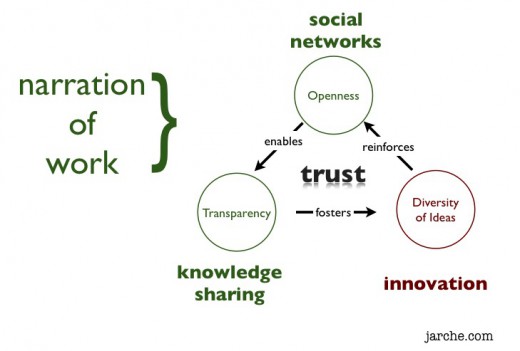
narration

Training departments should put a major emphasis on learning flow. Stories are an excellent example of learning flow. For millennia, we have learned through stories. This is how gamers and hackers, the digital pioneers, have learned how to learn without curriculum, courses, or instructors:

  • They share their stories.
  • They know there is no user manual.
  • They embrace the flow.

Here is how to ensure knowledge flow through enterprise and external social networks:

  • Capture as much as possible and create digital artifacts.
  • Share as much as possible. Make it the default action by offering entrance into social networks to everyone. [e.g. feed readers, social bookmarks, blogs, photos, videos, social networks, activity streams].
  • Keep everything open and transparent [do not create “walled gardens”]; the key to useful information is being able to find it.
  • Support easy-to-make connections; between people, and with digital resources.

To learn more about narration and other open business practices, join my Learning in Social Business workshop, starting on March 1st.

Jobs and work

Here are some of the observations and insights that were shared via social media during the past two weeks. [Note: It seems that if you look in enough places, certain patterns begin to emerge.]

If they can get you asking the wrong questions, they don’t have to worry about answers. -Thomas Pynchon.” via @johnsonwhitney

Bert van Lamoen (@transarchitect) “If the old rules are left in place there are no new behaviors and the new model fails and nothing changes.

Hugh MacLeod (@gapingvoid) – “The rush hour @starbucks crowd has this nice bourgeois desperation about them …”

TechCrunch: America has hit peak jobs – via @sardire

Paul Kedrosky recently wrote a terrific essay about what I call cultural technical debt, i.e. “organizations or technologies that persist, largely for historical reasons, not because they remain the best solution to the problem for which they were created. They are often obstacles to much better solutions.” Well, the notion that ‘jobs are how the rewards of our society are distributed, and every decent human being should have a job’ is becoming cultural technical debt.

If it’s not solved, then in the coming decades you can expect a self-perpetuating privileged elite to accrue more and more of the wealth generated by software and robots, telling themselves that they’re carrying the entire world on their backs, Ayn Rand heroes come to life, while all the lazy jobless “takers” live off the fruits of their labor. Meanwhile, as the unemployed masses grow ever more frustrated and resentful, the Occupy protests will be a mere candle flame next to the conflagrations to come.

Disposable worker syndrome is killing us – by @michelemmartin

In the past, through this blog, I’ve focused on how we as individuals need to keep renewing and recycling ourselves through a process of lifelong learning and adapting to change. I still believe this is true. But I also believe that, through our institutions, we are doing great spiritual and emotional damage to ourselves by consistently communicating to people that they are disposable and that they are on their own in the process of recycling and renewing.

To torture my metaphor, we are treating people like garbage–throwing them into landfills and just letting them waste away there. We are doing nothing to provide them with the structures and resources and emotional supports that would help them go through that renewal process.

NYT: The Rise of the Permanent Temp Economy – via @jerrymichalski

The temp industry’s continued growth even in a boom economy was a testament to its success in helping to forge a new cultural consensus about work and workers. Its model of expendable labor became so entrenched, in fact, that it became “common sense,” leaching into nearly every sector of the economy and allowing the newly renamed “staffing industry” to become sought-after experts on employment and work force development. Outsourcing, insourcing, offshoring and many other hallmarks of the global economy (including the use of “adjuncts” in academia, my own corner of the world) owe no small debt to the ideas developed by the temp industry in the last half-century.

Being paid for a task decreases intrinsic motivation (PDF) – Edward Deci’s original experiment from 1971 – via @dougald

It appears that money – perhaps because of its connotation and use in our culture – may act as a stimulus which leads the subject to a cognitive reevaluation of the activity from one which is intrinsically motivated to one which is motivated primarily by the expectation of financial rewards. In short, money may work to “buy off” one’s intrinsic motivation for an activity. And this decreased motivation appears (from the results of the field experiment) to be more than just a temporary phenomenon.

The Guardian: Payment by Results – via @JohnQShift

Payment by results is a simple idea: people and organisations should only get paid for what they deliver. Who could argue with that? If your job is to get people back to work, then find them a job dammit … and they make people lie …

… This lying takes all sorts of different forms. Some of them are subtle forms of deception: teachers who teach to the test or who only enter pupils for exams they know they are going to pass; employment support that helps only those likely to get a job and ignores those most in need; or hospitals that reclassify trolleys as beds, and keep people waiting in ambulances on the hospital doorstep until they know they can be seen within a target time. In the literature, this is known as gaming the system.

The new artisans of the network era

Are knowledge workers the new artisans of the network era? If so, can you call yourself a knowledge worker if you are not allowed to choose your own tools? How about managing your own learning?

toolsAn artisan is a skilled worker in a particular craft, using specialized processes, tools, and machinery. Artisans were the dominant producers of goods before the industrial era. Today, knowledge artisans of the network era are using the latest information and social tools in an interconnected economy. Look at a web start-up company and you will see it is filled with knowledge artisans, using their own tools and connecting to outside social networks to get work done. They can be programmers, designers, writers, or any other field requiring complex skills and creativity. One of their distinguishing characteristics is the ability to seek and share information with their networks in order to get work done. Knowledge artisans are connected workers.

Knowledge artisans are amplified versions of their pre-industrial counterparts. Augmented by technology, they rely on their networks and skills to solve complex problems and test new ideas. Small groups of highly productive knowledge artisans are capable of producing goods and services that used to take much larger teams and resources. In addition to redefining how work is done, knowledge artisans are creating new organizational structures and business models, such as virtual companies, crowd-sourced product development, and alternative currencies.

Knowledge artisans not only design the work, they can also do the work. It is not passed down an assembly line. They tolerate few, if any, silos between the product, the work, and the customer. Many integrate marketing, sales, and customer service with their creations. To ensure that they stay current, they become members of various ‘guilds’, known today as ‘communities of practice’ or ‘knowledge networks’. One of the earliest knowledge guilds was the open source community, which developed many of the communication tools and processes used by knowledge artisans today — distributed work, results-only work environments, blogs & wikis for sharing, agile programming, flattened hierarchies, working out loud, and much more.

Companies like Netflix understand that they are best served by people who take control of their own careers. Netflix is constantly looking for the best knowledge artisans in the industry. People who work hard, but produce just good enough results, will get let go. A master artisan strives for perfection. The 2009 presentation on Netflix culture makes their demand for the best workers abundantly clear. It’s the only way to deal with complexity.

netflix economic security

As more organizations engage with connected workers who have seen the new workplace structures, they will need to change some habits, like letting workers choose their own tools. Knowledge artisans are often more contractual, more independent and shorter-term than previous information age employees. Because of their more nomadic nature, artisanal workers will bring their own learning networks. Companies will need to accept this in order to get work done. Also, training departments must be ready to adapt to knowledge artisans by allowing them to  collaborate and connect with their external online networks. When the future of learning is the future of work, then learning support has to adapt to the new reality of an artisanal workforce. But it’s also worth noting that to be a successful knowledge artisan will take a lot more than just being a good employee.

Learning subverts business entropy

When Harold Jarche says work is learning and learning is the work, I think he’s suggesting that for a business to thrive, it must place learning at the heart of everything it does. Purposeful learning. Learning that is not “training” as we have visioned it up till now. Any training that is disconnected from the people is not sufficient. Learning that is not about the work is not sufficient. Real 21st century learning must change how we think, behave and interact with each other, as well as what we know. It must be relevant to purpose, activity and relationships. Not just one of those: all three. A business, which is a living system, requires relevant learning in order to subvert that thing which happens to all living systems: entropy. John Wenger: A Matter of Life and Death

Why do I say that work is learning and learning is the work? Because it’s been obvious to me for a long time that learning is THE critical business skill, whether you work for others or yourself. By learning, I do not mean education, or the ability to get good marks in class. Here is an update of my pitch on why I think learning is so integral to working today.

How work gets done in the network era:

  1. our increasing interconnectedness illuminates the complexity of our work environments
  2. simple work keeps getting automated
  3. complicated work usually gets outsourced
  4. complex work gives unique business advantages, while creative work finds new opportunities
  5. complex work is difficult to copy & creative work constantly changes:
    both require greater tacit knowledge
  6. tacit knowledge is best developed through conversations and social relationships
  7. social learning networks enable better and faster knowledge feedback loops
  8. but hierarchies constrain social interactions … so traditional management models must change
  9. learning amongst ourselves is the real work in business today … so management’s job is to support social learning
  10. social learning is how work gets done in the network era

The future of learning is the future of work

Where skills and qualifications have been acquired through formal education, many find themselves unable to secure work that makes use of these; where skills are acquired informally, the challenge is to represent these effectively to potential employers. – The Regeneration of Meaning

This image, from a series on the Future of Learning by Gerd Leonhard summarizes how technology is changing our concepts of learning, training, and education.

SoLoMo by Gerd Leonhard

The role that institutions played as gatekeepers is changing, and the support systems that many of us depended upon, like jobs, are disappearing. Hyperlinks subvert hierarchy, for good and not so good.

hyperlinks hierarchy

The answer, I believe, is to use nearly unlimited information, self-publishing, and ridiculously easy group-forming to our advantage. Thierry de Baillon, co-author of the most popular post on this blog, writes about “a new set of managerial and operational paradigms” in My Social Business Predictions, namely: no boundaries; trusted exchanges; a culture of experimentation; and emergent and adaptive structures.

Returning to the initial quote on this post, the author, Dougald, shows some concrete examples of new operational paradigms: Centers for New Work; Access Space; West Norwood Feast; the rise of house concerts; and unMonasteries. I know of many more examples, and organizations like Shareable are highlighting these new models and experiments.

So it’s important to note that it’s not really the future of learning we should be concerned with, because it is merely a symptom of the future of work. It is becoming obvious that individuals need to take control of their learning in a world where they are simultaneously connected, mobile, and global; while conversely contractual, part-time, and local. Watch how work is changing and you will see how education and training will change.

changing nature of work

Managing in Complexity

As our markets and technologies get more complex, we need new models to get work done. For instance, we know that creative work can yield more innovation, yet our workplaces usually stifle creativity. Many of our practices are still premised on work being simple or complicated. Simple systems are easily knowable, whereas complicated systems, while not simple, are still knowable through analysis. These can be easily managed. However, complex systems are not fully knowable, though they can be partially understood through interaction with them. This is antithetical to many workplace control protocols.

Every day, jobs and work are getting automated and outsourced. If companies want to remain competitive in the global market, they need to focus on complex and creative work. Much of complex work is in exception-handling and when exceptions are the rule, rigid rules must become the exception.

We have to understand complex adaptive systems and develop work structures that let us focus our efforts on learning as we work in order to continuously develop next practices. In a knowledge-intensive and creative workplace the role of leadership becomes supportive and inspirational rather than directive. Artificial boundaries that limit collaboration and communication only serve to drag projects, and companies, down and create opportunities for more agile competitors.

A new mindset toward work is required. Frameworks like hyper-connected pattern-seeking or networked unmanagement can promote new perspectives on what valued work really should be. This can be fostered in a culture of perpetual Beta. Perpetual Beta means we accept never getting to the final release of our work, and that our learning will never stop. Organizations need to realize they will never reach some future point where everything stabilizes and they don’t need to learn or do anything new.

In additional to a new mindset, workers need autonomy. But many are not ready for it. We are trained early in life to look to authority for direction in learning and work. The idea that there is a right answer or an expert with the right answer begins in our schools. Too often, the message from the workplace continues to be that good employees wait for their managers to tell them what to do. This is counter-productive in dealing with complexity and working in perpetual Beta. It also destroys creativity. When we move away from a linear “design it first, then build it” mindset, we can then engage everyone in critical and systems thinking. Workers must be passionate, adaptive, innovative, and collaborative. Autonomy is the just beginning.

Fostering autonomy starts by looking at work differently. For example, dropping the notion of being paid for time is one way to start this change. An hourly wage implies that people are interchangeable. But no two minds are the same. Being paid for time fosters neither autonomy nor agility. There are many other human resource practices should be questioned and dropped, such as job competencies, or one-size-fits all training programs.

The new networked workplace requires both collaboration and cooperation. Complex problems cannot be solved alone. Tacit knowledge flows in networks through social learning. Learner autonomy is a foundation for effective social learning. It is the lubricant for a more agile organization. Agility becomes a necessity as we deal with increasing complexity. In order to develop the necessary emergent practices to handle complexity we therefore need to cultivate the diversity and autonomy of each worker. We also must foster richer and deeper connections which can be built through meaningful conversations. This is social learning in the workplace.

Change and complexity are becoming the norm in our work. We already see this with increasing numbers of freelancers and contractors. Any work where complexity is not the norm will be of diminishing value. Embracing complexity, and even chaos, is where the future of work lies.

As traditional core activities get automated or outsourced, almost all high value work will be done at the outer edge of organizations. At the fuzzy edge of the organization life is complex and even chaotic. On this periphery, where things are less homogenous, there is more diversity and more opportunities for innovation. Individuals, project teams and organizations have to move operations to the edge to continue learning and developing. In this century a greater percentage of workers will be moving to the edge. The core will be managed by very few internal staff. What does this mean for management? No matter what model one prefers, it will have to be more open, networked and cooperative. Are you ready to move to the edge?

edges_gapingvoid

Work environment design for learning

Catherine Lombardozzi writes, in Time for an Evolution:

To those of you who feel like you just stepped into the middle of a conversation, a learning environment (to my mind) is a collect of resources and activities for learning. The resources may be inanimate or human; the activities may be formal or informal. A well designed learning environment is curated with a specific need in mind. It may be curated by an individual (as in a personal learning environment), by a group (such as a community of practice), or by a designer who is supporting a specific complex need that can’t be met by training or other formal programs alone.

I’ve been promoting learning environment design as a way of thinking about what we used to call blended learning, and as a way of capitalizing on informal learning resources by curating the best materials (in your judgment) and making them easily accessible by your learners.

I have taken her image and added a 70:20:10 overlay. This could serve as a decision support tool for allocating time and resources for organizational learning and development.

70 20 10

As the world keeps churning, work today is all about learning

to sell is humanThe title of this post is what Dan Pink, in his book To Sell is Human, would call a rhyming pitch. He also discusses the question pitch, and I followed his recommendation in the Pitch chapter and developed my own.

Are things more complex now, than they were five years ago?

Your Work? Your Markets? Your Customers? Your Profession?

I also developed a Pixar pitch:

Work used to be fairly straight forward. You had a job, knew what to do, and were paid to do it. Then the Web appeared. Everybody got connected to almost everyone else. All these connections made things more complex.  Some work was automated. Some of it outsourced. Much of it became more complex. Making sense of complexity, and developing ways to keep up, is how I help people and organizations.

Finally I created a one-word pitch: SENSE-MAKING

The Pitch chapter also explains the Twitter pitch (140 characters) and the subject line pitch. These are all excellent exercises to focus on your business or mission, and I will continue to refine mine over time.

Here is Dan’s pitch to continue reading the book, subtitled “the surprising truth about moving others“:

Here we confront a paradox. There are no “natural” salespeople, in part because we are all naturally salespeople. Each of us – because we’re human – has a selling instinct, which means that anyone can master the basics of moving others. The rest of the book will show you how.

I found the book quite compelling and much of what was covered, such as improv skills for business, are areas of interest for me. The chapter on Clarity was directly aligned with my work on personal knowledge mastery . In it, Beth Kanter is quoted using my Seek-Sense-Share framework in her Content Curation Primer and earlier post.Kanter-PKM

In this chapter, Dan also proposes that you seek out the “one percent”.

Don’t get lost in the crabgrass of details, he [Pink’s Law professor, Harold Hongju Koh] urged us. Instead, think about the essence of what you’re exploring – the one percent that gives life to the other ninety-nine. Understanding that one percent, and being able to explain it to others, is the hallmark of strong minds and good attorneys.

This is the essence of sense-making in PKM. It is about seeking information and knowledge and distilling it so that you can make sense of it and then it is ready to be shared. Seek, make-sense and share (then repeat).

You are not the only bee in the hive

Joachim Stroh adds some perspective to my post on tools and competencies for the social enterprise: “It’s about you, but you’re not the only bee in the hive; the further you expand the more you grow.”

honeycomb stroh

I think this image gives a good view of the various facets people have in the workplace: My Content, My Presence, My Networks, My Tasks, My Reputation, My Goals. It also shows that workers are not mere human resources that fill job positions. They are all multi-faceted and each of these facets touches the facets of others. It is social and it is complex.

In the digitally connected workplace, systemic changes are sensed almost immediately. Therefore reaction times and feedback loops have to get faster and be more effective. We need to know who to ask for advice right now, and this requires a level of trust. But trusted relationships take time to nurture. This is evident from Joachim’s image, showing many facets that each take time to develop. Since our default action at work is usually to turn to our friends and known colleagues for help, we need to share more of our experiences with others in order to grow our trusted networks. The more colleagues we can depend upon, the better we can get work done. The time to start is now.

“We learned that individual expertise did not distinguish people as high performers. What distinguished high performers were larger and more diversified personal networks.” – Rob Cross, The Hidden Power of Social Networks

Social learning is critical for organizational effectiveness today. Workers need to connect with others in order to co-solve problems. Sharing tacit knowledge through conversations is an essential component of knowledge work. Social media enable adaptation, and the development of emergent practices, through conversations. Ensuring our facets are interconnected is one way to become a more social business. For example:

  • Am I creating content that can easily be curated and shared?
  • Am I connecting my physical and virtual presences optimally?
  • Am I finding learning opportunities through my networks?

I create these tools and presentations in order to ask better questions while trying to solve client problems. If these provide some new insight, then they are useful. I am glad that others, like Joachim, share what they are doing so we can work on these together, without ever meeting (yet).

Greater task variety means no more standardized work

The resurrection of American manufacturing will require more than simply bringing back production to America. Global manufacturing is at the cusp of a massive transformation as the new economics of energy and labor plays out and a set of new technologies—robotics, artificial intelligence, 3D printing, and nanotechnology—are advancing rapidly. Together these developments will spark a radical transformation of manufacturing around the world over the next decade. The winners in the rapidly changing world of manufacturing will be those firms that have mastered the agility needed to generate rapid and continuous customer-based innovation. Steve Denning

I have often said that anything that is simple enough to be automated will be, and that any work that is merely complicated will be outsourced to the lowest cost of labour. But a funny thing is happening with manufacturing in the 21st century. It is becoming complex. Manufacturing today requires interdependent workers with initiative, creativity and passion. The new manufacturing workplace has higher task variety, which is based on a greater percentage of tacit knowledge and requires more informal and social learning. This is not Ford’s assembly line, nor is it based on F.W. Taylor’s Principles of Scientific Management.
standardized work
The new manufacturing, like new businesses everywhere, will have fewer people. Computers and software are replacing people, especially information processing jobs. This is the new reality. There will be more work variety (for what used to be called jobs) because there will be more task variety. That means there will be fewer plug-and-play jobs. We will have to create our roles in the 21st century workplace. They will not be created for us. This is liberating but scary for generations who have tried to fit in to the existing job structure. Younger people seem to get it. Generations caught in the middle may find it difficult.

Community and organizational leaders will need to figure out how to adapt to the transition period, which will continue to see high employment while conversely witnessing instant millionaires who create the next mobile app. Times are changing, and we will need new methods to manage and organize work. Even those who understand this cannot see how much things will change. We are like the early generations that witnessed the power of the printing press, without understanding that it would lead to years of religious wars.

As Steve Denning concludes in his Forbes article:

Success in this new world of manufacturing will require a radically different kind of management from the hierarchical bureaucracy focused on shareholder value that is now prevalent in large firms. It will require a different goal (delighting the customer), a different role for managers (enabling self-organizing teams), a different way of coordinating work (dynamic linking), different values (continuous improvement and radical transparency) and different communications (horizontal conversations). Merely shifting the locus of production is not enough. Companies need systemic change—a new management paradigm.

It will require even more.