The initial design influences everything else

“If you pit a good performer against a bad system, the system will win almost every time.”

This quote from Rummler & Brache in Improving Performance, sums up many of the symptoms of hierarchical systems, whether they be schools, businesses, or even prisons.

The great work to be done at the beginning of this century is the democratization of the workplace. Efficiency and effectiveness are not enough, and too often become mechanistic. It’s time to discard industrial management models that emphasize command and control and ensure that individuals at all levels have opportunities to engage in and question the system.

Without questioning, things can quickly go awry.

Gary Stager discussed the well-known Milgram Experiments, conducted in the 1960’s to see how far people would go in administering electric shocks to learners [some of the methods are now in question]. These experiments were replicated by ABC News and Stager picked up the direct link to public education [please read the whole article]:

‘One of the subjects in the television program was a 7th grade teacher who explained that she didn’t stop shocking the learner because as a teacher she had learned when a student’s complaints were phoney. I thought to myself, “Has she electrocuted many students?”

The teacher asked the researcher, “There isn’t going to be any lawsuit from this medical facility, right?” When told that the teacher was not liable, she replied, “That’s what I needed to know.” It is however worth noting that this was after she induced the maximum shock and the learner demanded that the experiment be terminated.’

This is why we need to change the entire education system – constraining curriculum; compulsory testing; useless homework; irrelevant subjects; classrooms cut off from the world; systemic bullying; etc. More or better teachers won’t help; we need to change the system.

In this interview, Dr. Philip Zimardo discussed the 1971 Stanford Prison Experiment, where students played their roles as guards or prisoners and abuses started within 24 hours:

“But on the second morning, the prisoners rebelled; the guards crushed the rebellion and then instituted stern measures against these now ‘dangerous prisoners’. From then on, abuse, aggression, and eventually sadistic pleasure in degrading the prisoners became the daily norm. Within thirty-six hours the first prisoner had an emotional breakdown and had to be released, followed in kind by similar prisoner breakdowns on each of the next four days.”

Father John Culkin, in A Schoolman’s Guide to Marshall McLuhan, wrote that, “We become what we behold.
 We shape our tools 
and then our tools shape us.” This reminds me of the question about who is the most important person on board a ship. Is it the Captain, the Navigator or the Engineer? Actually, it’s the Architect, because the initial design influences everything else.

Sometimes, no matter how hard you try, you cannot change the way things work in an organization. The problem may be the organizational model itself and it may be better to leave and create an alternative model than help keep a flawed one going.

Clay Burell had guest blogger Bill Farren discussing the hidden curriculum of school architectural design. He asked what hidden messages are our schools themselves asking by their inherent design:

  • Did the building’s designers take into consideration its location?
  • Who decided how (if) it should be built?
  • Does the building make an attempt to connect students with their outside world?
  • What does the formal, intentional curriculum teach?
  • How is this formal, intentional curriculum taught?
  • How is the school run?
  • How is security portrayed?
  • What is sold or advertised on campus?

There was an article I read many years ago, but never see cited, about designing learning environments. It’s Rodney Fulton’s SPATIAL model (1991) [my emphasis added]:

“While a body of knowledge does exist that documents the relationships between learning and physical environment, there are problems that need to be resolved before the present level of understanding can be systematically advanced. One problem is that common vocabulary does not exist. Thus, in the literature, concepts are often described with similar but not identical terminology. Conversely, the same terms are used for similar but not exactly the same concepts. But this confusion in vocabulary is only a symptom of the fundamental problem: the lack of a conceptual model that explores relationships of physical environment to learning rather than to behavior in general. Architectural models address built environments, emphasizing both interior and exterior features of building design that allow, encourage, prohibit, or inhibit various behaviors. Psychological models discuss environmental attributes that set conditions for or even control human behavior. Sociological models emphasize the importance of environment in terms of how it facilitates human interactions. By emphasizing individual appreciation of the environment, aesthetic models address the relationship of values to human behavior. Workplace training models, including human factors engineering, emphasize the fit between environment and person and seek out optimal conditions for performance.

Each of these perspectives can add to a global understanding of the learning environment; however, a model that addresses learners in learning environments is a needed first step in refining educational research. The model described here — satisfaction-participation-achievement-transcendent/immanent attributes-authority-layout (SPATIAL) — can serve as a fundamental basis for organizing research designed to identify relationships between and among components of the learning environment and attributes of the learner. Further, this model has potential for weaving together findings from architectural, psychological, sociological, aesthetic, and human factors engineering studies.”

Rodney Fulton responded, when I originally wrote this post in 2008:

I found it very interesting that some 17 years after I published the SPATIAL Model in a Jossey-Bass publication there was discussion that included the model. I am not aware of any significant use of the model or of any real impact on the field of Adult Education in the United States. I have long since moved on from the field of Adult Education and am now very involved in Public Education at the Elementary level in the US. But again, it was gratifying to see my model referenced in 2008. If you know of any other people using or interested in the model, I’d be happy to hear from you. Thanks Rodney Fulton

There is still much structural work to be done

old-school.jpg

Photo by Atelier Teee

Note: this post is an update of two previous posts from 2008

Connect, exchange, contribute

Highlights from Skills for Learning & Development Professionals (an article I wrote for T&D Magazine in 2008).

My experiences over the past three years have shown that these skills are still necessary in the workplace.

Attitude:

Accepting that we will never know everything, but that others may be able to help, is the first step in becoming a learning professional. This is an acceptance of a world in flux and that knowledge is neither constant nor fixed.

Instead of trying to know everything in our field, we can concentrate on knowing who to connect with. The network becomes all-important. That means an attitude of openness and collaboration – joining others on a journey of understanding. Giving up control would be a first step on this journey.

Even reading on the web is quite different from print. Digitally, we have opportunities to engage the writers and make our thoughts known, whether through comments or linking to the original article from our blog.

Having a blog, a permanent presence on the Web, becomes the jumping off point for deeper professional discussions. Producing a blog also opens a person up to criticism, so once again, an open attitude to learning is essential.

Learning:

Learning professionals can no longer rest on their past accomplishments while the field changes and grows. They should be testing Web 2.0 tools so that they can develop optimal processes to support their organizations. If learning professionals are not setting the example of learning online, who is?

The example of putting your own learning process out in public or on your intranet shows that you are willing to learn from others. As new tools are introduced, learning professionals should be early adopters, leading the way in testing them out. We are in an age of “walking the talk”.

Collaboration:

Through sharing and exposing their work on the Web, learning professionals can connect to communities of practice and get informal peer review. There is no way to stay current with the technology, the neuroscience or the pedagogy all by ourselves.

With blogs and other collaboration methods, each of us can become a participatory node in various communities of practice. The whole becomes greater than the sum of the parts, and knowing who to call becomes more important than having the right answer. But we are all humans and we relate on a human level. That means that we first have to get to know others and develop a level of trust before real sharing can happen. Collaboration is a two-way street and a blog can get you moving.

Flow [from original transcript and not published in T&D article]

Imagine walking into a cocktail party that has been going on for a few hours and jumping into the conversation. Blogs and activity streams (e.g. Twitter) are like that. They flow along and different people join in the conversation from time to time. One can monitor dozens of blogs and hundreds of streams, not necessarily reading each post. You can then have a general idea of what’s flowing by, so that it’s easy to join the conversation when something interesting pops up.

To use blogs and streams for learning effectively, you have to jump in and go with the flow for a while. Understanding what is behind the writing, as well as the conversations around each post, provides the necessary context. Learning with online media isn’t just about finding a useful fact here or there, but requires an engagement with multiple stories that flow by, sometimes mixing and other times diverging. Following these flows is an acquired skill. It’s a meta- learning skill for the Internet age that is worth developing. Jumping in is the first step.

Critical Thinking

A part of critical thinking is the questioning of underlying assumptions, including our own. There are several Web 2.0 tools that can help develop critical thinking in the four areas of:

1. observing and studying our fields;
2. participating in professional communities;
3. building tentative opinions; and
4. challenging and evaluating ideas.

Connect, exchange, contribute

In many workplaces today, anyone can connect with almost everyone. Each of us can be a contributor to the network. Who you know becomes as important as what you know. Conversations help people make meaning, and the quality of our conversations is affected by the quality of our networks.

If we limit our conversations to only those in the same office, we’re missing out. People with larger and more diverse networks have an advantage as learning professionals and in dealing with change. This constant flow of sense-making through conversations in our workplace networks makes the idea of learning as a fixed event in a specific place look obsolete.

Experience-Performance-Reflection

The above diagram, by Nick Milton, shows some important aspects of what influences performance [hint: blue]. First, knowledge is the result of information (e.g. learning content) AND experience. Knowledge is directly influenced by one’s own experience. Therefore there is no such thing as “knowledge transfer“. Second, performance is taking action on knowledge. This is what is evident to others in the workplace. They observe what we do. It’s not what we know that is important to others, but what we do with it. In the workplace, what we do with knowledge is usually in a social context. This influences the third key point, that reflection of one’s performance is an important part of the learning process and this is often in a social context as well. Learning from what others do is the foundation of Albert Bandura’s social learning theory:

“Learning would be exceedingly laborious, not to mention hazardous, if people had to rely solely on the effects of their own actions to inform them what to do. Fortunately, most human behavior is learned observationally through modeling: from observing others one forms an idea of how new behaviors are performed, and on later occasions this coded information serves as a guide for action.”

Nick Milton’s diagram shows the inherent weakness of the pervasive workplace technology called learning management systems. LMS are disconnected from 1) Experience, 2) Performance & 3) Reflection. Their focus is on formal learning (a mere 10% of workplace learning) usually in the form of information transmission. As Jane Hart explains, the LMS is not part of the experience-performance-reflection workflow:

Although the LMS has in recent years become the de facto place to store learning content in the form of courses, it is not the first port of call for a worker when they need to solve a problem – since an LMS is generally a separate, password-protected system, which is not easily searchable and the content within in it is not available in a usable format.

Smart Work starts with an understanding of what is important for the 21st century workplace. It’s not content delivery. We are awash in content. Smart workers need ways to enhance their experience-performance-reflection processes, not have more information dumped into the pipeline.


New Hire Practices

I know that there are no “best practices” in new hire development, also known as onboarding, as each organization is unique and often rather complex. However, there are some practices that could make onboarding better in certain contexts. I’ve looked at several examples and am very interested in unique practices (outliers) beyond the corporate norm.

I’d appreciate any unique examples if you can share them.

Unemployed Girl by Kazimir Malevich (1904)

ReferenceOnboarding bookmarks on Diigo

Here are some of the key themes that I found about onboarding programs across many organizations.

Personal, dedicated coaching for each new hire (Capital One, Nokia).

Connecting each new hire to to key contacts in the organization (Capital One, Nokia). Note that Nokia will even pay for new hires to travel to other locations to meet their key contacts and co-workers.

Ensuring new hires understand the shadow or informal part of the organization through the use of tools such as network maps (Jon Katzenbach, Senior Partner of Booz & Company, author of The Wisdom of Teams).

Pairing with another worker or even tripling with two experienced workers and getting to work immediately, in order to reduce formal training (Menlo Innovations)

Two actions that can begin even before a formal offer is made:

  1. Providing access to an online knowledge base.
  2. Connecting to an internal social network to connect online & ask questions.

Embedding collaboration from the start by co-developing an individualized new hire program.

Giving time for new hires to just look around and talk to people (Semco SA; New Seasons Market)

Having weekly/monthly new hire welcome breakfasts, lunches & Happy Hours which all managers attend.

Other common qualities of good programs are that they are – informal; extend over time (up to 2 years in some cases); and involve active participation by supervisors/managers

Some companies, like Zappos, will pay people ($2,000) to leave after onboarding, so that only motivated workers stay.

Working Smarter, one day at a time

ITA 2011Yesterday we hosted a conversation on social learning and working smarter, facilitated by the folks at Citrix and the eLearning Guild. We all enjoyed the hour long session and participants will be sent the link to the recording by Citrix. In Jane’s social learning community a few comments arose about the lack of interaction. I responded that with 500 people in the audience and only one hour, we were limited in what we could do. Citrix provided the platform and support staff for one hour (plus several hours of rehearsal). We had already crowd-sourced the questions and also answered dozens of text questions that came in (however, it seems not all were posted back to the audience). It was great the community participated for 30 days before the event and hopefully will continue for many days after.

Yesterday’s event was only one part of many conversations that started several years ago on our blogs and continues on Twitter and other platforms.

I’ve highlighted some of the questions on performance improvement asked yesterday  and expanded on the responses, including links:

Q: Where does performance support as a process integrate into social tools and learning at the time and place of need? Where do you best recommend that HPT/ISD individuals gain the social/collaboration skills? What tools are you using to create the performance/support and learning communities?

Performance support starts as a complement to social learning, but then we move to having the community co-develop the performance support tools. The best way to develop any skill is to practice & get feedback – I suggest you  jump in and start using these tools in order to understand them and then see how they can be used in the workplace. Check Jane’s tool of the day site, but lots of potential solutions: open source, commercial, already out there (e.g. Yammer & Status.net)

Links:

Whither ISD, ADDIE & HPT? (includes definitions of these acronyms)

HPT and ISD

Getting to Working Smarter

Q: What do you opine regarding HPI/HPT practitioners (ASTD/ISPI) and the need for this type of specialized practitioner as a member of organizations’ HR or as a community resource?

I think HPT skills are a good addition to training development skills but we also need to add business skills and social/collaboration skills. I find that HPT doesn’t get “social” very well. Basically, HPT is only one toolset;  good for some things, but not all.

HPT, like many other workplace disciplines, creates silos. Networks require the integration of organizational support. We’re realizing that compartmentalized approaches to supporting work do not work in a highly networked world. Why should HR, IT, Finance, Training, KM, OD, Marketing etc. be separate functions? It’s time to rid our organizations of Taylor’s ghost and use radically different management. Clark Quinn calls it a unified performer-facing environment and I have said for a while that we need to break down the intra-organizational walls. I hear the same discussions in HR, OD, KM, Training and IT. They see their traditional roles and control eroding. Each field is trying to remain relevant but it’s only by working together that they will.

It’s not just about HPT, or L&D, or HR. Systems thinking is necessary.

Q: Did I miss it, or have you not defined the term “social learning”?

No cookie-cutter answers here ;)

Bandura’s Social Learning Theory

Bandura and Social Cognitive Theory

Working Smarter through Social Learning

Learning Socially

Social Learning Handbook

More to follow …


Mapping quality with VNA

Our NetWorkShop on Saturday was a great success and I think everyone left with a better understanding of networks, as well as some ideas for future pursuit. One main message that came through early in the workshop is that you cannot manage a network. That’s probably the biggest barrier to Net Work in most organizations. We also went through a few exercises to describe some of our networks and created value network maps that looked much messier than this one, by Patti Anklam.

Our value network analyses (VNA) looked like this:

One key insight for me is that when analyzing networks we need to describe the connections in detail. It’s not just mapping the nodes, but understanding how they are connected. With Value Network Analysis, one looks at tangible and intangible asset transfers. Process maps often ignore the type of connection and show it as an arrow without describing all the fuzzy relationships. This is a limitation of performance analysis as it often misses the social aspect of organizations.

Incorporating a process map like performance analysis into a value network analysis might give us deeper insights into how an organization and its people actually work. Given that more of our work collaboration happens in networks and uses social media platforms, this is the direction our analysis should go. As Jay Deragon notes, it’s not the outputs that really matter but the quality of the connected processes. I’ve added comments on the need for descriptions of relationships and quality of connections to the performance analysis process map above. It’s just a start.

More photos of our NetWorkShop are on Flickr.

Patti Anklam’s book on Net Work is now available on the Kindle.

Training Evaluation: a mug’s game

“Efficiency is doing things right. Effectiveness is doing the right things.” —Peter Drucker

Dan Pontefract is quite clear in Dear Kirkpatrick’s: You still don’t get it:

Let me be clear – training is not an event; learning is a connected, collaborative and continuous process. It can and does occur in formal, informal and social ways every day in and out of your job. In your email, with the statement “what happens after the training event”, you have cemented (again) the root cause of the Kirkpatrick model. The ‘event’ is not solely how learning occurs. Whether in the original model, or the weakly updated model, the single largest flaw with the Kirkpatrick Four Levels model is the fact its basic premise is that learning starts with an event. Once you ultimately get past this stumbling block, the Kirkpatrick Four Levels model will potentially become relevant again, should it be suitably updated again.

Dan is not the first person to show the limitations of the Kirkpatrick model. Eric Davidove and Craig Mindrun wrote in Verifying Virtual Value:

The key to determining the business value of networked learning, however, is a more expansive view of the kinds of outcomes delivered. Traditional training analyses, such as Kirkpatrick’s four levels of evaluation, were designed to assess solutions that are delivered in a linear manner. Since networked or collaborative learning solutions are informal, integrated with the workflow and driven by the learners, these traditional assessments will not work.

Event-based instructional interventions, or the course as learning vehicle, is an outdated and useless way to look at workplace learning. Courses are an artifact of a time when information was scarce and connections were few. The internet is an environment optimized for ABC learning [Anything But Courses].

In “Not Your Father’s ROI”, Jay Cross suggests:

Make a hypothesis of cause and effect. Interview a statistically significant sample of the workforce to see if the hypothesis holds up. Often, results obtained from social science research methods will produce more meaningful feedback than solid counts of the wrong thing.

Changing our training evaluation models shouldn’t be a management focus anyway. That’s looking at the wrong thing. Even if we get 100% efficiency, and some level of effectiveness, we’re missing 90% of the  picture, as shown in this graphic by Charles Jennings.

Training more efficiently is a mug’s game. Managers and workplace performance professionals should focus on Working Smarter, by helping people learn and develop socially.

Will's Learning Landscape Model

Will Thalheimer has developed the Learning Landscape Model and created this 13 minute video to explain it.

Overall I find the model useful, though I would replace “Learning” (at 2:15) with “Instruction”, because that’s really what training departments provide in order to promote on-job-performance.

It is also good to see on-job-learning as part of the model. The various measurement points, beyond Kirkpatrick’s four levels of evaluation, (at 9:50) are really worth noting. There are over a dozen measurements noted that are often ignored in organizations.

If you’re in the learning & development (L&D) field I would highly recommend this video and further perusal of Will’s work.

As the video concludes (from 10:39) Will shows the divided responsibilities of Learning versus Business professionals. This division of responsibility highlights a problem with our current work support structures.

Handing-off from learning to working is a vestige of the industrial mindset and reminds me of Waterfall software development models. We need to integrate learning and working, using something more akin to an Agile model, as Sahana Chattopadhyay recently described. My challenge to L&D professionals would be to integrate and support the entire model, not just the parts in pink. This is what the 21st century training department needs to do.

The Learning Landscape Model is based on solid research, as is all of Will’s work, and provides an excellent framework for L&D departments to practice their craft. While I don’t think it’s enough, it’s a good place to start the journey of developing the necessary emergent work practices for the next century.

Corporate Learning’s focus

Inspired by Jay Cross, Amanda Fenton asks how her Corporate Learning department could better meet the needs of employees. I think these are excellent questions and the answers form the basis of addressing how to integrate work and learning in the enterprise.

Q1) Close to 80% of learning happens informally and 20% formally, yet we spend most of our time and money on the 20%. How could we better support this and shift our time and money?

There are a few ways to address this imbalance.

The organization can adopt a performance improvement perspective and ensure that all formal training meets a need. HPT (human performance technology) is a broader design approach and should be seen as an enabler to get to instructional systems design (ISD). Without the proper analysis of the organizational needs, constraints and performance factors, a “learning” project may be doomed from the onset, because too often, training is a solution looking for a problem. By doing a performance analysis, it becomes obvious that many performance problems do not require training. I have developed a performance analysis job aid which is available for non-commercial use.

Another approach would be to divert or expand training funds to support informal learning. This could start small but would show that informal learning is important to the organization.  Starting small makes sense because the essence of implementing informal learning is giving up control. This can be scary for managers used to tight command and control. Start with the message that training  addresses less than ten percent of workplace performance. That might get somebody’s attention. Then look at ways to help with the other 90% of work.
One final note, don’t try to formalize informal learning.

Q2) Novices and experts have very different needs (curve from formal to informal). What needs to be in place to better support those differences? How can we support these differences across diverse business units (sales, service and specialized functions)?

Jay Cross and Clark Quinn have used this to explain the formal/informal mix by level of experience:
The above graphic is a good rule of thumb but should not be adhered to slavishly, as there are cases where informal learning works for new hires. I would look at ways to support do-it-yourself learning at all levels.

Q3) How can we shift from teaching content to developing search & find skills, critical thinking skills, creative thinking skills, analytical skills, networking skills, people skills, and reasoning and argument skills?

Organizations should start with Dan Pink’s advice – create an environment where workers have autonomy, mastery and a sense of purpose. A key factor in innovation is to allow people to do meaningful work, in their own way.  The skills listed in this question directly relate to critical thinking. Teaching critical thinking skills may take some time for people used to getting content served on a platter and then being tested on short-term mastery of that content. I don’t see these changes happening overnight.

There are web tools that can be used for critical thinking skills, but tools are not enough. Good informal learning skills are directly linked to critical theory – to question authority, seek the truth and question our own perceptions of reality. All workers need to be good learners but learning cannot be controlled externally, only supported. I like this quote from an unlikely source, Margaret Atwood’s The Year of the Flood: “I was going to Martha Graham [College] partly to get away from Lucerne, but also I had to do something so I might as well get an education. That’s how they talked about it, as if an education was a thing you got, like a dress.
Start by giving up total control of the training process and focus instead on connecting & communicating.

Q4) What training programs do we need to provide, at minimum,  for legal compliance purposes?

Compliance training is a symptom of the current disconnect between learning and working. Meeting compliance training objectives is usually not a worthwhile goal for the organization, though it may keep executives out of jail. Ray Jimenez summed up the issues with this type of training when he commented on my post, compliance of an industry:

“This is bold, cut and dry and thanks for the exposition.

I see debilitating effects across the training industry when many of our training colleagues accept “compliance” as the norm for training. a good example is the blind loyalty to testing for retention with little concern for applications in real-job situations.

Why not fight this culture? I might be wrong, but our industry might be too “onion-skinned” to accept self-reflections and self-criticisms that we rather continue to hide the dirty linens than confront them.

How do we lift ourselves out of this mindset?”

In subsequent posts, I look at Amanda’s other questions on:

A curved path to social learning

When I was introduced to Charles Jennings’ C-Curve for learning & development (L&D) I wrote about it in the transition to networked accountability.

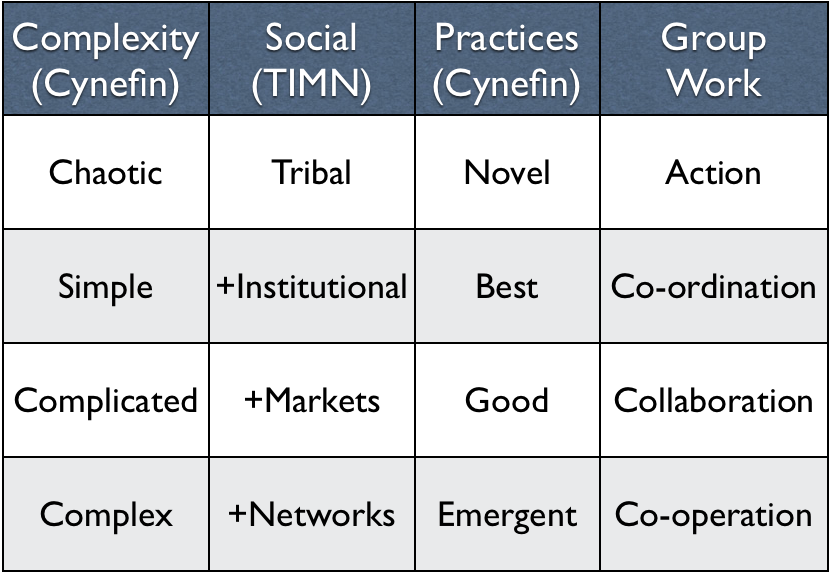
Charles’ C-Curve is a model in practice, based on his experience as CLO of Reuters. I see a parallel between this migration of the L&D department and the social order necessary to do certain types of group work [Refs: CynefinTIMN]

  1. L&D Autonomous = taking action as a Tribe of its own
  2. L&D Aligned with organization = coordinated with the Institution
  3. L&D with governance & guidelines = able to work in a collaborative Market
  4. L&D strategically aligned = a co-operative member of (a) Network(s)

I wondered if tribal organizations may be able to thrive in networks because they are already used to more freedom. I have noticed that it is difficult to convince organizations steeped in the institutional models that the networked model may be better to deal with growing complexity. Also, those who already have to respond to markets may understand the value of networks much better than institutions. Hence the advantage of the private sector in adapting new work models before the public sector.

In organizations and complexity, I discussed three archetypal organizational models and some of their defining characteristics.

Simplicity Complication Complexity
Organizational Theory Knowledge-Based View Learning Organization Value Networks
Attractors Stakeholders (vision) Shareholders (wealth) Clients (service)
Growth Model Internal Mergers & Acquisitions Ecosystem
Knowledge Acquisition Formal Training Performance Support Social
Knowledge Capitalization Best Practices Good Practices Emergent Practices

I’ve combined the C-Curve [X=Autonomy, Y= Strategic Alignment] with the knowledge acquisition models from these three organizational types in the figure below. The question that I ask here is whether it is necessary to follow the curve or if one can leap from Stage 1 to 4.  If not, that means that organizations need to understand and implement something like a human performance technology model for L&D before they can move on to social learning. Perhaps this is why social learning is being resisted or put into a formal training box in many organizations. They have not made the move to Stage 3 (Performance Support) yet. It’s too much of a leap for organizations in Stage 2. On the other hand, social learning is only a short leap for more tribal start-ups that have not developed any structure at all for L&D as they are quite comfortable with autonomy and messy networks. Stage 2 seems like the worst place to be.