Making sense of complexity and innovation

Friday’s Finds:

friday2Gall’s Law: A complex system that works is invariably found to have evolved from a simple system that worked. A complex system designed from scratch never works and cannot be patched up to make it work. You have to start over with a working simple system. – John Gall

@euan : “My discomfort with case studies is the inclination to force things to make sense in retrospect when they didn’t in advance!”

@Cory_Foy“Innovation comes from slack. Slack comes from saying no. If you’re afraid of both, no startup bubble technique is going to help you.”

Deconstructing Innovation: a complex concept made simple; by @ShaunCoffey

So it is important to understand that there is no one-size-fits-all philosophy in terms of successful innovation. The one constant is that you have to be open to change and new points of view. Innovation is continuous.

Successful innovators and entrepreneurs all embrace change and the risks that they pose. In fact, innovation is the poster child of the mantra that there are no rules. Only by trying out new things, by failing, by discovering what works and what doesn’t, do you gain answers to the innovation question.

Knowledge Leadership in the Era of Convergencevia @JonHusband

In an environment where speed, access, and tools allow workers to seamlessly collaborate across time zones, store massive amounts of data, and crowdsource the answers to difficult organizational issues, organizations that trend toward openness in the knowledge management arena will be better able to use new technologies and react to cultural and business changes. This makes leaders responsible for developing an open, collaborative culture, and suggests that inspiring these attitudes toward knowledge management will have positive individual and organizational consequences.

stop talking about jobs

Andy McAfee reports in HBR that United Technologies is laying off workers, even though its stock is at an all time high and sales have increased by 35%.

I simply want to point out that if this example is part of any larger trend, then we cannot rely on economic growth to fix our current problems of unemployment or underemployment. Because even for individual companies, economic growth has become so decoupled from employment growth that the former goes up while the latter goes down.

I have been observing for quite some time that most work is getting automated and outsourced, while only complex and creative work remain valued, and therefore wealth-generating for those who do it. The construct of the JOB highlights this problem, because jobs are designed around work that can be copied and workers who can be replaced, but anything that can be reduced to a flowchart will be automated. Relying on the job as society’s main wealth-sharing mechanism is a major mistake in the network era, but one that politicians and many others continue to make. We are entering a post-job economy.

Part of the solution is taking control of our own professional development. Another is developing new systems of wealth exchange, such as the many new models examined at Shareable. But most importantly, we need to change our language as we discuss work, wealth, and economics. We need to stop focusing on job creation and figure out better systems of wealth redistribution for a networked society.

employment opportunities

Productivity tools for the networked workplace

* This post is sponsored by Microsoft Office 365 *

I have noticed that the Microsoft Office suite is used by pretty well every one of my clients. All of the larger organizations have and use Sharepoint. These tools are ubiquitous in business and government, so I have agreed to write a few articles on how they can be used to improve work productivity. Since these are the tools that are already in place in many organizations, it might make sense to understand how best to use them.

One of the gaps between enterprise work and more open and serendipitous cooperation is a lack of ways to quickly connect to others in the organization. Email and telephone are often the only choice. Instant messaging may be available, but is not used intensely, like email is. A Forrester research report – The Total Economic Impact Of Microsoft Office 365 Midsize Customers – describes these collaboration needs of mid-size companies:

“Everyone being able to work in a collaborative environment is essential. We can work smarter and fewer hours.”
“We are a knowledge company. IT has to make us more productive, smarter.”
“Without Lync we have no mechanism for communicating across the company – except phones and shouting. Lync will be a huge improvement in terms of time savings.”

The addition of Lync has made a significant improvement to the Microsoft suite, according to several of my clients. I developed my enterprise social network tool analytical framework at the request of a client who wanted to know what mix of platforms and tools was optimal for collaboration and knowledge sharing. From their perspective, Lync was a game-changer.

I continued to refine this analytical framework with two more clients over the past year and all have found it useful. The slide presentation below looks at Microsoft’s Office 365 suite from that perspective. Please note that I do not use any of these tools myself. The analytical framework is my creation but the perspective on each tool were based on client user feedback and other third-party sources. I would suggest doing your own analysis of all your enterprise collaboration and productivity tools, based on the framework.

In the slide presentation, one conclusion offered is that content creation is a way to capture knowledge, even though we know that we can only “capture” a small part of our implicit knowledge by making it more explicit. Conversations and the ongoing narration of work must still be supported. This again shows the gap that Lync is filling; it provides opportunities for impromptu knowledge sharing. As the content creation tools of the Microsoft Office suite become more networked, it will be easier to connect cooperative and collaborative behaviours.

For those who are interested, here is the background of the framework. Ian McCarthy’s honeycomb of social media was an initial inspiration, showing how one could quickly and graphically portray differences between social media platforms. The Altimeter Group’s 2012 report on making the business case for enterprise social networks provided more detail on what happens inside organizations. Finally, Oscar Berg’s digital workplace concretized gave a good picture of what people-centric, service-oriented businesses should look like.

The seven facets identified by Oscar Berg align with some general digital competencies that are necessary for connected knowledge workers everywhere. These also align with the PKM framework that can support the flow of cooperative and collaborative work in a coherent organization.

In my next post in this series, later this month, I will discuss the digital competencies described in Slide #6.

  • Sharing openly
  • Communicating effectively in communities & networks
  • Contributing to knowledge networks
  • Creating content to share inside & outside the organization
  • Coordinating tasks with minimal time & effort
  • Conducting & participating in meetings to maximize impact & minimize wasted effort
  • Quickly finding people best suited to solve a given problem

Disclosure: This post was sponsored by Office 365 but I retained editorial control and take full responsibility for what is posted. Contract writing is one of the ways I make my living.

Notes on social learning in business

We just finished a month-long workshop at the Social Learning Centre which involved over 50 participants from many countries. The workshop was on social learning in business, and followed on from previous ones like the PKM workshop on individual, informal learning, and the Training to Performance Support workshop on tools that can often replace instruction. This was my last in a series that Jane Hart and I have done over the past year. Jane is conducting an April workshop on enterprise community management and sign-up ends this week. Jane and I also have a Summer Camp scheduled as our final joint offering, and it will cover a wide variety of topics, to be announced prior to starting in June.

The core themes in this workshop were around social aspects of learning at work: narrating our work for others; communities of practice & understanding networks. Social learning can happen in both formal instruction and informally. Many of the structures and systems that can support informal learning can also help social learning. While not interchangeable terms, they can often apply to the same activity. For example, when I learn informally in a social network, it is social learning as well. However, reading a book alone may be informal, but not social. As Albert Bandura wrote; “most human behavior is learned observationally through modeling: from observing others one forms an idea of how new behaviors are performed, and on later occasions this coded information serves as a guide for action.” This is most often outside of formal instructional activities.

People learn socially at work, which is why organizational design is so important. We automatically ask those close to us for help, but they may not be the best people to ask. Social enterprise tools can help expand our social learning networks. Understanding that social learning is natural, we should look at ways to support and enhance it.

Training and instruction are all about control, with curricula, sanctioned learning objectives, and performance criteria. This works when the field of study is knowable. But fewer fields remain completely knowable, if they ever were. Many institutions and professions have been built on the premise that knowledge can be transferred in some kind of controlled process. If you question that premise, you threaten people’s jobs, status, and sense of worth. This is why you see some violent reactions to the notion of informal and social learning having validity within organizations.

A major difference between communities of practice and work teams is that the former are voluntary. People want to join communities of practice. People feel affinity for their communities of practice. You know you are in a community of practice when it changes your practice. If the groups are mandated by management, they are work teams, or project teams etc., but not communities of practice.

“Communities of practice are groups of people who share a passion for something that they know how to do and who interact regularly to learn how to do it better.” — Etienne Wenger

For those who want to promote social learning in the workplace, start by modelling good networked learning skills. Be the example and wait for opportunities. For instance, narrate your work for others to see. Consider the Buddhist proverb; “When the student is ready, the teacher will appear.” Be ready to appear once their eyes are open.

sitting buddhaBecoming comfortable with narrating your work takes time, practice and feedback. When I have worked with companies, it has taken several months for people to get comfortable with working and learning out loud. It also takes modelling of new behaviours, a gentle hand to guide, and once in a while, a bit of cajoling. I have not figured out a way to do this quickly, or without allowing time for practice and reflection. I don’t think it’s possible. That is often the problem with enterprise social software implementations. Once the initial training is over, management thinks all problems have been solved. Getting to social takes time.

No cookie cutters for complexity

Five years ago I noted that big consultancies were jumping on the Web 2.0 bandwagon but more nimble upstarts (like me) could now significantly engage in a conversation with our markets using our own tools, like blogs, with which we have developed a certain advanced level of expertise. Jon Husband had written a good observation on how large consultancies work:

Big firms either 1) develop standardized methodologies and practices (their business models depend upon it), or 2) if their business model does not depend upon the standardization, they will charge you a mint and a half (McKinsey?)

The organization(s) [clients] will in my opinion get better advice rooted in critical thinking and experience and focused on results, as opposed to maintaining an expensive dependency on canned rhetoric that may not be based in much experience. For example, what exactly is “Advanced” Web 2.0 technology ? Blogs with lots of colourful widgets?

Five years later, Dave Snowden makes a similar observation, sparked by a KPMG marketing brochure on “cutting through complexity”. Dave concludes:

If a consultancy firm really wants to help their clients then they should support them in living with complexity, riding its potential, avoiding reductionist approaches, engaging customer and staff in a sensing network.  The trouble is that would not allow large teams of recently graduated MBA’s to reuse recipes and documents from over codified knowledge management systems.

cookie-cutterSo while we upstarts may now have a greater voice online, there is still a large demand for cookie cutter solutions. As social learning, collaboration, and even complexity become mainstream concepts, the array of products and services around them are becoming commoditized. Making a value proposition around behaviour and culture change is therefore very difficult.

I have noted in the past year clients wanting more products and fewer customized services. Some of this is due to their own difficulties in facing complexity and not having the time or energy to dig into these concepts. It’s just easier to buy a product, and nobody makes shinier products, such as case studies, than the big consultancies.

Case studies abound in business and many sell for a significant amount. But other than for general education, they’re rather useless. Each organization’s situation is not only different, it’s changing. Case studies and best practices in business are like the arbitrary subjects in our schools. They’re easy to package but don’t transfer well into real life.

Few managers ask the tough questions, like what are the underlying assumptions of how we do business and do they make sense? Are any of our practices self-defeating?

Complex problems require different thinking. In the book, Getting to Maybe, the authors say that in complex environments:

  • Rigid protocols are counter-productive
  • There is an uncertainty of outcomes in much of our work
  • We cannot separate parts from the whole
  • Success is not a fixed address [what I call perpetual Beta]

Rigid protocols are prescriptive and tell you what to do. To understand complex systems one must marinate in them, as John Seely Brown advocates. The problem with best practices is they presume simplicity, like being able to ‘cut through complexity’. The next time you pick up a report on best practices, ask yourself:

  • Has anything changed since this report was written?
  • How is my organization different from these?
  • Who stands to gain from the report?

Many best practices are self-evident. They’ve worked for years and address relatively simple systems. But the business issues that consume us are most likely complex. Instead of looking for best practices, take that time and money to invest in an experiment (a probe).

Beware the cookie-cutter salespeople. They abound, and are aided by marketing departments that do not have a clue about complexity. There are some real advantages in avoiding the large consultancies and going with smaller companies and free-agents. These include:

  • Personal relationship based on knowledge and trust
  • Work is usually done by senior consultants
  • Responsiveness and flexibility
  • Ability to innovate faster
  • Fewer costs to pass on (shareholders, marketing, advertising, bonuses)

One should never bring a knife to a gun fight, nor a cookie cutter to a complex adaptive system.

Only open systems are effective for knowledge sharing

Seth Godin makes a very good point about trusting the select few to curate information, whether they be leaders, managers, certified professionals, researchers, or any other group of experts.

We have no idea in advance who the great contributors are going to be. We know that there’s a huge cohort of people struggling outside the boundaries of the curated, selected few, but we don’t know who they are.

When it comes to knowledge, we often do not know in advance what will be useful in the future. I discuss this when coaching people how to narrate their work, an essential part of encouraging social learning in the workplace. Overly editing one’s own work is similar to overly editing who does the curation of our knowledge flows. Seth Godin explains it with this graphic.

open v curationIn software programming, the saying is that with enough eyes, all bugs are shallow. Or put another way, the more people who look at a problem, fewer errors will get through. In the case of enterprise knowledge-sharing, an incredibly inexact practice; with enough voices quality will emerge. Only an open system can ensure this, which is why I highlighted the knowledge sharing paradox.

When it comes to knowledge, and learning, only open systems are effective. All closed systems will fail over time, especially if discovery and innovation are happening outside that system. The question for organizational leaders is whether they think they can create an artificial, closed system that can compete with almost 3 billion people connected to that hive mind called the internet.  The good news is that they do not have to. Encouraging cooperation, along with workplace collaboration, ensures more open knowledge sharing.

collab coop

The knowledge sharing paradox

An effective suite of enterprise social tools can help organizations share knowledge, collaborate, and cooperate – connecting the work being done with the identification of new opportunities and ideas. In an age when everything is getting connected, it only makes sense to have platforms in place that enable faster feedback loops inside the organization in order to deal with connected customers, suppliers, partners, and competitors. It takes a networked organization, staffed by people with networked mindsets, to thrive in a networked economy.

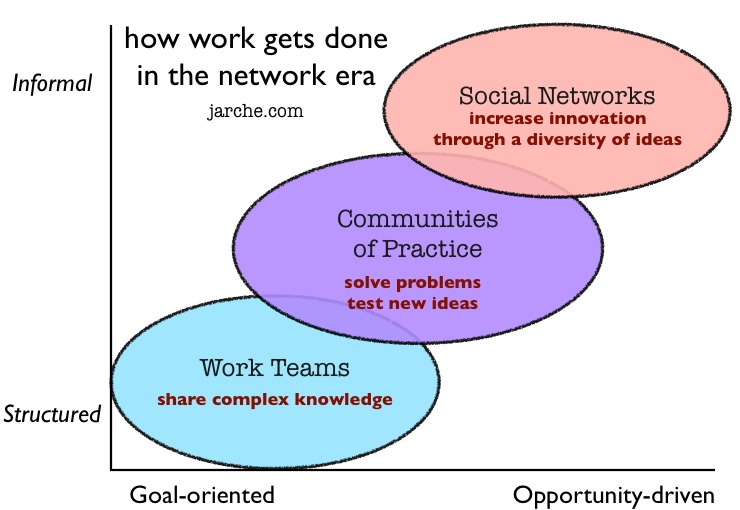
enterprise social toolsGetting work done today means finding a balance between sharing complex knowledge (collaboration) and seeking innovation in internet time (cooperation).

how work gets doneIndividual workers can develop sense-making skills, using frameworks like PKM, to continuously learn and put their learning to work. For example, they can seek new ideas from their social networks; make sense of these ideas by connecting with communities of practice; try new ideas out alone or with their work teams, and then share these ideas and practices.

PKM at workBut there is a major issue that gets ignored, by software vendors, managers, IT departments, and most everyone except the workers themselves. People will freely share their knowledge if they remain in control of it. Knowledge is a very personal thing. Most workers do not care about organizational knowledge bases. They care about what they need to get work done. However, if we are going to build organizational knowledge from individual knowledge-sharing, we have to connect the two.

The knowledge sharing paradox is that enterprise social tools constrain what they are supposed to enhance. Why would someone share everything they know on an enterprise network, knowing that on the inevitable day that they leave, their knowledge artifacts will remain behind? I could not imagine having this blog (AKA my outboard brain) cut off from me. I would not put anywhere near the effort I do now if someone else controlled my access to this blog.

The elephant in the room is human nature. Enterprise knowledge sharing will never be as good as what networked individuals can do. Individuals who own their knowledge networks will invest more in them. I think this means that innovation outside of organizations will continue to evolve faster than inside. It may mean that the half-life of organizations will continue to decrease, as more nimble businesses continuously emerge to compete with incumbents. Whoever creates an organizational structure that bridges the individual-organizational knowledge sharing divide may have significant business advantages.

Friday’s Finds #189

Here are some of the observations and insights that were shared via social media during the past fortnight. My Friday’s Finds are a collection of what I have found of interest but have not blogged about. I have been curating these collections for several years, this one is the 189th.

“If I were unemployed, I would spend my non-job hunting time learning to code. It’s a skill that can be applied in just about any field.” —Nedra Weinreich

I think the reward for conformity is that everyone likes you except yourself.” – Rita Mae Brown, via Marcia Conner

O’Reilly Radar: GitHub gains new prominence as the use of open source within governments grows, via JP Rangaswami

When it comes to government IT in 2013, GitHub may have surpassed Twitter and Facebook as the most interesting social network.

The Atlantic: Young people are desperate for learning that is relevant … without it all being mapped for them in advance

It is no wonder my daughter wants to mess around with the guitar and the Internet and pursue some interests at a pace that doesn’t feel like the relentlessly scheduled pressure of school and structured activities. For her, the Internet has been a lifeline for self-directed learning and connection to peers. In our research, we found that parents more often than not have a negative view of the role of the Internet in learning, but young people almost always have a positive one.

Three reasons to keep the name with the knowledge – “personal” knowledge management for organizations, by Nick Milton

When you’re publishing knowledge,there are three main reasons why it’s important to keep the name of the originator attached to the piece of knowledge. Whether it is a blog post, a lesson in a database, a contribution in a call centre knowledge base, or a couple of paragraphs in a Knowledge asset,  it is important tokeep the name with the knowledge.

HBR: How WordPress Thrives with a 100% Remote Workforce. via Florence Dujardin

Not all remote work is the same. To evaluate remote work as a singular idea is a paper tiger. There are many policies to choose from and those choices matter. Managers of remote workers at older companies need to make adjustments to enable remote workers to thrive, especially during a trial period when everyone is experimenting and learning what will work for them. But to try remote work without making any allowances or adjustments is foolish. Any progressive idea can be made to fail if the people in charge don’t support it.

The best ever review of standing desks why and what to buy from Wirecutter, via Robert Paterson. Here is my new standing desk :)

harold jarche standing desk

Military Training and Simulation

aerospace allianceI’m attending the training and simulation conference, hosted by the Atlantic Aerospace & Defence Industry Alliance in Halifax this week and spent the day getting caught up on what is happening in the Canadian Armed Forces, an organization I left in 1998.

I learned about the current Army training review that is fundamentally changing the existing training system. The military seems to understand the changing times and its challenges. What is interesting is that “learner centric” is a new priority for the Army. What we call mobile & local is what the Army calls “location independent”.

It was noted that legacy software systems will continue to be a barrier to adopting new technologies. This is the same as the other industries I have worked with. There is no money to replace existing expensive existing systems that still work. Even more interesting was an example of open learning resources. The US Army Ranger school has made all of its courses available online with open access for all. This facilitates the distribution of learning resources to all potential students, when and where they need them. The Canadian Armed Forces cannot (or will not) do this. This is a major barrier to access.

There was also a point about using subject matter experts as instructors. I was told that military personnel can get burnt out when employed as instructors at training units. It was questioned by the military if it was worth it to use SME’s in this role, due to the high demands of continuous teaching. Training seems to be a tough business in the military.

The major themes included the need to get agile in personnel development and training, as well as a strong requirement to address the increasing complexity faced by the military. There seems to be a significant impetus to integrate individual with collective training. Currently the two are separate. Military training needs simpler systems, we were told. It was suggested that mass customization for training was becoming an imperative. This means addressing the needs of individual soldiers, sailors and airmen, all within operational constraints. It was obvious that the existing Cold War structures [my time in the military] need to change, especially the Canadian Forces Individual Training and Education System. From the way I see it, the challenge is shifting to a Probe-Sense-Respond perspective on change.

One more thing, I did note that the military still love their massive bulleted lists on Powerpoint slides. Some thing do not change.

From hierarchies to wirearchies

Work in the network era needs to be both cooperative and collaborative, meaning that organizations have to support both types of activities. This may not be an easy transition for companies based almost uniquely on command and control leadership. But in this emerging network era, cooperative innovation trumps collaborative innovation, writes Stowe Boyd.

My experience is that communities of practice can help make the transition from hierarchies to networks, or as Jon Husband describes the resulting structure; wirearchy. Communities of practice, both internal and external; can be safe places between highly focused work and potentially chaotic social networking. The Community Roundtable has a Community Maturity Model that describes this transition, in four stages. The model makes it relatively easy to see where your organization stands and where it should go.

Community Maturity Model

The CMM aligns with my own way of looking at the need to balance structured work and the sharing of complex knowledge, with the concurrent requirement for unstructured social networking which can increase innovation through a diversity of ideas. I have added in the four CMM stages to the image below. Communities of practice can link collaboration and cooperation, and help weave the organization and its people into a wirearchy.

Wirearchy – “a dynamic two-way flow of power and authority based on knowledge, trust, credibility and a focus on results, enabled by interconnected people and technology.” – Jon Husband

HCNW

Getting there may not be easy, but the evidence is showing that it is necessary. For example, here is how Yammer builds its products, according to Kris Gale, VP of Engineering:

Yammer’s biggest rule of thumb is 2 to 10 people, 2 to 10 weeks – which means they generally don’t do projects that are larger or more complicated.  There is a non-linear relationship between the complexity of a project and the wrap-up integration phase at the end.  If you go anywhere beyond ten weeks, the percentage of time in the wrap-up phase becomes disproportionate. – First Round Capital

This sounds like it’s aligned with the general rules of dealing with complexity, developed by Dave Snowden. Each project at Yammer is a probe. It’s also small enough so that the potential ROI does not drive the company off the rails. A small project failure is much easier to deal with than a large one. Yammer understands that working in a hyper-connected economy makes complex work less predictable, so project cycles are kept short. As Gale goes on to explain:

I don’t think you should be building a product.  I think you should be building an organization that builds a product.

Be very wary of only trusting managers with engineering decisions; in fact, you should delegate these all the way down to individual contributors.  If managers are the only ones making decisions as you grow past thirty to forty people, this should be a red flag.  – First Round Capital

probe sense respond

Becoming a wirearchy requires new organizational structures that incorporate communities and networks. In addition, they require new ways of doing work, like thinking in terms of perpetual Beta and doing manageable probes to test complex problems. It’s a new way of doing work, within a new work structure. Both are required.