Play, explore, converse

Was the dominance of morality usurped by responsibility at the beginning of the industrial era? (Nine Shift: Part 1Part 2Part 3).

In the Industrial Age of the 20th century, you didn’t have to be of good moral character to work in the factory. But you did have to be responsible.  And so teachers in the 20th century schoolhouse and college taught (still teach) responsibility.   And by that  teachers mean specific behaviors.

Those behaviors are now obsolete. They made sense in the factory …  But not in the virtual office.

As we moved from morality to responsibility one hundred years ago, are we now shifting from responsibility to creativity in the network era? Just last week a creative teenager sold his mobile start-up to Yahoo! for $30 million. If creativity, and especially any resulting innovation, is what is valued and profitable in this era, then why are we teaching and reinforcing responsibility to its exclusion?

Read more

The knowledge sharing paradox

An effective suite of enterprise social tools can help organizations share knowledge, collaborate, and cooperate – connecting the work being done with the identification of new opportunities and ideas. In an age when everything is getting connected, it only makes sense to have platforms in place that enable faster feedback loops inside the organization in order to deal with connected customers, suppliers, partners, and competitors. It takes a networked organization, staffed by people with networked mindsets, to thrive in a networked economy.

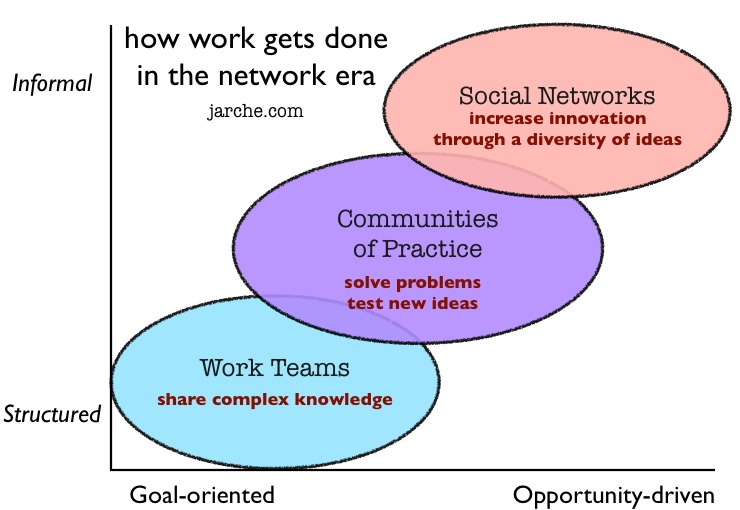
enterprise social toolsGetting work done today means finding a balance between sharing complex knowledge (collaboration) and seeking innovation in internet time (cooperation).

how work gets doneIndividual workers can develop sense-making skills, using frameworks like PKM, to continuously learn and put their learning to work. For example, they can seek new ideas from their social networks; make sense of these ideas by connecting with communities of practice; try new ideas out alone or with their work teams, and then share these ideas and practices.

PKM at workBut there is a major issue that gets ignored, by software vendors, managers, IT departments, and most everyone except the workers themselves. People will freely share their knowledge if they remain in control of it. Knowledge is a very personal thing. Most workers do not care about organizational knowledge bases. They care about what they need to get work done. However, if we are going to build organizational knowledge from individual knowledge-sharing, we have to connect the two.

The knowledge sharing paradox is that enterprise social tools constrain what they are supposed to enhance. Why would someone share everything they know on an enterprise network, knowing that on the inevitable day that they leave, their knowledge artifacts will remain behind? I could not imagine having this blog (AKA my outboard brain) cut off from me. I would not put anywhere near the effort I do now if someone else controlled my access to this blog.

The elephant in the room is human nature. Enterprise knowledge sharing will never be as good as what networked individuals can do. Individuals who own their knowledge networks will invest more in them. I think this means that innovation outside of organizations will continue to evolve faster than inside. It may mean that the half-life of organizations will continue to decrease, as more nimble businesses continuously emerge to compete with incumbents. Whoever creates an organizational structure that bridges the individual-organizational knowledge sharing divide may have significant business advantages.

PKM in 2013

“The basic unit of social business technology is personal knowledge management, not collaborative workspaces.” —Thierry de Baillon

Personal knowledge management (PKM) is a set of processes, individually constructed, to help each of us make sense of our world and work more effectively. But what we loosely call knowledge, using terms like knowledge-sharing or knowledge capture, is often just an approximation. As knowledge management expert Dave Snowden says, we are not very good at articulating our knowledge; “We always know more than we can say, and we will always say more than we can write down.” [see comment by Cynefin co-author, Cynthia Kurtz]

Knowledge

When we use our knowledge to describe some data, such as what we remember from an experience or our summary of a book, we convey this knowledge by creating information, even though writing it down is not perfect. This does not mean that we shouldn’t even try, because the cumulative pieces of information, or knowledge artifacts, that we share can help us have better conversations and increase our understanding of things that cannot easily be codified. Our individual sense-making can be shared, and from it can emerge better organizational knowledge. This is not a linear process, as in from information we get knowledge, which over time becomes wisdom. Gaining knowledge is much messier than that.

Becoming knowledgeable can be thought of as bits of knowledge partially shared and experienced over time. It is laborious, hence the reason why masters through the ages could only have a limited number of apprentices. But when writing, and later books, came along, we had a new technology that could more widely distribute information created by the wise, and also the not so wise. Whether being mentored by a master or reading a book, knowledge does not actually get transferred, but shared observations and information can be helpful to those who have a desire to learn and do something with their learning.

Merely being well read is not enough to be knowledgeable, as possibly first noted by Socrates. Plato wrote in Phaedrus that Socrates felt the written language would result in “men filled, not with wisdom, but with the conceit of wisdom, who will be a burden to their fellows“. Socrates saw a core truth in learning from artifacts like books. Even today, we cannot become complacent with knowledge and just store it away. It has a shelf life and needs to be used, tested and experienced. It should be shared amongst people who understand that they are only seeing a fragment of others’ knowledge. Because it is so difficult to represent our knowledge to others, we have to make every effort to continuously share it. Once is not enough, as most parents know. Knowledge shared in flows over time can help us create better mental pictures than a single piece of knowledge stock, like a book, can ever do.

Seek : Sense : Share

Capturing knowledge, as crudely as we do, is just a first step. The PKM framework I have developed over the past eight years suggests two more steps: sense-making and sharing. PKM, or learning in networks, is a continuous process of seeking, sensing, and sharing.

Seeking is finding things out and keeping up to date. Building a network of colleagues is helpful in this regard. It not only allows us to “pull” information, but also have it “pushed” to us by trusted sources.

Sensing is how we personalize information and use it. Sensing includes reflection and putting into practice what we have learned. Often it requires experimentation, as we learn best by doing.

Sharing includes exchanging resources, ideas, and experiences with our networks as well as collaborating with our colleagues. As Tim Kastelle notes:

Yes, when we send our ideas out into the world, they change the people with whom they interact.

But sending these ideas out, and seeing how they interact with people changes us as well.

PKM 2013

Innovation

Scott Anthony, author of The Little Black Book of Innovation, identifies four skills exhibited by innovators: Observing; Questioning; Experimenting; Networking. These directly align with the PKM framework of Seek, Sense, Share. It is quite likely that innovation in organizations can be improved with individuals practising PKM. It could even be a major value proposition for Learning & Development departments everywhere, something to seriously think about.

Seeking includes observation through effective filters and diverse sources of information. Sense-making starts with questioning our observations and includes experimenting, or probing. Sharing through our networks helps to develop better feedback loops. In an organization where everyone is practising PKM, the chances for more connections increases.

PKM may be an individual activity but it is also social. It is the process by which we can connect what we learn outside the organization with what need to do inside. Research shows that work teams that need to share complex knowledge need tighter social bonds. Work teams often share a unique language or vocabulary. However, they can become myopic and may lack a diversity of opinions. Social networks, on the other hand, encourage diversity and can sow the seeds of innovation. However, it is almost impossible to get work done in social networks due to their lack of structure. PKM is the active process of connecting the innovative ideas that can arise in our social networks with the deadline-driven work inside organizations.

PKM is beneficial on both a personal and organizational level, but its real value is in increasing innovation. Without innovation, organizations cannot evolve.

Social Learning

Both collaborative behaviours (working together for a common goal) and cooperative behaviours (sharing freely without any quid pro quo) are needed in the network era. Most organizations focus on shorter term collaborative behaviours, but networks thrive on cooperative behaviours, where people share without any direct benefit. PKM helps to add cooperation to workplace collaboration.

social ties collaboration cooperation

In addition to seeking, sensing and sharing, we need to become adept at filtering information as well as discerning when and with whom to share. Like any skill, these require practice and feedback. Much of this feedback can be provided in communities of practice, a half-way space between work teams and social networks, where trusted relationships can form that enable to share more openly.?

Connecting social networks, communities of practice and work teams, becomes an important framework for integrating learning and working in the network era. We seek new ideas from our social networks and then filter them through more focused conversations with our communities of practice, where we have trusted relationships. We make sense of these embryonic ideas by doing new things, either ourselves, or with our work teams. We later share our creations, first with our teams and perhaps later with our communities of practice or even our networks. We use our understanding of our communities and networks to discern with whom and when to share our knowledge.?

Narration

Narrating one’s work does not get knowledge transferred, but it provides a better medium to gain more understanding. Working out loud is a concept that is very easy to understand, but not quite so easy to do. Most people are too busy managing in their information age workplaces and have little spare time to try to learn how to work in the network age. The most important step in learning a new skill is the first one. This same step has to be repeated many times before it becomes a habit.I have learned that the first step of starting to work out loud, as part of personal knowledge management, has to be as simple as possible. Here are three simple steps I recommend to begin a regular PKM practice with.

1) Free Your Bookmarks: This is a very simple shift that only requires a slight deviation from a common practice: saving bookmarks/favourites on your browser. Using tools like Diigo, or Delicious moves them off a single device, makes them more searchable, and (later) makes them shareable. Being able to share is usually not a prime reason why people start using social bookmarks but it becomes more important over time.

2) Aggregate: Driving as many information sources as possible through a feed reader such as Google Reader or Feedly, saves time and helps stay organized. It is amazing how many people still do not understand RSS or how to grab a feed and save it. Aggregation makes information flows much easier to deal with.

3) Connect: How does one get started micro-blogging on a platform like Twitter? I suggest beginning with an aim in mind, such as professional development or staying current in a specific field. The search function can help find people who post about a specific topics. To start, one should follow no less than 20 and no more than 30 interesting people. Once set up, beginners should dip into their stream once or twice a day and read through any posts of interest. Over time, as they follow links, they may add or delete feeds. Within a week or two, anyone should be able to sense some patterns and then modify their streams to provide more signal and less noise.

Sometimes we get all caught up in the latest social media tools. Getting started working out loud is not complicated and should not involve a steep learning curve on a complicated system. It is best to start with simple tools and frameworks.

Small pieces, loosely joined

The mainstream application of knowledge management and learning management over the past few decades has had it all wrong. We over-managed information, knowledge and learning because it was easy. Our organizations remain enamoured with the next wave of enterprise software systems. But the ubiquity of information outside the organization is showing the weakness of centralized enterprise systems. As organizations begin to understand the Web, the principle of “small pieces loosely joined” is permeating some thick industrial age walls. More workers have their own sources of information and knowledge, often on mobile devices, but they often lack the means or internal support to connect their knowledge with others to actually get work done. Supporting PKM, especially internal sharing, can help information flow more freely.

Personal knowledge management frameworks can help knowledge workers capture and make sense of their knowledge. Organizations should support the individual sharing of information and expertise between knowledge workers, on their terms, using PKM methods and tools. Simple standards like RSS can facilitate this sharing. Knowledge bases and traditional KM systems should focus on essential information, and what is necessary for inexperienced workers. Experienced workers should not be constrained by too much structure but rather be given the flexibility to contribute how and where they think they can best help the organization.

We know that formal instruction accounts for less than 10% of workplace learning. The same rule of thumb should apply to knowledge management. Capture and codify the 10% that is essential, especially for new employees. Now use the same principle to get work done. Structure the essential 10% and leave the rest unstructured, but networked, so that workers can group as needed to get work done. Teams are too slow and hierarchical to be useful for the network era. Organizations structured around looser hierarchies and stronger networks are much more effective for increasingly complex work.

Conclusion

PKM is a framework for individuals to take control of their professional development while working in organizations or across networks. Disciplined personal knowledge management brings focus to the information sea we swim in. The multiple pieces of information that we capture and share can increase the frequency of serendipitous connections, especially across disciplines and outside organizations. As Steven Johnson, author of Where Good Ideas Come From says; “chance favors the connected mind“.

As the world keeps churning, work today is all about learning

to sell is humanThe title of this post is what Dan Pink, in his book To Sell is Human, would call a rhyming pitch. He also discusses the question pitch, and I followed his recommendation in the Pitch chapter and developed my own.

Are things more complex now, than they were five years ago?

Your Work? Your Markets? Your Customers? Your Profession?

I also developed a Pixar pitch:

Work used to be fairly straight forward. You had a job, knew what to do, and were paid to do it. Then the Web appeared. Everybody got connected to almost everyone else. All these connections made things more complex.  Some work was automated. Some of it outsourced. Much of it became more complex. Making sense of complexity, and developing ways to keep up, is how I help people and organizations.

Finally I created a one-word pitch: SENSE-MAKING

The Pitch chapter also explains the Twitter pitch (140 characters) and the subject line pitch. These are all excellent exercises to focus on your business or mission, and I will continue to refine mine over time.

Here is Dan’s pitch to continue reading the book, subtitled “the surprising truth about moving others“:

Here we confront a paradox. There are no “natural” salespeople, in part because we are all naturally salespeople. Each of us – because we’re human – has a selling instinct, which means that anyone can master the basics of moving others. The rest of the book will show you how.

I found the book quite compelling and much of what was covered, such as improv skills for business, are areas of interest for me. The chapter on Clarity was directly aligned with my work on personal knowledge mastery . In it, Beth Kanter is quoted using my Seek-Sense-Share framework in her Content Curation Primer and earlier post.Kanter-PKM

In this chapter, Dan also proposes that you seek out the “one percent”.

Don’t get lost in the crabgrass of details, he [Pink’s Law professor, Harold Hongju Koh] urged us. Instead, think about the essence of what you’re exploring – the one percent that gives life to the other ninety-nine. Understanding that one percent, and being able to explain it to others, is the hallmark of strong minds and good attorneys.

This is the essence of sense-making in PKM. It is about seeking information and knowledge and distilling it so that you can make sense of it and then it is ready to be shared. Seek, make-sense and share (then repeat).

Prepare for the future of work

Ross Dawson says that people who have “learnt how to learn” will be better prepared for jobs of the future. “We’re finding people who have learnt how to learn know how to engage with a community and tap into others for support.” This is what personal knowledge mastery (PKM) is all about. It starts by seeking people and knowledge sources and the Seek > Sense > Share cycle finishes by sharing with communities and social networks. My recent workshops, both online and in person, indicate a need for PKM skills in all types of organizations and for people at all levels, from freelancers, researchers, managers, executives and more. The benefits are not just for individuals, preparing for their next job, but the organization gains from employees who take control of their learning and freely share their knowledge. PKM makes for more resilient individuals and companies.

Much of PKM is about finding balance. In seeking knowledge sources, we have to balance aggregation, or getting as much information as possibile, with filtering, or ensuring that we have more signal than noise. Our networks need to be diverse and varied in order to be exposed to new ideas, but we cannot keep track of everything, so we have to be judicious with our time.  We need to constantly lump things together, such as with a feed reader, while filtering out the good stuff so we can find it again, such as with social bookmarks. It’s like breathing information in and out, while making sense of only a small portion at a time, sometimes built by many grains before trying to express our knowledge in order to make sense of it.

These processes are not taught in schools or training programes. There is no right answer in PKM. There are only processes that work. The test of PKM is whether it works for you. My experience is that a person’s PKM changes over time, and the most important aspect is being aware of how we seek sources of information, make sense of our own knowledge, and then share it at work, in communities or through networks.

As Helen Blunden has noted about her PKM, it’s about continuous learning.

It’s opened up a whole new world and it’s just made me eager to know more.  It’s also made me realise that our learning will never stop – and we should get comfortable with that idea.  (I believe the creativity is now coming from the “Seek” part of the model because information is not one-sided anymore; you get a variety of opinions, perspectives and angles and from a wider expanded network of people from all walks of life – different industries, different skillsets – my curiosity in life also helps me out here).

PKM practices can help make sense of the current environment, whether it be your profession, your job, or your areas of interest. A resilient learning network, that can develop from practising PKM, creates a more resilient framework from which to make decisions about the future. The more you give to your networks, the more you will receive. PKM provides a way to do this in a more structured, but personal, manner. The result is enhanced serendipity, always an advantage in a changing world.

PKM for future jobsMore info:

PKM Workshops

#itashare

The Power of Pull and PKM

The Power of Pull by John Hagel, John Seely Brown & Lang Davison looks at how digital networks and the need for long-term relationships that support the flow of tacit knowledge are radically changing the nature of the enterprise as we know it. It is also an excellent reference book for understanding many facets of personal knowledge mastery. I have had this book on my reading list for quite some time and luckily Jay Cross gave me a copy which I read on the flight back from the west coast this week.

PKM helps people stay focused on the edges of their knowledge and look for innovation and opportunity. I have written, in embrace chaos, that I think the edge will be where almost all high value work gets done in organizations. Core activities will be increasingly automated or outsourced. Value is moving to the edge. The core is being managed by fewer internal staff and any work where complexity is not the norm will be of diminishing value. PKM enables tacit knowledge flows from the edge to the core and back.

emergent value

“Edge Participants also often reach out to participants in the core in an effort to build relationships and enhance knowledge flows. But these efforts are often frustrated – or at best marginalized – because core participants are too busy concentrating on defensive strategies within the core, trying to protect their profits and position, to understand the true growth opportunities represented by relevant edges.” – The Power of Pull, p. 54

PKM is a process of moving knowledge from the edge (social networks) to the core (work teams) and back out to the edges. It is the way that Pull can be done on a daily basis. Connecting the edge (emergent & cooperative) to the core (controlled & automated) is a major challenge for organizations. Part of the solution is more open management frameworks but another part is edge-like individual skills and aptitudes. PKM covers the latter.

PKM is a continual process of seeking from the edge (networks), filtering through communities of practice (CoP) and sense-making at the core (work teams) and also sharing back out to our communities and networks. Once habituated, it’s like breathing.

PKM flow

As stated in the book, “Pull platforms tend to allow us to perform the following activities with a blurring of the boundaries between creation and use“, showing four components that map directly to Seek > Sense > Share.

  • Find (Seek)
  • Connect (Seek)
  • Innovate (Sense)
  • Reflect (Share)

As the authors write, “Pull is not a spectator sport.” Neither is PKM. I would highly recommend The Power of Pull as a reference book that looks at how organizations need to change and how individuals need to redefine the nature of work.

“The choices each of us makes about the environments we participate in and the practices and behaviors we choose to pursue once we’re there will make a crucial difference in what we experience and the extent to which we can shape these experiences or simply let random experiences shape us.”  The Power of Pull, p. 99

Chance favors the connected mind.” – Steven B. Johnson.

PKM 2013

PKM workshop 2013

PKM-logo-smA number of people have requested that I run another Personal Knowledge Management workshop, so the next online PKM workshop is now scheduled for 21 Jan – 15 Feb 2013 through the Social Learning Centre. This will be the last workshop in the current format. In the Spring I will look at what has been learned to date and redesign the resources and activities.

In 2012, we conducted three online workshops and I also ran some on-site sessions for clients. What is becoming obvious is that the skills addressed in PKM are seen as important to many managers, knowledge workers, and practitioners in a wide array of disciplines. PKM combines aspects of traditional knowledge management, as well as digital curation, social learning, and critical thinking. I have shown how it is directly related to innovation and I believe it is an essential aspect of what are becoming known as digital competencies.

The Seek > Sense > Share framework I developed for PKM almost three years ago has helped many people establish their own sense-making processes. A common remark from workshop participants is how difficult sense-making can be, “I entered this workshop feeling I could seek and share quite effectively, it was the sensing I needed to work on.” Another participant described PKM as a way of “cleaning out my crap filters so the right information can come through so I don’t feel overwhelmed with information”; a very good description.

The main concept behind the workshops is to create a bounded space of active learners who can share their thoughts around a selection of resources and activities. The only rule is that all communication is within the discussion area, available for all participants to read and comment on. As facilitators, we use these discussions as starting points for deeper inquiry. Without the participants narrating their learning, the value of the experience would diminish.

Each workshop is a shared, cooperative experience. Many participants have made connections and friendships that have continued afterwards. My objective is to provide just enough structure for people to focus, but not too much to constrain personal reflection and social learning. It is very dependent on the positive intentions of everyone. Usually, we have enough active participants to get some deep conversations. What one gets out of each workshop is very dependent on what one puts in. From me, you get my undivided attention for a month and I look at ways to make better connections for participants, based on what they share. The structure is not for everyone, and people looking to be guided through a more linear process, such as a typical self-paced course, can be disappointed.

PKM: the basic unit of social business

True collaborative networks do not rely so much on teams than on individuals, as B. Nardi, S. Whittaker and H. Schwartz have shown. The main benefits for networked organizations do not lie in the outcome from teams, but in individual knowledge acquisition, in the ability to connect with the right people and to access the right information at the right time. Instead of focusing on teams and communities, we must concentrate our efforts in providing workers with the right resources and knowledge to build their own connections. The basic unit of social business technology is personal knowledge management [PKM], not collaborative workspaces. – Thierry de Baillon, The Tainted Narrative of the Workplace

Teams are for sports, not knowledge work

Teamwork is over-rated. For instance, it can be a cover for office bullies to coerce fellow workers. The economic stick often hangs over the team; “be a team player or lose your job”. Empowered individuals working in networks, not teams, will give organizations the flexibility they need to be creative and deal with complexity.

Teams seldom take into consideration the uniqueness of individuals. Usually individuals have to fit into the existing team like cogs in a machine. Team members can be replaced. The team, like the gang, rules.

People are more complex and multi-faceted than the simplistic view of Homo Economicus. Our lives have psycho-social aspects. We are more than our jobs and we are more than our teams. Teams promote unity of purpose, not diversity, creativity, and passion. The team, as a unit of work, is outdated in the network era.

As much as organizations advertise for “team players”, what would be better are workers who can truly collaborate and cooperate, inside and outside the organizational walls. There are other ways of organizing work than in teams. Orchestras are not teams; neither are jazz ensembles. There may be teamwork on a theatre production but the cast is not a team. It is more like a social network. Teams are what we get when we use the blunt stick of economic consequences as the prime motivator. In a complex world, unity is counter-productive.

Small pieces, loosely joined

The mainstream application of knowledge and learning management over the past few decades has had it all wrong. We have over-managed information because it’s easy and we remain enamoured with information technology. The ubiquity of information outside the organization is showing the weakness of centralized enterprise systems. As enterprises begin to understand the Web, the principle of “small pieces loosely joined” is permeating thick industrial walls. More and more workers have their own sources of information and knowledge, often on a mobile device. But they often lack the means or internal support to connect their knowledge with others to get actually get work done.

Personal knowledge mastery [PKM] frameworks can help knowledge workers capture and make sense of their knowledge. Organizations should support the individual sharing of information and expertise between knowledge workers, on their terms, using PKM methods & tools. Simple standards, like RSS, can facilitate this sharing. Knowledge bases and traditional KM systems should focus on essential information, and what is necessary for inexperienced workers. Experienced workers should not be constrained by work structures like teams but rather be given the flexibility to contribute how and where they think they can best help the organization.

We know that formal instruction accounts for less than 10% of workplace learning. The same rule of thumb should apply to knowledge management. Capture and codify the 10% that is essential, especially for new employees. Now use the same principle to get work done. Structure the essential 10% and leave the rest unstructured, but networked, so that workers can group as needed to get work done. Teams are too slow and hierarchical to be useful for the network era. Organizations structured around Loose Hierarchies & Strong Networks, as described in the image below by Verna Allee, are much better for increasingly complex work.

cynefin networks verna allee

Social businesses should leave teams for the sports field, and managing knowledge for each worker

Starting to work out loud

John Stepper discusses how people can get started working out loud and shows examples of different types of networks that one could connect with. It’s very easy to understand, but not quite so easy to do. Most people are too busy managing in the industrial/information age workplace and have no slack to try to learn how work in the network age.

But they probably won’t. Because they’re already busy. Because they’re afraid to make a mistake or unsure of their writing or speaking skills. Because they’re simply not used to working this way.

The most important step in learning a new skill is the first one. This same step has to be repeated many times before it becomes a habit. As John concludes:

For these people I offer some very simple advice: Schedule time in your calendar for working out loud. Start with simple contributions. Keep shipping.

Over time, you’ll develop the skills you need to be effective and the habits you need to do it regularly.

I strongly suggest that the first step of starting to work out loud, as part of personal knowledge management, has to be as simple as possible.

first step

Free Your Bookmarks: This is a very simple shift that only requires a slight deviation from a common practice: saving bookmarks/favourites on your browser. Using tools like Diigo, or Delicious moves them off a single device, makes them more searchable, and (later) makes them shareable. Being able to share is usually not a prime reason why people start using social bookmarks.

Aggregate: Driving as many information sources as possible through a feed reader such as Google Reader or Feedly, saves time and helps stay organized. It’s amazing how many people do not understand RSS or how to grab a feed and save it. Aggregation makes information flows much easier to deal with.

Connect: How do you get started micro-blogging on a platform like Twitter? I suggest beginning with an aim in mind, such as professional development or staying current in a specific field. Use the search function to find people who post about your area of interest. Then follow no less than 20 and no more than 30 interesting people. Dip into the stream once or twice a day and read through any posts that interest you. Over time, as you follow links, you may add or delete feeds. Within a week or two, you should be able to sense some patterns and then can modify your stream to help you in learning more about the areas that interest you.

Sometimes we get all caught up in the latest social media tools. Getting started working out loud is not complicated and should not involve a steep learning curve on a complicated system. Start with simple tools and frameworks and then use your experience over time to modify them.

networked unlearning

Our nature – our bias towards an inward focus based on tradition and the past, or an external focus on what we’re seeing around us – cuts across age. Those of us who are willing to question our assumptions will find that we can unlearn (and relearn) at any age. Those who put more weight on what they already know will struggle to change at any age. Today’s digital native will be tomorrow’s digital dinosaur if they are unable to unlearn. That bleeding edge agile practitioner who dogmatically insists that they won’t work with unless you follow these four (in their view) essential agile practices has more in common with their older colleagues still clinging to waterfall methodologies than they are comfortable admitting. —Peter Evans-Greenwood

How can we avoid becoming dogmatic? I think social media can help a lot. Today, we can easily connect to networks that offer diverse views. Inge de Waard uses the example of research tribes: “When joining forces with people that have a common language – but different viewing angles – everyone learns as there is some kind of zone of proximal development there, or it can be created based on mutual conversation and dialogue.” Social media are tools that can help us develop emergent practices. They enable conversations between people separated by distance or time. Social media can facilitate the sharing of tacit knowledge through conversations to inform the collaborative development of emergent work practices. Conversations that push our limits enable critical thinking, which boils down to questioning assumptions, including our own.

One way to build a cognitive web toolbox would be to start with each of the four critical thinking categories shown in the image above. Each sub-category is just an example, and includes many different tools. One can start unlearning by finding and mastering tools that allow you to critically observe and study your field, participate in conversations that  push your understanding, challenge your assumptions, evaluate others’ arguments, and make tentative opinions that in turn will be challenged.

Unlearning takes practice. Living in a state of perpetual Beta can also be uncomfortable. The key is to be engaged in your learning. It requires strong opinions, loosely held. That means going out on a limb knowing you may be criticized. It also means putting forth half-baked ideas, which over time and exposure may develop into something more solid.

But finding and weaving our knowledge networks is getting easier with over two billion of us connected by the Internet. This scale and diversity is an advantage, not something to be concerned about. There is no such thing as information overload. I have yet to see someone completely filled with information. The real challenge is finding the right information. The more I learn, the more I realize I have to learn even more.

As Peter says in the article quoted above, “… it’s not learning that is the challenge, it’s our ability to unlearn that’s holding many of us back.” But we don’t need to unlearn alone. Our networks can help us unlearn; if they are are open, transparent, and most importantly, diverse. A more descriptive term for Personal Knowledge Mastery might just be Networked Unlearning or connected critical thinking.