A curved path to social learning

When I was introduced to Charles Jennings’ C-Curve for learning & development (L&D) I wrote about it in the transition to networked accountability.

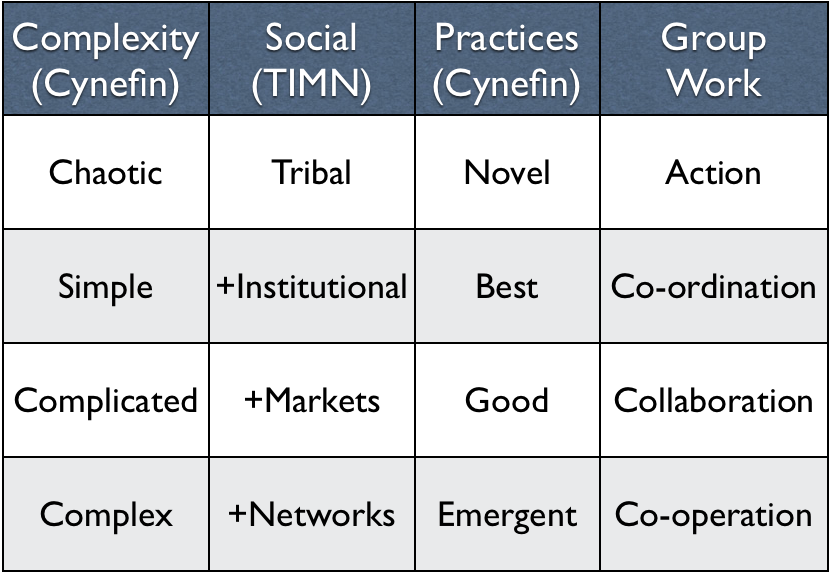
Charles’ C-Curve is a model in practice, based on his experience as CLO of Reuters. I see a parallel between this migration of the L&D department and the social order necessary to do certain types of group work [Refs: CynefinTIMN]

  1. L&D Autonomous = taking action as a Tribe of its own
  2. L&D Aligned with organization = coordinated with the Institution
  3. L&D with governance & guidelines = able to work in a collaborative Market
  4. L&D strategically aligned = a co-operative member of (a) Network(s)

I wondered if tribal organizations may be able to thrive in networks because they are already used to more freedom. I have noticed that it is difficult to convince organizations steeped in the institutional models that the networked model may be better to deal with growing complexity. Also, those who already have to respond to markets may understand the value of networks much better than institutions. Hence the advantage of the private sector in adapting new work models before the public sector.

In organizations and complexity, I discussed three archetypal organizational models and some of their defining characteristics.

Simplicity Complication Complexity
Organizational Theory Knowledge-Based View Learning Organization Value Networks
Attractors Stakeholders (vision) Shareholders (wealth) Clients (service)
Growth Model Internal Mergers & Acquisitions Ecosystem
Knowledge Acquisition Formal Training Performance Support Social
Knowledge Capitalization Best Practices Good Practices Emergent Practices

I’ve combined the C-Curve [X=Autonomy, Y= Strategic Alignment] with the knowledge acquisition models from these three organizational types in the figure below. The question that I ask here is whether it is necessary to follow the curve or if one can leap from Stage 1 to 4.  If not, that means that organizations need to understand and implement something like a human performance technology model for L&D before they can move on to social learning. Perhaps this is why social learning is being resisted or put into a formal training box in many organizations. They have not made the move to Stage 3 (Performance Support) yet. It’s too much of a leap for organizations in Stage 2. On the other hand, social learning is only a short leap for more tribal start-ups that have not developed any structure at all for L&D as they are quite comfortable with autonomy and messy networks. Stage 2 seems like the worst place to be.

The New Social Learning – Review

Let me say just two words about The New Social Learning by Marcia Conner & Tony Bingham – buy it.

OK, that’s for people who want it short and sweet. Let me add a bit of explanation. This book covers not only the why of social media for learning but also the how, with plenty of examples and case studies. Marcia and Tony have mined the collective knowledge of hundreds of specialists and practitioners and blended it all together with their own insight. This is an impressive work and it is just as accessible to the novice as the expert (if there is such a thing in this new field).

The book starts with just enough theory to cover the rationale of why networked learning is so powerful and includes detailed notes and references for those who want to dig further. The companion website offers more information, videos and links. You can also connect via Twitter to @NewSocialLearn. However, there is enough information in the book to get you started, convince your boss, or dig deeper into a particular medium, like micro-sharing or immersive environments.

As they write in the book, the time has come for social learning :

The convergence of three key trends accelerates the need for social learning. Although some of these trends have been observable for decades, their influence compounds.

Three Converging Workplace Trends

  • Expanding opportunities for personal connection.
  • Emerging expectations from shifting workforce demographics
  • Increasing reach of customized technology.

If you liked the ideas discussed in A Framework for Social Learning or The Evolving Social Organization, then The New Social Learning provides greater depth and many resources all under one cover (without the hyperlinks, but that’s the limitation of print). It’s like a snapshot of a field just on the cusp of major growth and publicly perceived relevance. I think that this book will be seen as key to workplace learning, much like Gloria Gery’s Electronic Performance Support Systems (1995); Marc Rosenberg’s e-Learning (2000); and Jay Cross’s Informal Learning (2006). All of these books contribute to the understanding of workplace learning as much more than the delivery of courses.

Being social for learning and performance

Social learning has been a theme here for some time [my first post on the subject in 2005: from e-learning to s-learning]. Recent research by CMU, MIT & Union College shows that being social is also a key to group performance:

That collective intelligence, the researchers believe, stems from how well the group works together. For instance, groups whose members had higher levels of “social sensitivity” were more collectively intelligent. “Social sensitivity has to do with how well group members perceive each other’s emotions,” says Christopher Chabris, a co-author and assistant professor of psychology at Union College in New York.

“Also, in groups where one person dominated, the group was less collectively intelligent than in groups where the conversational turns were more evenly distributed,” adds Woolley. And teams containing more women demonstrated greater social sensitivity and in turn greater collective intelligence compared to teams containing fewer women.

However, many OD, HR and training departments still focus on individual skill development and the perennial favourite, leadership training. How often do people work in total isolation today? Why are skills taught separately from the workplace and co-workers? As for leadership, how can you decontextualize it from the workplace? Easy cookie-cutter solutions, like MBTI for leadership, are mainstream fare, even though MBTI is about as valid as astrology [I’m a reflector, completer finisher, ENTJ, inspirer – what are you?]

In the evolving social organization, we noted how knowledge workers get things done by conversing with peers, customers and partners, as they solve the problems of the day. Learning from these social interactions is a key to business innovation. To participate in their markets, organizations, customers and suppliers need to understand each other and this too, is social. Social learning is how knowledge is created, internalized and shared. It is how knowledge work gets done.

A serious re-focus is needed for organizations to take advantage of social learning in business and professional networks. Everything from team composition, job titles, performance evaluation and training approaches must be examined through the lens of [social] networks. There is solid research in social network analysis, value network analysis and social learning that can inform this shift. But leaders and managers must first put aside their old mental models, and that’s the real challenge.

With my ITA colleagues, we’re trying to start a shift to working smarter in networks, without some fancy, and unnecessary, software platform to enable it. It’s a cultural challenge to change mental models, not a technological one.

Related post: Let’s talk about work

A framework for the social enterprise

I have put together two of the major articles on social learning in the enterprise that were posted here this year. A framework for social learning drew on my collaboration with colleagues at the Internet Time Alliance and the evolving social organization was co-authored by Thierry deBaillon.


Please feel free to share this 18 page white paper as I hope it will encourage more conversations on how we can integrate learning and working, a key part of enabling Enterprise 2.0.

Social Enterprise White Paper (PDF)

Open Innovation

The most interesting presentation at last week’s ACCTCanada Directors Forum was, in my opinion, on open innovation by Angus Livingstone, UILO at UBC. Much of the discussion by other presenters focused on patents and other control mechanisms, while Angus showed the shifting paradigms that we are experiencing in university knowledge transfer. He explained that the main shift over the next five years will be from closed to open innovation, in parallel with shifts from outputs to impacts and from transactions to relationships. Angus highlighted the old paradigm:

  • Patents
  • Licenses
  • Spin-offs
  • Proprietary industry research funding

and showed the new paradigm:

  • Industry engagement
  • Entrepreneurship
  • Knowledge mobilization

Since hearing that presentation and reflecting on the slides that Angus sent me, I came across Ed Morrison’s paper on how regional innovation clusters form. The initial step is to change the conversation.


The shifting conversation then encourages learning networks to develop, from which can emerge a concerted strategy for innovation. Ed calls the underlying activity, strategic doing:

Networks are complex adaptive systems. We can guide these networks, even manage them, if we follow simple rules. And that’s the point. We cannot guide complexity with complexity. Strategy in complex adaptive systems emerges from  following simple disciplines.

Both Angus Livingstone and Ed Morrison show that innovation is dependent on learning in networks. Social learning is about getting things done in networks. It is a constant flow of listening, observing, doing, and sharing. Effective working in networks requires cooperation, meaning there is no fixed plan, structure or direct feedback. Through social learning we can co-develop emergent practices. Social learning is how we move from transactions to relationships and foster knowledge mobilization.

Social learning is not some buzz word from the HR department but is a critical component in fostering innovation and hence prosperity. It’s the ‘how’ of business innovation and is important for decision-makers to not only understand but to embrace by doing. This is why I say that work is learning and learning is the work. Life in perpetual Beta is what every leader and manager needs to understand today.

The Evolving Social Organization

Co-author: Thierry deBaillon@tdebaillon

Simplicity and the Enterprise

Most companies start simple, with a few people gathering together around an idea. For small companies, decision-making, task assignments and direct interaction with clients are rather straightforward.  With growth, the simplicity ends. As every entrepreneur knows, the initial growth of a company is often synonymous with efficiency drops and decreases in profits, since administrative tasks, indirect structural costs and middle-term forecasts add financial and human pressure on early growth.

Overcoming these obstacles is one of the main burdens of start-ups and young businesses. Innovation abounds in the early stages and knowledge capitalization is aided by a common vision of the business. Further growth equates to sustainable efficiencies and market share increases. For decades, organizational growth has been viewed as a positive development, but it has come at a cost.

Complication: the industrial disease

As organizations grow, the original simplicity gets harder to maintain. Current management wisdom – based on Robin Dunbar’s research; the size of military units through history; and the work of management experts such as Tom Peters – considers the ideal size of an organization to be around 150 people. Beyond this size, knowing everybody in person becomes impossible. Intermediate layers of power and delegation begin to develop above 150 people and companies then enter the realm of complication.

Most of today’s larger companies have a complicated structure. To enable growth and efficiencies, more processes are put in place. This is what management schools have been doing for over half a century.  To ensure reliable operations and risk mitigation, the core competencies of decision-making and innovation are moved to the periphery. The company’s vision, if there is one, is now supported at the board level but not the individual level. New layers of control and supervision continue to appear, silos are created, and knowledge acquisition is formalized in an attempt to gain efficiency through specialization.

As companies get even bigger, internal growth and innovation reach a tipping point, and companies rely on mergers and acquisitions to maintain the illusion of  growth. At some stage of complication, companies do not even create jobs anymore. In France, a study from INSEE showed that large organizations have a tendency to destroy internal jobs: by transferring jobs to subsidiaries, contractors and subcontractors. Large firms barely participate in job creation. Similar studies conducted in other countries show the same results. However, knowledge, and the acquisition of new knowledge, are still key factors for innovation and effectiveness. To compensate for its complicated processes, the enterprise attempts to shift to another paradigm, and tries to become a learning organization, putting significant effort into training.

Complexity and the new Enterprise

Today’s large, complicated organizations are now facing increasingly complex business environments that require agility in simultaneously learning and working. Typical strategies of optimizing existing business processes or cost reductions only marginally influence the organization’s effectiveness. Faster evolving markets challenge the organization’s ability to react to customer demand. Decision-making becomes paralyzed by process-based operations and chains of command and control; thereby decreasing agility. Training, as “the” solution to workplace learning needs, fails to deliver and then gets marginalized, often being the first department to have its budget cut.

Many organizations today are also facing significant demographic challenges. Baby boomers, once the lifeblood of business, are retiring, while Generation Y wants to communicate and interact in a completely different manner. There may be four generations in the modern workplace and each has its unique traits and demands. There is growing complexity both inside and outside the organization.

Organizations need to understand complexity, instead of simply increasing complication. This lack of understanding, as well as some existing, but minor, efficiency improvements in tweaking the old system, are the major barriers to adopting Enterprise 2.0 concepts and practices. Companies need to get a clearer view of the competitive advantages of Enterprise 2.0 before an organizational framework like wirearchy can co-exist with hierarchical structures and thinking.

Wirearchy: a dynamic two-flow of power and authority based on knowledge, trust, credibility and a focus on results enabled by people and technology.

Here are some key organizational changes during the journey from simplicity to complexity:

Simplicity
Complication
Complexity
Organizational Theory
Knowledge-Based View Learning Organization Value Networks
Attractors
Stakeholders (vision) Shareholders (wealth) Clients (service)
Growth Model
Internal Mergers & Acquisitions Ecosystem
Knowledge Acquisition
Formal Training Performance Support Social
Knowledge Capitalization
Best Practices Good Practices Emergent Practices

Let’s look at how social learning can support emergent practices in the enterprise:

Implementing Social Learning

Knowledge workers get things done by conversing with peers, customers and partners, as they solve the problems of the day. Learning from these social interactions is a key to business innovation. In a globally networked economy, based increasingly on intangible goods and services, constant innovation is necessary to stand out. Markets such as software, financial services, consulting and consumer goods have to continuously adapt their offers to keep up with changing demands and advances in technology.

Hyper-linked knowledge flows have made organizational walls permeable. Official channels are competing with an expanding number of informal communications. A collaborative enterprise is becoming  the optimal organization for such a networked economy, capitalizing on these expanding knowledge flows. To innovate, organizations need to collaborate internally and this is social. To participate in their markets, organizations, customers and suppliers need to understand each other and this too, is social. Social learning is how knowledge is created, internalized and shared. It is how knowledge work gets done.

In complex environments, learning is much more than just a matter of structured knowledge acquisition. However, that is all that training enables. Corporate training methods often consist of delivering content and perhaps providing drill and practice sometime prior to doing the task. There is often a gap between training and doing. Training alone cannot address the wide variety of informal learning needs of workers. Nor can it help to transfer the tacit knowledge on which many of us depend to do our jobs.

We know that informal learning happens all of the time but often the best answers or experts are not connected to the person with the problem. Social learning networks can address that issue by giving each worker a much larger group of people to help get work done.  Regularly publishing to our networks is how we can stay connected. Here is an approach to embed social learning into organization work flows. This is an iterative process that can be adapted to fit the context.

Listen & Create: Being open to self-education is the foundation of individual learning. Part of this is the development of habits of continuous sense-making by recording what we hear, read and observe; e.g. personal learning environments (PLE) & personal knowledge management (PKM).

Converse: Sharing is an act of learning and can be considered an individual’s responsibility for the greater social learning contract. Without sharing, there is no social learning. Through ongoing trusted conversations we can share tacit knowledge, even across organizational boundaries; e.g. social learning.

Co-create: Group performance enables the creation of new knowledge and is a source of innovation; e.g. collaborative work, customer experience.

Formalize & Share: Some informal knowledge can be made explicit and consolidated through the formalization and creation of new structured knowledge; e.g. taxonomies, document management, storytelling.

Enterprise social learning

Social learning consultant Jane Hart has created a comprehensive, and growing, list of social learning examples in the workplace. Companies listed here include British Telecom, Sun Microsystems, NASA, Nationwide Insurance, and SFR. The SFR case study, reported by Sue Weakes, shows how a younger workforce is demanding better access to social media.

French mobile phone company SFR implemented ActiveNetworker from Jobpartners to support its new social network. My SFR comprises a company blog, a central space for discussion, and the ability to build profiles that allow employees to share information on career progress, learning and development and aspirations. They can also join groups of interest … ActiveNetworker has been well received and SFR is averaging 80,000 visits per week from the 10,000 employees that are using it.

Dave Wilkins at Learn.com, describes the case at ACE Hardware in which the company set up a web-based social learning platform for its 4,600 independent hardware dealers to share and seek advice. They were able to look for new sales leads, find rarely used items through the community and share merchandising display strategies. This social learning community strategy resulted in a 500% return on investment in just six months.

Cristóbal Conde, CEO of SunGard, a software and IT services company, was recently interviewed in the New York Times. He discussed how he has flattened the company’s hierarchy as a way of dealing with the globalization of the company. One important social communication tool at SunGard is Yammer, a micro-blogging platform similar to Twitter but used internally. NYT: “What kind of things do you write on Yammer?”

I try to see a client every day, and because of my title I get to see more senior people. And so then they’ll tell me things — you know, what are their biggest problems, what are their biggest issues, what are their biggest bets. All this information is incredibly valuable. Now, what could I do with that? I’m not going to send that out in a broadcast voice mail to every employee. I’m not even going to write a long e-mail about it to every employee, because even that is almost too formal. But I can write five lines on Yammer, which is about all it takes.

A free flow of information is an incredible tool because I can tell people, “Look, this is one of our largest clients, and the C.E.O. just told me his top three priorities are X, Y and Z. Think about them.”

The Ford Motor Company has used social media for learning, beginning with SyncMyRide, and now integrating it as a way to connect customers and the company.

Ford’s intention is to consider how social media can inform the company as a whole, rather than judging its efforts by the criteria of one department and those “holistic” lessons filter up and down through the company, says Monty [head of social media]y. That includes the company’s executive board and goes as far as putting up senior execs for online Q&As through Twitter and on the corporate Facebook page. “There is a healthy respect for [social media] and how we participate in it. Two-way dialogue is healthy for a company like Ford, and we’ve grown as a result of having participated in it,” says Farley [Chief Communications Officer]. At some point, as executives grow in seniority, they tend to become “isolated from reality,” adds Monty. Making the Ford board aware of and engaged with social conversations counters that isolation. “When [CEO Alan Mulally] says we are making the cars people want, well, how do we know unless we are listening?” asks Monty.

A business imperative

Deloitte’s Shift Index of 2009 highlights the challenges facing several industries today, that of declining return on assets and the need for innovation. One recommendation is to enable knowledge flows, a key benefit of social learning:

Given the growing importance of knowledge flows, perhaps the most powerful form of innovation in this context may be institutional innovation –re-thinking roles and relationships across institutions to better enable them to create and participate in knowledge flows.

One of the great things about web social media is that they are for the most part free. Experimentation does not require an enterprise-wide software deployment strategy at the onset. As Seth Godin, marketing and branding expert, says:

You guessed it: new media is largely free. So why teach it in school as if it were a scary theory? Why encourage people to be afraid? Just do it. Build your own platform. Appear in the places that seem productive or interesting or challenging or fun. Experiment quietly, figure out what works, do it more. No need to be a dilettante, and certainly you shouldn’t spread yourself too thin or quit at the first sign of failure… but… quit waiting for the right answer.

Our social networks have a greater influence on us than we think. Nicholas Christakis & James Fowler explain the latest research in great detail in the book, Connected: The surprising power of our social networks and how they shape our lives (Little-Brown, 2009). Robin Hanson shows that we seldom change our behaviour based solely on getting new information. “People don’t believe something works until they’ve seen it work in something pretty close to their situation. A media story about something far away just doesn’t say much.” Again, social learning is about getting things done in networks.

Getting started

According to Rebecca Ferguson at The Open University, social learning can take place when people:

  • clarify their intention – learning rather than browsing
  • ground their learning – by defining their question or problem
  • engage in focused conversations – increasing their understanding of the available resources.

Following the process explained earlier:

Listen: The first step in social learning is paying attention and watching what others are doing. Finding trusted sources of information is very important. Hearing what others are doing and connecting to them with social media such as Twitter or blogs increases the chances of accidental and serendipitous learning. For example, one can follow conversations on Twitter by searching for “hashtags”. Typing “#PKM” shows current conversations on personal knowledge management.

Converse: By engaging in conversations and providing valuable information to others one becomes part of professional networks. Many experts are willing to help those new to the field but newcomers first must say what they don’t know.

Co-create: Over time one can engage more in co-operative activities, such as adding comments to a blog post or extending the thought in an article or discussion thread. For many people used to traditional work, working transparently in the open takes some time to get to used to.

Formalize & Share: Writing professional journals or lessons learnt can ingrain the important process of formalizing aspects of social learning. Sharing with others, internally or externally, over time becomes part of a normal daily work flow.

As our work environments become more complex due to the speed of information transmission via ubiquitous networks, we need to adopt more flexible and less mechanistic processes to get work done. Workers have many more connections, to information and people, than ever before. But the ability to deal with complexity lies in our minds, not our artificial organizational structures. In order to free our minds for complex work, we need to simplify our organizational structures. According to the authors of Getting to Maybe, in complex environments:

  • Rigid protocols are counter-productive
  • There is an uncertainty of outcomes in much of our work
  • We cannot separate parts from the whole
  • Success is not a fixed address

This is the basis of the evolving social organization.

Some additional thoughts on social learning

Learning Executives Discuss Social Learning at ASTD 2009 (video):

Mike McDermott (T Rowe Price): “I think the impact of social learning will dramatically increase in the future, in a number of ways, both internally with our associates and externally with our clients.”

Karie Willyerd (Sun Microsystems): “we see the death of newspapers … the same thing is going to happen with learning functions and training materials … if we don’t learn how to publish with social media … through social learning.”

Walt McFarland (Booz Allen Hamilton): “The environment is going to demand it [social learning]. The problems are just tougher and they’re too big for any one consultant or any consulting team”

Dave Pollard on bridging generational differences in the workplace:

Our job, as people who appreciate the value and perspective of both generations, and value diversity, is what Nancy White calls “building bridges” — translating Gen Y’s ideas and requests into language “the man” can understand (value creation and ROI), and translating the boss’ and IT’s restrictions into language that Gen Y’ers can understand (the risk of catastrophic financial loss, loss of business reputation, and insolvency). The best way to build these bridges is by telling stories — of history, of unexpected and astonishing success, and of unintended consequences.

Tony Karrer on measurement:

What’s interesting to me is that with eLearning 2.0 or social learning or more specifically with using social tools to do things like have interesting conversations – what I want to measure is really not at all what is learned. I want to measure whether the results produced are better. I am not sure I know what they should have learned at all.

Social media & workplace performance matrix

c4lpt_corporateJane Hart has an excellent resource on Case Studies for Social Media & Learning in the Workplace that she keeps up to date. I’ve looked at it many times and thought that it might be easier to see the big picture as a matrix, which I’ve created as a Google Document.

Feel free to use and improve this spreadsheet. If you do re-post it, please let me know so I can add the link here. Much of the information comes from third-party reports so I cannot attest to its accuracy. Let me know of any errors or omissions and I will address them.

If you would like to edit the Google Doc, or get it as a spreadsheet, please contact me.

PKM: a node in the learning network

Hyperlinks subvert hierarchy, or, in other words, digital networks enable multiple connections, so organizational communications are no longer just vertical. Somebody else, outside the hierarchy, is only one click away, and perhaps easier to deal with and a better source of information and knowledge. This is becoming obvious in the business world and frameworks such as Social CRM (customer relationship management) are one attempt to address it.

Too often we think of learning as school, training as something that is delivered, and complex problems as solvable with enough effort and resources. We are wrong on all three counts.

Social learning is about getting things done in networks. It is a constant flow of listening, observing, doing, and sharing. Effective working in networks requires cooperation, meaning there is no plan, structure or direct feedback. This can scare managers and organizational leaders because no one is in change of social learning and there is no end-state or final learning objective. But social learning in networks can help us deal with complexity by providing a platform to test out ideas and learn from and with each other.

Jane Hart has described five types of learning using social media, the lubricant of learning in digital networks. Then she looked at how they relate to formal/informal learning as well as the spectrum of dependent/independent/interdependent learning.

social pkm

I have circled those activities at the bottom of this grid to show what personal knowledge management (PKM) enables. I have described PKM as our part of the social learning contract and the more I look at implementing social learning, social CRM or social business models, the more convinced I am that PKM is a foundational skill-set.

knowledge-management

Keeping knowledge in our heads is not of much use in getting things done, though that is what most of our training and development efforts have focused on for the past century. Individual training, stemming from the military systems approach to training, addressed skills and knowledge acquisition, as directed by those in change. The organization wanted to drive stuff into our heads.

networks-n-nodes


In networks, though, one of our main jobs now is getting stuff out of our heads and sharing with others.

PKM is focused on accidental, serendipitous, personal-directed, informal, independent learning.

PKM enables group-directed, intra-organizational, interdependent learning.

PKM enriches formal, structured learning and helps learners be less dependent.

PKM is taking control of our learning, as well as making much of it transparent. It makes us a valuable node in our various networks. We share our learning riches without diminishing them. If more people start seeking, sensing & sharing then we’re on the social learning path. Notice how I did not mention that you need some special “social learning” technology platform to do this?

A framework for social learning in the enterprise

A framework for social learning in the enterprise

The social learning revolution has only just begun. Corporations that understand the value of knowledge sharing, teamwork, informal learning and joint problem solving are investing heavily in collaboration technology and are reaping the early rewards.

—Jay Cross

Social learning

Why is social learning important for today’s enterprise?

George Siemens has succinctly explained the importance of social learning in the context of today’s workplace:

There is a growing demand for the ability to connect to others. It is with each other that we can make sense, and this is social. Organizations, in order to function, need to encourage social exchanges and social learning due to faster rates of business and technological changes. Social experience is adaptive by nature and a social learning mindset enables better feedback on environmental changes back to the organization.

The Internet has fundamentally changed how we communicate on a scale as large as the printing press or the advent of written language. Charles Jennings explains why we need to move away from a focus on knowledge transfer and acquisition, an approach rooted in Plato’s academy:

“We are moving to the world of the sons of Socrates, where dialogue and guidance are key competencies. It is a world where the capability to find information and turn it into knowledge at the point-of-need provides the key competitive advantage, where knowing the right people to ask the right questions of is more likely to lead to success than any amount of internally-held knowledge and skill.”

Our relationship with knowledge is changing as our work becomes more intangible and complex. Notice how most value in today’s marketplace is intangible, with Google’s multi-billion dollar valuation an example of value in non-tangible processes that could be deflated with the development of a better search algorithm. Non-physical assets comprise about 80 percent of the value of Standard & Poor’s 500 US companies in leading industries.

From replaceable human resources to dynamic social groups

The manner in which we prepare people for work is based on the Taylorist perspective that there is only one way to do a job and that the person doing the work needs to conform to job requirements [F.W. Taylor, The Principles of Scientific Management, 1911]. Individual training, the core of corporate learning and development, is based on the premise that jobs are constant and those who fill them are interchangeable.

However, when you look at the modern organization, it is moving to a model of constant change, whether through mergers and acquisitions or as quick-start web-enabled networks. For the human resources department, the question becomes one of preparing people for jobs that don’t even exist. For example, the role of online community manager, a fast-growing field today, barely existed five years ago. Individual training for job preparation requires a stable work environment, a luxury no one has any more.

evolution of work

A collective, social learning approach, on the other hand, takes the perspective that learning and work happen as groups and how the group is connected (the network) is more important than any individual node within it.

MIT’s Peter Senge has made some important clarifications on terms we often use in looking at work, job classifications and training to support them.

Knowledge: the capacity for effective action. “Know how” is the only aspect of knowledge that really matters in life.

Practitioner: someone who is accountable for producing results.

Learning may be an individual activity but if it remains within the individual it is of no value whatsoever to the organization. Acting on knowledge, as a practitioner (work performance) is all that matters. So why are organizations in the individual learning (training) business anyway? Individuals should be directing their own learning. Organizations should focus on results.

Individual learning in organizations is basically irrelevant because work is almost never done by one person. All organizational value is created by teams and networks. Furthermore, learning may be generated in teams but even this type of knowledge comes and goes. Learning really spreads through social networks. Social networks are the primary conduit for effective organizational performance. Blocking, or circumventing, social networks slows learning, reduces effectiveness and may in the end kill the organization.

Social learning is how groups work and share knowledge to become better practitioners. Organizations should focus on enabling practitioners to produce results by supporting learning through social networks. The rest is just window dressing. Over a century ago, Charles Darwin helped us understand the importance of adaptation and the concept that those who survive are the ones who most accurately perceive their environment and successfully adapt to it. Cooperating in networks can increase our ability to perceive what is happening.

Making social learning work

Jon Husband’s working definition of “Wirearchy” is “a dynamic two-way flow of power and authority, based on knowledge, trust, credibility and a focus on results, enabled by interconnected people and technology”. We are seeing increasing examples of this on the edges of the modern enterprise. World Blu’s annual listing of our most democratic workplaces continues to grow and gain attention. Google’s dedicated time-off for private projects, given to its engineers, promotes non-directed learning and collaboration. Zappos directly engages with its customers on Twitter, fostering higher levels of two-way trust. As customers, suppliers and competitors become more networked, being more wirearchical will be a business imperative.

Wirearchies inherently require trust, and trusted relationships are powerful allies in getting things done in organizations. Trust is also an essential component of social learning. Just because we have the technical networks does not mean that learning will automatically happen. Communications without trust are just noise, not accepted and never internalized by the recipients.

wirearchy

Here are some ways to make social learning work in the enterprise:

Think and act at a macro level (what to do) and leave the micro (how to do it) to each worker or team. The little stuff is changing too fast.

Engage with Web media and understand how they work. The Web is too important to be left to the information technology department, communications staff or outside vendors.

Use social media to make work easier or more effective. Use them to solve problems for work teams and groups.

Make traditional management obsolete. Teach people how to fish and move on to the next challenge. If the organization is maintaining a steady state then it has failed to evolve with the environment.

Analyzing social learning

Most 20th century workplaces had two types of learning: formal learning through training and informal learning (about 80% according to research) which just happened by accident or the result of observation, conversation and time in the job. This focus on formal training, for skills and knowledge, missed out on our social nature. Business has always been social, especially at the higher levels of management and with ubiquitous access to networks, this is once again part of everyone’s work. In the global village, we are all interconnected.

Jane Hart has shown how social media can be used for workplace learning and that instead of just training, there are five types of learning that should be supported by the organization:

IOL – Intra-Organizational Learning – keeping the organization up to date and up to speed on strategic and other internal initiatives and activities

GDL – Group Directed Learning – groups of individuals working in teams, projects, study groups, etc Even two people working together in a coaching and mentoring capacity

PDL – Personal Directed Learning – individuals organizing and managing their own personal or professional learning

ASL – Accidental & Serendipitous Learning – individuals learning without consciously realizing it (aka incidental or random learning)

FSL – Formal Structured Learning – formal education and training like classes, courses, workshops, etc (both synchronous and asynchronous)

Notice that traditional training (FSL) is only one of the five types. Three of these (IOL, GDL, PDF) require self-direction, and that is the essence of social learning: becoming self-directed learners and workers, all within a two-way flow of power and authority. Social and informal learning are not just feel-good notions, but have a real impact on an increasingly intangible business environment.

Jay Cross has looked at the ways that social learning is becoming real and developed this table to highlight some of the workplace changes he is observing:

get real jaycross

Implementing social learning

social media for learning

The changes in becoming a networked workplace can be further analyzed using Jane Hart’s five ways of using social media for learning in the organization.

ASL – Accidental & Serendipitous Learning: from Stocks to Flow

Learning is conversation and online conversations are an essential component of online learning. Online communication can be divided into Stocks (information that is archived and organized for reference and retrieval) and Flows (timely and engaging conversations between people, including voice or written communications). Blogs allow flow and micro-blogs, like Twitter, enable great flow due to the constraint of 140 characters

The web enables connections, or constant flow, as well as instant access to information, or infinite stock. Stock on the Internet is everywhere and the challenge is to make sense of it through flows of conversation. It is no longer enough to have the book, manual or information, but one must be able to use it in changing contexts. Because of this connectivity, the Web is an environment more suited to just-in-time learning than the outdated course model. ASL is shifting from looking at knowledge as the collection of bits and engaging in the learning flows around us, without any conscious plan. We are working and learning in networks and the only thing a network can do is share.

PDL – Personal Directed Learning: from Clockwork & Predictable to Complexity & Surprising

Complexity, or maybe our appreciation of it, has rendered the world unpredictable, so the orientation of learning is shifting from past (efficiency, best practice) to future (creative response, innovation). Organizing our own learning is necessary for creative work. Workplace learning is morphing from blocks of training followed by working to a merger of work and learning: they are becoming the same thing. Change is continuous, so learning must be continuous. Developing emergent practices, a necessity when there are no best practices in our changing work environments, requires constant personal directed learning.

In complex environments it no longer works to sit back and see what will happen. By the time we realize what’s happening, it will be too late to take action. Accepting surprise is similar to the delight an artist may have on completion of a work and only then see an emergent quality not consciously understood during the process of its creation.

GDL – Group Directed Learning: from Worker Centric to Team Centric

As mentioned earlier, the real work in organizations is done by groups. This means that sending individuals on a training course and then re-integrating to their work group is relatively useless. With work and learning merging in the network, groups need to find ways that support each member’s learning, while engaged in tasks and projects. Tools that can capture activities and keep group members focused should be used to reinforce group learning.

Social learning requires a certain amount of effort to maintain regular contact and association with our colleagues. Developing social learning practices, like keeping a work journal, may be an effort at first but later it’s just part of the work process. Bloggers have learned how powerful a learning medium they have only after blogging for an extended period. With the increased use of distributed work groups, it is even more important to foster social learning and web media are the current tools at hand.

IOL – Intra-Organizational Learning: from Subject Matter Experts to Subject Matter Networks

Mark Oehlert recently coined the term Subject Matter Networks as a new way of finding organizational knowledge. Instead of looking for subject matter experts from which to design training, we should extend knowledge gathering to the entire network of subject-matter expertise. Once again, the emphasis is no longer on the individual node but on the network. Good networks make for effective organizations.

Networked communities are better structures in dealing with complexity, when emerging practices need to be continuously developed and loose ties can help facilitate fast feedback loops without hierarchical intervention. Collaborative groups are better at making decisions and getting things done. The constraints of the group help to achieve defined goals.

Building capabilities from serendipitous to personally-directed and then group-directed learning help to create strong networks for intra-organizational learning. This is exceptionally important because the emerging knowledge-intensive and creative workplace has these attributes:

• Simple work will be automated.
• Complicated work will go to the lowest bidder, as processes & procedures become more defined and job aids more powerful (e.g. mortgage applications).
• Complex work requires creativity and is where the value of the post-industrial organization lies.
• Dealing with Chaos sometimes has be confronted and this requires creativity as well as a sense of adventure to try novel approaches.

FSL – Formal Structured Learning: from Curriculum to Competency

There remains a need for training in the networked workplace but it must move away from a content delivery approach. The content will be out of date before the training is “delivered” (another outdated term). Work competencies will still need to be developed through practice and appropriate feedback (what training does well) but that practice will have to be directly relevant to the individual or group (group training is an area of immense potential growth). Jointly defining work competence with input from individuals, groups and subject matter networks should become the new analysis process, enabled by social media. Think of it as social ADDIE (analysis, design, development, implementation, evaluation) for the complex workplace.

Summary

Our workplaces are becoming interconnected because technology has enabled communication networks on a worldwide scale. This means that systemic changes are sensed almost immediately. Reaction times and feedback loops have to get faster and more effective. We need to know who to ask for advice right now but that requires a level of trust and trusted relationships take time to nurture. Our default action is to turn to our friends and trusted colleagues; those people with whom we’ve shared experiences. Therefore, we need to share more of our work experiences in order to grow those trusted networks. This is social learning and it is critical for networked organizational effectiveness.

Our current models for managing people, training and knowledge-sharing are insufficient for a workplace that demands emergent practices just to keep up. Formal training has only ever addressed 20% of workplace learning and this was acceptable when the work environment was merely complicated. Knowledge workers today need to connect with others to co-solve problems. Sharing tacit knowledge through conversations is an essential component of knowledge work. Social media enable adaptation, and the development of emergent practices, through conversations.

emergent practices

About Internet Time Alliance

Internet Time Alliance helps organizations solve performance problems.

Our toolkit contains collaborative intelligence, network optimization, performance support, informal learning, and a hundred years of practical experience.

Together, we can help you make your workers and partners more proficient, in less time, and often for lower cost.

See what we’re thinking, visit us at the Internet Time Alliance

Jay Cross | Jane Hart | Harold Jarche | Charles Jennings | Clark Quinn

External References

George Siemens http://elearnspace.org/

Social Learning White Paper http://www.entreprisecollaborative.com/

Charles Jennings http://charles-jennings.blogspot.com/

F.W. Taylor: Principles of Scientific Management Wikipedia

Jon Husband: Wirearchy http://www.wirearchy.com/

WorldBlu: Most Democratic Workplaces http://www.worldblu.com/

Jay Cross: Where did the 80% Come From? http://www.informl.com/where-did-the-80-come-from/

Jane Hart: Social Learning Handbook http://www.c4lpt.co.uk/handbook/state.html

Jay Cross: Social Learning Gets Real http://www.internettime.com/2009/11/social-learning-gets-real/

Mark Oehlert: Subject Matter Networks eclippings (learning as art)
Building common ground

The focus of this blog is on learning and working on the web and how work and learning are becoming one in a digitally interconnected world. I believe there is a critical need for new organizational frameworks, such as wirearchy, and a shift from learning as training & schooling to a more agile approach. Evidence that the old management models are no longer effective abound – see The Future of Management or The Future of Work.

Lilia Efimova is looking into Agile software programming teams, where work is geographically distributed and has observed the challenges of communicating without “common ground:

From what we have seen, the communication in distributed teams often shrinks to purely functional and, compared to face-to-face settings, there is much less unstructured informal interactions – this works for getting the work done (at some level), but seriously limits the opportunities to build awareness of the bigger picture and relationships. Most of the solutions in respect to building the common ground in distributed Agile teams still rely on making sure that there are opportunities to visit each other, while there is a lot of space for a technology-mediated ways to do so next to the f2f.

commonground_lilia_efimova

Building common ground at work takes time and many informal interactions, such as those afforded in a shared physical space. For distributed teams to work well, they need to develop common ground through social grooming. My experience in working with distributed groups is that the more effective teams are those who know each other. I will be more forgiving with someone I know through several years of blogging than some new business acquaintance who has just joined the team. After several thousand tweets I have some understanding of people’s sense of humour, and perhaps they understand mine as well.These casual interactions make the leap to collaborative work much easier, as I am experiencing with my Internet Time Alliance colleagues.

For distributed teams, informal social learning has to take place with digitally mediated communications. Allowing, and indeed promoting, casual social media use may actually be good for work and business. Blocking these channels may inhibit the development of common ground.  This is something to consider as more work becomes distributed – break down those firewalls and let workers be people.