Connected leadership is not the status quo

What is connected leadership? It’s not the status quo. Stephen Downes provides a succinct counterpoint to certain popular leadership literature, especially ‘great man’ theories.

‘Leadership’ is the trait people who have been successful ascribe as the reason for their success.
It is one of those properties that appears to be empirically unverifiable and is probably fictional.

As organizations, markets, and society become networked, complexity in all human endeavors increases. There are more variables as a result of more connections. In complex adaptive systems, the relationship between cause and effect can only be known after the fact. This makes traditional planning and control obsolete. Connected organizations must learn how to deal with ambiguity and complexity. Those in positions of leadership have to find ways to nurture creativity and critical thinking. The connected workplace is all about understanding networks, modelling networked learning, and strengthening networks. In networks, anyone can show leadership, not just those appointed by management.

Read more

Leveraging visualization

Stowe Boyd and I had an email conversation a few weeks ago, which is now posted on his Socialogy site:

[Stowe] The thesis of Socialogy is that scientific findings about sociality, social networks, and human cognition are only slowly becoming part of management thinking, and as a result, much of what goes on as established practice in business is actually folklore dressed up as policy. Where do you see the greatest point of leverage in the application of scientific understanding of social connection in business?

[Harold] Cognitive science, anthropology, bioeconomics and other sciences may be the long lever, but visualization [with tools like social network analysis] is the fulcrum to widespread understanding of social connection in business.

As any marketing professional knows, ideas don’t spread themselves, they need to be in a form that first gets the recipient’s attention. Dan Pink talks about this with his six  types of sales pitches, giving the same message in different ways. I have found that the visualization that social network analysis provides can be very powerful, and network thinking can fundamentally change our view of social connection in business. Seeing is believing. Visualizing network relationships can give the initial leverage of getting complex new ideas accepted into general management thinking.

leverageFor example, I once used value network analysis to help a steering group see their internal community of practice in a new light. For the first time, they saw it mapped as a value network, not a hierarchy. They immediately realized that they were pushing solutions instead of listening to their community. This was obvious when all arrows pointed toward the user community, but no tangible or intangible value arrows pointed out. As a result, they decided to change their Charter and develop more network-centric practices. Thinking in terms of networks enabled them to see with new eyes.

HJ-network-map

Map of my LinkedIn connections, by LinkedIn Labs

How to work in the creative economy

Gary Hamel says that we are moving from an Industrial to a Creative Economy, which requires more independent workers with initiative, creativity, and passion.

What other changes will this creative economy drive? I see changes on several levels.

  1. Core ideas about valued work:
    1. from producing tangible goods to intangible services;
    2. from looking for best practices to constantly developing emergent practices;
    3. from standardized jobs to being transparent in changing work practices as one learns while working.
  2. The underlying technology that enables work:
    1. from centralized factories to distributed and dynamic workplaces.
  3. Organizational models to get work done:
    1. from centralized physical workplaces, to decentralized and dynamically changing ones.
  4. Distribution and sharing of knowledge about how work is managed:
    1. from schools of business, removed from the workplace, to communities of professionals learning as they work.
  5. The ideology behind business and work:
    1. from the principles of scientific management based on:
      1. hierarchies
      2. standardized practices
      3. specialized tasks and jobs
      4. planning and control
      5. predominantly extrinsic rewards
    2. to an understanding of complexity and the necessity to continuously Probe-Sense-Respond and engage workers by enabling autonomy, mastery and a sense of purpose.

work is changing

Solo change agents set you free

Here is what Domino’s Pizza learned about implementing personal knowledge management practices, after their recent pilot project:

First, learners want some guidance about the changing boundaries of professional development. Traditional models of learning involve taking a chunk of time to step out of the workplace. PKM makes learning a real-time activity within the flow of work. The company needs to clarify what people are allowed and expected to do in terms of learning during the workday.

Second, information services, particularly information security, needs to be a partner in the effort. The director of information security consulted throughout the effort and attended the workshop, where he was able to offer some valuable insights.

Finally, as learning practitioners, we’re awash in information about social tools and technology-enabled learning. It can be easy to overlook how unfamiliar busy professionals are with some of these technologies—especially in a work context. We need to take the time to help familiarize them with new tools, using practical, realistic examples. – Eric Kammerer

There were three key considerations: 1) how to take control of your professional development; 2) how to do this within a particular organizational structure, and 3) how to do this with the available tools and abilities of users. Unlike PKM at an individual level, in a corporate implementation there needs to be a balance found between organizational objectives and personal ones. In this case, I helped set the stage, provided some initial guidance, and then Eric and his team continued on their journey.

A key difference between a solo change agent and a corporate consultant, is that the former is there to set you free, not chain you to proprietary methods and processes. Had I been working for one of the big name consultancies on this PKM project I would likely have lost my job for not selling an ongoing engagement to my client at Domino’s. Instead, I provided enough support to get them going on their own. I am not selling fish, and I am not teaching people how to fish. I help people learn for themselves how to fish. This is social consulting and it does not scale the way traditional consultancies do. Instead, it grows through transparency, authenticity, results, and especially trust.fishing-nets

I have said before to beware of anyone trying to sell cookie cutter solutions for complex organizational issues. Companies have to do the hard part of organizational change themselves by putting in the effort. As a solo change agent, I can get you started, give coaching and advice, and provide ongoing resources. I cannot do it for you. Domino’s is an excellent example of a company that understands this. Is your company getting the best value from its consultants?

networks are the new companies

Nilofer Merchant wrote in The New How that, “Permission to innovate without asking happens when the strategy is co-owned.” This is a necessity in an economy where the average company lifespan continues to decrease. The company no longer offers the stability it once did as innovation, and resulting business disruption, comes from all corners. Economic value has been redistributed to creative workers, and then diffused through knowledge networks. In an interview with Stowe Boyd, Nilofer succinctly explains several of the pieces that must come together in structuring work in the network era.

“Independent of the term, we all agree value comes from the creative source of a connected human. And to the earlier point, networks are the new companies. Connected individuals can now do what once only large organizations could. That tosses Ronald Coase’s work out the window. And those strategic constructs from the Porter frame of mind that suggest you can have an advantage over time are largely moot because sustainable advantages aren’t so sustainable anymore.” —Socialogy: An Interview with Nilofer Merchant

1) “value comes from the creative source of a connected human”

How can any organization create value if people are not connected? This should be the main concern for any support function within the enterprise. If HR, IT, or L&D departments are not enabling better connections, then they are decreasing business value. Measuring how connected workers are should be a prime indicator of relationship capital.

2) “networks are the new companies”

The biggest impact of this new reality will be on management. Networked workers do not need bosses as work becomes transparent. Inserting managers into a network decreases connections between workers and creates bottlenecks. The relationship between contributors (workers) and coordinators (managers) is flipping. Managers in networks are called assistants.

3) “Connected individuals can now do what once only large organizations could”

The evidence is mounting that work can get done with a minimal amount of managerial friction. Network-centric organizations are smaller than their industrial counterparts. Crowd-sourced funding platforms, like Indiegogo, require less management than traditional investment firms. Network transparency and the ability to connect to anybody, decrease transactional costs.

4) “tosses Ronald Coase’s work out the window”

One of the main criticisms of Coase’s work is also being tossed out the window. “So, a key criticism is that the [Coase] theorem is almost always inapplicable in economic reality, because real-world transaction costs are rarely low enough to allow for efficient bargaining.” —Wikipedia. In the network era, real-world transaction costs diminish. Furthermore, transaction costs between networked individuals are getting to be less than transaction costs inside organizations. Workers today often have faster access to knowledge outside their enterprises. With knowledge work, this begs the question of why we need organizations for anything other than support.

5) “sustainable advantages aren’t so sustainable anymore”

The example of large consulting firms purchasing others in order to create even larger entities shows that these companies are losing their sustainable advantage and taking short-term actions to try to increase value. But as the consulting industry amalgamates and becomes a monoculture, it will be ever more open to diverse and innovative disruption from outside. As Nilofer’s point #1 states, value today comes from connected humans, not monolithic structures.

Structuring for the network era

It’s about networks

It is 2013 and F.W. Taylor’s Principles of Scientific Management (1911) are still the basis for most of our current management systems.

It is only through enforced standardization of  methods, enforced adoption of the best implements and working conditions, and enforced cooperation that this faster work can be assured. And the duty of enforcing the adoption of standards and enforcing this cooperation rests with management alone.

These principles assume that management knows best and that the higher up the hierarchy, the more competent and knowledgeable that person is. Of course, this is wrong. But it is why companies have such great expectations every time a new CEO is hired. We read about these in all the business media, and the cult of the leader helps to sell books, speaking engagements, and training programs. Many large enterprises are still looking for cookie-cutter best practices to save their businesses.

The “principles of networked management” should read more like this:

It is only through innovative and contextual methods, the self-selection of the most appropriate tools and work conditions, and willing cooperation that more productive work can be assured. The duty of being transparent in our work and sharing our knowledge rests with all workers.

Collaboration is not the same as cooperation. Collaboration means working together, with an objective, and usually for a boss. This can work well when the objective is clear and the conditions do not change. Cooperation means sharing and helping others without expectations of direct reciprocation. Cooperation helps to strengthen networks, where there is no central management. In times of rapid change, and decreasing lifespans of companies, cooperation trumps collaboration.

In complex environments, weak hierarchies and strong networks are the best organizing principle. While many organizations today have strong networks, they are too often coupled with strong central control. Letting go of control is necessary for individuals and organizations to thrive in the network era.

It’s about knowledge

Research shows that sharing complex knowledge requires strong interpersonal relationships. But discovering innovative ideas usually comes through loose social ties. Organizations need both, and communities of practice can help to connect tight work teams with loose social networks. Communities of practice can provide a safe space for professionals to share knowledge and challenge each other at the cutting edge of their expertise.

Effective organizational knowledge-sharing for this new world of work needs individuals who are adept at sense-making. One framework for this is personal knowledge management (PKM) because organizations don’t create or manage knowledge, people do.

PKM is a technology-neutral framework to promote common understanding through ongoing conversations. PKM is based on personal practices that are independent from enterprise software. It is a simple framework that needs experimentation and practice to master, but mostly it requires sharing. PKM makes knowledge-sharing a personal responsibility, so that each node contributes to the network. These knowledge networks need trust to function well.

It’s about trust

Solving problems is what most knowledge workers are hired to do. But complex problems usually cannot be solved alone. They require the sharing of tacit knowledge, which is knowledge that cannot easily be put into a manual or procedural guide. Research shows that tacit knowledge flows best in trusted networks. Trust promotes individual autonomy and this becomes a foundation for more open social learning. Without trust, few are willing to share their knowledge. An effective knowledge network also cultivates the diversity and autonomy of each worker.

People naturally like to be helpful and get recognition for their work. But humans need more than extrinsic compensation, as our behaviour on Wikipedia and online social networks proves. For the most part, people like to help others. Cooperation makes for more resilient knowledge networks, which are better for business.

As markets get more complex in the network era, business value is created through innovation. But innovative ideas come through loose social ties and diverse opinions. Organizations therefore need to push work beyond the coordination of tasks, and past collaborative work, in order to improve trusted cooperation amongst peers. Openness improves internal task coordination, so that all problems can be seen. Transparency can improve collaboration to get tasks done better. In such a work environment, trust emerges. With openness and transparency in place, cooperation with more diverse knowledge networks can then lead to real business value.

chance favours the connected companyIt’s about structures

In the network era there is a need to balance structured work and the sharing of complex knowledge with the concurrent requirement for unstructured social networking which can increase innovation through a diversity of ideas. Communities of practice are a middle ground, sometimes inside and sometimes outside the organization, that can link collaboration and cooperation, and help weave the organization and its people into a wirearchy.

Wirearchy – “a dynamic two-way flow of power and authority based on knowledge, trust, credibility and a focus on results, enabled by interconnected people and technology.” – Jon Husband

We know that many jobs today are getting automated or outsourced. The job was the way we structured human work for the past century. We now need to focus on creating more opportunities for creative work. For institutions, employers, educators and workers, that means giving up control and co-creating a new social contract for a networked economy. It starts with understanding networks, then sharing our knowledge in trusted networks, in order to build the necessary structures for the network era.

Old dogs, new tricks

Senior folks have seen technology hucksterism too many times before to fall for hard sell, but equally more and more of them are becoming aware that, partly thanks to the internet, things are changing as never before. They know that they need to get their heads around what is happening — even if they decide that active engagement in it isn’t right for them or their organisations. —Euan Semple

After a presentation to the Conference Board of Canada’s HR Executives Forum, a senior VP told me that there was no way some kid was going to advise him on social media. However, he was willing to listen to me, as I was in my fifties, seemed to understand his situation, and didn’t make him feel uncomfortable. I think there is a great need to teach old dogs new tricks, especially senior managers and executives — my generation.

For example, the project leader for a client of mine was suddenly laid off, after 15 years in the same job. His professional network consisted almost entirely of people in that company. They were mostly useless in helping him find new work. A new LinkedIn profile, created the day someone needs to find work is like seeing a deer caught in the headlights. The sad part is that many salaried professionals think that social networks have no value other than looking for new work.

I have spoken at various venues and always come across people who do not see any reason to adapt to the network era. I am also seeing people who desperately jump on some social media platform because everyone else is doing so. But merely having a LinkedIn profile does not make you a networked professional. As Céline Schillinger recently remarked, “if you cannot find a community of practice for your professional development, then create one”.

Here’s the new trick for old dogs: you have to take some control in this networked, do-it-yourself, world. The good news is that you don’t have to do it alone. There are plenty of communities and networks to engage with, but creating a profile and waiting to see what happens is not engagement.

dogs_playing_pokerAs a single node in a network, you have to show that you are of some value. This means contributing your knowledge, in whatever form you like. I have suggested 14 ways to add value and 10 ways to share for starters. If you do not share, you will not benefit from a knowledge network or community of practice. But knowledge sharing requires practice, like working out loud or narrating your work.

The trick for old dogs is to find some way to practice these new skills. It may be difficult to do this at work, especially for those in positions of authority. But these skills can be developed outside the workplace as well. Take a hobby or interest and find networks where others share their passions. It could be finding wine lovers on Twitter, Facebook, or a more niche network. While it may take thousands of hours to master a skill, basic competence can be developed fairly quickly. I have seen people become adept at Twitter for professional knowledge-sharing within a few months.

I offer coaching and more structured workshops to show that even we old dogs can learn new tricks. As I look back on my own learning, I note that I took my first computer programming course in 1978 and swore I would never touch a computer again for as long as I lived. Over time, we learn not to say things like that.

Lateral Organizations

Hierarchical organizational forms have been the norm through much of history, especially the last 2,000 years. Lateral organizations, or more egalitarian structures, have been the exception. In the endless allure of non-hierarchical organizations, David Creelman notes that both forms have their flaws, but says it’s best to thoroughly understand the history of the field.

I once asked Dr. Ed Lawler, an expert on the high-involvement form [lateral organization], why it had not become the dominant type of organization. He speculated that it was a fragile form. It needs trust and a strong culture to work. Any crisis can knock a lateral high-involvement firm back into hierarchical mode. Lateral may be better, but if it is inherently unstable we cannot expect it to become the norm.

Trust is something we don’t see a lot of in our current organizational forms, with many examples cited in the hard costs of low trust:

According to The Economist Intelligence Unit (2010), 84% of senior leaders say disengaged employees are considered one of the biggest threats facing their business. However, only 12% of them reported doing anything about this problem.

Jon Husband’s wirearchy framework has influenced me over the years and I think the game-changer today is the Internet. It brings back the intimacy and connections we had in earlier organizational forms. For example, hunter-gatherer societies were relatively small, and many actively practiced ways of deflating egos and bullies, which enabled trust and a stronger egalitarian culture. They could control this culture within their geographic bounds. This became more difficult in larger societies.

If you observe organizations from a TIMN (Tribal, Institutional, Market, Network) perspective, then looking back at the dominant structures in a T+I+M society, which we have had for many years, may not give much insight. If we are heading toward a quadriform T+I+M+N society, then we may want to adjust our assumptions of what can work and what is now practical. Here is  a quick overview of David Ronfeldt’s TIMN framework:

According to my review of history and theory, four forms of organization — and evidently only four — lie behind the governance and evolution of all societies across the ages:

  • The tribal form was the first to emerge and mature, beginning thousands of years ago. Its main dynamic is kinship, which gives people a distinct sense of identity and belonging — the basic elements of culture, as manifested still today in matters ranging from nationalism to fan clubs.

  • The institutional form was the second to emerge. Emphasizing hierarchy, it led to the development of the state and the military, as epitomized initially by the Roman Empire, not to mention the Catholic papacy and other corporate enterprises.

  • The market form, the third form of organization to take hold, enables people to excel at openly competitive, free, and fair economic exchanges. Although present in ancient times, it did not gain sway until the 19th century, at first mainly in England.

  • The network form, the fourth to mature, serves to connect dispersed groups and individuals so that they may coordinate and act conjointly. Enabled by the digital information-technology revolution, this form is only now coming into its own, so far strengthening civil society more than other realms.

TIMN by David RonfeldtThere are growing examples of new organizational forms testing themselves in the network (TIMN) era (e.g. Automattic; Occupy Movement; Arab Spring). I think there is a lot more testing to do, but we should keep on trying. If not, we will have sub-optimal structures for the challenges that face us as a networked society.

Warren Bennis wrote that hierarchy is a prosthesis for trust. With more lateral organizational structures, trust can emerge.

effective networks are open

the social imperative

Dr. Robert Sapolski has been studying baboons for thirty years. While many researchers took for granted the hierarchical nature of baboon life, with dominant males attacking those next down the social ladder and then the process repeating itself down to infants and females, Sapolski did not. One thing his research showed was that the baboons on top were less stressed (lower stress hormones) and had lower blood pressure than those lower down the social ladder.

But then a most interesting event occurred with a certain troop that Sapolski was observing. The baboons started feeding from a garbage dump and many became infected with tuberculosis. Nearly half the males in the troop died, mostly the aggressive and non-social ones. Every alpha male was gone! As a result, the atmosphere of the troop changed and became much less aggressive and more social. Not only that, but any new males who joined the troop were discouraged from being aggressive and adopted more pro-social behaviours within six months.

In this more social and less hierarchical environment, the troop as a whole became healthier and less stressed. It is currently thriving. The fundamental lesson that Sopolski came back with was that “textbook social systems that are engraved in stone” can be changed in one single generation. There may be hope for the human race, it seems.

Recent research shows that evolution is on the side of those who cooperate.

“We found evolution will punish you if you’re selfish and mean. For a short time and against a specific set of opponents, some selfish organisms may come out ahead. But selfishness isn’t evolutionarily sustainable.”

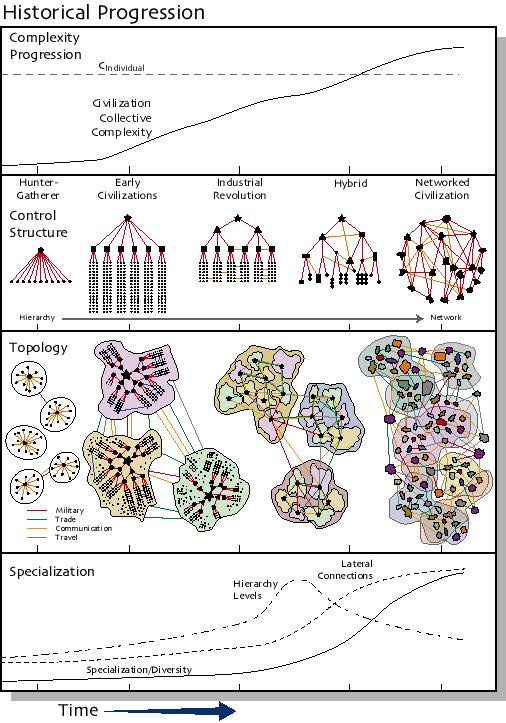
The natural world is composed of complex systems and it makes sense that the best strategies for any population are ones that take complexity into account. This is a limitation of hierarchical organizational models. They cannot address large-scale levels of complexity, as explained in Complexity Rising, a 1997 paper on complexity profiles.

“In summary, the complexity of the collective behavior must be smaller than the complexity of the controlling individual. A group of individuals whose collective behavior is controlled by a single individual cannot behave in a more complex way than the individual who is exercising the control. Hierarchical control structures are symptomatic of collective behavior that is no more complex than one individual. Comparing an individual human being with the hierarchy as an entirety, the hierarchy amplifies the scale of the behavior of an individual, but does not increase its complexity.”

As Yaneer Bar-Yam explains in Complexity Rising, hierarchies have diminishing usefulness as complexity increases.

“At the point at which the collective complexity reaches the complexity of an individual, the process of complexity increase encounters the limitations of hierarchical structures. Hierarchical structures are not able to provide a higher complexity and must give way to structures that are dominated by lateral interactions.”

rp_historical-progression.jpg
Image: Complexity Rising, UNESCO

Many of these lateral interactions are what we would call social relationships. They are outside the official hierarchy. As Verna Allee has noted, for complex environments, or ‘un order’, we need stronger networks and looser hierarchies. But most of our organizations are designed for ‘complicated order’ only. Or you could say that we need more lateral interactions.

Better social relationships (non-hierarchical and not based on the dominance of others) can make for healthier populations. In addition, networks are the only way our collective intelligence can be used to address increasing complexity. Becoming more social is not just a business driver but also a societal imperative.

rp_cynefin-networks-verna-allee.jpg
Image: Verna Allee

Preparing for the network era workplace

My presentation at the Learning Technologies Summer Forum in London two weeks ago concluded with the advice to help people be more explicit in their work. Leading up to that conclusion, I showed how the nature of work is changing. We are moving into a creative economy, as Gary Hamel says. Customized work, with high task variety, is becoming the norm. Routine work is being replaced by software and robots. Formal instruction cannot keep up with workplace needs, so there is an increasing requirement to support informal learning and the sharing of implicit knowledge. Finally, much of what we produce at work today is intangible.

Here is the video recording: enterprise social technologies, learning & performance