Scaffolding and capability building

Jane Hart’s recent post on changing the role of L&D (learning & development) explains how training departments need to move beyond packaging content and toward scaffolding and capability building.

What I like about this matrix is that it makes it easier to describe my professional services in the organizational learning area. I have highlighted my areas of focus in red. The rest is not really my business, as there are plenty of companies that do that. I used to say I did ABC Learning [Anything But Courses]. Jane’s graphic makes it  much more clear, and it’s what our new Connected Worker site is all about.
scaffolding

It’s the worldview, stupid

I have written on various topics on this blog over the years. For example, I believe that it is only by working (and learning) interdependently, retaining our autonomy, co-developing our mastery and feeling a shared sense of purpose that we will be truly motivated. Imagine my surprise when I watched the movie, Crossroads: Labor pains of a new worldview, when it began with interdependence and then went on to discuss recent mass, decentralized, social world events; the need for cooperation; the Stanford Prison Experiment; and how our social networks influence our behaviour.

This documentary clearly shows that if we change our worldview, we can change the future, for good. However, institutional, business, and political leaders are too committed to the status quo. Meanwhile, the global poor are too busy surviving. That leaves those in the middle, and I would surmise that would be most of the people reading this blog. It’s up to us. As noted in the video, research shows that it only takes 10% of a population to spread an idea. If you understand that we are all connected and that only together will we get ourselves out of the messes we have created, then this video is for you.

Watching this movie was like seeing many of my thoughts put together in a single narrative. I have seen several future-looking videos in recent years but this one really covers the complexities of our current situation. It is worth the one hour of your time. I strongly recommend it. Changing our worldview will be a process of social learning.

VideoCrossroads: Labor Pains of a new worldview

Social Learning in Business

Social learning is how work gets done in the network era. But what does that really mean?

Our dominant frameworks for structuring work are currently hierarchical structures, like corporations and bureaucracies. But these structures are failing us, as the world gets so networked that traditional command & control structures cannot deal with the rapid change and increasing complexity. As Umair Haque asked last year, “Name a ‘working’ institution. Just one. Better yet, define a ‘working’ institution. See the problem? ”

Because of powerful software and cheap worldwide  communications, routine work is getting automated and outsourced. Routine means work that can be standardized, and that applies to any work that can have a ‘job description’. Here are some examples:

– get ready to lose your job

– recession & technology kill middle class jobs

– job commoditization

If routine and standardized jobs are relics of the past, what can we do now to ensure that we have meaningful work?

The answer lies in our networks. Knowledge networks are like the paradox of life; the more you give, the more you get. If you don’t engage, you get nothing.

“We learned that individual expertise did not distinguish people as high performers. What distinguished high performers were larger and more diversified personal networks.”  —Rob Cross, et al

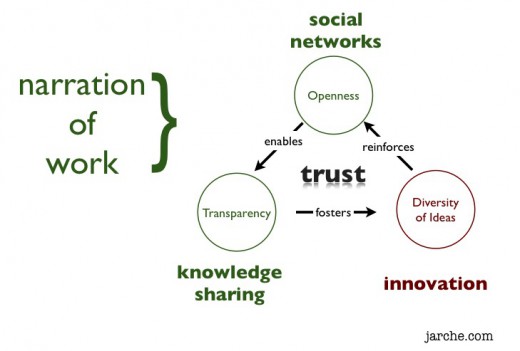
In knowledge networks, openness enables transparency, which fosters a diversity of ideas. Diversity is essential for innovation, and innovation drives business success.

“We need input from people with a diversity of viewpoints to help generate innovative new ideas. If our circle of connections grow too small, or if everyone in it starts thinking the same way, we’ll stop generating new ideas.” —Tim Kastelle

Social learning is how work gets done in the Internet age. As John Kelldon observed, “In a network, one of the few things that scales really well is social learning.” It’s the secret sauce for organizational success today, increasing return on engagement for both employees and customers.

On March 1st, I will start my last workshop of our series at the Social Learning Centre, on Social Learning in Business. It is based on my work over the past few years, with both large organizations and free agents around the world. The focus will be on understanding networks and how social learning is the lubricant that helps intangible capital flow. In a world where intangibles drive the economy, we need practical ways to work in this fuzzy space.

Jay Deragon says that, “Work is a by-product of intangible capital that creates tangible results beyond expectations.” Intangible capital, unlike tangible capital, cannot be stored, moved, or transferred. It needs the constant involvement of people and their complex relationships. Supporting social learning is essential for organizations today. Understanding social learning is critical for managers. Practising social learning is important for all of us.

Social learning is how work gets redesigned in the network era

Jon Husband referred me to a 2005 paper by Martin Weisbord, Techniques to Match our Values (PDF) that discusses the shifts in approaches to work design over the past century, from scientific management, to socio-technical redesign, to “whole system in a room”. The paper is a must-read for anyone involved in organizational design & development. Weisbord shows that even large group, participatory redesign efforts may not be good enough to deal with the rapid environmental changes all organizations face today in a networked world.

No matter what strategies we choose, if we organization designers want job satisfaction, we still are stuck with finding techniques equal to our values. Techniques cascade down the generations like Niagara Falls. Values move like glaciers. Techniques fill whole bookshelves. Values take up hardly space room at all. I can still say mine in eight words: Productive workplaces that foster dignity, meaning and community.

In the intervening years since Weisbord wrote this paper describing his whole system in a room technique,  there has been one major change – the room is virtual and it is almost immeasurable. This change has the potential to involve everyone in the constant process of organizational redesign. Social learning can help organizations address rapid and constant organizational change, and get people committed. As Weisbord states, “Nobody has yet figured out how to commit people to organizational designs, even very good ones, over which they have no influence.” Social learning, facilitated by transparency, work narration and shared power, keeps everyone involved in organizational redesign, through ongoing conversations. John Kellden clearly shows the value of social learning, in The 11 Conversations: it’s return on engagement.

11 conversations by John Kellden

Weisbord’s conclusion tells us that we have to work on these things together.

I can tell you right now, though, what the future holds: unpredictable change. All we have to work with is our own experience . The learning curve belongs to all of us.

But for once, we have the technologies that can help enable this.

social learning is how work gets doneSocial learning is also how work gets redesigned in the network era.

Collaboration is a means not an end

Collaboration Isn’t Working: What We Have Here is a Chasm writes Deb Lavoy in CMS Wire.

Why do teams fail to act the way we think they will? Are we oversimplifying the notion of team? What about organizations? Where is the deeper insight on the relationship between teams and organizations? Why isn’t a sophisticated vocabulary breaking out? Why do we not yet have 100 words for different kinds of collaboration and teams, as expert in it as we think Eskimos are about snow? What is the difference between an intranet, a community and a team?

My immediate response was to say to myself, why of course it isn’t working, based on my own observations and client experiences. Collaboration is only part of the solution to building social or open businesses. I have looked at the two types of behaviours necessary in a social enterprise: collaboration and cooperation. Cooperation differs from collaboration in that it is sharing freely without any expectation of reciprocation or reward. Try to get people to openly cooperate in most businesses and they will be reprimanded for not being focused on their jobs, the bottom line, or shareholder value. However, cooperation contributes to the REAL bottom line: the entire business ecosystem.

One other necessary change in becoming a real social business is much more difficult. Both Don Tapscott (via Ross Dawson) and I see certain principles necessary for open networked business.  Transparency, Collaboration, Sharing, and Narration are all relatively easy. Empowerment, or distributed power, is rarely, if ever, discussed when it comes to social business. It’s the big gorilla in the room that can scare owners, executives, and managers senseless. But we have the technology to move away from command & control, because, as Gwynne Dyer clearly shows, “Tyranny was the solution to what was essentially a communications problem.” We no longer have that communications problem in business.

Social business lacks overarching principles. Social business is a means to an end, not an end in itself. For me the objective is clearly the democratization of the workplace. Many business leaders shirk away from such thoughts. Wirearchy, as Deb notes, is an excellent example of such a principle [notice the bit about “power & authority”]. It sounds more like a democracy than a well-oiled industrial business machine.

“Wirearchy: a dynamic flow of power and authority based on trust, knowledge, credibility and a focus on results enabled by interconnected people and technology.”

wirearchy

Vendors of collaboration platforms are selling tools that can enable a more democratic workplace, but most clients don’t want that, so vendors don’t mention it. Business just wants more efficient and effective work. Networks, by their very nature, subvert hierarchies, whether those in charge like it or not. But hyper-connected work environments require different operating principles. That’s the big shift that has happened over the past two decades. It’s becoming much more obvious now because people outside the business structures are seeing the value of cooperation in a networked world; Wikipedia being the best-known example. Many in business still need to wake up to the notion of cooperating with your environment, your customers, your suppliers, and especially your workers.

Until workplaces becomes more cooperative, enterprise collaboration software will amount to very little. Social business is just a hollow shell without democracy (I wrote that a year ago and little has changed). Businesses can harness the powers of knowledge networks by promoting cooperative behaviours, within an overarching organizing principle like Wirearchy. While it’s not about the technology, the technology has changed everything. I cannot see any other way that businesses will remain relevant in a networked world other than by becoming more open, and democratic.

Create conversation spaces

Curation is more than integration, writes Rick Segal in Forbes [via Robin Good]. Segal discusses how marketing is about curating all the conversations around a subject.

In truth, curation has more to do with the multi-participant communications flowing in the stream of social media conversation …

Now, marketing communications must be framed by the conversation, and not just by the marketer, but by all the parties to the conversation …

A conversation is not like an exhibit hall. It’s physical boundaries are potentially limitless, though most can and will exhaust in time. The membership of a conversation is certainly not always well-controlled. A new meme or raconteur can abscond with it, if we’re not careful. Not everything that shows up belongs. But the great curator, like the great raconteur, is always two or three stories or anecdotes ahead of the rest of the table.

Now think of this from a workplace performance perspective. Solving complex problems also requires “multi-participant communications”. In the network age, learning is conversation. But aren’t training courses more like “exhibit halls”? They are prepared in advance, checked for quality control, and delivered with the best look & feel. Conversations are messier with ill-defined boundaries; just like work and just like life.

Informal Learning Conversations

Personal knowledge management is akin to pre-curation. If we look at workplace performance support as curation, then creating spaces for conversation would be an obvious component. Getting all the necessary parties involved in workplace conversations can enhance knowledge-sharing and contribute to greater diversity of ideas, a necessity for innovation. I think training & organizational development can learn a lot from marketing, but of course I’ve said that before.

Competitive knowledge

Knowledge itself is not a great business advantage, and if it were, academic institutions would be running circles around the Fortune 100. It’s what gets done with the knowledge that matters. But there still needs to be a good flow of information and ideas that get tested out in the specific context of the organization, such as its markets and the technology available. Nick Milton describes four types of organizational knowledge: Core, Non-core, New, & Competitive. Moving competitive knowledge into core knowledge is a key part of this flow.

Competitive knowledge. These are areas of new evolving knowledge that the company knows a lot about. This knowledge may well give them a competitive advantage – the first learner advantage. In areas of evolving knowledge, the company that learns the best and learns the fastest, has the potential to outperform its rivals.  The KM focus for competitive knowledge is on the development of best practice. As this knowledge is being applied around the business, there needs to be a continuous capture of knowledge from practice, comparing of knowledge through communities of practice, and development of best practice. Ownership of competitive competence probably lies with the communities and networks.

I have mapped Nick’s Boston Square to the coherent organization to show how communities of practice provide the link between social networks and enterprise work teams to filter new knowledge and find competitive knowledge.

competitive knowledge

One challenge of finding new knowledge is that social networks are comprised mostly of non-core knowledge. There is often more noise than signal. However, given their diversity, social networks are where we can find innovative ideas. This is why curation and PKM skills are so important for organizations today. Testing new knowledge is where communities of practice can be handy. Gaining competitive knowledge is the obvious ROI for fostering internal and external communities of practice.

So here is a clear value proposition. Communities of practice act as filters of new knowledge in order to find competitive knowledge for your organization. People who understand the context of the work teams must participate in communities of practice, as only they can identify what new knowledge could be competitive. That means that those doing the work need time and support to get away from their teams and see the bigger picture. Does your organization provide this time, or is everyone too busy focused on managing core knowledge? The implications of myopic work practices are quite obvious.

Ensuring knowledge flow through narration

Can the training department, or learning & development, directly contribute to innovation, or are they merely bystanders? Enabling the narration of work is one area where they can help. When it comes down to it, much of learning is conversation. Organizational learning is no longer about courses, which are artifacts of a time when information was scarce and connections were few, because that era is over. Work narration already happens outside the organization, and it’s time to bring it inside.

As with knowledge artisans, many learners now own their knowledge-sharing networks. Today, content capture and creation tools let people tell their own stories and weave these together to share in their networks. Narrating one’s work has been done by coders and programmers for decades, as they “learn out loud.” What started as forums and wikis quickly evolved into more robust networks and communities. Programmers who share their work process and solutions in public are building a resource for other programmers looking to do the same type of work. This makes the whole programming environment smarter. Organizations can do the same.

The public narration of what we do, attempt, and learn on a daily basis not only helps us help others, but also puts us in a position to get help from peers. When your co-workers know what you’re working on and what problems you’ve run into, they can offer their experience. Since few people work in the same room as all their co-workers, they rely on online networks to offer them a common space to find and offer work narration.

Narration helps everyone get smarter. John Stepper says that everyone should work and learn out loud. If you’re confused about what to write, John suggests posting about what you’re working on every day, who you’re meeting with, the research you’re doing, the articles you find relevant, lessons you learned and mistakes you made. These insights are valuable to people trying to train or help co-workers. He also recommends creating short posts that are easy-to-skim; as they make this kind of narration practical for both the author and the audience.

Narration is turning one’s tacit knowledge — what you know — into explicit knowledge — what you can share. Developing good narration skills takes time and practice. Just adding finished reports to a knowledge base does not help others understand how that report was developed. This is where online activity streams and micro-blogging have helped organizational learning. People can see the flow of work in small bits of conversation that, over time, become patterns. Narration of work is the first step in integrating learning into the workflow.

Organizational sense-making can be looked at as either stock or flow. Stock is organized for reference and does not change frequently. Courses are stock. Flow is timely and engaging. Narration of work in social networks is flow. With access to more knowledge flow, via social technologies, highly networked workers can have broader, deeper and richer learning experiences than any instructional designer could ever create in advance.

A worker today can ask questions to a worldwide support network on a platform like Twitter and get an answer in minutes. Deeper questions can be addressed on a service like Quora, where responses get voted on by the community. Many experts worldwide are now narrating their work and making it freely available on the Internet. A new form of distributed cognitive apprenticeship is available, and knowledge workers are taking advantage of this.

In knowledge networks, openness enables transparency, which fosters a diversity of ideas, which in turn reinforces the need for openness. This can be implemented through the use of social networks which can improve knowledge-sharing which fosters innovation, the bottom line for any organization in the network age. The narration of work, is basically knowledge sharing on a regular basis. It’s the raw material of knowledge sharing. It’s not content delivery (stock) that training departments should be focused on but the narration of work (flow).
narration

Training departments should put a major emphasis on learning flow. Stories are an excellent example of learning flow. For millennia, we have learned through stories. This is how gamers and hackers, the digital pioneers, have learned how to learn without curriculum, courses, or instructors:

  • They share their stories.
  • They know there is no user manual.
  • They embrace the flow.

Here is how to ensure knowledge flow through enterprise and external social networks:

  • Capture as much as possible and create digital artifacts.
  • Share as much as possible. Make it the default action by offering entrance into social networks to everyone. [e.g. feed readers, social bookmarks, blogs, photos, videos, social networks, activity streams].
  • Keep everything open and transparent [do not create “walled gardens”]; the key to useful information is being able to find it.
  • Support easy-to-make connections; between people, and with digital resources.

To learn more about narration and other open business practices, join my Learning in Social Business workshop, starting on March 1st.

Learning subverts business entropy

When Harold Jarche says work is learning and learning is the work, I think he’s suggesting that for a business to thrive, it must place learning at the heart of everything it does. Purposeful learning. Learning that is not “training” as we have visioned it up till now. Any training that is disconnected from the people is not sufficient. Learning that is not about the work is not sufficient. Real 21st century learning must change how we think, behave and interact with each other, as well as what we know. It must be relevant to purpose, activity and relationships. Not just one of those: all three. A business, which is a living system, requires relevant learning in order to subvert that thing which happens to all living systems: entropy. John Wenger: A Matter of Life and Death

Why do I say that work is learning and learning is the work? Because it’s been obvious to me for a long time that learning is THE critical business skill, whether you work for others or yourself. By learning, I do not mean education, or the ability to get good marks in class. Here is an update of my pitch on why I think learning is so integral to working today.

How work gets done in the network era:

  1. our increasing interconnectedness illuminates the complexity of our work environments
  2. simple work keeps getting automated
  3. complicated work usually gets outsourced
  4. complex work gives unique business advantages, while creative work finds new opportunities
  5. complex work is difficult to copy & creative work constantly changes:
    both require greater tacit knowledge
  6. tacit knowledge is best developed through conversations and social relationships
  7. social learning networks enable better and faster knowledge feedback loops
  8. but hierarchies constrain social interactions … so traditional management models must change
  9. learning amongst ourselves is the real work in business today … so management’s job is to support social learning
  10. social learning is how work gets done in the network era

Cooperating in the open

I’ve been thinking about collaboration and cooperation a lot lately. I see PKM as mostly comprising cooperative behaviours, as well as being self-serving (in the good sense). With cooperation, there is often no direct feedback on behaviour. Feedback emerges from the network through time. The image below is based on a previous post on tools & competencies for the social enterprise.

Cooperation is for the long term, while collaboration is usually bound by time, such as one’s career, a job, or a project. This difference is perhaps why I have been avoiding many online community invitations. These communities are often nothing more than a bounded social network. Google Plus communities are an example. If I want to cooperate, then the most porous and least bounded social network is the best for me. This is what my blog (open to anyone) or Twitter (public stream as default) help me do. If I wish to be bounded through membership in a community then I need a reason to do so. A project is a good reason. I belong to several collaborative online project-based communities, as well as few private communities.

This brings me to a simple way to decide if I want to join an online community. If it does not have a stated expiration date, objective, or end point, then I won’t join. I will keep my cooperation open, not within a walled garden. If I want to collaborate to get something done, then a walled garden, with some end in sight, makes sense.

I think one of the problems today is that many online social networks are trying to be communities of practice. But to be a community of practice, there has to be something to practice. One social network, mine, is enough for me. How I manage the connections is also up to me. In some cases I will follow a blogger, in others I will connect via LinkedIn or Twitter, but from my perspective it is one network, with varying types of connections. Jumping into someone else’s bounded social network/community only makes sense if I have an objective. If not, I’ll keep cooperating out in the open.