Learning is the work

continued from Why do I need KM?

Work is learning and learning is the work.

Why?

Because the nature of work is changing. For example, automation is replacing most routine work. That leaves customized work, which requires initiative, creativity and passion. Valued work, and the environments in which it takes place, is becoming more complex. Professionals today are doing work that cannot be easily standardized.

In complexity, we can determine the relationship between cause and effect only in retrospect. Think about that. It puts into question most of our management frameworks that require detailed analysis before we take action. It also shows that identifying and copying best practices is pretty well useless.

In complex work environments, the optimal way to do work is to constantly probe the environment and test emergent practices. This requires an engaged and empowered workforce. Emergent practices are dependent on the cooperation of all workers (and management) as well as the free flow of knowledge.

future jobs work valueWork in complex situations requires a greater percentage of implicit knowledge, which cannot be easily codified. Research shows that sharing complex knowledge requires strong interpersonal relationships. But discovering innovative ideas usually comes through loose social ties. Organizations need both, and communities of practice can help to connect tight work teams with loose social networks. Communities of practice can provide a safe space for professionals to challenge each other at the cutting edge of their expertise.

Effective organizational knowledge-sharing for this new world of work needs individuals who are adept at sense-making. One framework for this is personal knowledge management.

PKM is a set of processes, individually constructed, to help each of us make sense of our world, and work more effectively.

Personal = according to one’s abilities, interests & motivation
(not directed by external forces).

Knowledge = connecting information to experience
(know what, know who, know how).

Mastery = getting things done
(not being managed).

PKM connects work and learning, guided by three principles:

  • Seek playfully to connect.
  • Make sense and be empowered through learning.
  • Share to inspire through your work.

PKM is individuals sense-making and sharing their knowledge.

curation to socialThe future of work is customized, complex, and intangible. In this environment, sense-making and knowledge-sharing become critical skills. This will be in our teams, communities, and networks; but mostly it will be individual workers engaged in all three at once.

The most effective learning in the new world of work will be when engaged individuals, working out loud, share their knowledge. Training and education will remain inputs, but minor ones. One concrete result of this sense-making and knowledge-sharing should be performance support. As people work out loud, they can identify and develop tools and techniques to support emergent practices. In the 70:20:10 Framework, Charles Jennings describes workplace learning as based on four key activities:

  1. Exposure to new and rich experiences.
  2. The opportunity to practice.
  3. Engaging in conversation and exchanges with each other.
  4. Making time to reflect on new observations, information, experiences, etc.

This is where learning is the work.

70-20-10

Make it relevant

John Stepper describes his recent experiences in discussing working out loud in Berlin. The recommendations are those many of us are familiar with:

  1. Make it simple. Just changing someone’s home page can make the platform seem much more accessible. And curated suggestions of people, groups, and content relevant to a person’s division and location make the value more apparent.

  2. Start small. Create situations – such as town halls and other events – where people can find material or ask a question and feel the benefits themselves.

  3. Make it safe. Give every team a private online space to make posting seem less risky.

  4. Leverage social influence. Spend more effort on getting influential people, especially senior management, to model the behavior.

  5. Make it relevant. Provide more content and more integration with daily processes so it’s part of the daily work and not yet another thing to do.

The first four are pretty typical of any change initiative: start simple, small, safe & social. I have done this with clients, and these are usually good ways to get going, especially on limited budgets and competing priorities. I would like to focus on the fifth point: relevance. This is what makes a new change initiative become a different way of doing things all the time.

This is where KM, L&D, OD and many other projects break down. It’s also where enterprise software initiatives can fail. They are not relevant to the daily work being done because the change project never really looked at that.

working out loudThink about the term, “working out loud”. It’s what I call narration of work. The primary focus is on work. You don’t work out loud in a classroom because it’s not “work”. You don’t work out loud on stuff that isn’t really work. That’s just practice.

This is why I strongly advocate that work is learning and learning is the work. Working out loud has to be part of the work. Bolting anything on to the workflow just shows what it really is: an impediment to work. As John says, “Even getting people to simply login to a collaboration platform remains a challenge.” If the collaboration system is not also the work system, then it’s just a bolted-on appendage.

To make collaboration, and working out loud, work, the same tools must be used. This is why I am not the most popular person amongst LMS vendors, as I believe the underlying principle of learning management systems is in direct conflict with collaborative and cooperative work. Changing the way that daily work is done, how knowledge is shared, and what gets communicated, are the important things to focus on in improving knowledge work.

The criticism I hear most frequently about any learning or knowledge management project is that it lacks relevance. Maybe before starting the next major initiative, conduct a secret poll and see how many people think it’s relevant.

Seeing What Others Don’t – Review

Following Gary Klein on his search to find out how insight happens is a pleasurable, even mind-blowing experience. In Seeing What Others Don’t, Klein begins with an open mind and decides that he needs to stay out of the laboratory of puzzle-solving, described in the chapter on how not to search for insights. His perspective is based on what has been my professional practice for almost two decades: performance improvement. Klein says that PI is a combination of reducing errors & uncertainty PLUS increasing insights. Too often in organizations, management only focuses on reducing errors. Klein cites the overemphasis on practices like Six Sigma over the past 30 years as being detrimental to overall innovation; “Six Sigma shouldn’t be abandoned, it needs to be corralled.”

performance improvement klein

In examining 120 cases, Klein found that there are three main paths that insight can follow. [My overview lacks the depth of Klein’s explanations, so please read the book if you really want to understand this.] Klein’s Triple Path Model neatly describes the phenomena of gaining insights. I find the connection path the most interesting because I think it can be enhanced through practices like personal knowledge mastery. Also interesting is that gaining insight is about changing one’s stories. We have stories that we use to explain why we do things. These can be good anchors that give us the right perspective on a situation or they can weigh us down and stop us from gaining insight. For example, the prevailing theory of miasma stopped researchers from seeing that cholera was waterborne or that yellow fever was mosquito borne. It was when some people paid attention to the contradictions, that they gained insight. Once you have insight, that’s it. Klein quotes the author Hilary Mantel; “Insight cannot be taken back. You cannot return to the moment you were in before.” Which of course can make those with new insights seem like such a bother to the status quo.

triple path model kleinKlein has some advice on how “to strengthen the up arrow”, or improve insight. He sees stories as a strong way of sharing insight. Loosening the filters through which information and knowledge pass in the organization is another suggestion. I’d call that democracy. He also says that organizations need to increase their willpower to act on insight. This takes a shift in the corporate mind-set.

Klein counters some of the contemporary perceptions around insight in the research community.

The heuristics-and-biases community has provided us with a stream of studies showing how our mental habits can be used against us and make us look stupid and irrational. They don’t offer a balanced set of studies of how these habits enable us to make more discoveries.

I see the examples in this book as a collective celebration of our capacity for gaining insights, a corrective to the gloomy picture offered by the heuristics-and-biases community. Insights help us escape the confinements of perfection, which traps us in a compulsion to avoid errors and in a fixation on the original plan or vision.

I strongly recommend Seeing What Others Don’t, which provides new perspectives for a wide range of disciplines and practices. Finally, one of the best features of this book is the Story Index, making each one easy to find, even in the paper copy.

You can read more about the ideas in this book on Gary Klein’s blog posts at Psychology Today [thanks to Kenneth Mikkelsen for the tip].

Data is nothing without people

About 30 percent of the U.S. workforce is currently self employed, Moritz [Michael Moritz of Sequoia Capital] says, a figure that could rise to 60 percent in the next 10 years. Those who lack the skills or entrepreneurial experience to create their own careers could struggle.

In the next great industrial revolution will be data-driven, the major premise is that data factories are “changing the nature of work by allowing freelancers to market their services to an increasingly large audience.” The danger of course is that a few companies will have control of these data factories and freelancers will become the product. As they say with social media, if you are not paying for the service, then you are the product. But all they really have is data. It’s the freelancers who actually do the work. These data factories are nothing but a new breed of middle-men.

As a freelancer for the past decade I can state how important it is to control your own data platform. While I use services that are owned by others (e.g. Twitter, LinkedIn, Google+, Flickr) I keep very firm control of my website and blog. If I have one piece of advice for any freelancer, it is to own your own domain name and keep your content on it. You can share it through whatever social medium is currently hot, but keep the original work on your own site. No matter how wonderful some hosted platform may look, it’s not about you – ever.

harold jarche standing deskSo after a decade of blogging, consulting, and speaking; my experience is that almost all of my new clients find me through my blog. Yes, it’s that important. A good blog is like an extensive résumé and tells much more than an interview or marketing brochure can. While a labour force of 60% freelancers can sound scary, if we first take control of our own data, and then create our own communities of practice, the future may look even better than the past period of mostly indentured servitude. However, it’s up to us to make it so.

Related posts:

Freelancers Unite

Jobs? We ain’t got no jobs!

Taking charge of your own professional development

Prepare for the future of work

The Mobile Enterprise

Work is becoming predominantly social, collaborative & mobile. This mobile work requires mobile learning and a mobile workforce needs more flexible approaches in supporting learning. At the same time, a mobile workforce should have physical spaces that encourage conversations when nomadic workers do get together. With a mobile workforce, we cannot take for granted the hallway conversations of the last century, but should be optimizing our physical work spaces for conversations.

These conversations are necessary to help implicit knowledge be shared as explicit knowledge. As mobile workers become responsible for their own devices as well as their own learning, learning from colleagues gets even more important. Just look at the rise of video-conferencing.

Odds are again, if you’re a mobile professional you are probably doing more video calls lately than ever before — and far fewer, if any, are taking place in a “video room” or some other specialized broadcast facility. Instead, you’re likely doing it yourself, on a webcam built into your laptop or via a smartphone or tablet. It’s the way work is going to be done, increasingly, going forward. Paul Kapustka in Mobile Enterprise 360

The increase in mobility will reinforce the need for openness in organizations. A mobile workforce must easily collaborate and cooperate across timezones in order to deal with complex and often time-sensitive issues. One reason workers are mobile is to keep them closer to their customers. This proximity means they can sense changes faster, but they also need to be able to react quicker. Trust needs to be pushed to the organization’s edges.

A mobile workforce can be a formidable way to deal with complexity. But this workforce needs to be supported for networked learning as well as networked working. Knowledge networks are optimized through openness, transparency and diversity. If your workforce is becoming increasingly mobile, it may be time to review how things get done:

vintage-164281_640

This post is brought to you by Mobile Enterprise 360 Community and Citrix

Note: I retained editorial control and take full responsibility for what is posted. Contract writing is one of the ways I make my living.

Experience, Exposure, Education

70-20-1070%: Experience

20%: Exposure

10%: Education

The 70:20:10 Framework Explained is a holistic framework, a “reference model”, and not a recipe. “A reference model is an abstract framework consisting of an interlinking set of clearly defined concepts produced by an expert or body of experts in order to encourage clear communication.” —p.17. Charles Jennings explains the framework in detail so that organizations can use it to improve how people work and learn at work. Each organization will have to add its unique context in order to implement the framework, but this book provides an excellent start. The 70:20:10 institute can provide more contextual feedback.

The book gives clear guidance on dealing with the changing nature of work and organizations, such as:

  • Flattening organizations
  • Softening structures
  • Increasing complexity
  • Globalization pressures
  • Decrease in the half-life of knowledge
  • Rapid changes in business conditions
  • Increasingly dynamic market for expertise
  • Shifting and diminishing role of managers

The 70:20:10 Framework is based on learning at work, not in a classroom and not in a lab. Charles describes workplace learning as based on four key activities:

  1. Exposure to new and rich experiences.
  2. The opportunity to practice.
  3. Engaging in conversation and exchanges with each other.
  4. Making time to reflect on new observations, information, experiences, etc.

In today’s workplace, work is learning and learning is the work. This book helps you get there. Not only do I recommend this book, I think most organizations should buy several and keep them around so that everyone can read them. Why? Because experience with the framework, “tells us that reductions of 50% of spend on formal development are not unreasonable to expect.” That’s one good reason, and there are many more.

Three Amigos

What happens when four independent consultants get thrown together and are told they are now a team? Sometimes, everything clicks and a wonderful new relationship begins. That’s what happened in Riyadh this week. Four of us were invited to work with a relatively new governmental organization focused on renewable energy, K.A. CARE:

“The world depends on energy and is moving inexorably towards more sustainable sources than fossil fuel as they are a non-renewable resource. Saudi Arabia is no exception  to this; it has the vision and drive to ensure the introduction of renewable sources of energy. To provide a sustainable and efficient energy future for the Kingdom, KA CARE has recommended a sustainable energy mix taking into account: the economics of the hydrocarbons saved; electricity and water demand patterns; technology choices; regulatory and physical infrastructure requirements; human capacity development; and value chain enhancement.”

Coordinated by Alan Kantrow, a seasoned professional, the remaining three of us were challenged to work together to weave together a single narrative on institutional memory and storytelling over two days. On the third day, it would be presented to the executive leadership. The three amigos improvisational team — Alex Barrera, David Hutchens, and myself — had to quickly understand each other and then develop a coherent narrative that made business sense for the client. Needless to say, there were many things to take into consideration, including the client’s cultural context. So a Spaniard, an American, and a Canadian walk into a Saudi organization, and …. [see the photos]

As Alex and David presented, I learned a lot about storytelling from these experts. First of all, don’t confuse story with narrative, said Alex, as stories contain emotion. Stories are how we best remember and a story can be thought of as what happens in the gap between expectations and results. David provided an excellent structure for stories, discussing story mining, crafting & telling, and sharing & sense-making. It reminded me of PKM‘s Seek-Sense-Share.

storytelling frameworkMy presentation was based on several of the posts on institutional memory & knowledge management that I’ve shared here over the past few weeks, particularly looking at the different ways to deal with implicit and explicit knowledge. Our client commented that implicit knowledge is the glue that connects explicit knowledge together. I think our gluing together of the explicit knowledge that we presented was aided by the fact that we could spend several days together, get to know each other, and try to share some implicit knowledge, such as our perspectives on life, the universe and everything. The answer of course, was 42 ;) press42-logo-smallAfter our presentation to the senior leadership on Wednesday, one participant asked to confirm that we were not all from the same company and had never worked together. He did not believe that three individuals, from different backgrounds and countries could come together so quickly and speak with a unified voice. I think our collective participation in social media made this a lot easier, as were were able to integrate our networked thinking into a larger network. It seemed quite natural to all three of us.

The End (for now)

stop

the social imperative

Dr. Robert Sapolski has been studying baboons for thirty years. While many researchers took for granted the hierarchical nature of baboon life, with dominant males attacking those next down the social ladder and then the process repeating itself down to infants and females, Sapolski did not. One thing his research showed was that the baboons on top were less stressed (lower stress hormones) and had lower blood pressure than those lower down the social ladder.

But then a most interesting event occurred with a certain troop that Sapolski was observing. The baboons started feeding from a garbage dump and many became infected with tuberculosis. Nearly half the males in the troop died, mostly the aggressive and non-social ones. Every alpha male was gone! As a result, the atmosphere of the troop changed and became much less aggressive and more social. Not only that, but any new males who joined the troop were discouraged from being aggressive and adopted more pro-social behaviours within six months.

In this more social and less hierarchical environment, the troop as a whole became healthier and less stressed. It is currently thriving. The fundamental lesson that Sopolski came back with was that “textbook social systems that are engraved in stone” can be changed in one single generation. There may be hope for the human race, it seems.

Recent research shows that evolution is on the side of those who cooperate.

“We found evolution will punish you if you’re selfish and mean. For a short time and against a specific set of opponents, some selfish organisms may come out ahead. But selfishness isn’t evolutionarily sustainable.”

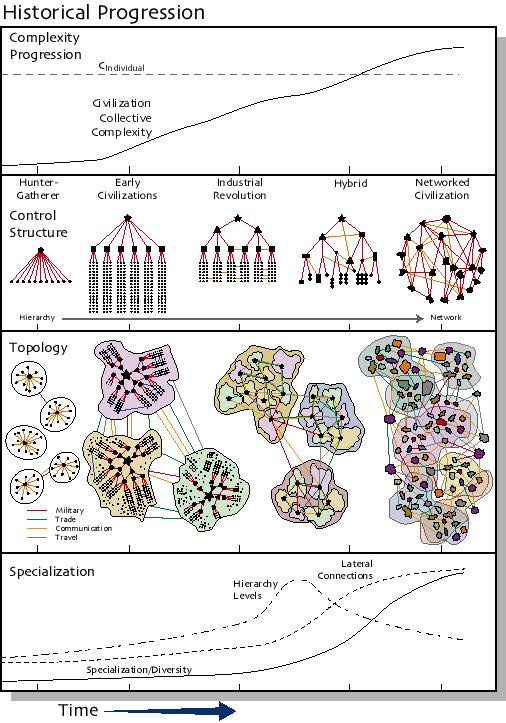
The natural world is composed of complex systems and it makes sense that the best strategies for any population are ones that take complexity into account. This is a limitation of hierarchical organizational models. They cannot address large-scale levels of complexity, as explained in Complexity Rising, a 1997 paper on complexity profiles.

“In summary, the complexity of the collective behavior must be smaller than the complexity of the controlling individual. A group of individuals whose collective behavior is controlled by a single individual cannot behave in a more complex way than the individual who is exercising the control. Hierarchical control structures are symptomatic of collective behavior that is no more complex than one individual. Comparing an individual human being with the hierarchy as an entirety, the hierarchy amplifies the scale of the behavior of an individual, but does not increase its complexity.”

As Yaneer Bar-Yam explains in Complexity Rising, hierarchies have diminishing usefulness as complexity increases.

“At the point at which the collective complexity reaches the complexity of an individual, the process of complexity increase encounters the limitations of hierarchical structures. Hierarchical structures are not able to provide a higher complexity and must give way to structures that are dominated by lateral interactions.”

rp_historical-progression.jpg
Image: Complexity Rising, UNESCO

Many of these lateral interactions are what we would call social relationships. They are outside the official hierarchy. As Verna Allee has noted, for complex environments, or ‘un order’, we need stronger networks and looser hierarchies. But most of our organizations are designed for ‘complicated order’ only. Or you could say that we need more lateral interactions.

Better social relationships (non-hierarchical and not based on the dominance of others) can make for healthier populations. In addition, networks are the only way our collective intelligence can be used to address increasing complexity. Becoming more social is not just a business driver but also a societal imperative.

rp_cynefin-networks-verna-allee.jpg
Image: Verna Allee

New Jobs People will have in 2025

CORPORATE DISORGANIZER
Big companies want to be more like startups, seeing innovation as vital to future profits. Young says they’ll want “corporate disorganizers” who can introduce a little “organized chaos.” Young says: “The disruptor will be tapping into the new systems of the collaborative economy, creating greater fragmentation and a more distributed ecosystem.” – Terry Young, CEO Sparks & Honey, in FastCoexist

I would say this role already exists!

Institutional Memory and Knowledge Management

This is a follow-up post on building institutional memory. The basic premises are stated in sense-making for decision memories. This presentation includes additional details and more explanations. It adds many new slides to help with the flow of the narrative, limited as it is with this medium.

The main themes are:

Memories are captured as knowledge artifacts, each limited by what it can convey, depending on its nature and the knowledge of the recipient.

Decision memories have a certain importance for organizations; to understand why decisions were, or were not, taken.

Knowledge management can provide a structure to capture institutional memory, but it requires more than a single approach.

Complex work, which is growing in importance in networked organizations, requires the sharing of implicit knowledge and this presents certain challenges.

We should take complexity into account and develop frameworks for sharing knowledge and storing institutional memory to help organizations deal with current events and prepare for an uncertain future.

institutional_memory