The new work

All work today can be reduced to just four basic types of jobs, according to Lou Adler. His company identified four prototypical jobs after developing thousands of job descriptions over the years.

Everything starts with an idea. This is the first of the four jobs – the Thinkers. Builders convert these ideas into reality. This the second job. Improvers make this reality better. This is the third job. Producers do the work over and over again, delivering quality goods and services to the company’s customers in a repeatable manner. This is the fourth job. And then the process begins again with new ideas and new ways of doing business being developed as the old ones become stale.

While I am not a fan of job competencies, I think this article can tell us something about the future of work in general. For instance, Gary Hamel identified obedience, diligence, and intellect as industrial/information economy competencies. Today, initiative, creativity, and passion are essential skills for what Hamel describes as the Creative Economy. I view this new creative economy as a property of the Network Era which is bringing about the rise of knowledge artisans. So I began to map Hamel’s essential work competencies against Adler’s job types.

Another factor in the changing nature of work is the changing perception of value. In the creative economy, more value is coming from intangible assets than tangible ones. For example, the S&P stock index in 2009 was 81% intangible assets, up from 17% in 1975. I recently discussed intangibles and organizational dynamics with Jay Deragon, as part of the Smarter Companies initiative. As the Smarter Companies website explains:

Despite its enormous importance today, most businesspeople lack the basic knowledge and tools needed to optimize intangible capital. This leads to blocked learning, suboptimal performance, stifled innovation and stagnant growth.

Learning to better deal with intangibles is the next challenge for today’s organizations and workers. I developed the following graphic to describe the four job types in relation to 1) work competencies and 2) economic value. It appears that an economy that creates more intangible value will require a greater percentage of Thinkers and Builders.

jobs value competenciesAs we move into a post-job economy, the difference between labour and talent will become more distinct. Producers and Improvers will continue to get automated, at the speed of Moore’s law. Those lacking enough ‘Talent’ competencies may get marginalized. I think there will be increasing pressure to become ‘Thinkers + Builders’, similar to what  Cory Doctorow describes as Makers in his fictional book about the near future.

What is relatively certain is that ‘Labour’ competencies, which most education and training still focuses on, will have diminishing value. How individuals can improve their Thinking and Building competence should be the focus of anyone’s professional development plan. How organizations can support Thinking and Building should be the focus of Organizational Development and Human Resources departments. While Producing and Improving will not go away, they are not where most economic value will be generated in the Network Era.

As with all models, this one simplifies reality, but it may be useful for thinking about the future of work.

Cooperation in the networked workplace

* This post is sponsored by Microsoft Office 365 *

This is my second post on productivity tools for the networked workplace. First, I want to elaborate a bit on collaboration and cooperation. Two types of behaviours are necessary in the networked workplace: collaboration and cooperation. Cooperation differs from collaboration in that it is sharing freely without any expectation of reciprocation or reward. Collaboration is just getting things done. Cooperation is what drives the extended enterprise — customers, suppliers, partners and anyone else touched by the business.

In my previous post I discussed how Microsoft tools differed in supporting either collaborative or cooperative behaviours, or both. These facets align with the digital competencies required in the networked workplace.

collab-coop competenciesCooperative competencies of 1) sharing openly; 2) communicating effectively in communities & networks; and 3) contributing to knowledge networks; are often given less attention by management than the more job-focused collaborative competencies. But yesterday’s soft skills are today’s critical skills. New tools for cooperation, like activity stream platforms can support open sharing. Yammer is one such platform, and Jared Spataro, at the Microsoft Office Division, has this to say about Yammer’s place in their business model:

What should I do?  In my customer meetings over the last few months, people have often asked, “What should I use for social?  Yammer or the SharePoint newsfeed?”  My answer has been clear: Go Yammer!  Yammer is our big bet for enterprise social, and we’re committed to making it the underlying social layer for all of our products.  It will power the social experiences in SharePoint, Office 365, Dynamics, and more.   Yammer’s unique adoption model appeals directly to end users and makes it easy to start enjoying the benefits of social immediately.  And because it’s an online service, Yammer gives us the ability to innovate rapidly-updating the service quickly as the market evolves.  So whether you’re an Office 365 customer or running SharePoint on-premises, Yammer will provide the latest innovations and best user experience.

yammer for cooperationThe above image is a continuation of a review of Office 365 I posted to Slideshare. In Yammer’s case, it is clearly a platform focused on cooperation. Like other activity stream, or micro-blogging, platforms, Yammer enables serendipitous connections by making work more transparent. As Ross Dawson says, Yes you can ‘engineer’ serendipity. Yammer would be one tool to help with that engineering.

As I mentioned in my last post, a tool like Lync can greatly enhance workplace collaboration as well as support internal cooperation. Yammer can extend that cooperation, with the real potential for business innovation resulting from connecting with people outside the department or enterprise.

If you don’t think you need to increase cooperation for your enterprise, then perhaps it fits into one of the two categories of companies that IDG’s Bill Laberis identifies in a short, but pointed, video. Fostering distributed work may not be suitable for 1) financially troubled companies, or 2) companies who don’t trust their own employees. For these companies, no networked productivity tool suite will help.

Disclosure: This post was sponsored by Office 365 but I retained editorial control and take full responsibility for what is posted. Contract writing is one of the ways I make my living.

ten years

ten of spadesOn 21 April 2003, jarche.com went online. It started as a single web page, later upgraded to a Drupal powered site and then changed over to its current WordPress configuration. About 2,350 posts have been published so far, with over 6,500 comments [+1 million comment spam have been blocked]. Many thanks to Chris at tantramar.ca for keeping this site running for so long.

So what has changed and what have I learned over the past decade?

It is easier and more acceptable to work from home, live in a different time zone, and work with people you may have never met face to face. When I started, the mainstream media were making fun of blogs. Now every media outlet has one, if not many. This blog has helped me connect with people all over the world. Without it, I doubt I would have lasted 10 years as a freelancer.

My early Blogger site is still online. I moved my blogging here in February 2004. In 2003 social media were primarily blogs. While blogs now face a lot of competition, I have noticed that the influence of a single blog post can be much greater today, as it gets re-posted on various other platforms. I would still strongly recommend blogging, especially for freelancers. What I’ve learned about blogging is that you have to do it for yourself. Most of my posts are just thoughts that I want to capture.

One advantage (?) of living in a remote and rural part of the country is that I need to have a wide focus. There are not enough potential clients around here, so there is no local market. Because of this, I saw the world as my market from the onset, and the past 10 years have shown that it’s possible (though sometimes difficult) to do international work and not live in a major metropolitan area. Sackville boasts a population of around 5,000 people and the nearest major cities are Boston (900 KM) and Montréal (1,000 KM).

One of my guiding principles is accepting life in perpetual Beta, meaning that things keep changing and I have to keep learning. In 2003 Twitter did not exist and WordPress was only released in May of that year. Twitter is now the main source of referrals to this blog, surpassing Google, while WordPress is the number one blogging platform in the world. This month I tried two new RSS readers, as the social media landscape keeps changing.

Probably the most significant change in my work came with the formation of the Internet Time Alliance, in 2009, with my partners Jay Cross, Jane Hart, Charles Jennings, and Clark Quinn. Not only has this international think-tank exposed me to new networks, but it’s a wonderful support group, where I can bounce around my half-baked ideas.

Thanks to everyone who has connected here over the past 10 years and especially those who have shared their knowledge and experiences. I look forward to the next decade.

The risky quadrant

Donald Taylor asks where your learning & development (training) department resides.

  1. Are you unacknowledged prophets, with a manager or executive who understands that you need to change, but the organization lags behind?
  2. Are you facing comfortable extinction, like the once dominant but now bankrupt Kodak?
  3. Or are you in the training ghetto, disconnected from the business and unable to be part of any change?

training extinctionThe reality today is that risky leadership is needed. As Don notes:

If both the department and the organisation are changing fast, this is a great opportunity. We can invest in new procedures and systems, build our skills and experiment with different ways of working with the business, and the business – because it is also changing fast and open to new ideas – will respond. It’s in this quadrant that we find really progressive L&D teams that are making an impact. While they are undoubtedly leaders, this quadrant is also risky, because that’s the nature of change.

Unacknowledged Prophets: If you are in this quadrant I would advise you to bide your time, build up your skills, create alliances, and wait for opportunities. As Stephen Berlin Johnson says, “Chance favours the connected mind.” Get collaborative, cooperative & connected. Louis Pasteur said that “Chance favours the prepared mind“. Be prepared.

Comfortable Extinction: This is a difficult quadrant because there is no understanding of the need for change. Everything is just fine. If you are the only person in your organization without rose coloured glasses, I would try to become a lone unacknowledged prophet, preparing for the inevitable crisis. If nobody sees it, then it would be best to let the training department drift into obscurity so that others can take the lead in promoting cooperation, collaboration and knowledge sharing. Sometimes it’s best to let natural selection do its thing.

Training Ghetto: Getting out of the basement and becoming relevant may take some time, which departments in this quadrant may not have. I would suggest first moving from training delivery to performance improvement. Get someone (yourself?) skilled at performance consulting. Forget about social learning, for the time being, and focus on performance support tools and job aids. Become useful to the business by bringing practical tools that can be used right away.

So how will you get to the risky quadrant?

Loose hierarchies for knowledge management

Knowledge-sharing practices are highly contextual. I have seen this with clients in multiple locations, across national borders. This makes sense when you consider that knowledge sharing is deeply personal as well as social, so it reflects the larger culture and the particular workplace. A 2011 study (via David Gurteen) concluded that even in the same company, knowledge management practices are different (note that the authors define Ba as shared context in motion).

Each subsidiary, although part of the same corporate group and including the same functional teams, displayed very different patterns of KM and organizational features. The regression model showed that different organizational factors – especially Ba, work styles, and organizational control – were responsible for the resulting KM profiles of each local office: formal Ba in the U.S. office, clear objectives in the French subsidiary, formal Ba in the Chinese branch, and a self-directed vision in the Japanese head office.

Source: A study of knowledge management enablers across countries, by Rémy Magnier-Watanabe, Caroline Benton & Dai Senoo, in Knowledge Management Research & Practice (2011) 9, 17–28 (PDF).

This need for contextual knowledge management practices aligns with the advice of Snowden & Kurtz who recommend “loose hierarchies & strong networks” in complex environments, as shown in this image by Verna Allee.

cynefin networks verna alleeSo, for large organizations, not only will no single technology platform meet all your knowledge-sharing, collaboration and cooperation needs, but no single approach will either. While there is a need to create a balance between individual and enterprise
knowledge-sharing tools, there is also a need to balance the needs of the central organization with those of external locations. In our distributed economic world, this is workplace reality.

With loose hierarchies and strong networks as a guiding principle, departments need to have the ability to try out different KM practices and see how they work in their unique contexts. Of course, this flies in the face of standardization of processes and the search for best practices that have been drilled into management heads for the past century. For knowledge management today, industrial management just won’t cut it.

industrial management

stop talking about jobs

Andy McAfee reports in HBR that United Technologies is laying off workers, even though its stock is at an all time high and sales have increased by 35%.

I simply want to point out that if this example is part of any larger trend, then we cannot rely on economic growth to fix our current problems of unemployment or underemployment. Because even for individual companies, economic growth has become so decoupled from employment growth that the former goes up while the latter goes down.

I have been observing for quite some time that most work is getting automated and outsourced, while only complex and creative work remain valued, and therefore wealth-generating for those who do it. The construct of the JOB highlights this problem, because jobs are designed around work that can be copied and workers who can be replaced, but anything that can be reduced to a flowchart will be automated. Relying on the job as society’s main wealth-sharing mechanism is a major mistake in the network era, but one that politicians and many others continue to make. We are entering a post-job economy.

Part of the solution is taking control of our own professional development. Another is developing new systems of wealth exchange, such as the many new models examined at Shareable. But most importantly, we need to change our language as we discuss work, wealth, and economics. We need to stop focusing on job creation and figure out better systems of wealth redistribution for a networked society.

employment opportunities

Productivity tools for the networked workplace

* This post is sponsored by Microsoft Office 365 *

I have noticed that the Microsoft Office suite is used by pretty well every one of my clients. All of the larger organizations have and use Sharepoint. These tools are ubiquitous in business and government, so I have agreed to write a few articles on how they can be used to improve work productivity. Since these are the tools that are already in place in many organizations, it might make sense to understand how best to use them.

One of the gaps between enterprise work and more open and serendipitous cooperation is a lack of ways to quickly connect to others in the organization. Email and telephone are often the only choice. Instant messaging may be available, but is not used intensely, like email is. A Forrester research report – The Total Economic Impact Of Microsoft Office 365 Midsize Customers – describes these collaboration needs of mid-size companies:

“Everyone being able to work in a collaborative environment is essential. We can work smarter and fewer hours.”
“We are a knowledge company. IT has to make us more productive, smarter.”
“Without Lync we have no mechanism for communicating across the company – except phones and shouting. Lync will be a huge improvement in terms of time savings.”

The addition of Lync has made a significant improvement to the Microsoft suite, according to several of my clients. I developed my enterprise social network tool analytical framework at the request of a client who wanted to know what mix of platforms and tools was optimal for collaboration and knowledge sharing. From their perspective, Lync was a game-changer.

I continued to refine this analytical framework with two more clients over the past year and all have found it useful. The slide presentation below looks at Microsoft’s Office 365 suite from that perspective. Please note that I do not use any of these tools myself. The analytical framework is my creation but the perspective on each tool were based on client user feedback and other third-party sources. I would suggest doing your own analysis of all your enterprise collaboration and productivity tools, based on the framework.

In the slide presentation, one conclusion offered is that content creation is a way to capture knowledge, even though we know that we can only “capture” a small part of our implicit knowledge by making it more explicit. Conversations and the ongoing narration of work must still be supported. This again shows the gap that Lync is filling; it provides opportunities for impromptu knowledge sharing. As the content creation tools of the Microsoft Office suite become more networked, it will be easier to connect cooperative and collaborative behaviours.

For those who are interested, here is the background of the framework. Ian McCarthy’s honeycomb of social media was an initial inspiration, showing how one could quickly and graphically portray differences between social media platforms. The Altimeter Group’s 2012 report on making the business case for enterprise social networks provided more detail on what happens inside organizations. Finally, Oscar Berg’s digital workplace concretized gave a good picture of what people-centric, service-oriented businesses should look like.

The seven facets identified by Oscar Berg align with some general digital competencies that are necessary for connected knowledge workers everywhere. These also align with the PKM framework that can support the flow of cooperative and collaborative work in a coherent organization.

In my next post in this series, later this month, I will discuss the digital competencies described in Slide #6.

  • Sharing openly
  • Communicating effectively in communities & networks
  • Contributing to knowledge networks
  • Creating content to share inside & outside the organization
  • Coordinating tasks with minimal time & effort
  • Conducting & participating in meetings to maximize impact & minimize wasted effort
  • Quickly finding people best suited to solve a given problem

Disclosure: This post was sponsored by Office 365 but I retained editorial control and take full responsibility for what is posted. Contract writing is one of the ways I make my living.

The knowledge sharing paradox

An effective suite of enterprise social tools can help organizations share knowledge, collaborate, and cooperate – connecting the work being done with the identification of new opportunities and ideas. In an age when everything is getting connected, it only makes sense to have platforms in place that enable faster feedback loops inside the organization in order to deal with connected customers, suppliers, partners, and competitors. It takes a networked organization, staffed by people with networked mindsets, to thrive in a networked economy.

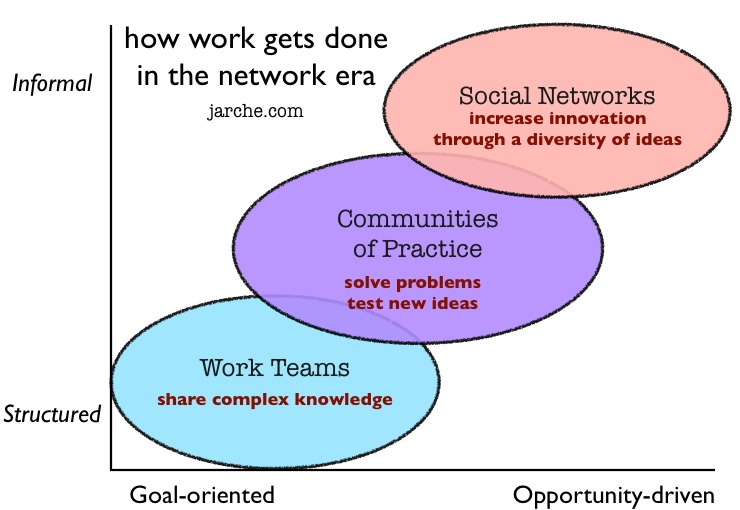
enterprise social toolsGetting work done today means finding a balance between sharing complex knowledge (collaboration) and seeking innovation in internet time (cooperation).

how work gets doneIndividual workers can develop sense-making skills, using frameworks like PKM, to continuously learn and put their learning to work. For example, they can seek new ideas from their social networks; make sense of these ideas by connecting with communities of practice; try new ideas out alone or with their work teams, and then share these ideas and practices.

PKM at workBut there is a major issue that gets ignored, by software vendors, managers, IT departments, and most everyone except the workers themselves. People will freely share their knowledge if they remain in control of it. Knowledge is a very personal thing. Most workers do not care about organizational knowledge bases. They care about what they need to get work done. However, if we are going to build organizational knowledge from individual knowledge-sharing, we have to connect the two.

The knowledge sharing paradox is that enterprise social tools constrain what they are supposed to enhance. Why would someone share everything they know on an enterprise network, knowing that on the inevitable day that they leave, their knowledge artifacts will remain behind? I could not imagine having this blog (AKA my outboard brain) cut off from me. I would not put anywhere near the effort I do now if someone else controlled my access to this blog.

The elephant in the room is human nature. Enterprise knowledge sharing will never be as good as what networked individuals can do. Individuals who own their knowledge networks will invest more in them. I think this means that innovation outside of organizations will continue to evolve faster than inside. It may mean that the half-life of organizations will continue to decrease, as more nimble businesses continuously emerge to compete with incumbents. Whoever creates an organizational structure that bridges the individual-organizational knowledge sharing divide may have significant business advantages.

From hierarchies to wirearchies

Work in the network era needs to be both cooperative and collaborative, meaning that organizations have to support both types of activities. This may not be an easy transition for companies based almost uniquely on command and control leadership. But in this emerging network era, cooperative innovation trumps collaborative innovation, writes Stowe Boyd.

My experience is that communities of practice can help make the transition from hierarchies to networks, or as Jon Husband describes the resulting structure; wirearchy. Communities of practice, both internal and external; can be safe places between highly focused work and potentially chaotic social networking. The Community Roundtable has a Community Maturity Model that describes this transition, in four stages. The model makes it relatively easy to see where your organization stands and where it should go.

Community Maturity Model

The CMM aligns with my own way of looking at the need to balance structured work and the sharing of complex knowledge, with the concurrent requirement for unstructured social networking which can increase innovation through a diversity of ideas. I have added in the four CMM stages to the image below. Communities of practice can link collaboration and cooperation, and help weave the organization and its people into a wirearchy.

Wirearchy – “a dynamic two-way flow of power and authority based on knowledge, trust, credibility and a focus on results, enabled by interconnected people and technology.” – Jon Husband

HCNW

Getting there may not be easy, but the evidence is showing that it is necessary. For example, here is how Yammer builds its products, according to Kris Gale, VP of Engineering:

Yammer’s biggest rule of thumb is 2 to 10 people, 2 to 10 weeks – which means they generally don’t do projects that are larger or more complicated.  There is a non-linear relationship between the complexity of a project and the wrap-up integration phase at the end.  If you go anywhere beyond ten weeks, the percentage of time in the wrap-up phase becomes disproportionate. – First Round Capital

This sounds like it’s aligned with the general rules of dealing with complexity, developed by Dave Snowden. Each project at Yammer is a probe. It’s also small enough so that the potential ROI does not drive the company off the rails. A small project failure is much easier to deal with than a large one. Yammer understands that working in a hyper-connected economy makes complex work less predictable, so project cycles are kept short. As Gale goes on to explain:

I don’t think you should be building a product.  I think you should be building an organization that builds a product.

Be very wary of only trusting managers with engineering decisions; in fact, you should delegate these all the way down to individual contributors.  If managers are the only ones making decisions as you grow past thirty to forty people, this should be a red flag.  – First Round Capital

probe sense respond

Becoming a wirearchy requires new organizational structures that incorporate communities and networks. In addition, they require new ways of doing work, like thinking in terms of perpetual Beta and doing manageable probes to test complex problems. It’s a new way of doing work, within a new work structure. Both are required.

The right tool for the right job

The field of Human Performance Technology (HPT) is systemic and systematic, but not very human. For that we also need to support informal andt social learning. However, HPT, especially performance analysis can be a useful tool, if used selectively and appropriately.

HPT does not work well for tasks that require high degrees of tacit knowledge and cooperation to address complex problems. But I find it useful for confirming that training is the optimal solution, as it is often the most expensive option, so it’s best to be sure. Some barriers to performance that are often overlooked when prescribing training include:

  • Unclear expectations (such as policies & guidelines);
  • Inadequate resources;
  • Unclear performance measures;
  • Rewards and consequences not directly linked to the desired performance.

In some cases, these barriers could be addressed and there would be no further requirement for training. Where there is a genuine lack of skills and knowledge, training may be required, but it should only be in cases where the other barriers to performance have been addressed. A trained worker, without the right resources and with unclear expectations, will still not perform up to the desired standard.

The performance analysis process shown below is based on Mager & Pipe’s book, Analyzing Performance Problems. According to this chart, training is only warranted when there is a clear lack of skills & new knowledge and the person has not done anything like this before. If there is any doubt, one should confirm that there are no obstacles to performance; there are adequate resources; NOT performing is not being rewarded; performance is not being punished; and performance does matter. My experience is that individual performance issues are often the result of inadequate resources or conflicting messages from management.

Here is my updated graphic, as the previous one, made several years ago, was a bit hard to read.

performance analysis process chart

Having enough tools, and knowing which ones to choose, is important for any discipline. In organizational performance, it is critical because we are always dealing with complex adaptive systems. We should consider that all models are flawed, but some may be useful. But we shouldn’t get too attached to our models.

In many cases, when training is prescribed for a work performance issue, it is a case of assuming it is a “training problem” without any further analysis. I can think of two examples in my own business experience.

In one case, e-learning was prescribed to address the performance needs of nurses changing to a new nursing care methodology. In that instance, I was able to convince the client that a quick performance analysis could be used to confirm the assumption that e-learning was the solution. As a result of the analysis, we changed the intervention to the development of an online diagramming tool, because we determined that nursing staff already had 80% of the necessary skills and knowledge, but they didn’t know how to use the new diagramming and reporting procedures. The initial e-learning program was greatly reduced and job aids were created.

In another case, training was prescribed in order to get staff up to date with a new organization-wide policy. Each person received an average of 17 days classroom training. As an observer for part of the training, I would estimate that all of the classroom training could have been done in less than a week, had the new procedures and some job aids been first developed. The total cost of training approached millions of dollars, plus the cost of missed work. The change in performance appeared to be minimal, but the training provider generated significant revenue.

The right tool, for the right job, in the hands of an experienced practitioner, can often ensure that the right problem is addressed.