the social imperative

Dr. Robert Sapolski has been studying baboons for thirty years. While many researchers took for granted the hierarchical nature of baboon life, with dominant males attacking those next down the social ladder and then the process repeating itself down to infants and females, Sapolski did not. One thing his research showed was that the baboons on top were less stressed (lower stress hormones) and had lower blood pressure than those lower down the social ladder.

But then a most interesting event occurred with a certain troop that Sapolski was observing. The baboons started feeding from a garbage dump and many became infected with tuberculosis. Nearly half the males in the troop died, mostly the aggressive and non-social ones. Every alpha male was gone! As a result, the atmosphere of the troop changed and became much less aggressive and more social. Not only that, but any new males who joined the troop were discouraged from being aggressive and adopted more pro-social behaviours within six months.

In this more social and less hierarchical environment, the troop as a whole became healthier and less stressed. It is currently thriving. The fundamental lesson that Sopolski came back with was that “textbook social systems that are engraved in stone” can be changed in one single generation. There may be hope for the human race, it seems.

Recent research shows that evolution is on the side of those who cooperate.

“We found evolution will punish you if you’re selfish and mean. For a short time and against a specific set of opponents, some selfish organisms may come out ahead. But selfishness isn’t evolutionarily sustainable.”

The natural world is composed of complex systems and it makes sense that the best strategies for any population are ones that take complexity into account. This is a limitation of hierarchical organizational models. They cannot address large-scale levels of complexity, as explained in Complexity Rising, a 1997 paper on complexity profiles.

“In summary, the complexity of the collective behavior must be smaller than the complexity of the controlling individual. A group of individuals whose collective behavior is controlled by a single individual cannot behave in a more complex way than the individual who is exercising the control. Hierarchical control structures are symptomatic of collective behavior that is no more complex than one individual. Comparing an individual human being with the hierarchy as an entirety, the hierarchy amplifies the scale of the behavior of an individual, but does not increase its complexity.”

As Yaneer Bar-Yam explains in Complexity Rising, hierarchies have diminishing usefulness as complexity increases.

“At the point at which the collective complexity reaches the complexity of an individual, the process of complexity increase encounters the limitations of hierarchical structures. Hierarchical structures are not able to provide a higher complexity and must give way to structures that are dominated by lateral interactions.”
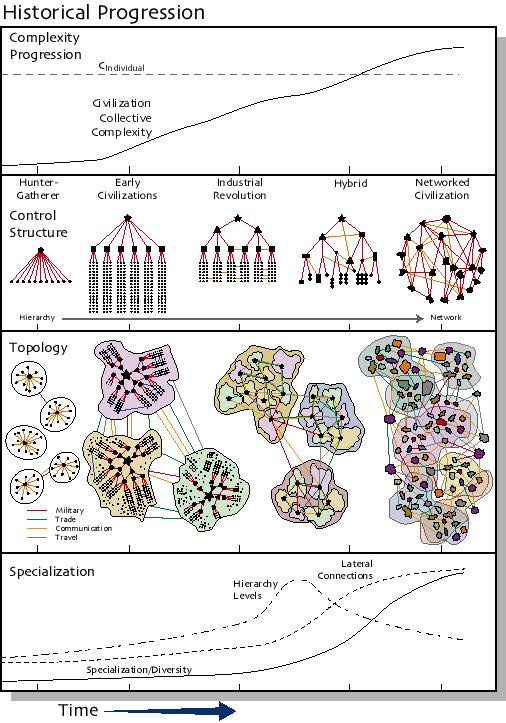
rp_historical-progression.jpg
Image: Complexity Rising, UNESCO

Many of these lateral interactions are what we would call social relationships. They are outside the official hierarchy. As Verna Allee has noted, for complex environments, or ‘un order’, we need stronger networks and looser hierarchies. But most of our organizations are designed for ‘complicated order’ only. Or you could say that we need more lateral interactions.

Better social relationships (non-hierarchical and not based on the dominance of others) can make for healthier populations. In addition, networks are the only way our collective intelligence can be used to address increasing complexity. Becoming more social is not just a business driver but also a societal imperative.

rp_cynefin-networks-verna-allee.jpg
Image: Verna Allee

New Jobs People will have in 2025

CORPORATE DISORGANIZER
Big companies want to be more like startups, seeing innovation as vital to future profits. Young says they’ll want “corporate disorganizers” who can introduce a little “organized chaos.” Young says: “The disruptor will be tapping into the new systems of the collaborative economy, creating greater fragmentation and a more distributed ecosystem.” – Terry Young, CEO Sparks & Honey, in FastCoexist

I would say this role already exists!

Continuing the subversion, one post at a time

friday2Friday’s Finds:

Quote of the Fortnight:

@nestguy – “Writing for Medium is like joining a hip gym where all the benefits of your workouts are transferred to the gym owner’s body.

« La séparation des sciences et des lettres est un artefact universitaire, créé de toute pièce par l’enseignement. – Michel Serres » – via @zecool [The separation of the sciences and the arts is a created fiction by the higher education system.]

Today in 1986, Charles Bukowski wrote a great letter to the man who rescued him from his ‘9 to 5’ job – via @raesmaa

And what hurts is the steadily diminishing humanity of those fighting to hold jobs they don’t want but fear the alternative worse. People simply empty out. They are bodies with fearful and obedient minds. The color leaves the eye. The voice becomes ugly. And the body. The hair. The fingernails. The shoes. Everything does.

The intelligent, the bandits, the helpless and the stupid – by A Man with a PhD

One hallmark of the bandits when they run a company is that they are mostly concerned with how Wall Street sees them, focused on quarterly earnings instead of long term growth, looking at market share rather than profitability. All in order to maximize the money they get. Short term manipulation is better than long term growth.

Selfishness doomed while cooperation evolves, study says –  via @dinoboy89

In their study, released Thursday in Nature Communications, they created theoretical populations of organisms in which some were selfish and some were “suckers,” as Adami put it. If the two personality types were unable to tell each other apart, the selfish individuals would attack one another and the suckers and eventually go extinct, and the suckers would win. However, if the selfish ones could recognize the suckers but not vice versa, then the selfish ones would win, playing nice with one another while killing off the suckers.

Co-operation beats competition in natural selection. “Maybe we should teach ourselves how co-operate better?” – @paulgslatter

“We found evolution will punish you if you’re selfish and mean. For a short time and against a specific set of opponents, some selfish organisms may come out ahead. But selfishness isn’t evolutionarily sustainable.”

Institutional Memory and Knowledge Management

This is a follow-up post on building institutional memory. The basic premises are stated in sense-making for decision memories. This presentation includes additional details and more explanations. It adds many new slides to help with the flow of the narrative, limited as it is with this medium.

The main themes are:

Memories are captured as knowledge artifacts, each limited by what it can convey, depending on its nature and the knowledge of the recipient.

Decision memories have a certain importance for organizations; to understand why decisions were, or were not, taken.

Knowledge management can provide a structure to capture institutional memory, but it requires more than a single approach.

Complex work, which is growing in importance in networked organizations, requires the sharing of implicit knowledge and this presents certain challenges.

We should take complexity into account and develop frameworks for sharing knowledge and storing institutional memory to help organizations deal with current events and prepare for an uncertain future.

institutional_memory

The New How – Review

The New How: Creating Business Solutions through Collaborative Strategy is a how-to book for anyone involved in strategy development in a large organization. It’s a toolkit for implementing a more collaborative workplace. It’s about the How and not so much the What or Why, though there are many anecdotes shared by the author Nilofer Merchant, from her experiences with companies like Apple, Adobe, Nokia and HP. Co-creation of strategy, especially the How part it, is a major theme here. As Nilofer explains:

Once upon a time, some firms had more access to data and information than others. Some firms had more skills at slicing and dicing. In that time, heavy-duty data analysis was enough to form a competitive advantage. Today, everybody has access to vast amounts of high-quality information and the tools to crunch it. What matters now is the ability to act on that information: to conceive – now – the nugget of hidden opportunity in a given situation. The key is being able to work with one another and come up with new ideas, build on those ideas, and then add insights based on the data that empower us to act in unique and differentiated ways.

Another reason that collaboration is so important is that the notion of the great leader, or what Nilofer describes as The Chief Answer Officer, cannot handle the complexity of the current hyper-connected business environment. Here is her advice to GMs, VPs and others in high management places:

The answer to today’s specific question is only that – part of the solution to today’s problem. Next week’s problem will require a different solution. And next month’s question will need yet another answer. Crowning yourself the Chief of Answers puts you in a difficult position, one with very little advantage. It sets your team up to be the Tribe of Doing Things. And, at the end of the day, you end up feeding the very counterproductive cycle you need to alter.

As a bonus, the book is amply illustrated by Hugh MacLeod, which makes it an even more interesting read.

0711allcontrolA good part of the book covers the Quest method of strategy development, with plenty of examples and aids. I found the “MurderBoard” the most interesting section. This section alone makes the book worth buying. The MurderBoarding sequence is simple: 1) Decide what  matters; 2) Sort; 3) Test; 4) Choose. The last step is critical, for “If you don’t choose, you don’t have a strategy; you just have a set of options.” Or, to make it as clear as possible,  “MurderBoarding: It’s not how many ideas you have. It’s how many good ideas you kill.

This is a detailed and practical book. It is not a high-concept tome where at the end you feel good but don’t know what to do next. There is enough pragmatic advice in this book for any executive or manager to run with. It’s a valuable addition for people with management responsibilities in large organizations or anyone consulting to such an organization. Here is one final quote that succinctly describes the end goal of The New How:

“Permission to innovate without asking happens when the strategy is co-owned.”

A mobile workforce needs better on-site conversations

The future of workplace learning is social, cooperative and especially mobile. One approach for this type of workforce is to support their mobility with something like a ‘genius bar’, instead of having to request a support ticket from IT or get an appointment with HR. There is a growing array of enterprise software tools to support the emerging workforce, but it takes more than technology, as Dion Hinchcliffe warns.

We forget at our peril that collaboration is a fundamentally human activity. This implies that any use of enabling technology without taking into account how people actually conduct their work, their inclinations to share information and interact with each other, and in particular how the proposed technology will empower them and alter their collaborative behavior for the better/worse, is bound to disappoint.

Providing mobile access for work and learning just makes sense today. Clark Quinn says that mobile technology makes a lot of sense, as “it decouples that complementary capability from the desktop, and untethers our outboard brain“. Sense-making is a critical skill for most knowledge workers today, and frameworks like PKM can help. When I refer to personal knowledge management, especially my blog, I often call it my outboard brain. Supporting mobile technologies can leverage every worker’s outboard brain and free up cognitive load for pattern recognition, the stuff that machines are not as good at.

clar quinn on mobileWhile sales of tablets are increasing, and mobile business is an expanding sector, there is still a lot of work to be done on how people actually conduct their work. Legislating mobile collaboration is probably not the best solution, but it does underline the huge cost-savings of abandoning the industrial age concept of being paid for merely putting in time. As Nancy Dixon writes, “The only reason to come together face-to-face is for people to be in conversation with each other!” Too often though, the workplace is not designed to enable conversations. While mobile technologies may be part of the solution to a more agile workforce, another component is improving the workplace environment so that people can do what they do best face-to-face — converse.

If you replace the word “learner” with “worker’ in this article on the SPATIAL model, you can see that there is a lot that can be done to make work environments more open. More open environments can encourage conversations [AKA, participation in complex work].

Participation is a critical variable in nonmandated education; thus, the physical environment’s impact on participation rates can be especially important in educational and training efforts outside of school settings.

Mobile work and learning proponents should also be looking at changing the physical workplace to further support a more nomadic workforce that is empowered with mobile technologies. Let me finish with another example from Nancy Dixon, a case study called The Hallways of Learning, where a change in the physical layout of a hallway significantly increased in-depth professional interactions.

The learning that occurred in Researcher’s Square did not come from presentations, rather the knowledge gained was through conversation. When we think about learning from others our first thought is to have someone make a presentation. But as ubiquitous as presentations are, they are a poor way to learn from peers. Typically, a presenter offers what happened in his or her own situation, but that is not what learners need to hear. Learners are interested in knowing how to adapt the lessons to their situation and for that they need to have a conversation so that the other person can understand their context, and they also can understand the context of the other.

This post is brought to you by Mobile Enterprise 360 Community and Citrix

Note: I retained editorial control and take full responsibility for what is posted. Contract writing is one of the ways I make my living.

Knowledge Management for Decision Memories

Institutional decision memories can describe how and why we, as an organization, chose one course of action over another. As Brian Gongol notes:

“If a capital project has an expected service life of 20 to 30 years, it’s entirely possible that people working in an institution in their 20s will be middle or upper-level managers in the same institution by the time the project has to be replaced or upgraded. Unless someone documents the process by which the original decision was made, including notes on the alternatives not taken, the 50-year-old manager who’s been with the institution all along will usually be guided more by 25 years of habits and built-in bias than by a fresh look at the available alternatives. And the situation is likely to be even worse if the 50-year-old manager making the decisions came into the institution recently and doesn’t even have a memory for when the original project was completed in the first place.”

Over time, these memories can be codified and institutionalized. This is Big Knowledge Management, leveraging the power of enterprise software platforms to store decision, process, and event memories. Process and event memories, like project outputs, are relatively easy to capture and codify. But decision memories are often hampered by our tendency to justify decisions after they have been made, and even create elaborate, and often fictional, stories around them. For this reason, it is important to capture decisions as they are being made, not after the fact.

Explaining why other decisions were not made, should also be normal practice. For example, I was working with a client that made decisions on which chemical compound to develop out of a possibility of thousands. There was a cost to initially create any compound, so not all possibilities could be attempted. Decisions were made by a committee on which compound to pursue. However, the decisions on why the other compounds were not developed were never recorded. Several years later, the situation had changed due to improvements in technology and new research findings, and now some of the rejected compounds may have had potential for development. Unfortunately, no records were available to search the rejected compound database and find ones that met the new criteria. Sometimes our decisions not to do something are just as important as our selected course of action, from the perspective of the future. But we never know this in advance.

Recording and sharing our knowledge on a regular basis is what Little Knowledge Management is about, as it focuses on providing ways for groups to try new methods safely. Examples include curation, communities of practice, and mentoring. For complex work, Little KM is critical, as most of the knowledge required is implicit, and not easy to codify. According to the Cynefin framework, in the Complex domain “the relationship between cause and effect can only be perceived in retrospect, but not in advance, the approach is to Probe – Sense – Respond , and we can sense emergent practice.” Teams working in the complex domain have to make “probes” on a regular basis in order to understand the changing environment. It then becomes essential to develop ways to capture and share the decisions made with each one.

decision memories

Institutional memory, especially the decisions taken over time, has to be part of the workflow of any knowledge worker doing complex work and making decisions. Ewen Le Borgne writes that, “Institutional memory feeds off strong personal knowledge management among individual staff members“. I define PKMastery as a set of processes, individually constructed, to help each of us make sense of our world and work more effectively. PKM is an ongoing process of filtering information from our networks; creating knowledge individually and with our teams, and then discerning with whom and when to share the artifacts of our knowledge. As Roger Schank states, “Comprehension is mapping your stories onto mine.” PKM helps to put your maps out there for others to see.

We have to remember that all of this “knowledge management” is nothing without people engaged in the process. Viola Spolin, creator of the “Theater Games” actor training system, says that, “Information is a weak form of communication.” But, it can be improved, as Gary Schwartz notes, “Story becomes important in the ordering of all this information.” Stories are the glue, holding information together in some semblance of order, for our brains to process into knowledge.

stories are personal

Related Posts

Institutional Memory
The Storytelling Animal
Building Institutional Memory
An Organizational Knowledge Sharing Framework

Creativity, uncertainty, and sense-making

friday2Friday’s Finds:

@RossDawson – “The democratization of creativity is truly one of the defining themes of our era.

Unless I hear differently“- a better approach to getting work done. Always assume positive intent.

Quite often when executives share the story of their strategy it’s the first time when all are in no doubt what their strategy means.@ShawnCallahan

The more you face uncertainty, the more inefficient your organisation needs to be, because that leaves room for resilience.@snowded” via @BryanBoyer

context collapse: “an infinite number of contexts collapsing upon one another into a single moment” – via @courasa

@NancyDixon – Collective Sensemaking: How One Organization uses the Oscillation Principle

principles of Collective Sensemaking:

  • Connection before content (Block)

  • Learn in small groups integrate in the large group (Weisbord)

  • Setting aside time for joint reflection

  • Circles connect

  • We learn when we talk (Johnson & Johnson)

  • Intentionally explore differences (Weisbord)

  • Insure cognitive diversity (Page)

  • Create a culture of psychological safety (Edmondson)

  • Design shared experiences (Weick)


Networked Professional Development

It can sometimes be difficult to see oneself as a node in multiple networks, as opposed to a more conventional position within an organizational hierarchy. We have become used to titles, job descriptions, and other institutional trappings. But network thinking can fundamentally change our view of hierarchical relationships.

For example, I once used value network analysis to help a steering group see their community of practice in a new light. For the first time, they saw it mapped as a network. They immediately realized that they were pushing solutions instead of listening to their community. As a result, they decided to change their Charter and develop more network-centric practices. Thinking in terms of networks can enable us see with new eyes.

effective networks are open

Managing in Networks:

Here are some recommendations for organizations moving to more networked and creative work.

  • Abolish the organization chart and replace it with a network diagram (some new tech companies have done this).
  • Move away from counting hours, to a results only work environment.
  • Encourage outside work that doesn’t directly interfere with paid work, as it will strengthen the network.
  • Provide options for workers to come and go and give them ways to stay connected when they’re not employed (like Ericsson’s Stay Connected Facebook group). Build an ecosystem, not a monolith.
  • Organizations should promote connected leadership.

Learning in Networks:

As we learn in digital networks, stock (content) loses significance, while flow (conversation) becomes more important – the challenge becomes how to continuously weave the many bits of information and knowledge that pass by us each day. Conversations help us make sense. But we need diversity in our conversations or we become insular. We cannot predict what will emerge from continuous learning, co-creating & sharing at the individual, organizational and market level, but we do know it will make for more resilient organizations.

Networked Professional Development:

A professional learning network, with its redundant connections, repetition of information and indirect communications, is a much more resilient system than any designed development program can be. Redundancy is also a good principal for supporting social learning diffusion. There is always more than one way to communicate or find something and just because something was blogged, tweeted or posted does not mean it will be understood and eventually internalized as actionable knowledge. The more complex or novel the idea, the more time it will take to be understood.

Programmers often say that you are only as good as your code. Credentials and certifications often act as blinders and stop us from recognizing the complexity of a situation. As Henry Mencken wrote, “For every complex problem there is an answer that is clear, simple, and wrong.

One approach to working smarter starts by organizing to embrace diversity and manage complexity.  Diversity is a key factor in innovation and there are few organizations that do not want to improve innovation.

At the Connected Knowledge Lab, we offer a place and time to develop network skills. Our next event will focus on building a professional network, providing resources and feedback for anyone interested in getting started. Our workshops are designed to give just enough structure, without constraining personal and social learning, all at a reasonable price.

Play, Learn, Work

In my last post I mentioned Nollind Whachel’s sense-making process:

Connect = producing content
Empower = making sense of content patterns
Inspire = leap of logic, the patterns form a story, you see the bigger picture

Steve Scott combined Nollind’s suggestions and suggested this:

Seek + Connect = Play
Sense + Empower = Learn
Share + Inspire = Work

Both of these align with, and add to, the PKM framework of Seek> Sense > Share. Seeking works best with a playful attitude, exploring new possibilities in diverse networks with many connections in order to enhance serendipity. Sense-making, the most difficult aspect, requires a willingness to try new things, empowering through learning. Sharing is necessary in almost all work contexts today and it is through sharing that we can inspire and be inspired.

rp_PKM-focus-attitude-result-520x415.png

Here are some suggestions for doing this on your own.

Seek playfully to connect:

  • Stray outside your comfort zone (not your usual networks)
  • Try new activities
  • Test out new tools from time to time
  • Don’t worry about doing it “correctly”
  • Note: one PKM workshop participant cautioned, “There is a risk of getting stuck in seeking and not going further into sensing and acting on information.

Make sense and be empowered through learning:

  • Test out an expression medium, then try another
  • Find out what others have done, some practices are quite old
  • Make time for reflection
  • Put yourself out there
  • It’s fine to fail
  • Keep trying
  • Think of sense-making as a craft that has to be mastered over time

Share to inspire through your work:

  • Model behaviours of those who have shared and helped you
  • Narrate your work
  • Try to add value to what you share

PKM playfully learning