Six roles of network management

If helping the network make better decisions is a primary role of management in the emerging economy, how does one get there? I highlighted the six roles of management in the network era in my last post and I would like to build on these and show how this is being practiced at Change Agents Worldwide.

help network make better decisionsFirst of all, the founders set a good example of transparency and working out loud. Subsequent members have joined and continue to narrate their work. Also, the network does not have a marketing department, as everyone is responsible for connecting with our markets. Everyone must set an example because there is no one to defer work to. In this environment everyone is learning and everyone is teaching by example. As a result, work gets done very quickly, such as our first ebook, that would have taken months to complete by a central marketing department.

We are all knowledge managers at CAWW, sharing as we work transparently. Some, like myself, share blog posts at appropriate moments. Others share tools, techniques, and experiences. The organizational knowledge base, much of it captured in a large wiki, constantly grows. There is no central management for our knowledge.

It is important to know why we are creating this not-for-profit “collaborative sharing economy model for consulting services”. We constantly discuss the Why of our work, and ensure we stay focused and do not chase every new opportunity. Our Why is to change how work gets done in large organizations. As a result, we have a very diverse group of change agents, from various disciplines, countries, and industries.

It is interesting to see how our discussions focus on improving insights and we are not overly focused on merely improving internal processes and procedures. We leave that to people doing the work, as change agents are independent and can choose their own tools and techniques, like true knowledge artisans.

With hundreds of years of experience, an open discussion environment, and people who have worked as internal and external consultants, there is no shortage of learning opportunities. Change agents can freely join project teams and try something new. CAWW is one big learning experience for everyone, and the speed of learning is amazing.

These ‘management’ roles apply to all members, for in a network, everyone is a manager, and everyone can play a leadership role. The principles of openness, transparency, and diversity provide a solid foundation for these roles to be practiced. I think this model will help to create a new way of approaching workplace change. Large, hierarchical consultancies are no longer sufficient to help organizations adapt to the network era. As Donald Clark says, “Dinosaurs don’t give birth to gazelles.”

Helping the network make better decisions is the primary job of every change agent. It should be the job of every person in every organization. Perhaps some day it will be.

Only people can let knowledge flow

The knowledge sharing paradox is that while sharing our knowledge is good for the organization, each individual has to see a personal benefit as well. The more the enterprise directs knowledge-sharing, the less likely it will happen. Conversely, the less structured the process, the more difficult it is for the organization to benefit. Damned if you do, damned if you don’t, or so it seems. Helen Blunden neatly sums up what can happen to those who freely share their knowledge.

I felt that my network, my trusted network which I worked hard to maintain, cultivate, nurture, trust and grow was going to be exploited by other individuals within the organisation who saw me as their ‘free ride’ to some quick answers.

Aye, there’s the rub; as Helen goes on:

My key learning point always goes back to looking at the culture of the organisation.  If there is a genuine, authentic opportunity to share and learn and be respectful of each other’s networks then I have no problem with it at all.  If it is mandated, or if my networks are used, misused or discounted, then I’d question why I’m even working there.

Knowledge flows when individuals actively engage in teams, communities, and networks by working and learning out loud. Both cooperative and collaborative behaviours, depending on the situation, are required. However, most organizations only focus on collaboration and fixed goals. Management often views cooperation as an aimless waste of time, which it can be. But collaboration and too much focus on teamwork can be detrimental to the organization as well.

knowledge flowsCommunities of practice can connect the knowledge flows between those messy social networks and focused work. This is where PKM (personal knowledge mastery) and PLN (personal learning networks) appear to differ. One aim of PKM is to connect learning and work. Steve Wheeler sees communities of practice as separate from the PLN, which he describes as mostly in the informal and opportunity-driven social network space.

One of the key differences I see between the two is that in PLNs, connections can be fairly random and interactions largely informal. Often there is a common ground such as a mutual interest or shared concern, but generally those who make up my PLN are a fairly ad hoc group of friends, colleagues, family and also those who have casually connected with me either through my instigation or theirs. In CoPs, connections are generally more deliberate, focused upon practice, often of a professional nature, and the interactions are focused largely upon the shared business of that community of practice.

PKM is focused on individuals who must negotiate and transcend the artificial barriers between their teams, communities of practice, and networks. Inside that person’s head, there are no knowledge barriers. However, discerning with whom and when to share, remains a key part of effective PKM. Social learning requires social intelligence, but organizations have to establish ways to support the multifaceted knowledge worker, or continue to face the knowledge sharing paradox. Understanding that people, not management systems, enable knowledge flow would be a good start.

connecting with PKM

the social imperative

Dr. Robert Sapolski has been studying baboons for thirty years. While many researchers took for granted the hierarchical nature of baboon life, with dominant males attacking those next down the social ladder and then the process repeating itself down to infants and females, Sapolski did not. One thing his research showed was that the baboons on top were less stressed (lower stress hormones) and had lower blood pressure than those lower down the social ladder.

But then a most interesting event occurred with a certain troop that Sapolski was observing. The baboons started feeding from a garbage dump and many became infected with tuberculosis. Nearly half the males in the troop died, mostly the aggressive and non-social ones. Every alpha male was gone! As a result, the atmosphere of the troop changed and became much less aggressive and more social. Not only that, but any new males who joined the troop were discouraged from being aggressive and adopted more pro-social behaviours within six months.

In this more social and less hierarchical environment, the troop as a whole became healthier and less stressed. It is currently thriving. The fundamental lesson that Sopolski came back with was that “textbook social systems that are engraved in stone” can be changed in one single generation. There may be hope for the human race, it seems.

Recent research shows that evolution is on the side of those who cooperate.

“We found evolution will punish you if you’re selfish and mean. For a short time and against a specific set of opponents, some selfish organisms may come out ahead. But selfishness isn’t evolutionarily sustainable.”

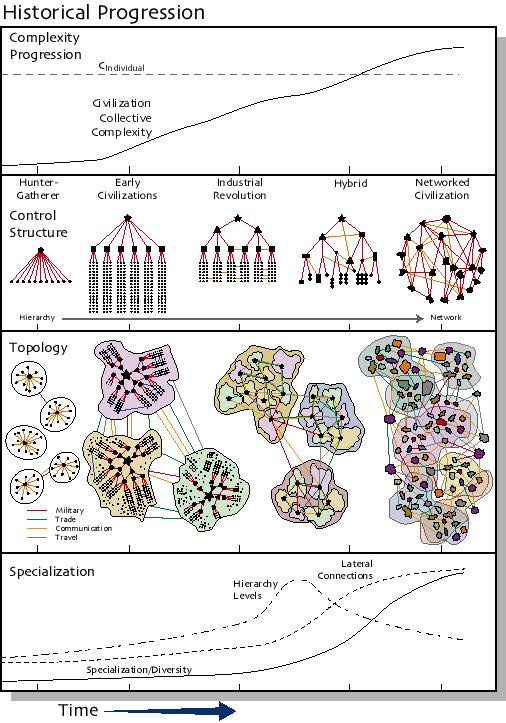
The natural world is composed of complex systems and it makes sense that the best strategies for any population are ones that take complexity into account. This is a limitation of hierarchical organizational models. They cannot address large-scale levels of complexity, as explained in Complexity Rising, a 1997 paper on complexity profiles.

“In summary, the complexity of the collective behavior must be smaller than the complexity of the controlling individual. A group of individuals whose collective behavior is controlled by a single individual cannot behave in a more complex way than the individual who is exercising the control. Hierarchical control structures are symptomatic of collective behavior that is no more complex than one individual. Comparing an individual human being with the hierarchy as an entirety, the hierarchy amplifies the scale of the behavior of an individual, but does not increase its complexity.”

As Yaneer Bar-Yam explains in Complexity Rising, hierarchies have diminishing usefulness as complexity increases.

“At the point at which the collective complexity reaches the complexity of an individual, the process of complexity increase encounters the limitations of hierarchical structures. Hierarchical structures are not able to provide a higher complexity and must give way to structures that are dominated by lateral interactions.”

rp_historical-progression.jpg
Image: Complexity Rising, UNESCO

Many of these lateral interactions are what we would call social relationships. They are outside the official hierarchy. As Verna Allee has noted, for complex environments, or ‘un order’, we need stronger networks and looser hierarchies. But most of our organizations are designed for ‘complicated order’ only. Or you could say that we need more lateral interactions.

Better social relationships (non-hierarchical and not based on the dominance of others) can make for healthier populations. In addition, networks are the only way our collective intelligence can be used to address increasing complexity. Becoming more social is not just a business driver but also a societal imperative.

rp_cynefin-networks-verna-allee.jpg
Image: Verna Allee

All things to all people

It was reported that only 2% of social sharing happens on Google Plus (G+). I too, do not share much on G+. I recently posted on G+ that it did not fit in with my professional use of social media, even though discussions are often fun, interesting, and informative. That G+ post I made now has 52 comments, more than any post on this blog has had.

In that post, Jeff Roach described G+ as “a network that looks like Facebook (media rich) but functions more like twitter (streams etc) but is more friendly to conversations and sharing than both of them.” Joachim Stroh suggested that I create a community on G+ but I countered that I preferred to cooperate in the open, not in another social media walled garden:

I think one of the problems today is that many online social networks are trying to be communities of practice. But to be a community of practice, there has to be something to practice. One social network, mine, is enough for me. How I manage the connections is also up to me. In some cases I will follow a blogger, in others I will connect via Google Plus or Twitter, but from my perspective it is one network, with varying types of connections. Jumping into someone else’s bounded social network/community only makes sense if I have an objective. If not, I’ll keep cooperating out in the open.

Nollind Whachel then weighed-in with several thoughtful comments and Joachim Stroh continued to engage. I stood on the sidelines, and a few others added comments, including one commentator unknown to me who felt I was being unprofessional because I did not understand G+. By the way, all of my G+ posts have been public, so anyone can jump in.

Nollind provided a good way to describe the sense-making process in these online social networks:

Connect = producing content
Empower = making sense of content patterns
Inspire = leap of logic, the patterns form a story, you see the bigger picture

Joachim made an interesting subsequent comment:

So, I’m still looking for the connection to go from unstructured to structured content, without doing a lot of curation. It’s not easy if you are doing this on your own (as you describe), it’s almost impossible to do this collectively (without a CM role).

Nollind added an emergent thought, that I think is important, and is partially what this blog post is all about:

Hmm, just had an interesting thought. It actually may be easier to do the writing and sense making within one community and then do the outlining and structuring in another community.

My interest in all of this comes down to PKM, and so far, G+ is a mere extension of my PKM processes. Perhaps it could be more, but I strongly believe in the centrality of my blog, which I own and control. I am not ready to give that to Google or any other third party. Nollind also made an excellent comparison of my PKM framework with his own methodology,

Seek = Connect = Play
Sense = Empower = Learn
Share = Inspire = Work

At this time, G+ provides a nice place for deep discussions with people who probably would not post as much on my blog and would be throttled by Twitter’s 140 character limit. I know that others use it much more, adding tags to make search and retrieval easier, and engaging with communities. G+ does add to my weak & diverse ties and even enables the sharing of complex knowledge. Perhaps G+ is trying to be all things to all people, and for those of us with existing PKM processes, that’s just too much.

social ties collaboration cooperationImage: Social Ties for Cooperation & Collaboration

Building institutional memory, one story at a time

Institutional memory, which I wrote about recently, is a mixture of explicit and implicit knowledge sharing. It can be as explicit as Harvard Business School’s Institutional Memory site, or as implicit as the feeling one gets from a well-known local legend. A lot depends on what the organization wants to preserve. Is it how-to knowledge, like a trade secret formula, or is it certain practices and norms that define the culture? Or is it both? Each institution has to define this for itself.

Implicit knowledge is difficult to share and is usually complex. We know that this type of knowledge cannot easily be codified. However, it’s often what gives institutions sustainability and even competitive advantage. Finding ways to collect and share both types of knowledge is important for institutional memory. Stories can be an effective medium for these exchanges. The Ritz-Carlton provides an excellent example with Stories that Stay with You. Stories do not have to be exceptional to be effective, and simple anecdotes may be better on a large scale, rather than sweeping epics, or one can wind up in the uncanny valley of business storytelling.

stories.001

Institutional memory is a close cousin of knowledge management. Both can be strengthened with a firm foundation of personal knowledge management (Seek-Sense-Share). While seeking and sense-making are mostly individual activities and people should be allowed to use what’s best for them, the organization can overtly support knowledge sharing. One suggestion is to create more opportunities for “people to have coffee together”. Though it’s not the coffee that’s important, the act of gathering, combined with an environment that encourages capturing and sharing knowledge artifacts, serves to build institutional memory.

IM_coffee.001

our words

A strange thing I’ve noted in the past few years of social media proliferation is that blogs seem to be becoming fewer but more powerful. One indicator is that for the first time, I am being paid to blog (not this post). Original thoughts are getting harder to find, as everyone is Liking, Pinning & Retweeting. While this is good for me in some ways, it also shows the value of a unique voice.

Marcia Conner talks about turning words into swords, inspired by Douglas Rushkoff, who makes an interesting conclusion:

“My advice is to focus on groups over individuals, and verbs over nouns. It’s not the heroes who matter so much as the groups that have modeled their behavior; it’s not the things that matter so much as the actions we take.” —D. Rushkoff

Our training and education systems and establishments focus on individual skills. But what really changes organizations and makes them effective is group behaviour. So it’s not the lone blogger who is powerful but the network of bloggers who can build upon ideas and take action. One blogger is a mere scribe, but a blogging culture builds transparency and trust. Changing to a culture of work narration is not merely developing writing skills but embracing openness.

Writing is doing, especially if done frequently. Modelling narration can help change group behaviour. In the end it doesn’t matter how good one person is, it’s how good our societal networks are. The more effective these knowledge networks are at transmitting ideas and taking action from them, the less susceptible we will be to corporate shills, government agencies purporting to protect us, and many others who pretend to speak on our behalf. If ‘we’ can show that ‘we’ are connected, engaged, and will take action, then ‘we’ will be in a real democracy at home, or at work.

democracy puzzlePhoto by S_K_S : CC-By-NC-SA

London Summer Picnic

For the past 18 months, Jane Hart has been hosting the Social Learning Centre, offering a wide variety of resources, coaching, and workshops. I have run several workshops as well, some alone, and others jointly with Jane. We have learned much in supporting social learning with hundreds of participants from around the globe. Last year, we decided to offer a workshop series, which will be ending with our second Summer Camp in June. The series consisted of workshops on:

  • Personal Knowledge Management
  • Social Media for Professional Development
  • Social Learning in the Workplace
  • From Training to Performance Support
  • Online Communities
  • Enterprise Community Management
  • Social Learning in Business

For our Summer Camp, we are planning on doing something different. It will be a chance to reflect on what we have learned together. The focus will be on synthesizing all the conversations from our workshops over the past year and more. We will curate the conversations and observations and present them to Summer Campers. We will then work collaboratively on weaving these threads together into a narrative that makes sense. Jane and I will do the initial curation but then each person will be able to add to it, in view of the other participants, working cooperatively as desired. Each person will be able to create a mind-map, or other form of sense-making to make a cognitive toolbox.

Robinson_picnic_PDIn addition to these online activities, we will start the Summer Camp with a “picnic” in London, on the afternoon of Thursday 20 June 2013. Jane and I will present our initial findings and observations in a semi-formal way. Weather permitting, this will start in a park, if not, we will find a suitable pub. This will be followed by us all “walking the talk” where we will go for a casual stroll through an interesting part of London, conversing as we walk.

After the walk, we will weave our conversations back together. Jane and I will be ready with a few other short presentations on topics of interest, kind of like a fast-paced Ignite! format. We will also be available for one-on-one chats or more open discussions. This will be an informal Summer camp, but Jane & I will bring a basket full of social goodies. Much of this will be recorded and curated, and shared with the other online participants. We will try to live-cast this as well, but it will depend on our connectivity. We will stay in London and we invite anyone who wishes to get together for an evening meal to join us.

If you wish to participate, please sign up for the Summer Camp, for £99

If you wish to attend our Summer Picnic, the cost is £49 for the afternoon or £119 including the online Summer Camp.

This is my work

The ability to learn is the only lasting competitive advantage for any organization. Hyper-connected work environments require people with better sense-making, collaboration, and cooperation skills. Social learning plays a significant role in this. Democratic workplaces that foster trust can share knowledge better and faster. To this end, I am a keen subversive of many of the last century’s management and education practices.

jarche services

Collaborative Work

Social Learning

Connected Leadership

Personal Knowledge Management

Adapting to perpetual Beta

Enterprise Social Tools

Communities of Practice

The Nature of the Future – Review

Nature of the FutureWhat will the future look like? Here are some glimpses.

  • Genomera: Crowdsourcing clinical trials.
  • BioCurious: Hackerspace for biotech.
  • Lending Club: “We replace the high cost and complexity of bank lending.”
  • ScholarMatch: Connect under-resourced students with resources, schools, and donors to make college possible.
  • Foresight Engine: How would you reinvent the process of medical discovery?
  • Open PCR Machine: Do it yourself thermocycler for controlling Polymerase Chain Reactions for DNA detection and sequencing.

These are all discussed in the book, The Nature of the Future, by Marina Gorbis, executive director of the Institute for the Future.

We are quickly finding out that when we go from a centralized communications infrastructure to a distributed one, when we connect everything and everyone, the result is not just to make things faster, better, and bigger. The social system itself acquires a fundamentally different quality: it becomes more diversified, more emergent, and often unpredictable.

This book provides probably the best background, and foreground, reading for most of the ideas discussed on this blog: complexity; the changing nature of work; the need to integrate learning into our work; and the primacy of cooperation in networks. Dedicated chapters cover money, education, science, governance, and health, with interesting future scenarios supported by current examples. While automation and robotics may be taking many jobs away, Gorbis identifies unique human skills which will continue to be important. These should be the core of any public education program.

  • Sensemaking
  • Social and emotional intelligence
  • Novel and adaptive thinking
  • Moral and ethical reasoning

As Gorbis writes, and I wholeheartedly agree, “Learning is social”.

We need to learn how to work better with machines, letting machines do what they are good at. Gorbis shows how machines and average people can outperform experts at playing chess. “Weak human + machine + better process was superior to a strong computer alone and, more remarkably, superior to a strong human + machine + inferior process.”

On the future of health care, Gorbis sees a new role for doctors. “In a socialstructed health care system, the doctor is not an omniscient God but a great conversationalist, astute observer, and insightful partner, that is, she is less a robot and more a real human being.” Doctors will be more like nurses, and with increasingly advanced technology, nurses will be more like doctors. I wonder if in the future, their roles will merge?

Gorbis identifies a major disconnect in our economy.

  1. Our technology tools and platforms are highly participatory and social.
  2. Our business models, by contrast, are based on market, i.e., monetary rewards.
  3. conflicts [between these two priorities] are likely to grow simply because the number of such endeavors [Twitter, Facebook, etc] is growing exponentially.

Gorbis concludes that “much new value and innovation will move from commodity-or-market-based production to socialstructed creation.” This reminds me of the T+I+M+N framework. A networked economy is not a mere modification of a market economy, but a form in itself that can address issues beyond the capabilities of markets.

Would I recommend this book? Yes. There are few people who would not benefit from this synthesis of the forces of technological, economic, and societal change coming at us. I will close with some practical advice, applicable to all, but especially for anyone entering the workforce.

In a world where people’s jobs will not be given to them, each individual will need to look deeply and understand what she or he is good at, how she or he can contribute to multiple efforts and navigate multiple roles and identities as a part of different communities.