Innovation through network learning

Innovation

I’ve really appreciated the many posts where Tim Kastelle and I have connected by sharing ideas. Tim says that innovation is the process of idea management, which makes sense to me. Andrew Hargadon expands on this:

In short, innovation is about connecting, not inventing. No idea will make a difference without building around it the networks that will support it as it grows, and the network partners with which it will ultimately flourish. Here Thomas Edison’s real genius can be seen … Shifting the central activity of innovation from ‘having an idea’ to seeing and building the networks shifts the attention from thinking to the actions required to build the network that will realize the idea.

Innovation is not so much about having ideas as it is about connecting and nurturing ideas. As Steven Johnson says, “Chance favours the connected mind.” This requires a network mindset. It also requires an understanding of the greater environment.

In Innovating in the Great Disruption, Scott Anthony suggests three disciplines necessary to foster innovation in our challenging economic times – placing a premium on progressmastering paradox; and learning to love the low end. He also discusses the importance of learning:

Innovators will need to continue to find creative, cheap ways to bring their ideas forward. Fortunately, they can tap into a plethora of powerful tools to facilitate rapid learning.

Tim Kastelle introduced me to the concept of Aggregate-Filter-Connect for innovation, which I used for personal knowledge management (network learning) and later changed it to Seek-Sense-Share. Innovation is inextricably linked to both networks and learning. That’s why the skills for learning in networks are essential for business today. We need to innovate to stay ahead in a rapidly changing world. The rules are constantly changing. Just as we get used to new business models like Amazon or Google, someone like Alvis Bigis knits together an excellent piece on how American business needs to get social. Discussing Groupon.com, he says; “Never before has a company reached $2 billion in annual revenue in just 2 years time.” Who knows what’s next?

Network Learning

Being an effective network learner is a basic skill for any knowledge worker today, and that’s pretty well anyone who wants to earn more than minimum wage. Network learning is also the foundation of collaboration. We know that collaboration is becoming critical for business, as Deb Lavoy notes:

Our wicked challenges [complex, entangled, multifaceted hairballs] require the diversity and experience of teams, as well as their ability to tap into and integrate new ideas and information. Our solutions will be tried and transient, keeping pace with the challenges they are meant to solve. A team with a bit of sense and technology can consistently outperform one corporate genius or the world’s most powerful computer in working through a wicked(ish) problem.

I now take for granted my network learning processes, using social bookmarking; blogging and tweeting, and these habits make collaboration much easier. However, these habits and practices have taken several years to develop and may not come easily to many workers. One difficult aspect of adopting network learning in an organization is that it’s personal. If not, it doesn’t work. Everybody has to develop their own methods, though there are frameworks and ideas that can help.

Here are some questions that network learning can address:

How do I keep track of all of this information?

How do I make sense of changing conditions and new knowledge?

How can I develop and improve critical thinking skills?

How can we cooperate?

How can I collaborate better?

How can I engage in problem-solving activities at the edge of my expertise?

My own personal learning journey took several years to transition to a network learner and my article on Network Learning: Working Smarter (2010) summarizes what I’ve learned, so far, on the subject.

Innovation & Learning

The connection between innovation and learning is evident. We can’t be innovative unless we integrate learning into our work. It sounds easy, but it’s a major cultural change. Why? Because it questions our basic, Taylorist, assumptions about work; assumptions like:

A JOB can be described as a series of competencies that can be “filled” by the best qualified person.

Somebody in a classroom, separate from the work environment, can “teach” you about a job requirement.

The higher you are on the “org chart”, the more you know.

Need I list more?

Getting to Working Smarter

I started my military career as an infantry officer and then I worked as a health care administrator and finally as a training specialist. The move to the training field coincided with the creation of  the Web. I was also responsible for some fairly technical training as well as flight simulation. My immersion in technology had begun.

However, almost all of my focus was on individual training, or getting people to an operational level to either fly or fix an aircraft. As I’ve explained before, “individual training” is seen as a separate field from “collective training”. The graduates of our formal training programs would go on to do informal, collective training. The military has learned over time that a bunch of even highly-trained individuals do not make a cohesive unit. Each unit has to learn how to work together, hence the emphasis on collective training and especially pre-deployment training. Collective training is a good way to add all the context to formal training that has been stripped away by the school [yes, we called them schools].

The Training Development branch was also keen on performance improvement and much of our own professional development reflected the practices of human performance technology. HPT is a good framework, and is an excellent addition to instructional systems design (ISD), but over time I have found it to be inadequate to deal with a more complex workplace and address the social aspects of work. Collective and collaborative learning seems to be missing from HPT. For example, even the Army understands the value of story-telling.

My new focus, which is not a directional change but a progression based on experience, is Working Smarter. This takes the best from ISD, HPT and social learning and also incorporates knowledge management, organizational development, network and management theory to look at how we can develop the next practices that will inform networked organizations. As we say at the Internet Time Alliance, work and learning have become one and the same. Networks rule. Nothing is certain. Simply doing things better no longer guarantees prosperity or even survival.

Here is a slide presentation explaining how I came to focus on working smarter. It is a theme I will be discussing in several venues and countries over the next few months. This is my personal learning journey, and it’s not over yet.

From learning to working technologies

Here is a graphic of Moore’s technology adoption curve. Inspired by Jane Hart, this is my view of the current state of the learning technologies industry:

The Late Majority and Laggards are focused on meeting their compliance needs. Many of these are in traditional industries. They are purchasing one of their first learning management systems (LMS) and are focused on features & functions, which is usually a large shopping list provided by a variety of constituents.

The Early Majority are focused on learning and particularly course delivery. They are comprised in large part of education and training (E&T) intensive organizations, including schools. Most have existing contracts that bind them to a vendor. Some are considering open source (OS) as an option to their costly systems.

The Innovators & Early Adopters have shifted to a work focus. Many are in newer industries, with little legacy software. Others are in more traditional industries who have seen the urgent need for change. They are focused on supporting social and informal learning and integrating it into the work flow. These companies are retiring their LMS and are outsourcing formal course development that accounts for only 10% of their performance needs.

As an organization, are you waiting for Workscapes to cross the chasm or are you content to use technologies that have jumped the shark?

Learning in public

In a succinct post on the nature of knowledge management in a knowledge-intensive field, Jasmin Fodil looks at how rocket scientists learn. She shows how workers at the NASA Goddard Space Fight Center reapply their knowledge:

Goddard is doing a pretty good job of knowledge sharing:

The Knowledge Management life-cycle at Goddard seems solid to me; the focus is on the individual’s learning processes, structures, and needs, rather than content management systems, which is already leaps and bounds ahead of the curve, and there are many practices and resources to facilitate the process. Because of that, the system is unique in that is dovetails nicely with a socialized knowledge management system. People are already used to residing within a learning organization, and social software will enhance the on-the-ground process that are already so robust.

Notice that, “How Can I Learn It?” does not include sharing through information flows, such as blogs, wikis or micro-blogs (social media). As Fodil asks at the end of her article, I also wonder how much more effective the organization would be if most learning was in public, or was a “socialized knowledge management system”. Of course, Goddard may already be doing this. If not, there can be a lot of knowledge loss between discrete events such as the development of case studies or the collection of lessons learned. Workshops and case-based events may not be frequent enough. All of these are knowledge “stock” and I think there is much potential, in most organizations, to improve knowledge flow to connect these events.

PKM is my suggested framework to enhance knowledge flows in the organization by first focusing on the needs and desires of the individual and then making each person’s flow public (Seek-Sense-Share). Network learning requires sense-making in public. But, as Fodil concludes:

Sometimes learning in public is a difficult process, but the feedback, support, and resultant improvements are worth it.

Transparency is the first, and perhaps largest, hurdle in creating new management frameworks for a networked world. Learning in public makes our work transparent and can help us develop critical next practices in our increasingly complex workplaces. We all have to start thinking and working like rocket scientists.

Corporate Learning’s focus

Inspired by Jay Cross, Amanda Fenton asks how her Corporate Learning department could better meet the needs of employees. I think these are excellent questions and the answers form the basis of addressing how to integrate work and learning in the enterprise.

Q1) Close to 80% of learning happens informally and 20% formally, yet we spend most of our time and money on the 20%. How could we better support this and shift our time and money?

There are a few ways to address this imbalance.

The organization can adopt a performance improvement perspective and ensure that all formal training meets a need. HPT (human performance technology) is a broader design approach and should be seen as an enabler to get to instructional systems design (ISD). Without the proper analysis of the organizational needs, constraints and performance factors, a “learning” project may be doomed from the onset, because too often, training is a solution looking for a problem. By doing a performance analysis, it becomes obvious that many performance problems do not require training. I have developed a performance analysis job aid which is available for non-commercial use.

Another approach would be to divert or expand training funds to support informal learning. This could start small but would show that informal learning is important to the organization.  Starting small makes sense because the essence of implementing informal learning is giving up control. This can be scary for managers used to tight command and control. Start with the message that training  addresses less than ten percent of workplace performance. That might get somebody’s attention. Then look at ways to help with the other 90% of work.
One final note, don’t try to formalize informal learning.

Q2) Novices and experts have very different needs (curve from formal to informal). What needs to be in place to better support those differences? How can we support these differences across diverse business units (sales, service and specialized functions)?

Jay Cross and Clark Quinn have used this to explain the formal/informal mix by level of experience:
The above graphic is a good rule of thumb but should not be adhered to slavishly, as there are cases where informal learning works for new hires. I would look at ways to support do-it-yourself learning at all levels.

Q3) How can we shift from teaching content to developing search & find skills, critical thinking skills, creative thinking skills, analytical skills, networking skills, people skills, and reasoning and argument skills?

Organizations should start with Dan Pink’s advice – create an environment where workers have autonomy, mastery and a sense of purpose. A key factor in innovation is to allow people to do meaningful work, in their own way.  The skills listed in this question directly relate to critical thinking. Teaching critical thinking skills may take some time for people used to getting content served on a platter and then being tested on short-term mastery of that content. I don’t see these changes happening overnight.

There are web tools that can be used for critical thinking skills, but tools are not enough. Good informal learning skills are directly linked to critical theory – to question authority, seek the truth and question our own perceptions of reality. All workers need to be good learners but learning cannot be controlled externally, only supported. I like this quote from an unlikely source, Margaret Atwood’s The Year of the Flood: “I was going to Martha Graham [College] partly to get away from Lucerne, but also I had to do something so I might as well get an education. That’s how they talked about it, as if an education was a thing you got, like a dress.
Start by giving up total control of the training process and focus instead on connecting & communicating.

Q4) What training programs do we need to provide, at minimum,  for legal compliance purposes?

Compliance training is a symptom of the current disconnect between learning and working. Meeting compliance training objectives is usually not a worthwhile goal for the organization, though it may keep executives out of jail. Ray Jimenez summed up the issues with this type of training when he commented on my post, compliance of an industry:

“This is bold, cut and dry and thanks for the exposition.

I see debilitating effects across the training industry when many of our training colleagues accept “compliance” as the norm for training. a good example is the blind loyalty to testing for retention with little concern for applications in real-job situations.

Why not fight this culture? I might be wrong, but our industry might be too “onion-skinned” to accept self-reflections and self-criticisms that we rather continue to hide the dirty linens than confront them.

How do we lift ourselves out of this mindset?”

In subsequent posts, I look at Amanda’s other questions on:

Collaboration is work

As I get together with my Internet Time Alliance colleagues here in California, I really appreciate all of the connecting and conversing we’ve done over the past two years, as our shared experiences ease the path to further collaboration. Working collaboratively and effectively is a challenge for all organizations and must be continuously renegotiated as conditions change. Collaboration is not the same as cooperation. Collaboration is working together and achieving a shared objective. Collaboration puts cooperation to the test, with outcomes, objectives and responsibilities; constrained by time, resources and priorities.

Here are some collected thoughts on collaboration from others:

100 Web Tools to Enhance Collaboration (Part 3) | Ozge Karaoglu’s Blog

“If you have an apple and I have an apple and we exchange these apples then you and I will still each have one apple. But if you have an idea and I have an idea and we exchange these ideas, then each of us will have two ideas.” George Bernard Shaw

Network Weaving: The 4 Laws of Networks

The pragmatic reality is that innovation happens at the intersection of learning and cultivating diverse connections. When you have diverse connections in a network, learning almost cannot not happen. Networks literally become learning disabled if the connections become too homophilous and without learning, no innovation is possible.

ME2: Horizontal Collaboration « TheBrycesWrite

It is also important to point out that advocating Enterprise 2.0 / social collaboration isn’t necessarily the equivalent to denouncing all forms of Vertical Collaboration. Each have their value and their place for particular types of work. Advocating Enterprise 2.0 / social collaboration is the recognition that we’ve found something effective at filling in the knowledge gaps left by traditional Vertical Collaboration methods that prevent organizations from maximizing the capacity of their people. Thus, encouraging the use of capabilities and behaviors that fill those gaps – Web 2.0 / social media inspired methods proving to be effective for Horizontal Community Collaboration – will complement your traditional collaboration methods well.

At the Corner of Assertiveness & Cooperation: Collaboration > Trust Matters

Collaboration gets its power because it uses the energy of Assertiveness–ideas and real points of view, championed by people who care–and the energy of Cooperation–a willingness to make things work for all involved. From collaboration comes the best result, the idea or solution which is fashioned from everyone’s input and is better than what any one person could have come up with on her or his own.

Esko Kilpi Oy / www.kilpi.fi

Connections are not enough. Third threshold is true conversation. For connected thinking to occur, for both sides to find meaning in the interaction, participants must create a common context: What is it we are here to do? This takes time. Conversations cannot be hurried. Conversations cannot be tightly scripted and agenda based meetings separated from the practice of work. Knowledge work is talking and listening! The real challenge today is slowing down our thinking processes and increasing awareness of the thinking behind our actions and the assumptions behind our thinking.

Collaboration – If it Were That Easy We Would all Do It – Well

Will we ever learn? We place new labels on the issue (it’s not KM anymore, now its collaboration); new products emerge (SharePoint: “it does everything”), and all too often forget the lessons of the past. We believe that the “new focus” and/or the new technology will deliver on the promise without requiring any strategy.

A curved path to social learning

When I was introduced to Charles Jennings’ C-Curve for learning & development (L&D) I wrote about it in the transition to networked accountability.

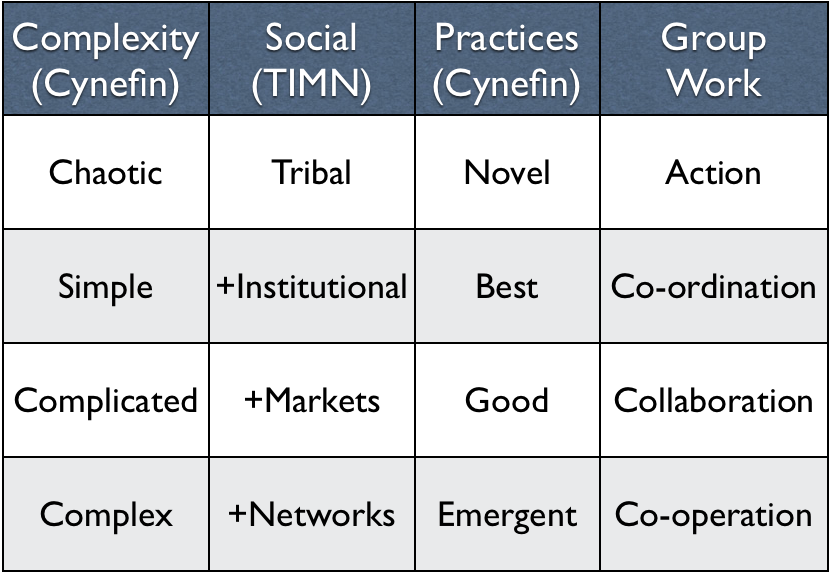
Charles’ C-Curve is a model in practice, based on his experience as CLO of Reuters. I see a parallel between this migration of the L&D department and the social order necessary to do certain types of group work [Refs: CynefinTIMN]

  1. L&D Autonomous = taking action as a Tribe of its own
  2. L&D Aligned with organization = coordinated with the Institution
  3. L&D with governance & guidelines = able to work in a collaborative Market
  4. L&D strategically aligned = a co-operative member of (a) Network(s)

I wondered if tribal organizations may be able to thrive in networks because they are already used to more freedom. I have noticed that it is difficult to convince organizations steeped in the institutional models that the networked model may be better to deal with growing complexity. Also, those who already have to respond to markets may understand the value of networks much better than institutions. Hence the advantage of the private sector in adapting new work models before the public sector.

In organizations and complexity, I discussed three archetypal organizational models and some of their defining characteristics.

Simplicity Complication Complexity
Organizational Theory Knowledge-Based View Learning Organization Value Networks
Attractors Stakeholders (vision) Shareholders (wealth) Clients (service)
Growth Model Internal Mergers & Acquisitions Ecosystem
Knowledge Acquisition Formal Training Performance Support Social
Knowledge Capitalization Best Practices Good Practices Emergent Practices

I’ve combined the C-Curve [X=Autonomy, Y= Strategic Alignment] with the knowledge acquisition models from these three organizational types in the figure below. The question that I ask here is whether it is necessary to follow the curve or if one can leap from Stage 1 to 4.  If not, that means that organizations need to understand and implement something like a human performance technology model for L&D before they can move on to social learning. Perhaps this is why social learning is being resisted or put into a formal training box in many organizations. They have not made the move to Stage 3 (Performance Support) yet. It’s too much of a leap for organizations in Stage 2. On the other hand, social learning is only a short leap for more tribal start-ups that have not developed any structure at all for L&D as they are quite comfortable with autonomy and messy networks. Stage 2 seems like the worst place to be.

Patterns emerge over time

Andrew Cerniglia has an excellent article that weaves complexity, cynefin and the classroom together. It is worth the read for anyone in the teaching profession. I became interested in complexity as I moved outside the institutional/corporate walls and was able to reflect more on how our systems work. The observation that simple work is being automated and complicated work is being outsourced seems rather obvious to me now. Complex work has increasing market value in developed countries and that is where the future lies. However, our schooling, training and job structures do not support this.

Cerniglia explains how complex the classroom can be, when we factor in the outside that touches each student daily:

But there is another, most important factor, life outside of the classroom. What happens beyond the classroom walls, in other classes, and more significantly outside of school, affects each learner. The combination of these variables supports the idea that classrooms should be classified as “complex” with the Cynefin Framework. If we review the traits of “Complex” systems, it is clear that often times there is “no right answer” in terms of instructional choices, that classrooms are “systems in constant flux”, and that the “ability to understand” (from the teacher’s perspective) comes after class has been dismissed.

This is the situation for many people outside the classroom, whether at work or in general life: there is no right answer. Cerniglia has created an excellent concept map that summarizes the cynefin framework and is worth exploring.
Here is a detail from the map:

The patience to watch patterns emerge over time is almost non-existent, though it’s what I’ve been able to do as a freelancer, and perhaps less engagement on a job site is part of the future of work. Furthermore, there are organizations that send tacit and explicit signals which could  result in these dangers:

  • The desire to revert to simple strategies, like simple PowerPoint presentations, executive summaries and three-phased operations.
  • Impatience with results that take more than one fiscal quarter to materialize.
  • Over-control of staff and resources, negating workers’ innate need for autonomy, mastery and purpose.

A strategy of probe-sense-respond (P-S-R) means testing things out and taking action before all the data are available or fully analyzed. So far, one of the few places I’ve noticed a P-S-R approach is in web development, especially with software as a service, like Google, where not-fully-baked applications get released and are then relentlessly analyzed in action. P-S-R is the mindset for life in perpetual Beta.

Organizations and Complexity

I’ve discussed this table before, but I’d like to put all the links together to highlight what we need to do with our organizations and structures to deal with complexity.

From the evolving social organization we developed this table to show the differences between three archetypal organizations.

Simplicity Complication Complexity
Organizational Theory Knowledge-Based View Learning Organization Value Networks
Attractors Stakeholders (vision) Shareholders (wealth) Clients (service)
Growth Model Internal Mergers & Acquisitions Ecosystem
Knowledge Acquisition Formal Training Performance Support Social
Knowledge Capitalization Best Practices Good Practices Emergent Practices

How we can support emergent practices in the increasingly complex enterprise:

COMPLEXITY

Patti Anklam, in discussing value networks and complexity  states:

Understanding of complexity provides a practical guide to managing context.

You can’t manage a network, you can only manage its context.

Slight alterations in the structure can create significant change over time;

But you must first look to understand the context

VALUE NETWORKS

Value network analysis is a process which is more art than science. Humans work in complex environments and we are by our very nature unpredictable. The result of a VNA allows you to ask better questions but it doesn’t give specific answers (it’s not a tool for bean counters). I think that VNA is an excellent change management tool. I can see the use of VNA and the resulting concept maps enabling better communication within organizations, with clients, with funders and throughout communities

CLIENTS (SERVICE)

I have met new friends, business partners and clients with social media, and like the authors of Trust Agents, I would say that a “no sales” approach works best in the long run. The chapter called the Human Artist covers online etiquette in detail and should be read by any self-described social media guru. Also, three of the book’s chapters reflect The Law of the Few – how small groups of people enable social change or the transmission of new ideas.

Connectors: They talk about the idea of being Agent Zero, or the person who connects groups where no previous connection exists.

Mavens: They also discuss creating value, or doing things that people need, one small bit at a time. In Make Your Own Game, the premise is to find a niche and become an expert in it.

Salespeople: In Build an Army, the authors show the promise and pitfalls of crowd-sourcing and social networks for business.

ECOSYSTEM

Most intelligent people know that there is no such thing as a job for life. Corporations have shown that loyalty to the enterprise does not work both ways. Organizations should look at how they can structure to take advantage of these workplace changes. The first part is to stop thinking like a hierarchy, with titles and reporting relationships, and start framing the enterprise in terms of networks. Mapping value networks is a start, as is talking about social networks and supporting them through the use of social media. If you look at work differently and talk about it differently, then new conversations and attitudes will result.

Here are some ideas, for starters:

Abolish the organization chart and replace it with a network diagram.

Move away from counting hours, to a results oriented work environment

Encourage outside work that doesn’t directly interfere with paid work, as it will strengthen the network

Provide options for workers to come and go and give them ways to stay connected when they’re not employed. Build an ecosystem or join one (e.g. an open source community).

SOCIAL

In a framework for the social enterprise we noted how knowledge workers get things done by conversing with peers, customers and partners, as they solve the problems of the day. Learning from these social interactions is a key to business innovation. To participate in their markets, organizations, customers and suppliers need to understand each other and this too, is social. Social learning is how knowledge is created, internalized and shared. It is how knowledge work gets done.

EMERGENT PRACTICES

The cynefin model shows that emergent practices are needed in order to manage in complex environments and novel practices are necessary for chaotic ones. Most of what we consider standard work today is being outsourced and automated. We are facing more complexity and chaos in our work because of our interconnectedness.

Many of the problems we face today are COMPLEX, and methods to solve simple and complicated problems will not work with complex ones. One of the ways we addressed simple & complicated problems was through training. Training works well when you have clear and measurable objectives. However, there are no clear objectives with complex problems. Learning as we probe the problem, we gain insight and our practices are emergent (emerging from our interaction with the changing environment and the problem). Training looks backwards, at what worked in the past (good & best practices), and creates a controlled environment to develop knowledge and skills.

To deal with increasing complexity, organizations need to support emergent work practices, in addition to their training efforts. They must support collaboration, communication, synthesis, pattern recognition and creative tension, all within a trusting environment in order to be effective.

Join Internet Time Alliance for a Day in SFO

The day following DevLearn, Saturday, November 6th, the five members of the Internet Time Alliance are holding a retreat to share insights and plan for the forthcoming year. We’re meeting at the Internet Time Lab, across the Bay from San Francisco in Berkeley.

We originally intended for this to be a private session for challenging one another’s views on what’s important in social learning, enterprise learning governance, working smarter, the impact of mobile learning, taking advantage of personal knowledge environments, breakthroughs in brain science, revised views of motivation, growing awareness of emergence, the shift from push to pull models, rethinking the role of the LMS, and breaking down barriers to change. We’d swap our views on recent thoughts emanating from Altimeter, IBM, Dan Pink, JSB, and others we listen to.

Then we spotted a potential pitfall: the echo-chamber effect. When it’s just us, there’s an ever-present danger that we’ll fall into griping about how most corporations simply don’t have a clue, leave gobs of money on the table, and look for salvation in all the wrong places. Name-calling isn’t going to help us make progress.

We decided to invite half a dozen outsiders to take part in our one-day retreat. It will keep us honest.

Our ground rules:

No competitors. If Fiat attends, Volkswagen can’t. Our choice.
Small group. This session will be intimate and participatory. No more than six outsiders can attend. Again, our choice.
No consultants. We’re the consultants (ugh). You’re the practitioners.
Big payback. Bring a problem to solve; you’ll receive individualized advice from thought leaders.

Everyone will share in the day’s activities, which will probably include:

Lunch at the Cafe at Chez Panisse
Walk in the redwoods in the Berkeley Hills
Books such as The Working Smarter Fieldbook, Informal Learning,Engaging Learning
Video records of the proceedings

Fee for the day is $1,200. Two from a single organization, $1,000 each. (Yes, you are essentially funding our plane tickets and picking up the tab for meals.)

Interested?